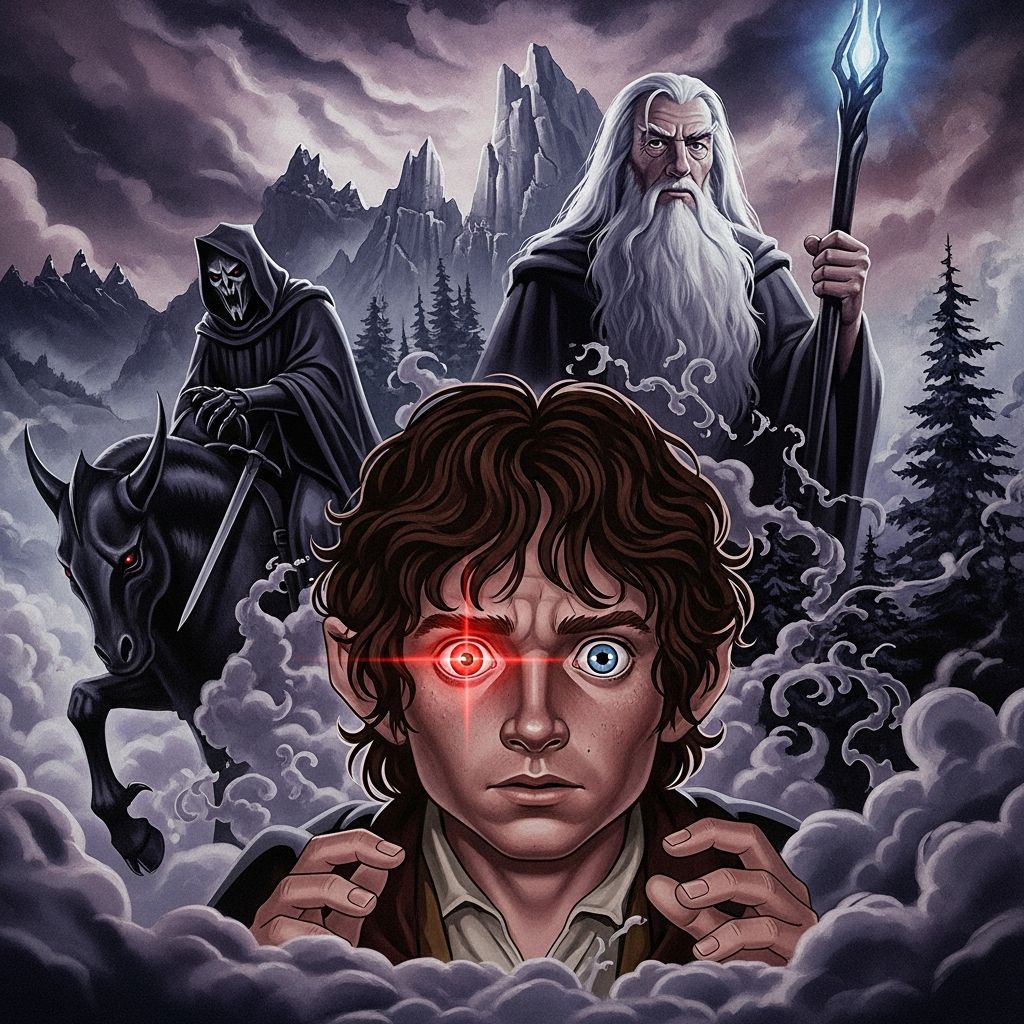
In 1978, animator and filmmaker Ralph Bakshi released the first-ever feature-length adaptation of J.R.R. Tolkien’s The Lord of the Rings. The film was daring, divisive, and incomplete, yet it helped open the door for the fantasy boom and later screen versions of Middle-earth.
This article takes a fresh look at Bakshi’s film — its ambitions, its limitations, and why it still matters in the shadow of the more famous live-action trilogy.
Bakshi Before Middle-earth: An Unlikely Tolkien Adaptor
Ralph Bakshi was not a typical choice to bring Tolkien to the screen. Born in 1938 and raised in New York, he came up through TV cartoon studios, working on characters like Mighty Mouse and Heckle & Jeckle before rising to director in his mid-twenties.
- Early studio work: Terrytoons and Paramount Cartoon Studios, where he directed TV cartoons and shorts.
- Adult animation pioneer: With films like Fritz the Cat (1972) and Heavy Traffic (1973), Bakshi helped establish animation as a medium for adults, not just children.
- Urban realism and fantasy: His work blended social commentary, street-level detail, and surreal fantasy, a combination that would shape his approach to Tolkien.
By the mid-1970s, Bakshi had already built a reputation as a rule-breaker, using animation to address sex, violence, race, and politics in ways that mainstream studios avoided. That rebellious streak heavily colored his vision of Middle-earth.
How the 1978 Lord of the Rings Came to Be
The road to the 1978 film was complicated. Tolkien’s massive trilogy posed daunting challenges: sheer length, dense worldbuilding, and a devoted readership wary of Hollywood simplifications. Attempts at adaptation had already faltered before Bakshi arrived.
Bakshi pursued the project as a serious, long-form fantasy epic rather than a children’s fairy tale. According to accounts of his career, he pitched studios on the idea of treating Tolkien with the same weight and scale as live-action epics, but using animation as the vehicle.
- Multiple films planned: The project was initially conceived as a multi-part adaptation, with the 1978 film covering roughly the first half of the story.
- Compromises in development: Budget, running time, and studio expectations forced the creative team to condense and reshape events from The Fellowship of the Ring and The Two Towers into a single film.
- Hybrid production approach: Bakshi chose a mix of traditional animation and rotoscoping — filming live-action actors and tracing over the footage — to capture large-scale battles and grounded movement.
The result was a film that felt unlike either typical cartoons or live-action fantasy of the era: stylized, often rough, and sometimes surreal.
Visual Style: Between Illustration and Nightmare
Bakshi’s Lord of the Rings is visually striking, especially when viewed in the context of 1970s animation. Influenced by both comic art and fantasy illustration, he pushed his team to create a world that felt weathered and dangerous rather than polished and storybook-like.
| Visual Element | Bakshi’s 1978 Film | Later Live-Action Adaptations |
|---|---|---|
| Medium | 2D animation with heavy rotoscoping | Live-action with digital effects |
| Palettes & Lighting | Muted earth tones, shadowy and often expressionistic | Naturalistic with high-detail realism |
| Creatures & Orcs | Distorted, sometimes almost abstract dark figures | Prosthetics, CGI, and detailed creature design |
| Battle Scenes | Rotoscoped silhouettes, stark contrasts, painterly backdrops | Large-scale live-action staging and compositing |
The rotoscoping technique, which Bakshi had experimented with in other projects, became a signature aspect of the film. Live actors were filmed in costume and then traced or painted over, producing combat and crowd sequences that felt raw and physical, though sometimes visually inconsistent.
Key features of the film’s look include:
- Atmospheric backgrounds: Misty swamps, stark battlefields, and gloomy strongholds rendered like fantasy paintings, emphasizing mood over precise geography.
- Heightened menace: Nazgûl and orcs are rendered as looming, misshapen threats rather than intricately detailed creatures, suggesting horror more than anatomy.
- Unpolished textures: The animation often feels rough or loose by modern standards, but that roughness enhances the sense of danger and otherworldliness.
Story Choices: Compressing a Trilogy into One Film
Adapting Tolkien’s dense narrative into a single feature forced Bakshi and his team into aggressive compression. The film begins in the Shire and ends with the Battle of Helm’s Deep, effectively covering most of The Fellowship of the Ring and parts of The Two Towers.
Some of the most notable narrative decisions include:
- Condensed early chapters: Events from the Shire to Rivendell are streamlined, with character introductions and exposition delivered at speed.
- Shifted emphasis: The film focuses heavily on the Ring’s threat and the military struggle against Sauron, sometimes at the expense of quieter moments and cultural detail.
- Abbreviated character arcs: Secondary characters like Merry, Pippin, and some members of the Fellowship receive limited development compared to the books.
These choices amplified one of the central tensions in the film: an attempt to preserve Tolkien’s epic scope while working within the harsh constraints of runtime and budget. Many fans were frustrated by omissions and changes, yet the film still managed to convey the vastness of the conflict and the burden of Frodo’s mission.
The Unfinished Epic: Why the Sequel Never Arrived
Perhaps the most controversial aspect of Bakshi’s Lord of the Rings is that it simply stops. The film reaches a climactic battle and then resolves with narration hinting at further struggles to come. No direct sequel by Bakshi was ever produced.
Several factors contributed to this abrupt ending:
- Financial performance: The film was not a failure, but it did not achieve the runaway success needed to guarantee a follow-up on the same scale.
- Studio hesitation: The mixed critical reception and polarized audience response made studios less enthusiastic about immediately funding another ambitious animated epic.
- Production strain: The complex mix of live-action, rotoscoping, and traditional animation had already pushed the team to their limits.
As a result, Bakshi’s version of Tolkien remained a half-told story—a rarity in cinema: a large-scale fantasy that ends mid-saga not by design, but by circumstance.
Reception: Between Visionary and Misfire
Critical and fan responses to the 1978 film were deeply split. Some reviewers admired the ambition and atmosphere; others criticized the narrative gaps, uneven animation, and abrupt conclusion. Over time, opinion has remained mixed but has tilted more toward recognition of its historical importance.
Common points of praise include:
- Serious tone: Bakshi treated Tolkien’s world as mythic and grave, avoiding the overt whimsy or parody that some earlier fantasy cartoons leaned on.
- Cinematic ambition: Large battles, sweeping vistas, and dramatic staging signaled a desire to compete with live-action epics, not just Saturday-morning TV.
- Experimentation: The film pushed animation techniques, especially rotoscoping, into new territory for Western feature films.
Recurring criticisms include:
- Inconsistent character design: The blend of rotoscoping and traditional animation sometimes resulted in jarring shifts in style within the same scene.
- Pacing issues: The story races through key events, especially early and late in the film, leaving little breathing room for character moments.
- Lack of closure: The absence of the second half of the story left many viewers unsatisfied, particularly those unfamiliar with the books.
Influence on Later Tolkien Adaptations and Fantasy Cinema
Despite its flaws and unfinished status, Bakshi’s Lord of the Rings had a lasting impact on how Tolkien could be visualized on screen and how fantasy could be handled in serious cinema.
Influence can be seen in multiple areas:
- Proof of concept for epic fantasy: The film demonstrated that audiences would show up for long, lore-heavy fantasy narratives, paving the way for later projects that treated such material with comparable seriousness.
- Visual precedents: Certain compositions—such as the Ringwraiths on horseback or the depiction of key battles—set imagery that future adaptations could echo or react against.
- Cultural footprint: Even as later live-action films eclipsed it in popularity, the 1978 adaptation remained a reference point in discussions of how to approach Tolkien on screen.
More broadly, Bakshi’s career showed that animation could handle complex themes and adult tones, encouraging subsequent filmmakers to explore mature content in animated form, from Western independent features to Japanese anime reaching Western audiences.
Ralph Bakshi’s Place in Animation History
To understand why Bakshi’s Lord of the Rings still matters, it helps to place it within his larger body of work. From the early 1970s onward, he consistently challenged the notion that animation was only for children.
- Adult themes and social commentary: Films like Fritz the Cat, Coonskin, and American Pop tackled race, class, violence, sexuality, and counterculture.
- Genre fusion: Bakshi blended urban realism with fantasy and surrealism, creating stylistic hybrids that were far from Disney’s polished fairy tales.
- Industry recognition: He received awards such as the Annie Award for Distinguished Contribution to the Art of Animation, acknowledging his role as an innovator.
The Lord of the Rings project was in some ways an outlier—an adaptation of a beloved literary work rather than an original script—but it still carried his signature: rough-edged, politically aware, and formally experimental.
How the Film Plays Today: A Cult Artifact Worth Revisiting
Modern viewers who discover Bakshi’s version after seeing later live-action trilogies often experience a kind of cultural whiplash. The differences in tone, technology, and pacing are stark. Yet the film offers unique rewards:
- Alternative vision of Middle-earth: The world feels grittier and more haunted, with a dreamlike, sometimes nightmarish atmosphere.
- Handmade energy: Imperfections in the animation give the film a tangible, handcrafted feel that contrasts with modern digital polish.
- Historical curiosity and influence: The adaptation serves as a snapshot of what serious fantasy filmmaking looked like on the cusp of major technological and cultural shifts.
For fans of animation history, fantasy cinema, or Tolkien studies, Bakshi’s Lord of the Rings occupies a fascinating middle ground between cult classic and pivotal experiment.
Key Takeaways for Viewers New to Bakshi’s Lord of the Rings
- Expect an incomplete story that ends around Helm’s Deep rather than the destruction of the One Ring.
- Prepare for a hybrid visual style that mixes rotoscoped live-action with traditional animation, sometimes elegantly, sometimes awkwardly.
- Look for mood and atmosphere over detailed exposition; the film leans heavily on tone, shadow, and gesture.
- View it as both a time capsule of 1970s animation and a stepping stone toward later, more celebrated fantasy epics.
Frequently Asked Questions
Is Ralph Bakshi’s 1978 Lord of the Rings a complete adaptation of the trilogy?
No. The film covers roughly the events of The Fellowship of the Ring and much of The Two Towers, ending around the Battle of Helm’s Deep. It does not adapt the final portion of the story, and a planned follow-up film was never produced.
Why does the animation in the film look so different from other cartoons of its era?
Bakshi used extensive rotoscoping, filming live actors and then tracing or painting over the footage to achieve realistic motion in battles and crowd scenes. This, combined with more traditional animation and painterly backgrounds, created a unique but sometimes inconsistent visual style.
How does Bakshi’s film differ in tone from later live-action adaptations?
The 1978 film leans into a darker, sometimes hallucinatory tone, with heavy shadows, distorted creatures, and a sense of mythic dread. Later live-action versions aim for greater realism and emotional nuance, while Bakshi’s version feels more like a fever dream of the Second Age’s trauma echoing into the War of the Ring.
Did Ralph Bakshi make other fantasy films?
Yes. Beyond The Lord of the Rings, Bakshi directed films such as Wizards (1977) and Fire and Ice (1983), both of which mix fantasy settings with distinctive visual and thematic approaches.
Why is Bakshi considered important in animation history?
He helped establish animation as a medium for adults by making feature films that tackled mature themes, political satire, and social commentary. His work broadened the perception of what animation could do and influenced later generations of animators and filmmakers.
References
- Ralph Bakshi — Wikipedia contributors. Last updated 2024-08-05. https://en.wikipedia.org/wiki/Ralph_Bakshi
- about | Bakshi Film Studios — Bakshi Productions. 2023-01-01. https://www.bakshistudio.com/about-filmography
- Ralph Bakshi – Lambiek Comiclopedia — Lambiek. 2016-05-10. https://www.lambiek.net/artists/b/bakshi_ralph.htm
- An Animated Life: Ralph Bakshi with Gregory Smulewicz-Zucker — The Brooklyn Rail. 2013-02-01. https://brooklynrail.org/2013/02/express/an-animated-life/
- Ralph Bakshi: A Forgotten Pioneer — Flickering Myth. 2017-03-19. https://www.flickeringmyth.com/ralph-bakshi-a-forgotten-pioneer/