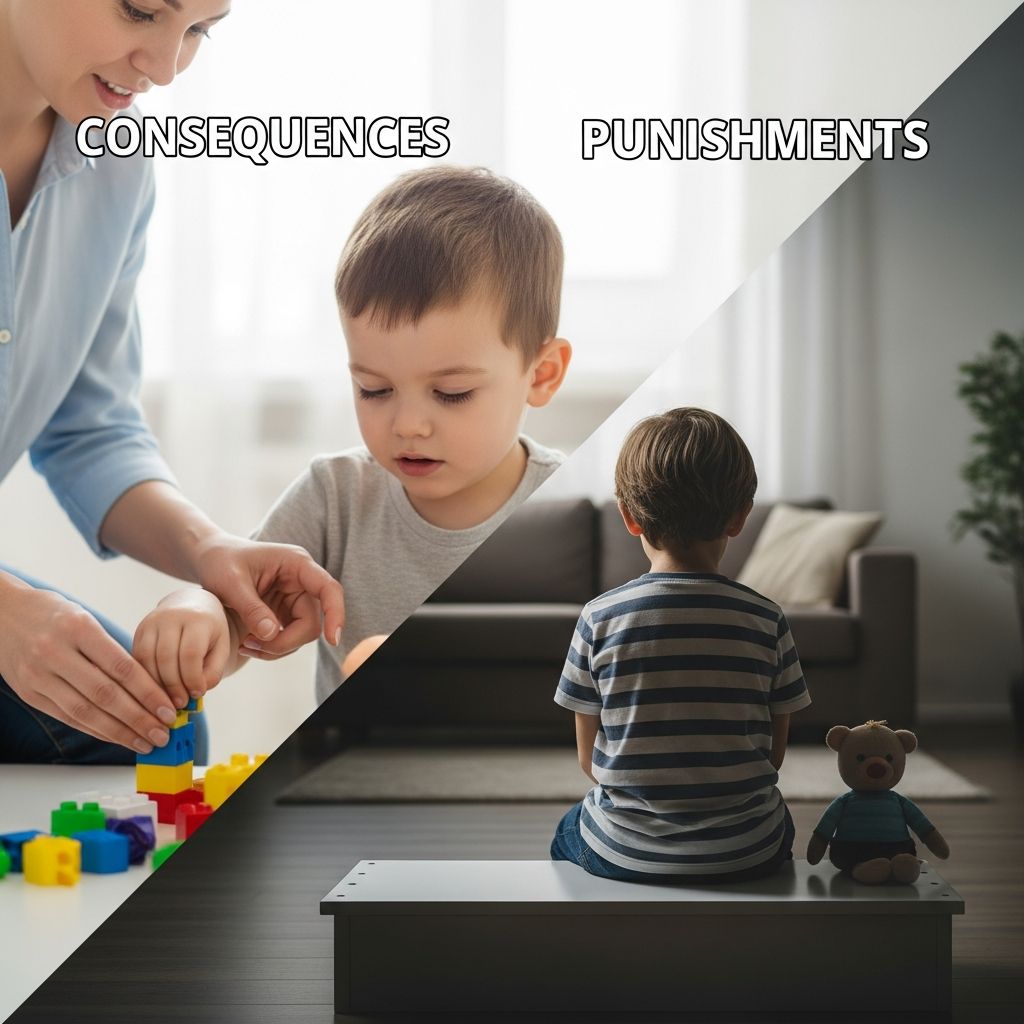
Effective discipline shapes children’s behavior while nurturing their emotional growth and family relationships. Understanding the distinction between punishments and consequences empowers parents to guide kids toward accountability and self-regulation without fostering fear or rebellion.
Defining Core Concepts in Child Discipline
Discipline strategies fall into two primary categories: punishments, which impose suffering to enforce compliance, and consequences, which link actions directly to outcomes for learning. Punishments often involve retribution, such as yelling, spanking, or arbitrary penalties, aiming to inflict pain or shame as payback for misbehavior. In contrast, consequences—natural or logical—arise directly from the child’s choices, teaching cause-and-effect without adult-imposed pain.
According to psychological frameworks, punishments focus on control and immediate behavior suppression, while consequences emphasize teaching and empowerment. This shift from reactive penalty to instructive outcome can transform family dynamics, promoting intrinsic motivation over fear-based obedience.
Why Punishments Fall Short in Long-Term Growth
Punishments may yield quick compliance but erode trust and resilience over time. Children subjected to frequent punishments often develop resentment, seeking revenge or mimicking punitive behaviors toward siblings or peers. The parent-child bond suffers, as kids perceive parents as controllers rather than guides, leading to resistance and power struggles.
- Fear-driven change: Behavior stops temporarily due to dread, not understanding.
- Escalation cycle: Kids become desensitized, requiring harsher penalties that strain relationships further.
- Missing skills: No guidance on alternative actions, leaving children ill-equipped for future choices.
- Modeling issues: Children internalize punishment as conflict resolution, perpetuating cycles.
Research highlights that punitive approaches prioritize justice over heart change, blocking natural emotional processing like guilt that motivates genuine repentance.
The Power of Natural Consequences
Natural consequences occur organically without parental intervention, offering the purest lesson in responsibility. When a child forgets a jacket, they feel cold—directly experiencing the result of their inaction. This method builds wisdom by helping kids notice and connect their actions to real-world impacts.
Parents facilitate learning by discussing these moments calmly: “You chose not to wear shoes, so your feet are cold now. What can we do differently next time?” Avoid rescuing, as it undermines the lesson. Natural outcomes excel for tangible issues like hunger from skipping meals or discomfort from poor choices.
| Scenario | Natural Consequence | Learning Opportunity |
|---|---|---|
| Forgets lunch | Hunger during school | Plan ahead for meals |
| Stays up late on device | Tired and irritable next day | Balance screen time with rest |
| Throws toy | Toy breaks | Value belongings and control impulses |
These experiences foster resilience, as children learn boundaries through life itself, not adult authority.
Implementing Logical Consequences Effectively
When natural outcomes are unsafe, delayed, or abstract (e.g., lying erodes trust invisibly), logical consequences bridge the gap. These are adult-imposed but directly tied to the behavior, focusing on restoration rather than retribution.
Key principles for logical consequences:
- Relatedness: Must connect to the misbehavior (e.g., damaging a wall means repairing it).
- Respect: Delivered calmly, without anger, to preserve dignity.
- Restoration: Aims to ‘make right’—teaching repair over mere penalty.
- Consistency: Applied predictably to build trust in boundaries.
For instance, if a child hogs the TV, a logical step is losing access until they contribute to family harmony, like helping a sibling choose next. Role-play correct behaviors post-consequence to reinforce positives.
Positive Consequences: Reinforcing Good Choices
Consequences aren’t solely negative; positive ones amplify desired behaviors. Rewards like extra playtime for completing chores outpace negatives in frequency, healing relational strains and motivating intrinsically. Unlike punishments, positives focus on what works, describing and celebrating efforts: “I love how you shared your toy—that made your sister smile!”
Balance is crucial: Use 4-5 positives per negative to elevate family happiness. This approach shifts focus from deficits to strengths, aligning with evidence-based parenting models.
Practical Strategies for Everyday Scenarios
Apply these distinctions daily:
- Observe without judgment: Describe behavior factually (“You’re hitting your brother”).
- Assess safety: Allow natural if safe; impose logical if needed.
- Follow through calmly: Enforce without emotion.
- Role-play alternatives: Practice better choices interactively.
- Reflect together: Discuss impacts to build insight.
Example: Teen skips homework for gaming. Natural: Poor grades follow. Logical: Device access tied to task completion. Positive: Bonus time for proactive work.
Building Stronger Family Relationships
Moving from punishment to consequences nurtures connection. Kids feel empowered, not controlled, leading to cooperation and reduced defiance. Parents model healthy boundaries, teaching emotional regulation and empathy.
Long-term benefits include resilient, accountable children who self-correct, reducing parental stress and enhancing joy. Consistent use repairs past punitive damage, fostering mutual respect.
Frequently Asked Questions (FAQs)
What if natural consequences seem too harsh?
Guide reflection without intervening: Empathize (“That must feel disappointing”) and brainstorm solutions, preserving the lesson while supporting emotionally.
How do I stay calm during enforcement?
Practice self-regulation techniques like deep breathing. View discipline as teaching, not winning.
Are consequences suitable for all ages?
Yes, adapt to developmental stage: Simpler for toddlers, abstract discussions for teens.
What about repeat offenses?
Escalate logically (e.g., shorter privileges) while increasing positives and role-play.
Can positives replace all negatives?
No, but prioritize them 4:1 for balance and motivation.
Overcoming Common Challenges
Resistance arises from inconsistency or emotional delivery. Track patterns in a journal, seek parenting classes, or consult professionals for tailored advice. Patience yields profound shifts—children thrive with clear, compassionate boundaries.
(Word count: 1678)
References
- The Difference Between Consequences and Punishments — Smarter Parenting. 2023. https://www.smarterparenting.com/the-difference-between-consequences-and-punishments/
- Consequences vs Punishment in Parenting — Connected Families. 2023. https://connectedfamilies.org/do-your-consequences-build-up-or-tear-down/
- Punishment versus Consequences — New Jersey Psychological Center. 2024-01-15. https://psychologynj.org/page/PunishmentvsConsequences
- Exploring Positive Parenting: Punitive, Natural, and Logical Consequences — Third Eye Family Solutions. 2023. https://thirdeyefamilysolutions.com/exploring-positive-parenting-punitive-natural-and-logical-consequences/
- Consequences vs. Punishments: Why Kids Need Boundaries — Albiona Substack. 2024-02-01. https://albiona.substack.com/p/consequences-vs-punishments-why-kids