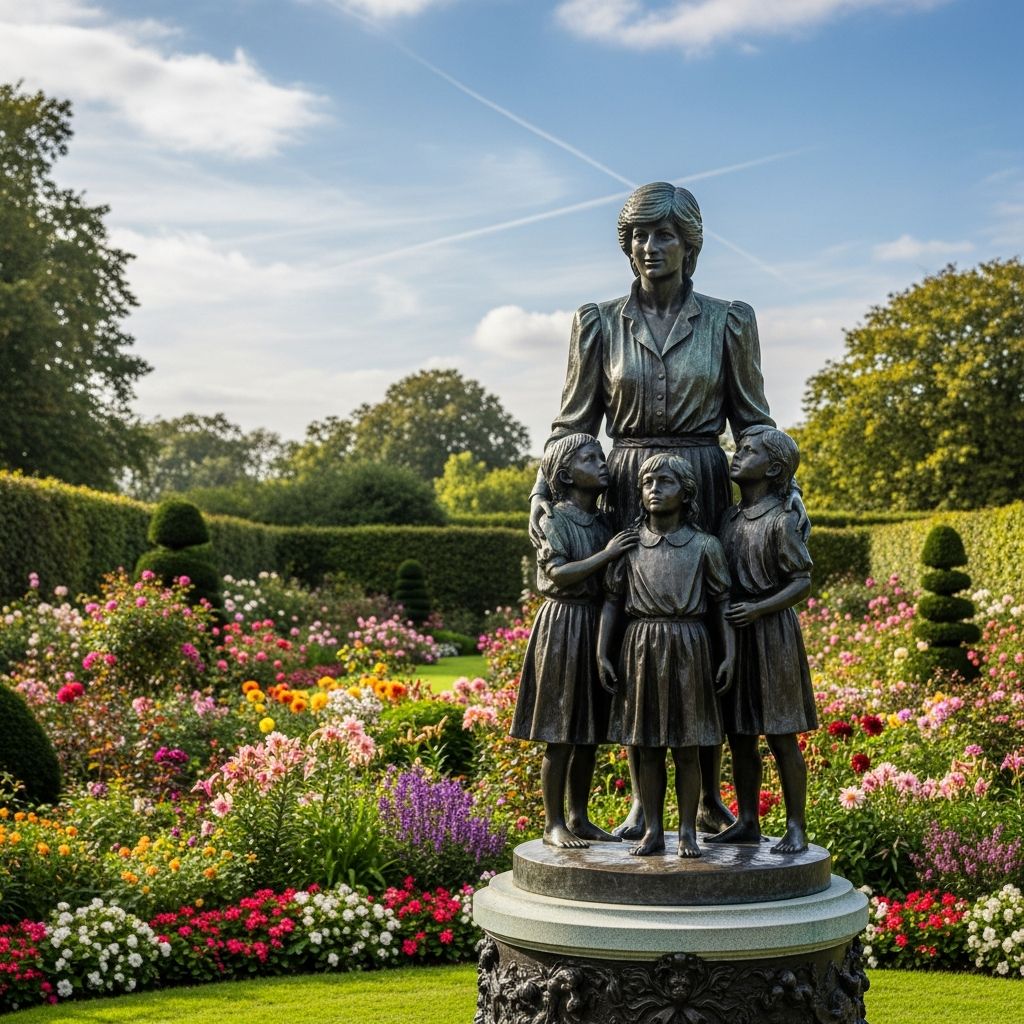
The statue of Princess Diana, Princess of Wales, stands as a poignant tribute in the Sunken Garden of Kensington Palace, her former home. Unveiled on what would have been her 60th birthday, it captures her essence as a humanitarian icon through a bronze figure embracing children, symbolizing her compassion.
The Genesis of a Royal Memorial
In 2017, Princes William and Harry announced plans for a lasting homage to their mother, selecting the serene Sunken Garden at Kensington Palace for its personal significance. This location held special memories for Diana, where she found solace amid her public life. The project aimed to reflect her dedication to children and humanitarian efforts worldwide.
Sculptor Ian Rank-Broadley was chosen for his expertise in crafting emotive portraits. His design features Diana in a simple pleated blouse, pencil skirt, and sensible shoes, evoking her later years as a confident advocate. The figure extends her arms protectively around two children, with a third positioned nearby, representing her nurturing spirit rather than specific individuals.
Unveiling: A Moment of Unity
The ceremony marked a rare joint appearance by Princes William and Harry, drawing global attention. Held on July 1, 2021, it coincided symbolically with Diana’s milestone birthday. The brothers’ shared tribute underscored their commitment to her memory, momentarily bridging any personal divides under the palace’s historic gaze.
Kensington Palace officials described the statue as embodying Diana’s ‘character and compassion,’ with her attire drawn from photographs of her mature humanitarian phase. This choice emphasized authenticity over glamour, prioritizing her substantive contributions.
Artistic Vision and Design Choices
Rank-Broadley’s sculpture portrays Diana as a modern maternal figure, her expression serene yet determined. The children’s inclusion highlights her work with charities like the National AIDS Trust and landmine campaigns. Critics note the deliberate avoidance of her iconic glamorous looks, opting instead for an everyday elegance that aligns with her evolved public role.
- Key Design Elements: Protective arm gesture symbolizing embrace of vulnerability.
- Clothing inspired by 1990s photographs, reflecting confidence and purpose.
- Bronze medium for durability and timeless patina.
- Sunken Garden setting for intimate reflection amid floral surroundings.
This approach sought to immortalize not the ‘People’s Princess’ of fairy-tale fame, but the resilient advocate who reshaped royal engagement with global issues.
Public and Critical Reception
Reactions to the statue have been sharply polarized. While royal supporters praised its heartfelt symbolism, many art critics lambasted its aesthetics. The Guardian’s Jonathan Jones called it a ‘spiritless and characterless hunk of nonsense,’ decrying its lack of vitality. The Telegraph noted divided opinions, with some finding it underwhelming.
Apollo Magazine highlighted mockery over Diana’s depicted appearance, questioning why a renowned beauty appeared ‘browbeaten’ with an unflattering hairstyle. Detractors argued it failed to capture her charisma, resembling a generic figure rather than the vibrant icon.
| Aspect | Positive Views | Critical Views |
|---|---|---|
| Aesthetics | Simple, compassionate portrayal | Lifeless, unflattering features |
| Symbolism | Perfect nod to humanitarian work | Generic, lacking personal spark |
| Location | Intimate and meaningful site | Underwhelms in grandeur |
Despite backlash, admirers argue the focus on substance over style honors Diana’s true legacy, inviting visitors to connect emotionally rather than superficially.
Diana’s Enduring Humanitarian Impact
The statue’s theme resonates with Diana’s transformative philanthropy. She broke taboos by hugging AIDS patients, walked through minefields to spotlight dangers, and championed children’s rights. Her hands-on approach humanized the monarchy, influencing modern royal initiatives like William’s mental health advocacy and Harry’s Invictus Games.
By depicting her with children, the artwork nods to organizations such as the Diana Award, which continues empowering youth. This memorial ensures her influence persists, inspiring new generations to embrace empathy and action.
Family Dynamics and Broader Implications
The unveiling sparked discussions on William and Harry’s relationship. Some viewed their collaboration as genuine reconciliation, while others saw it as a staged unity for the cameras. Regardless, it reaffirmed their shared devotion to their mother’s memory amid evolving personal paths.
For the royal family, the statue serves as a bridge between past glamour and present purpose, reminding the public of Diana’s role in modernizing traditions.
Visiting the Statue: A Personal Tribute
Located in Kensington Palace’s Sunken Garden, the site is accessible to the public. Visitors often leave flowers and notes, turning it into a living shrine. The garden’s redesign with 6000 blooms enhances the contemplative atmosphere, encouraging quiet reflection on Diana’s life.
- Best times: Early mornings for serenity.
- Accessibility: Wheelchair-friendly paths.
- Nearby: Kensington Palace tours for deeper context.
Legacy Beyond Bronze
More than sculpture, this memorial perpetuates Diana’s call for compassion in a divided world. It challenges viewers to embody her values, proving her impact transcends time. As debates continue, the statue stands resilient, much like the woman it honors.
Frequently Asked Questions (FAQs)
Where is the Princess Diana statue located?
The statue resides in the Sunken Garden at Kensington Palace, London, a place Diana cherished.
Who sculpted the Princess Diana statue?
Ian Rank-Broadley, known for his royal portraiture, created the bronze figure.
Why was the statue unveiled on that specific date?
It marked what would have been Diana’s 60th birthday, July 1, 2021.
What do critics say about the statue’s design?
Opinions vary; some praise its symbolism, others criticize its aesthetic execution as bland.
Can the public visit the statue?
Yes, it’s open to visitors in the palace gardens, free of charge.
Does the statue depict specific children?
No, the children are symbolic, representing Diana’s love for all vulnerable youth.
References
- The verdict on the Kensington Palace Princess Diana statue — The Week. 2021-07-02. https://theweek.com/news/uk-news/953368/kensington-palace-princess-diana-statue-verdict
- Diana was a fashion icon, so why is her statue in Kensington Gardens so frumpy? — Apollo Magazine. 2021-07-01. https://apollo-magazine.com/diana-statue-kensington-gardens/
- Princess Diana statue divides opinion, even though Prince Harry… — YouTube (Associated Press). 2021-07-01. https://www.youtube.com/watch?v=eITqI724LoQ
- Princess Diana statue: What inspired Prince William and Prince Harry’s tribute to their mother — BBC News. 2021-07-01. https://www.bbc.com/news/uk-57658405
- Statue of Diana, Princess of Wales — The Royal Parks (official). 2021-07-01. https://www.royalparks.org.uk/whats-on/princess-diana-statue