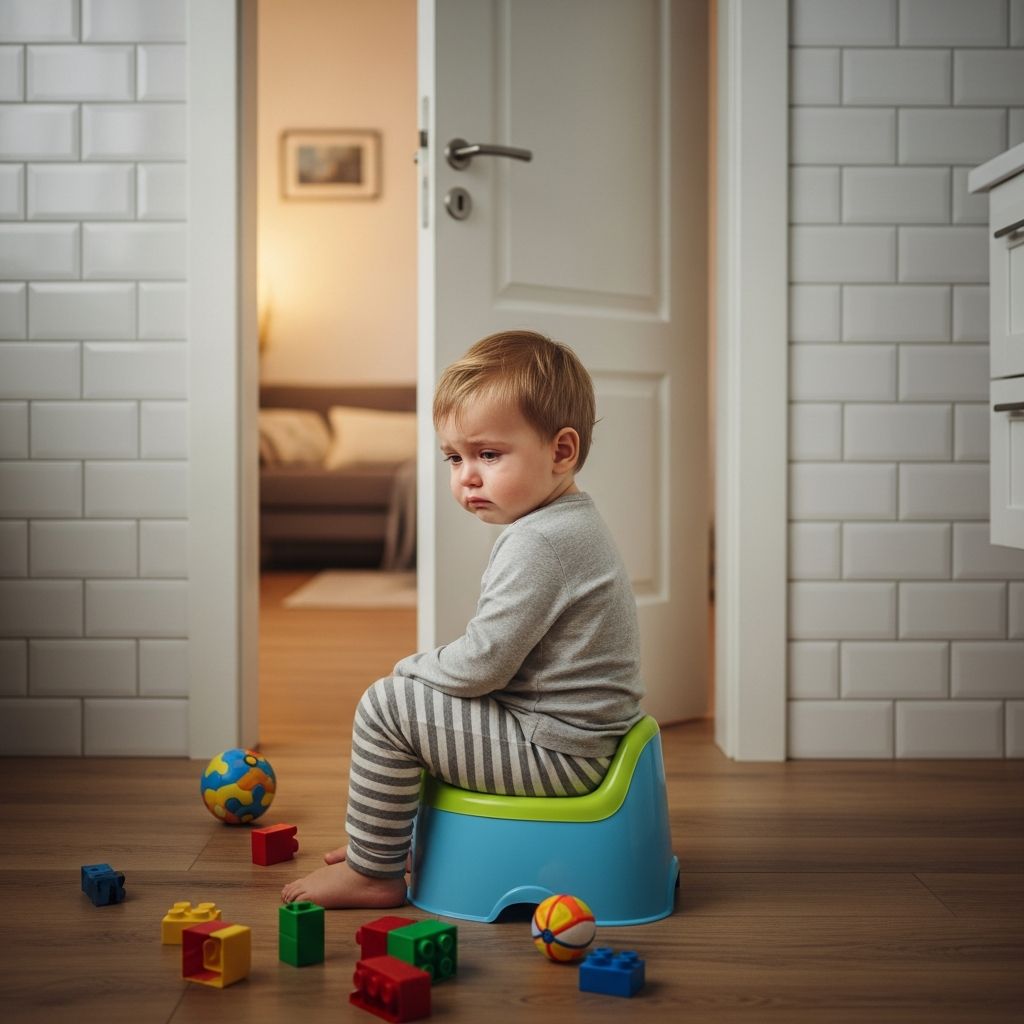
Many parents are surprised when a toddler who has been confidently using the potty suddenly starts having frequent accidents or asking for diapers again. What feels like a crisis is usually a normal, temporary setback that your child can move through with patience, structure, and emotional support.
What Potty Training Regression Really Looks Like
Potty training regression is not a failure in parenting or a sign that your child has forgotten everything. Instead, it is a period in which a child who previously used the toilet with some consistency begins to have more accidents, resists the potty, or asks to return to diapers.
- Frequent daytime accidents after a period of staying dry.
- Nighttime wetting that returns after a stretch of dry nights.
- Refusal to sit on the potty or sudden fear of it.
- Requests to wear diapers or pull-ups again.
- Using the potty successfully at one location (home or daycare) but not the other.
These behaviors can be frustrating, but they are also clues. Instead of seeing them as defiance, it helps to view them as communication: your child is telling you that something in their inner or outer world has shifted.
Common Reasons Toddlers Regress
Understanding why regression happens makes it easier to respond calmly. Toddlers live in a world of big changes, intense feelings, and limited language. Accidents often reflect that inner turbulence more than any lack of knowledge about the potty.
- Major life changes: A new baby, a move, a new caregiver, or starting school can push toileting skills to the background while your child copes with the transition.
- Stress and anxiety: Conflict at home, changes in routines, or even positive but overwhelming events (holidays, visitors) may show up as accidents.
- Developmental leaps: When kids pour energy into language, motor, or social development, other skills can temporarily wobble.
- Medical issues: Constipation, urinary tract infections, or general illness can make using the toilet uncomfortable and lead to avoidance.
- Overpressure: If toileting has become a battleground, a child may regress as a way of regaining a sense of control.
Often, more than one factor is involved. A toddler adjusting to a new sibling and a new preschool may regress even if parents are calm and supportive, simply because their emotional load is heavy.
Is It Regression or Attention-Seeking?
Parents often wonder whether their child is experiencing true regression or just trying to get attention. In reality, attention-seeking and regression frequently overlap. A toddler who is overwhelmed, insecure, or jealous may use toileting as a way to pull a parent closer.
Instead of treating these accidents as manipulative, it is useful to ask: “What need is my child expressing?” Even when behavior is deliberate, the underlying drive is usually a healthy one—connection, reassurance, or a sense of control—being expressed in a messy way.
Signals That Attention Is Part of the Picture
- Accidents mostly occur when a parent is busy with work, the baby, or another child.
- Your child watches your reaction closely after an accident and seems energized by big responses.
- They say things like “Look!” or “Oops!” with a smile or giggle when an accident happens.
- Accidents cluster around transitions, such as bedtime, leaving the house, or phone calls.
Even in these situations, the solution is not punishment or shame. Your child may be telling you, through their behavior, “I need more of you,” “I feel replaced,” or “I don’t like being rushed.” Responding to the need behind the behavior is far more effective than focusing only on the mess.
How to Respond Without Power Struggles
Potty setbacks push emotional buttons for many adults, especially when they interfere with work schedules, school readiness, or house rules. Yet the more emotional heat you bring, the longer and more entrenched the regression may become. The goal is calm, predictable responses.
Core Principles for Handling Setbacks
- Stay matter-of-fact: Treat accidents like a minor cleanup, not a crisis. Change clothes, clean the floor, and move on without lectures.
- Avoid shaming language: Phrases like “baby,” “naughty,” or “you know better” increase anxiety and resistance.
- Provide extra connection: Build in one-on-one time that is not related to toileting so your child does not need an accident to access your full attention.
- Protect your child’s dignity: Handle cleanup privately when possible and avoid jokes or teasing about accidents.
- Lower the pressure: Focus on progress over perfection. Occasional accidents are part of the learning process, even after a child appears fully trained.
Step-by-Step Plan to Get Back on Track
When accidents become frequent, it helps to follow a clear, consistent plan for a few weeks. The goal is to reduce stress, rebuild your child’s confidence, and make using the potty feel safe and predictable again.
- Rule out medical causes.
If there is pain, constipation, fever, unusual smell, blood in the urine or stool, or a sudden change in toileting habits after illness, contact your child’s health provider. Physical discomfort can quickly undermine even solid toilet skills.
- Reset the emotional tone.
For a few days, focus on warm connection and low-pressure routines rather than compliance. Replace comments like “You know where the potty is!” with “Your body is learning. We can practice together.” Calm reassurance rebuilds trust.
- Reintroduce a gentle routine.
Offer regular potty opportunities around natural transitions: after waking, before leaving the house, before and after meals, and before sleep. Invite rather than command, and allow your child to say no without a fight, while still offering the next opportunity later.
- Use simple visual supports.
A picture chart or simple checklist (wake up, potty, breakfast, play, potty, etc.) helps toddlers anticipate what comes next and feel more in control. You can let your child add stickers or check marks after each attempt, not just after success.
- Keep clothing practical.
Choose elastic waistbands, dresses, or loose shorts so your child can pull clothes down quickly. Complicated outfits increase the chance of last-minute accidents and create unnecessary frustration.
- Respond calmly to every accident.
Use a simple script like, “Pee goes in the potty. Let’s clean up together.” Then guide your child to help with small parts of the cleanup that are appropriate for their age, such as placing clothes in the hamper.
- Notice and name small wins.
Praise effort, not perfection. Comments like “You listened to your body and tried!” or “You told me you needed to go—that really helps!” reinforce the process, not just the outcome.
- Adjust expectations around naps and nights.
Staying dry while asleep is a neurological milestone that develops later than daytime control for many children. If regression is mostly at night, continuing to use diapers or absorbent products during sleep is not a failure—just a practical support.
Practical Phrases to Use With Your Toddler
In stressful moments, having ready-made language can prevent arguments and criticism from slipping out. Short, respectful phrases keep your child engaged without escalating big feelings.
| Situation | What Not to Say | What to Try Instead |
|---|---|---|
| Your child has an accident on the floor. | “You’re too big for this. Why did you do that?” | “Pee goes in the potty. Let’s get you clean and dry.” |
| Your child refuses to sit on the potty. | “Sit down right now or no TV.” | “Your body will tell you when it’s ready. We’ll try again later.” |
| Your child asks to wear a diaper during a stressful week. | “No, you’re potty trained. Stop being a baby.” | “Your body feels like diapers are easier right now. We can use them for a bit and keep practicing the potty together.” |
| Your child rushes to the potty but doesn’t make it in time. | “Too late. You should have gone earlier.” | “You ran so fast to the potty—that’s great listening to your body. Next time we’ll try to go a little sooner.” |
| Your child seems to have an accident when you’re on your phone. | “Are you doing this on purpose?” | “You wanted me with you. Let’s get cleaned up, and then we’ll read one book together.” |
Handling Attention-Seeking Accidents Constructively
When you suspect that accidents are partly driven by a need for attention, the solution is not to ignore your child completely or to respond with anger. Instead, shift the balance: give neutral, minimal attention to the accident itself, and rich, positive attention to independent toileting and other cooperative behaviors.
Strategies That Help Rebalance Attention
- Give “spotlight” time daily: Offer 10–15 minutes of one-on-one time where your child leads the activity and you are fully present. This reduces the need to seek attention through negative behavior.
- Keep cleanup low-key: Address the mess briefly, with calm instructions and minimal emotion, then quickly move on to a new activity.
- Praise independent steps: Comment warmly when your child heads to the bathroom, pulls pants down, washes hands, or tells you they need to go.
- Avoid bribes and big rewards: Over-the-top prizes for using the potty can create pressure and backfire. Small, sincere praise and natural pride work better.
- Reconnect after rough moments: A hug, a story, or a game together tells your child that they are loved even when accidents happen.
When to Pause or Scale Back Training
Sometimes the most helpful move is to partially pause active training. This can feel like going backward, but for a child who is overwhelmed, a strategic step back can make it easier to move forward later.
- Consider a short reset: If every bathroom visit ends in a battle, take a week or two to stop talking about the potty. Use diapers or training pants without criticism, then gently reintroduce the potty with a fresh start.
- Use mixed approaches: Some families keep underwear at home but allow pull-ups for long car trips, naps, or nighttime. Consistency is ideal, but flexibility is sometimes necessary for everyone’s sanity.
- Watch your child’s cues: Readiness signs include staying dry for an hour or more, noticing wet or dirty diapers, showing interest in the bathroom, and being able to follow simple instructions.
- Protect your relationship: If potty training is harming your connection with your child, prioritizing that relationship over a rigid timeline is the wiser long-term choice.
Supporting Yourself as a Parent
Toileting setbacks can stir up embarrassment, worry about judgment from others, or fear about school requirements and deadlines. It is easy to slip into harsh self-criticism or resentment toward your child. Protecting your own well-being helps you show up as the calm leader your toddler needs.
- Adjust expectations: Most children do not follow a straight, accident-free path from diapers to full independence. Ups and downs are part of the journey.
- Limit comparisons: Other families’ timelines and stories can be discouraging. Focus on your child’s unique pace and personality instead of treating toileting as a race.
- Share the load: If possible, divide cleanup, laundry, and bathroom reminders among caregivers so no one person becomes burned out.
- Use supportive self-talk: Reminders like “This is temporary,” “My child is learning,” and “I can handle this moment” can keep your nervous system steadier.
- Reach out for help: Talking with a pediatric provider, trusted friend, or parenting group can normalize the experience and provide fresh perspective.
Frequently Asked Questions About Potty Regression
How long does potty training regression usually last?
The length of regression varies widely. For some children it lasts a few days, while for others it stretches over several weeks. The duration often depends on what triggered the setback and how much pressure or anxiety surrounds toileting. Consistent, calm routines tend to shorten regressions, whereas power struggles and shaming can make them linger.
Should I put my child back in diapers?
There is no one-size-fits-all rule. If your child is distressed and having constant accidents, a temporary return to diapers or training pants can relieve pressure and protect self-esteem. However, if your child is mostly capable and only resisting in certain situations, keeping underwear but lowering emotional intensity might work better. You can also choose a hybrid approach: underwear when it is easy to get to a bathroom, and diapers or pull-ups for sleep or long outings.
What if my child only has accidents at home (or only at daycare)?
Different environments create different emotional climates. A child might stay dry at daycare because routines are predictable and peers are also using the toilet, but have accidents at home where feelings are bigger and attention is more intense. Rather than assuming your child is being difficult, view home accidents as a sign that your child feels safe enough to let their guard down with you, and keep working on calm, consistent habits.
Is bedwetting the same as regression?
Not always. Many otherwise toilet-trained children continue to wet the bed at night for months or even years. Nighttime dryness depends on physical maturation that is outside a child’s conscious control. If a child who had been consistently dry at night suddenly begins wetting again, check for changes in stress, fluid intake, or health, but treat the issue separately from daytime toileting skills.
When should I talk to a professional?
It is wise to seek guidance if accidents are accompanied by pain, blood, constipation, weight loss, intense fear of the bathroom, or drastic changes in mood or behavior. You may also benefit from professional input if regression continues for a long time despite calm, consistent efforts, or if toileting struggles are severely straining family relationships. Getting support is a sign of responsiveness, not failure.
Key Takeaways for Moving Forward
- Potty regression is common and usually temporary, especially during times of change or stress.
- What looks like attention-seeking is often a child’s way of signaling, “I need more connection and reassurance.”
- Calm routines, matter-of-fact cleanup, and positive attention for effort help your child regain confidence.
- It is acceptable to pause or scale back training if battles are constant or your child seems overwhelmed.
- Your relationship with your child is more important than any specific potty training timeline.
With patience, empathy, and flexible strategies, most children return to using the potty reliably. The goal is not just a dry pair of pants, but a child who feels capable, respected, and supported while mastering this important step toward independence.