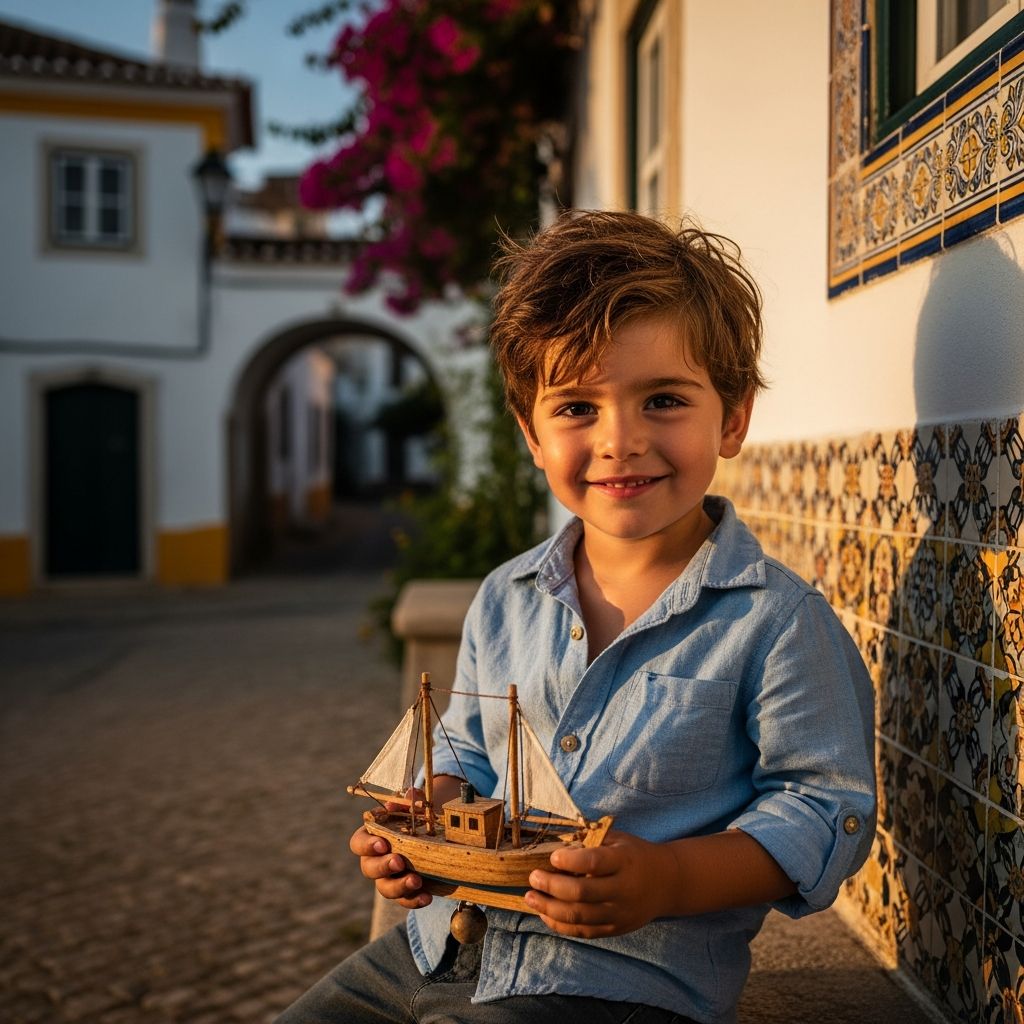
Portuguese boy names blend history, faith, and romance into short, melodic choices that travel well across languages. If you love the sound of Latin names but want something a bit more distinctive than the usual classics, Portuguese names offer a rich and inspiring pool of options.
Why Choose a Portuguese Boy Name?
Portuguese is spoken not only in Portugal but also in Brazil, parts of Africa, and communities around the world. That global reach makes many Portuguese boy names feel both familiar and international.
- Soft yet strong sounds: Many names end in “-o” or “-el,” giving them a warm, lyrical feel.
- Deep meanings: Traditional names often honor saints, virtues, or natural imagery like light, strength, or courage.
- International appeal: Variants of familiar names (such as João for John or Miguel for Michael) feel recognizable yet fresh outside the Lusophone world.
Understanding Portuguese Naming Traditions
In Portuguese-speaking cultures, naming often reflects a mix of religion, family heritage, and personal taste. While your child’s legal naming rules may depend on your country, it helps to understand how names are traditionally used.
- Given name plus multiple surnames: In Portugal and Brazil, a child may carry two family names, sometimes one from each parent, after one or more given names.
- Saints and biblical figures: Many boys are named for saints or religious figures, especially in Catholic families, giving the name a spiritual dimension.
- Nicknames in daily life: Even formal names often have affectionate short forms used by family and friends.
Pronouncing Portuguese Boy Names
Pronunciation can feel intimidating at first, but most Portuguese boy names are easy to say once you learn a few basic rules. You can always adapt pronunciation slightly to fit your native language if needed.
- ã / ão: These nasal sounds are unique to Portuguese. If they feel tricky, many families simply soften them when speaking another language.
- João vs. João-like forms: João (a form of John) is pronounced roughly “zho-OW,” but people outside Portugal may use a gentler “zho-AO.”
- Stress matters: Often the accent mark shows where to stress the syllable (for example, Matéus rather than MAteus).
Classic Portuguese Boy Names and Their Meanings
These timeless names have been used for generations in Portuguese-speaking families and carry a strong sense of tradition.
| Name | Approximate Pronunciation | Meaning / Origin | Style Notes |
|---|---|---|---|
| Afonso | ah-FON-soo | Often linked to “noble” or “ready for battle.” | Historic royal name with a strong, traditional feel. |
| João | zho-OW | Portuguese form of John, “God is gracious.” | Enduring biblical classic, extremely popular in Portugal and Brazil. |
| Miguel | mee-GEL | Equivalent of Michael, “who is like God?” | Strong, familiar across languages, with a global-friendly spelling. |
| Pedro | PEH-droo | Form of Peter, often interpreted as “rock” or “stone.” | Grounded and solid, with royal and religious connections. |
| Francisco | fran-SEES-koo | Linked to “Frenchman” or “free man.” | Traditional yet charming, with lots of nickname options. |
| Tiago | chee-AH-go | Derived from a form of James; often connected to “Saint James.” | Short, modern-sounding favorite that still feels historic. |
| Rui | ROO-ee | Linked to names meaning “famous ruler.” | Short, cool, and very Portuguese in flavor. |
| Tomás | toh-MAHS | Portuguese form of Thomas, often interpreted as “twin.” | A familiar classic with a European twist thanks to the accent. |
Modern and Trendy Portuguese Boy Names
Some Portuguese names feel especially current today, balancing tradition with a contemporary sound. These can be ideal if you want something stylish but not too unusual.
- Henrique – A form of Henry, often interpreted as “home ruler.” It feels refined yet energetic, and shortens nicely to Rique or Kiko in some families.
- Gustavo – A strong, approachable name with roots in older European forms, often associated with leadership and strength.
- Leonardo – Meaning “brave lion,” this name blends artistic associations with a bold, heroic image.
- Caio – Brief and modern, with ancient roots. Its two-syllable structure and vowel ending make it stand out without being hard to say.
- Davi – A Portuguese form of David, typically interpreted as “beloved.” The spelling feels fresh while the meaning remains timeless.
Short and Sweet Names That Travel Well
Short boy names are easy to spell, fast to learn, and work across many cultures. Portuguese offers plenty of concise options that still pack in meaning.
- Leo – Popular in many languages and often associated with the lion, a symbol of courage and nobility.
- Bruno – Frequently linked to meanings like “brown” or “dark-haired,” giving it a grounded, earthy vibe.
- Hugo – Often interpreted as related to “mind” or “spirit,” this name feels intellectual and stylish.
- Rui – Compact and distinctly Portuguese, with a meaning tied to fame or rulership.
- Nuno – A historic Lusophone name that remains friendly and approachable in sound.
Nature, Virtue, and Meaningful Themes
If you want a name with symbolic weight, look for meanings tied to nature, light, faith, or character. Many Portuguese names have deep, layered associations.
- Rafael – Usually interpreted as “God has healed,” often chosen to honor resilience or recovery in a family’s story.
- Salvador – Related to “savior,” this name can carry strong spiritual and protective connotations.
- Lucas – Often associated with “light,” making it a beautiful metaphor for a child who brightens the family.
- Fernando – Commonly linked to an “adventurous journey,” ideal for parents who value exploration and courage.
- Renato – Typically interpreted as “reborn,” a powerful symbol for new beginnings.
Strong Traditional Names with a Modern Edge
Some names manage to feel classic and grounded while also fitting in seamlessly on modern playgrounds. These choices may be perfect if you want a name that will age well.
- Artur – A Portuguese version of Arthur, associated with nobility and legendary kings.
- Bernardo – Typically linked to “brave” or “strong as a bear,” offering a serious yet charming impression.
- Eduardo – Often interpreted as “wealthy guardian,” combining images of protection and provision.
- Maurício – Sometimes connected to “dark-skinned” or “Moorish,” it has a rich historical backdrop.
- Rodrigo – Linked to rulership and fame, and popular in many Iberian-influenced cultures.
Balancing Uniqueness and Familiarity
When naming a child outside of a Portuguese-speaking country, many parents want something distinctive but not confusing. To strike that balance, you can consider a Portuguese name that resembles more familiar English, Spanish, or international names.
- Look for names with similar forms in other languages (for example, Leonardo, Daniel, or Lucas).
- Opt for spellings that are easy to read and pronounce wherever you live, even if you slightly adjust traditional Portuguese sounds.
- Pair a more distinctive first name (such as Rui or Nuno) with a middle name that feels widely familiar.
Sample Name Ideas by Style
The lists below group Portuguese boy names by vibe, helping you quickly zero in on a style that fits your family. Use them as a starting point and modify spellings or combinations as you like.
Gentle and Artistic
- Leonardo
- Rafael
- Hugo
- Matheus (a variant of Matthew)
- Caio
Strong and Traditional
- Afonso
- Bernardo
- Rodrigo
- Henrique
- Gustavo
Short and Modern
- Leo
- Rui
- Nuno
- Davi
- Caio
Tips for Choosing the Right Portuguese Name
Beyond meaning and style, it is worth considering how the name fits in everyday life. A name that looks perfect on paper should also feel right when you say it out loud many times a day.
- Say it with your surname: Try the full name out loud, including any middle names, to ensure the rhythm feels natural.
- Check initials: Glance at the initials for any unintended words or acronyms.
- Think about nicknames: Decide whether you like the most likely nicknames (for example, Chico for Francisco or Gui for Guilherme).
- Imagine different stages of life: Picture the name on a baby, a teenager, and an adult professional to see whether it feels versatile.
Frequently Asked Questions About Portuguese Boy Names
Are Portuguese boy names hard to pronounce?
Some authentic pronunciations can be challenging for non-native speakers, especially nasal vowels and particular consonant sounds. However, many families adapt the pronunciation slightly in daily use while still honoring the name’s origin. Choosing names with simpler spellings, such as Leo, Bruno, or Davi, can make pronunciation easier for everyone.
Can a Portuguese name work in a non-Portuguese-speaking country?
Absolutely. Many Portuguese boy names are close to popular international names, which makes them easy to recognize and use abroad. Names like Miguel, Leonardo, Lucas, and Rafael, for example, already have a global presence and rarely cause confusion.
Do Portuguese names always have religious meanings?
Not always, though many do have biblical or saintly origins because of the historical influence of Catholicism. If religion is important to your family, there are plenty of spiritually significant options; if not, there are also names linked to nature, virtues, or historical figures rather than explicitly religious themes.
Is it appropriate to choose a Portuguese name without Portuguese heritage?
Many parents choose names from cultures they admire, especially when they feel a connection through travel, friendships, or personal interests. As long as the name is used respectfully and you are comfortable explaining its origin and meaning, it can be a meaningful choice for your child.
How can I make a Portuguese name more unique?
You might pair a classic Portuguese first name with an unexpected middle name, or choose a less common traditional option rather than the most popular picks. Another approach is to use a familiar name in its Portuguese form—like João instead of John or Tomás instead of Thomas—to create a distinctive yet still approachable combination.
Bringing Lusophone Charm Into Your Baby’s Name
Choosing a Portuguese boy name opens the door to a world of history, culture, and lyrical sound. Whether you are honoring family roots or simply drawn to the beauty of the language, you can find a name that carries strength, warmth, and individuality. Take your time exploring meanings, trying out pronunciations, and imagining the name in your family’s daily life until one stands out as the perfect fit.