When Star Wars: The Last Jedi arrived in theaters, audiences expected lightsabers, space battles, and Skywalker drama. Few predicted that the most talked-about newcomers would be a flock of wide-eyed, squeaking bird-like creatures: the porgs. What began as a practical fix to a filming challenge quickly evolved into one of the sequel trilogy’s most recognizable icons.
This article unpacks how porgs came to exist, why they look the way they do, what role they play in the film, and why kids and adults alike latched onto them so fiercely.
From Puffins to Porgs: The Unplanned Origin Story
Despite how central they now feel to Ahch-To, porgs were not part of a decades-old lore plan. They were born from a very down-to-earth problem: puffins.
- Filming Location: Luke’s island exile, Ahch-To, was shot on Skellig Michael, a remote UNESCO World Heritage site off the Irish coast.
- Real Wildlife Issue: Skellig Michael is a protected habitat swarming with Atlantic puffins, which are legally protected seabirds.
- VFX Challenge: Removing hundreds of fast-moving birds from frame-by-frame footage using digital effects would have been extremely time-consuming and costly.
According to creature concept designer Jake Lunt Davies, the team realized they could not reasonably clear or erase the puffins, so writer-director Rian Johnson decided to “lean in” to the problem: instead of pretending the birds were not there, they would transform them into a new in-universe species.
By designing porgs to roughly match puffin body size and behavior, many real birds on screen could effectively be treated as background stand-ins once altered with digital models. What began as a technical workaround gave rise to a creature that would become a cultural phenomenon.
The Design Formula: Built to Be Instantly Appealing
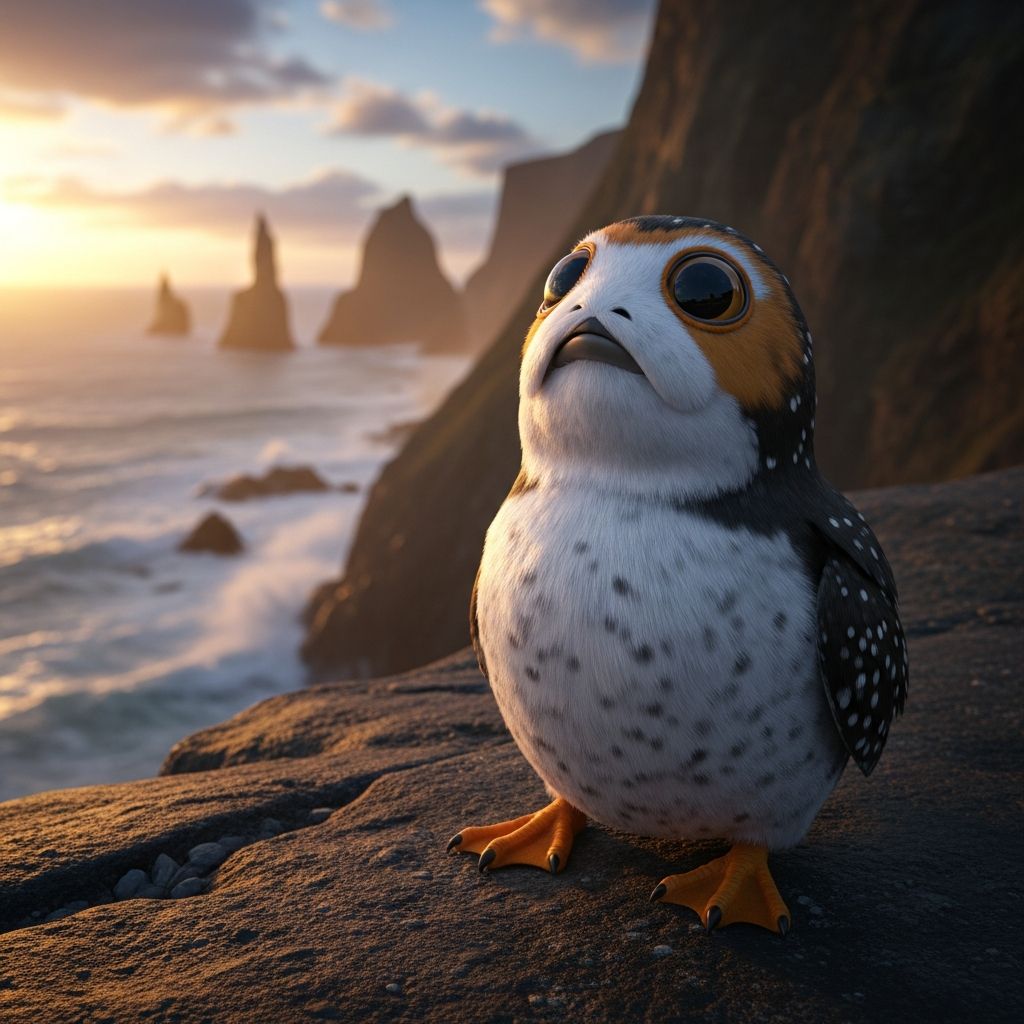
While porgs solved a logistics issue, their breakout popularity owes a lot to their design. Davies has said that porgs combined elements of puffins, seals, and pug dogs: animals known for big eyes and slightly awkward, endearing faces.
Psychologists studying cuteness often refer to the “baby schema” — a set of features like large eyes, rounded heads, and small noses that tend to trigger caregiving responses in humans. Porgs are a textbook example of this design language.
| Design Element | Real-World Inspiration | Effect on Audience |
|---|---|---|
| Round body and short wings | Puffin proportions | Looks soft, harmless, almost plush-like |
| Large forward-facing eyes | Seals and pug dogs | Enhances emotional connection and perceived vulnerability |
| Small beak-like mouth | Bird and mammal mix | Softens the face, avoids sharp or threatening lines |
| High-pitched vocalizations | Baby animal cries | Makes them sound needy or surprised, inviting empathy |
| Clumsy hopping movement | Puffins on land | Adds humor and relatability; they seem easy to care for |
These features match what research shows people across cultures tend to find cute: proportionally big heads, big eyes, and small lower faces often elicit immediate attention and warmth.
Inside the Star Wars Universe: What Are Porgs?
Within the story, porgs are framed as a native species of Ahch-To, the remote oceanic world where Luke has been living in seclusion.
- Habitat: Porgs are portrayed as cliff-dwelling, sea-associated birds that nest among the rocks and ruins on Ahch-To.
- Behavior: They appear curious, semi-tame around visitors, and unbothered by technology — often perching on the Millennium Falcon or near lightsabers.
- Intelligence: Canon sources describe them as non-sentient, more akin to wild animals than to characters like Ewoks or droids.
Their on-screen behavior blends real puffin traits (nesting on rocky ledges, waddling on land) with exaggerated facial expressions and sounds that are clearly tuned for comedy rather than biological realism.
Why Porgs Work in The Last Jedi’s Story
Porgs are often remembered for being cute, but they also serve several narrative and tonal functions in the film:
- Comic Relief: Their interactions with Chewbacca, in particular, provide light-hearted beats between more serious scenes of conflict and inner turmoil.
- World-Building: The presence of a small, indigenous species helps make Ahch-To feel like a real ecosystem rather than a bare set.
- Emotional Texture: Quick shots of porgs reacting to explosions or chaos give the audience a simple emotional “mirror” — fear, surprise, or confusion.
Many critics noted that, compared with some other family-oriented creatures in blockbuster franchises, porgs are used sparingly. They appear in memorable scenes but do not drive the plot or dominate the film’s runtime. That restraint arguably helped them remain charming rather than overwhelming.
Why Kids (and Parents) Responded So Strongly
Porgs tapped into multiple layers of appeal that resonate especially well with families watching together.
Visual Cuteness and Emotional Safety
For younger viewers, porgs are a safe point of focus amid intense battles and heavy themes. Their expressions are easy to read, and they are rarely threatened in extreme ways on-screen. Developmental research suggests that children often gravitate toward characters that are visually simple, expressive, and non-threatening, especially in fast-moving films.
Short, Repeatable Moments
Porg scenes are usually brief and self-contained: a startled look here, a squeak there, a comedic confrontation with Chewbacca. That brevity makes their moments easy for kids to anticipate and quote, turning them into instant favorites for repeat viewings and playtime reenactments.
Perfect for Play and Merchandise
From a design standpoint, porgs translate almost perfectly into plush toys and figurines: a simple silhouette, a neutral facial expression that can be interpreted as happy or sad, and a clear, recognizable color pattern. The media industry has long known that such stylized, round, and soft figures perform well as cross-media characters and toys.
The Merchandising Wave: Beyond the Movie Screen
Once fans saw porgs in trailers, it was clear they would be heavily merchandised. While some viewers worried that they existed only to sell toys, their origin story tied to puffins shows a more complex picture.
However, there is no denying that porgs fit cleanly into established patterns of franchise marketing:
- Easy to Reproduce: A simple body shape makes them ideal for plushies, keychains, and animated GIFs.
- Broad Demographic Appeal: They are not tailored exclusively to children; many adult fans collected porg-themed items as well.
- Low Narrative Baggage: Because they are not central to the main conflict, fans can enjoy them without engaging in larger story debates.
Media scholars point out that modern blockbuster franchises are often designed with transmedia storytelling and merchandise in mind, exposing children to characters across films, games, and products. Porgs, whether by accident or design, fit this strategy seamlessly.
Porgs, Puffins, and Real-World Conservation
One often-overlooked aspect of porgs is the way they indirectly highlight a real conservation success story. Atlantic puffins, the birds that inspired porgs, experienced significant population declines in parts of their range during the 20th century, largely due to overfishing and environmental change.
Conservation and monitoring efforts in places like Ireland and the UK have focused on protecting nesting grounds, managing tourism, and tracking population trends. While puffins still face threats from climate change and shifting fish stocks, protected sites such as Skellig Michael demonstrate how careful regulation can balance wildlife preservation with controlled tourism and, in this case, filming.
Parents and educators can use children’s fascination with porgs as a springboard to talk about real seabirds and marine conservation:
- Look up videos or photos of puffins and compare them to porgs.
- Discuss why certain islands are wildlife reserves and why rules protect nesting birds.
- Connect the idea of a fictional “native species” like porgs to the importance of real ecosystems.
How Porgs Fit into Star Wars’ Creature Tradition
Porgs join a long line of memorable beings in the Star Wars universe, from Jawas and Ewoks to droids and alien patrons of cantinas. Each trilogy has introduced a small, visually distinctive species that helps define its tone.
- Original Trilogy: Ewoks brought teddy bear-like guerrilla fighters into the story, sparking debates but also delighting younger viewers.
- Prequels: Gungans, particularly Jar Jar Binks, pushed heavily into comedic territory, sometimes clashing with fan expectations.
- Sequels: Porgs serve as more understated mascots, emphasizing cuteness and light humor without major dialogue or plot-driving roles.
Compared with some predecessors, porgs are intentionally low-stakes. They are there to populate the world, soften certain scenes, and offer moments of levity — a design choice that many viewers found welcome.
Tips for Parents Watching Porg-Fueled Star Wars With Kids
For families sharing The Last Jedi with younger children, porgs can be a useful bridge into a film that otherwise deals with failure, loss, and complex moral choices.
- Use Porg Scenes as Breathers: If your child is anxious during intense sequences, point out upcoming porg moments as light-hearted pauses.
- Invite Observation: Ask kids to notice what porgs do when spaceships take off, when characters argue, or when something explodes. It helps them process scenes through a safer lens.
- Encourage Creative Play: After the movie, children can draw porgs, invent new island creatures, or imagine how porgs might behave in other parts of the galaxy.
- Discuss Real Animals: Talk about puffins, islands, and wildlife protection to connect the fantasy to real-world nature.
Frequently Asked Questions About Porgs
Q: Are porgs real animals?
A: No. Porgs are fictional creatures created for Star Wars: The Last Jedi, but their design and behavior were heavily inspired by real Atlantic puffins that live on Skellig Michael, the island where Ahch-To scenes were filmed.
Q: Why didn’t the filmmakers just remove the puffins digitally?
A: Skellig Michael was covered with puffins, and removing hundreds of moving birds from each shot with visual effects would have been extremely labor-intensive and expensive. Turning them into porgs allowed filmmakers to work with reality instead of fighting it.
Q: Do porgs have any special powers or roles in Star Wars lore?
A: Canon materials describe porgs as non-sentient, sea-dwelling birds native to Ahch-To with no Force abilities or advanced culture. They mainly serve as wildlife and comic relief rather than central plot drivers.
Q: Why do people find porgs so cute?
A: Porgs were designed with big eyes, round heads, and small beaks — features that match the “baby schema” known to trigger feelings of tenderness in humans. Their high-pitched squeaks and clumsy movements enhance this effect.
Q: Are puffins endangered because of Star Wars filming?
A: No. Skellig Michael is a protected site, and filming had to follow strict guidelines to avoid disturbing nesting birds. Puffins do face broader threats from climate change and shifting fish populations, but responsible tourism and conservation policies aim to protect their colonies.
References
- Why Are There Porgs in ‘Last Jedi’? Because Puffins — Movie Paws / J. Lunt Davies interview summary. 2017-12-20. https://moviepaws.com/2017/12/20/why-are-there-porgs-in-last-jedi-because-puffins/
- The Real Reason Porgs Were Created in Star Wars: The Last Jedi — Motion Picture Association. 2017-12-18. https://www.motionpictures.org/2017/12/the-real-reason-porgs-were-created-in-star-wars-the-last-jedi/
- Baby schema in human and animal faces induces cuteness perception and motivation for caretaking in children, adults and the elderly — G. Lobmaier et al., Frontiers in Psychology. 2013-07-30. https://doi.org/10.3389/fpsyg.2013.00390
- Porg — Wookieepedia (StarWars.com–linked fan encyclopedia; summarizing official canon sources). Accessed 2025. https://starwars.fandom.com/wiki/Porg
- Media Franchising and Convergence Culture — D. Johnson, New Media & Society. 2011-10-01. https://doi.org/10.1177/1461444811410404
- Atlantic Puffin (Fratercula arctica) — BirdLife International species factsheet. 2022-03-01. https://www.birdlife.org/birds/atlantic-puffin/