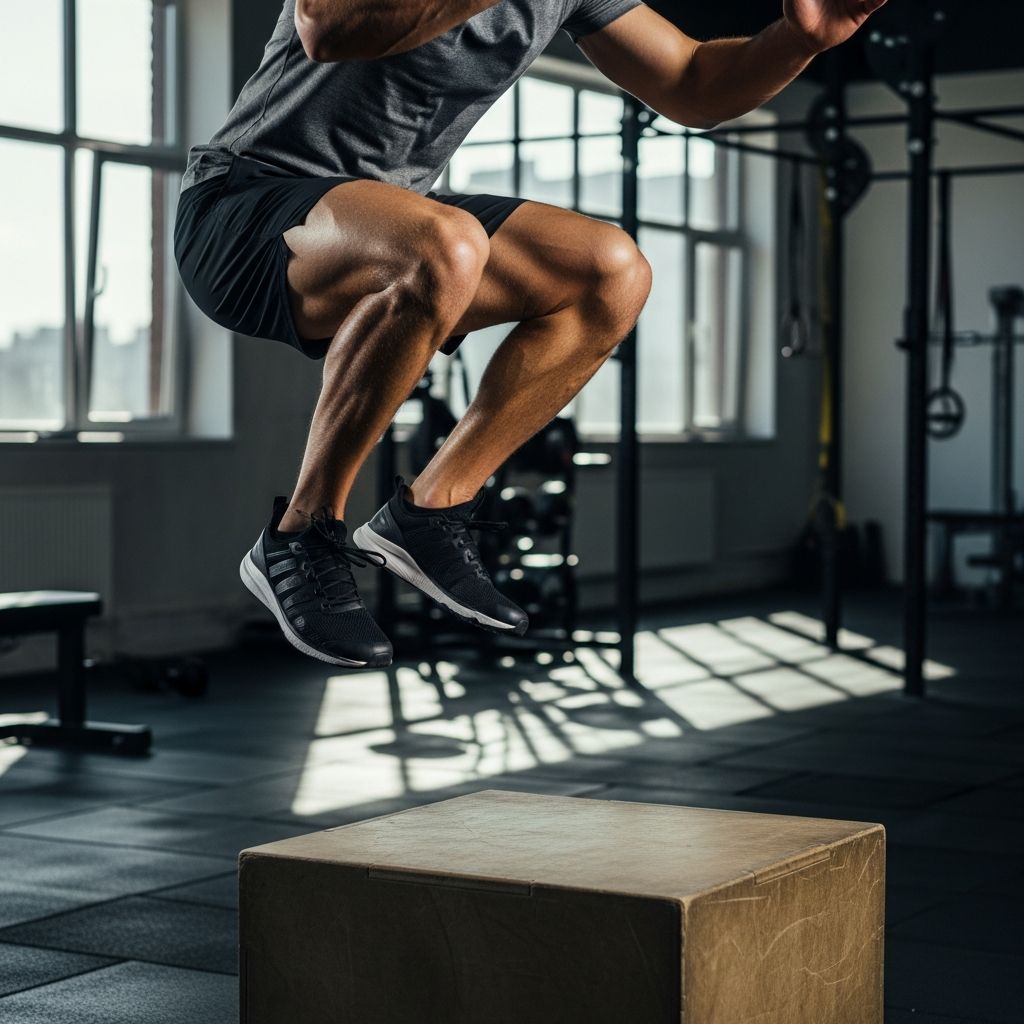
Explosive plyometric exercises, such as box jumps, represent a cornerstone of effective leg training, delivering rapid improvements in power, speed, and overall athletic capability. These high-intensity movements engage multiple lower body muscle groups simultaneously, mimicking real-world athletic demands and fostering functional strength that translates directly to sports and daily activities.
Why Plyometric Leg Training Transforms Your Fitness
Plyometrics, often called “plyo” training, involve quick, powerful stretches followed by explosive contractions, training muscles to generate maximum force in minimal time. For leg days, this means prioritizing jumps, bounds, and hops that build the fast-twitch muscle fibers essential for sprinting, jumping, and agility.
Lower body workouts using plyometrics offer multifaceted advantages. They stimulate significant hormonal responses, including elevated levels of testosterone and human growth hormone (HGH), which promote muscle repair, growth, and fat metabolism. Large muscle groups like the quadriceps, hamstrings, glutes, and calves demand substantial energy, leading to heightened calorie burn during and after sessions—often elevating metabolic rates for hours.
- Muscle Hypertrophy and Strength: Compound plyo moves recruit quads for knee extension, hamstrings and glutes for hip propulsion, and calves for push-off, creating balanced development and a sculpted physique.
- Injury Prevention: Strengthening stabilizers improves joint support, reducing risks of issues like runner’s knee, IT band syndrome, and lower back pain by addressing muscle imbalances.
- Enhanced Athletic Performance: Runners gain better economy and power output, while general fitness enthusiasts see improvements in speed, vertical leap, and core stability from unilateral demands.
- Hormonal and Metabolic Boost: Sessions trigger cortisol for stress adaptation, alongside anabolic hormones that aid recovery and body composition changes.
Research underscores these gains: heavy resistance involving lower body compounds spikes testosterone, directly correlating with muscle gains, while post-workout metabolism surges from glute activation—the body’s largest muscle.
Essential Muscle Groups Targeted in Plyo Leg Sessions
A comprehensive plyometric leg workout hits prime movers and stabilizers for holistic development. Quadriceps absorb landing impacts and drive knee extension; hamstrings counterbalance to prevent strains; glutes provide stride power and pelvic stability; calves handle propulsion; and hip flexors/adductors ensure alignment.
| Muscle Group | Primary Role in Plyos | Key Benefits |
|---|---|---|
| Quadriceps | Impact absorption, explosive extension | Speed, knee stability |
| Hamstrings | Hip extension, deceleration | Injury resistance, propulsion |
| Glutes | Power generation, stability | Athletic power, posture |
| Calves | Push-off, ankle stability | Vertical leap, endurance |
| Core/Hips | Balance, alignment | Overall injury prevention |
Mastering Box Jumps: Technique and Progressions
Box jumps epitomize plyometric efficacy, demanding full lower body explosion to propel upward onto a sturdy platform. Start with a knee-height box for beginners, focusing on soft landings to minimize joint stress.
- Setup: Position feet shoulder-width, box 12-24 inches high. Engage core, gaze forward.
- Explosion: Swing arms back, then forward as you dip hips into quarter-squat, exploding upward via ankles, knees, hips.
- Landing: Absorb on box with bent knees, hips back; step down to avoid eccentric overload.
- Reps: 3 sets of 5-8, emphasizing quality over quantity.
Progress by increasing box height, adding dumbbells, or incorporating knee drives for unilateral challenge. Common errors include knee valgus (inward collapse) or hard landings—cue hips back and controlled descent.
Complete Plyometric Leg Day Routine for All Levels
This 45-minute workout uses supersets for efficiency, blending plyos with strength for maximal gains. Perform twice weekly, with 48 hours recovery. Beginners scale to bodyweight; advanced add weights.
Warm-Up: Activate and Mobilize (8-10 Minutes)
- Leg swings: 12/leg (forward/back, lateral)
- High knees: 45 seconds
- Butt kicks: 45 seconds
- Bodyweight squats: 12 reps
- Walking lunges with twist: 8/leg
Main Workout: 4 Supersets (25-30 Minutes)
Do exercises back-to-back, rest 90 seconds between supersets. 3 rounds each.
- Superset A: Power Foundation
- Box Jumps: 6-10 reps
- Goblet Squats: 10-12 reps (hold dumbbell at chest)
- Superset B: Posterior Chain Blast
- Broad Jumps: 8 reps (jump forward maximally, reset)
- Romanian Deadlifts: 10 reps (dumbbells or barbell)
- Superset C: Unilateral Stability
- Single-Leg Box Step-Ups: 8/leg
- Bulgarian Split Squats: 8/leg
- Superset D: Calf Finisher
- Depth Jumps: 6 reps (step off box, immediate rebound)
- Standing Calf Raises: 15 reps
Cool-Down: Recovery Focus (5-8 Minutes)
- Quad stretch: 40s/side
- Hamstring stretch: 40s/side
- Glute figure-4: 40s/side
- Calf wall stretch: 40s/side
- Child’s pose: 60s
Low-intensity walking or cycling precedes stretches to flush lactic acid.
Advanced Plyometric Variations for Peak Performance
Once proficient, integrate hurdles, lateral bounds, or tuck jumps. For runners, emphasize single-leg hops to mirror gait. Track progress via jump height or rep endurance.
- Lateral Box Jumps: Build side-to-side agility.
- Bounding Drills: Exaggerated running strides for stride power.
- Drop Jumps: Heighten reactive strength.
Nutrition and Recovery for Optimal Plyo Gains
Fuel with protein (1.6-2.2g/kg bodyweight) post-workout for repair, alongside carbs for glycogen. Prioritize sleep, foam rolling, and active recovery days. Those with joint issues consult professionals before plyos.
Frequently Asked Questions
What makes plyometrics better than traditional leg weights?
Plyos enhance power and elasticity via stretch-shortening cycle, complementing hypertrophy-focused lifting for superior athleticism.
Can beginners do box jumps safely?
Yes, start low (12 inches), master form, and progress gradually to avoid injury.
How often should I train legs with plyos?
2-3 times weekly, allowing recovery; combine with upper body days.
Do plyos help with weight loss?
Absolutely—high calorie burn and metabolic afterburn from large muscles.
What’s the ideal box height for intermediates?
20-24 inches; ensure full hip extension at top.
References
- The Best Leg Day Workout For Runners — Still I Run. 2023. https://www.stillirun.org/post/the-best-leg-day-workout-for-runners
- Never Skip a Leg Day: Benefits, Cautions, and More — Healthline. 2023-10-12. https://www.healthline.com/health/exercise-fitness/never-skip-leg-day
- 5 Reasons Why Leg Day Is so Important — Men’s Health UK. 2023. https://www.menshealth.com/uk/building-muscle/a757214/5-reasons-why-leg-day-is-so-important/
- Best Leg Exercises For Your Leg Day Workout — Gymshark Central. 2024. https://www.gymshark.com/blog/article/best-leg-exercises
- How To Cool Down Properly After Leg Day — Gymshark Central. 2024. https://www.gymshark.com/blog/article/best-leg-exercises