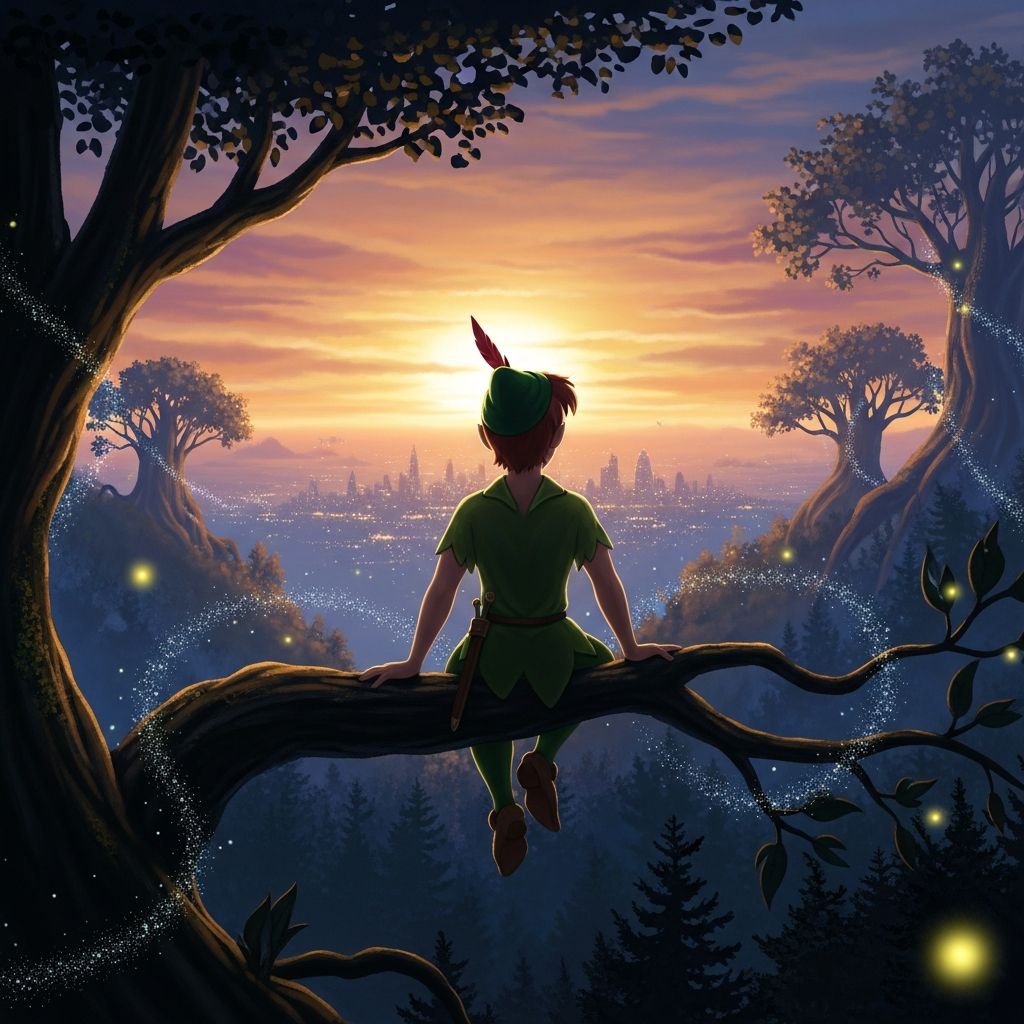
Peter Pan is more than just a flying boy with a fairy sidekick; he is one of the most enduring symbols of childhood in the English-speaking world. Over a century after J.M. Barrie first brought him to life, Peter still dances through books, films, stage shows, and pop culture, inviting each new generation to imagine a world where time stands still and adventure never ends. Yet beneath the swashbuckling pirates and fairy dust lies a surprisingly complex story about longing, loss, and the painful beauty of growing up — a story that resonates just as deeply with parents as it does with children.
The Boy Who Refuses to Grow Up
Peter Pan’s defining trait is his refusal to age. He is forever a child, living in a place called Neverland where the rules of the real world do not apply. In this magical island, children never have to go to school, follow bedtime, or face the responsibilities of adulthood. For kids, this is pure fantasy: the ultimate escape from homework, chores, and grown-up expectations. For adults, Peter embodies a wistful dream — the desire to hold on to the freedom, imagination, and fearlessness of youth.
But Peter’s eternal childhood comes at a cost. He cannot remember his past, forgets his friends as soon as they leave, and never forms lasting emotional bonds. In this way, Peter is not just a hero of adventure; he is also a tragic figure, forever isolated by his own choice to remain a child. His famous line, “I don’t want ever to be a man. I want always to be a little boy and to have fun,” captures both the joy and the loneliness of his existence.
Neverland: A World of Pure Imagination
Neverland is not a real place, but a world built entirely from a child’s imagination. It is filled with pirates, mermaids, Native American tribes (often portrayed problematically in older versions), wild animals, and secret hideouts. This island is a playground where anything can happen: children can fly, swords can duel, and crocodiles can swallow clocks. For young readers and viewers, Neverland represents the boundless creativity of childhood, where rules are made to be broken and every day can be an adventure.
What makes Neverland so powerful is that it is shaped by the children who visit it. When Wendy, John, and Michael Darling arrive, the island reflects their own stories, fears, and games. The Lost Boys live in underground homes and play at being soldiers and explorers, mirroring the kinds of imaginative play that real children engage in. In this sense, Neverland is less a fixed location and more a symbol of the inner world of a child’s mind, where fantasy and reality blur.
The Darker Side of Never Growing Up
While Peter Pan is often remembered as a joyful, mischievous hero, his character also has a darker, more unsettling side. He is forgetful, selfish, and emotionally detached. He forgets his own shadow, forgets his friends when they return home, and even forgets Wendy when she grows up. He treats life as a series of games, with little regard for consequences or lasting relationships. This makes him thrilling in the moment, but also deeply lonely in the long run.
Psychologically, Peter can be seen as a child who is afraid of growing up because he is afraid of loss. In the original story, he returns to his nursery only to find his window barred and another baby in his place, suggesting that his mother has moved on without him. This trauma shapes his entire existence: he runs away to Neverland not just for fun, but to escape the pain of being forgotten. In this light, Peter’s refusal to grow up is not just a celebration of youth, but a defense mechanism against the heartbreak of time and change.
Wendy: The Heart of the Story
While Peter is the star, Wendy Darling is the emotional center of the tale. She is the one who brings order, care, and storytelling to Neverland. She mothers the Lost Boys, listens to their problems, and keeps them safe. In many ways, Wendy represents the transition from childhood to adulthood: she is still young enough to fly and believe in fairies, but mature enough to take responsibility and make difficult choices.
Wendy’s decision to return home, despite the excitement of Neverland, is one of the story’s most powerful moments. She chooses family, growth, and real love over endless adventure and eternal youth. This choice reflects a universal truth: that growing up is not a failure, but a necessary and meaningful part of life. Wendy’s journey reminds us that while childhood is magical, adulthood brings its own kind of wonder — love, connection, and the ability to care for others.
Captain Hook: Fear, Honor, and the Shadow of Time
Captain Hook is more than just a villain; he is Peter’s dark mirror. Where Peter fears growing up, Hook is obsessed with time, honor, and his own mortality. His greatest fear is not death itself, but the crocodile that swallowed his hand and now follows him, ticking clock in its belly. This ticking sound haunts him, a constant reminder that time is running out.
Hook is also a man of twisted honor. He believes in rules, duels, and “good form,” even as he commits acts of piracy. In his final confrontation with Peter, he is defeated not just by skill, but by Peter’s refusal to play by adult rules. Hook’s tragic end — diving into the crocodile’s jaws — underscores the story’s central theme: that time cannot be escaped, and that clinging too tightly to the past or to fear only leads to destruction.
Why Peter Pan Still Matters Today
Peter Pan continues to captivate audiences because it speaks to a universal human tension: the desire to stay young versus the need to grow up. Children see in Peter a hero who defies authority and lives by his own rules. Adults see in him a poignant reminder of what they have lost — the innocence, the imagination, the sense of endless possibility that fades with age.
The story also raises important questions about parenting, memory, and identity. What does it mean to be a good parent? How do we balance freedom and responsibility? Can we ever truly go back to childhood, or is that a fantasy we must eventually let go of? These questions give Peter Pan a depth that goes far beyond a simple children’s adventure.
Modern Adaptations and Cultural Impact
Over the years, Peter Pan has been reimagined in countless ways: animated films, live-action movies, stage musicals, and even dark, psychological retellings. Each version reflects the values and concerns of its time. Some emphasize the magic and fun, while others explore the darker, more complex aspects of Peter’s character and the world of Neverland.
- Disney’s 1953 animated film softened many of the story’s edges, turning Peter into a cheerful, carefree hero and downplaying the more tragic elements.
- Later adaptations, like Steven Spielberg’s Hook (1991), focus on what happens when Peter grows up (or tries to), exploring the cost of abandoning family and responsibility.
- More recent retellings often address outdated stereotypes, especially in the portrayal of Native American characters, and place greater emphasis on Wendy’s agency and inner life.
These adaptations show that Peter Pan is not a fixed character, but a cultural touchstone that evolves with each generation, reflecting changing ideas about childhood, gender, and what it means to “grow up.”
Lessons for Parents and Kids
For parents, Peter Pan offers a gentle reminder to cherish the fleeting years of childhood. It encourages adults to play, to imagine, and to see the world through a child’s eyes, even as they guide their children toward maturity. At the same time, it warns against the temptation to live in the past or to resist the natural process of growing up.
For children, the story celebrates imagination, courage, and the joy of adventure. It also quietly teaches that love, family, and belonging are more important than endless fun. Wendy’s choice to return home, and Peter’s lonely existence in Neverland, together suggest that true happiness lies not in escaping life, but in embracing it — with all its changes, challenges, and connections.
FAQs About Peter Pan
Who created Peter Pan?
Peter Pan was created by Scottish author and playwright J.M. Barrie. He first appeared in the 1902 novel The Little White Bird, then became the central character in the 1904 play Peter Pan, or The Boy Who Wouldn’t Grow Up, later adapted into the novel Peter and Wendy in 1911.
What is the main message of Peter Pan?
The story explores the tension between childhood and adulthood, suggesting that while the freedom and imagination of youth are precious, growing up is a necessary and meaningful part of life. It also touches on themes of memory, loss, family, and the importance of love and connection.
Is Peter Pan a good role model for children?
Peter is a complex figure. He is brave, adventurous, and full of imagination, which can inspire children to be creative and courageous. However, he is also selfish, forgetful, and emotionally detached, which can serve as a cautionary example about the importance of responsibility, empathy, and lasting relationships.
Why does Peter Pan forget Wendy?
In the story, Peter lives entirely in the present moment and cannot remember the past. This forgetfulness is both a magical trait and a tragic one: it allows him to stay forever young, but it also means he cannot form deep, lasting bonds. When Wendy grows up and can no longer go to Neverland, Peter forgets her, just as he will forget her daughter Jane and later her granddaughter Margaret.
What does Neverland symbolize?
Neverland symbolizes the world of a child’s imagination — a place of endless adventure, play, and freedom from adult rules. It also represents the desire to escape time, responsibility, and the pain of growing up. For many, Neverland is a metaphor for the inner world of childhood, where fantasy and reality blend together.