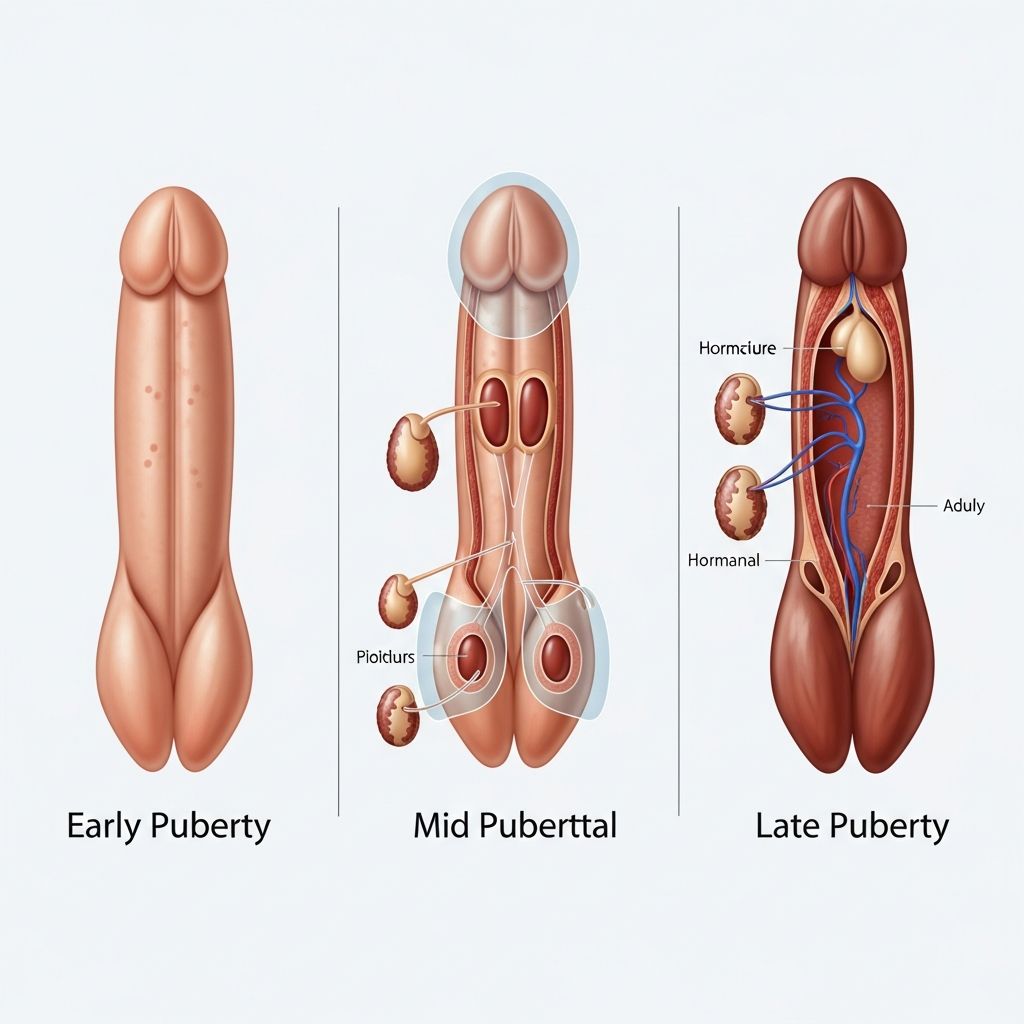
As you go through puberty, it is completely normal to wonder whether your penis size, shape, and growth are normal. Many teens compare themselves to friends or images online and end up feeling worried for no good reason. This guide offers clear, medically based answers so you can understand what is happening with your body and when to ask for help.
How Puberty Affects the Penis and Testicles
Puberty is the time when your brain and reproductive organs start working together to turn your body into an adult body capable of reproduction. In boys, puberty typically starts sometime between ages 9 and 14. The very first sign is usually that the testicles get larger, followed by changes in the scrotum and the penis.
- The testicles begin to grow first.
- The scrotum (the skin holding the testicles) becomes darker, thinner, and hangs lower.
- The penis gradually gets longer and thicker over several years.
- Pubic hair appears at the base of the penis and spreads with time.
Inside your body, hormones from the brain (especially luteinizing hormone and follicle-stimulating hormone) tell the testicles to make testosterone and sperm. Testosterone drives most of the visible changes, including penis growth, deeper voice, and muscle development.
Typical Timeline of Penis Development
Everyone develops at a different pace, but doctors describe a general sequence of changes:
| Stage | What Often Happens | Approximate Age Range (Boys) |
|---|---|---|
| Early puberty | Testicles begin to enlarge; scrotum changes texture and color. | 9–14 years |
| Middle puberty | Penis starts to lengthen; more pubic hair; first erections and possible wet dreams. | About 11–15 years |
| Later puberty | Penis gets both longer and thicker; testicles reach adult size; underarm, facial, and body hair grow. | Up to late teens, sometimes early 20s |
Growth can be slow and uneven: you might notice no change for months and then a lot of change in a short time. That is still normal.
Penis Size: What Is Considered Normal?
There is a huge range of normal penis sizes. Most people who worry that their penis is too small actually fall well within the normal range once puberty is complete. Growth continues throughout puberty and can go on into the late teens and even early 20s in some males.
Why Comparing to Others Does Not Work
- Puberty timing differs: Someone the same age may be years ahead or behind you in development.
- Locker-room comparisons are unreliable: People may exaggerate or you might only see them at certain angles or states (like partly erect).
- Online images are misleading: Many are edited, staged, or selected from people at the extreme high end of the size range.
Studies on adult men show that most penises cluster around an average size, with only a small minority at the extreme small or large ends. What matters for health and sexual function is not whether you are above or below average, but whether your body works normally and continues to develop over time.
Flaccid vs. Erect Size
Penises come in different patterns of size change:
- Some are shorter when soft but grow a lot when erect.
- Others look longer when soft but do not grow as dramatically when erect.
Both patterns are normal. A small-looking soft penis can still reach an average or above-average size when erect, and a larger-looking soft penis is not necessarily much larger during an erection.
Shape, Curvature, and Color
Just like noses or ears, there is a wide variety in how penises look. Differences in shape or color hardly ever mean that something is wrong.
Common Variations That Are Usually Normal
- Curvature: A penis that bends slightly to the left, right, up, or down when erect is common. A gentle curve that has always been present and does not cause pain or trouble during sex later in life is normally harmless.
- Color: The skin of the shaft may be lighter than the head (glans), which often appears more pink or purplish. The scrotum may be darker than the rest of the body. Color can also change slightly with temperature or arousal.
- Veins and skin texture: Visible veins, small bumps at the base of hairs, and tiny skin folds are all expected.
If a curve suddenly appears, gets worse over time, or causes pain, that is different and worth discussing with a health professional.
Erections, Ejaculation, and Wet Dreams
As testosterone levels rise, you will start having erections more often. An erection is when blood flows into the penis, making it firm and larger. Erections can happen because of sexual thoughts, physical touch, or for no clear reason at all, such as during class or while sleeping.
First Ejaculation
During puberty, the testicles start producing sperm, and the body becomes capable of ejaculation, which is the release of semen from the penis. Many boys have their first ejaculation around age 13, but the normal range is wider. Ejaculation may happen:
- During masturbation.
- During sexual activity.
- Spontaneously during sleep, known as a nocturnal emission or “wet dream.”
Wet dreams are completely natural and are one way the body releases semen. You cannot predict or fully control when they occur.
Is It Normal to Get Random Erections?
Yes. In puberty, hormone levels fluctuate throughout the day. The brain and erection reflexes are very sensitive to even small changes. That is why you may get an erection:
- For no obvious reason.
- In situations that are not sexual, like riding in a car or sitting in class.
- Multiple times a day.
Over time, as your body adjusts to hormone levels, these random erections usually become less frequent.
When Puberty Seems Early, Late, or Very Slow
Boys usually start puberty later than girls and often grow for a longer time. On average, puberty in boys begins between ages 10 and 14, but there is still a lot of normal variation.
Signs You Are Probably Still Within a Normal Range
- You notice some growth of the testicles or scrotum, even if the penis has not changed much yet.
- Pubic hair has started to appear.
- Your height is increasing, even if slowly.
If you are concerned about timing, it is reasonable to talk with a doctor. Many teens labeled as “late bloomers” are entirely healthy and simply mature a bit later than classmates.
When to Ask a Doctor About Growth
You should speak with a doctor, nurse practitioner, or adolescent medicine specialist if:
- You have no signs of puberty at all (no testicle growth, no pubic hair) by age 14–15.
- You noticed some changes, but they stopped progressing for more than a couple of years.
- Your penis seems extremely small compared with others your age, and this is upsetting you.
- You have pain, swelling, or a sudden change in shape or curvature of the penis.
Health professionals can examine you, possibly measure testicle size, ask about your growth history, and decide whether any tests are needed. In many cases, no treatment is required; reassurance and time are enough.
Common Worries and What They Usually Mean
Many of the questions teen boys ask about the penis are similar. Understanding what is common can reduce a lot of anxiety.
“Is My Penis Too Small?”
This is one of the most frequent worries. In reality:
- Most boys are still growing and cannot judge final adult size.
- Being shorter or thinner than friends right now does not predict adult size.
- Non-medical “enhancement” pills, creams, or exercises advertised online are not proven to work and can be unsafe.
If a doctor checks your development and says you are within a normal range, that usually means your body is on track, even if your penis is smaller than average right now.
“My Foreskin Looks Different”
If you are not circumcised, the foreskin (the skin covering the head of the penis) may stay tight in childhood and gradually loosen during puberty. Gentle retraction over time is normal. Forcing it back can cause pain or small tears. If the foreskin cannot be retracted at all by the later teen years, or you have pain, cracking, or difficulty urinating, see a doctor.
“The Skin on My Scrotum Is Wrinkly and Has Bumps”
The scrotal skin is supposed to be thin and wrinkled. Small bumps where hairs grow and tiny glands in the skin are common. However, if you see:
- Very painful lumps.
- Spots that change color or bleed.
- Growths that look like warts or blisters.
you should get checked, since these could be signs of infections or other conditions.
“One Testicle Hangs Lower Than the Other”
It is normal for one testicle, often the left, to hang slightly lower than the other so they do not bump into each other. A sudden increase in size, severe pain, or a testicle that feels very hard should be taken seriously and evaluated quickly.
Body Image, Emotions, and Sexual Feelings
Physical changes during puberty come with emotional changes. Higher testosterone levels, growth spurts, and new sexual feelings can all affect how you see your body and yourself.
- Feeling self-conscious about your penis or testicles is common.
- Having more frequent sexual thoughts or curiosity is a normal part of development.
- Mood swings can be related to hormone shifts and the stress of adjusting to new body changes.
If worries about your body are making it hard to focus, sleep, or enjoy life, consider talking with:
- A parent or trusted adult.
- A school counselor or mental health professional.
- A doctor who works with teens.
Getting accurate information can be a huge relief and can stop you from believing myths from friends or social media.
Staying Healthy as Your Body Develops
While you cannot control your genetic blueprint, you can support healthy development by taking care of your whole body.
- Sleep enough: Teen bodies need plenty of sleep for hormone regulation and growth.
- Eat a balanced diet: Adequate calories, protein, vitamins, and minerals support normal growth spurts.
- Be active: Regular physical activity helps build bones and muscles as hormones increase.
- Avoid tobacco, vaping, and heavy alcohol use: These can interfere with normal growth and overall health.
Safe, respectful sexual behavior and good hygiene, like washing the genital area regularly and using protection if you become sexually active, are also important parts of caring for your reproductive health.
Frequently Asked Questions (FAQs)
Q1: Can masturbation affect my penis size or growth?
No. Masturbation does not make the penis bigger or smaller, does not stop growth, and does not cause long-term health problems. Myths about harmful effects are not supported by medical evidence.
Q2: How long does penis growth usually last?
Penis and testicle growth usually starts after the testicles begin to enlarge and continues through the middle and late stages of puberty. For many boys, growth can continue into the late teens and may finish around the early 20s.
Q3: Is it normal if my penis looks very small when I am cold or nervous?
Yes. Cold temperatures, stress, or anxiety can cause temporary shrinking of the penis and scrotum as muscles in the area tighten. This does not affect permanent size and usually returns to normal once you warm up or relax.
Q4: Should I be worried if I do not have pubic hair yet?
Not necessarily. Some boys develop pubic hair earlier, others later. If you have no signs of puberty (no testicle growth or pubic hair) by about 14–15, it is a good idea to see a doctor to check that everything is developing normally.
Q5: When is a curved penis a problem?
A slight curve that has always been present and does not cause pain or interfere with sex later on is usually normal. However, if the penis develops a new curve that is severe, painful, or getting worse, you should see a health professional.
References
- Physiology, Puberty — Klein DA, Emerick JE, Sylvester JE, Vogt KS; StatPearls Publishing. Updated 2023-06-26. https://www.ncbi.nlm.nih.gov/books/NBK534827/
- Development of the Male and Female Reproductive Systems — Lumen Learning, SUNY. 2020. https://courses.lumenlearning.com/suny-ap2/chapter/development-of-the-male-and-female-reproductive-systems/
- Puberty in Boys — Merck Manual Consumer Version, Merck & Co. Last revised 2023. https://www.merckmanuals.com/home/men-s-health-issues/biology-of-the-male-reproductive-system/puberty-in-boys
- Male Reproductive System — Nemours KidsHealth. Reviewed 2022. https://kidshealth.org/en/parents/male-reproductive.html
- 13.58: Male Reproductive Development — CK-12 Foundation via Biology LibreTexts. 2019-06-03. https://bio.libretexts.org/Bookshelves/Introductory_and_General_Biology/Introductory_Biology_(CK-12)/13:_Human_Biology/13.58:_Male_Reproductive_Development
- Puberty — National Center for Biotechnology Information, adapted summary from multiple sources. Last updated 2022 (summary date via page metadata). https://en.wikipedia.org/wiki/Puberty
- Male Reproductive System: Structure & Function — Cleveland Clinic. Reviewed 2022. https://my.clevelandclinic.org/health/body/9117-male-reproductive-system