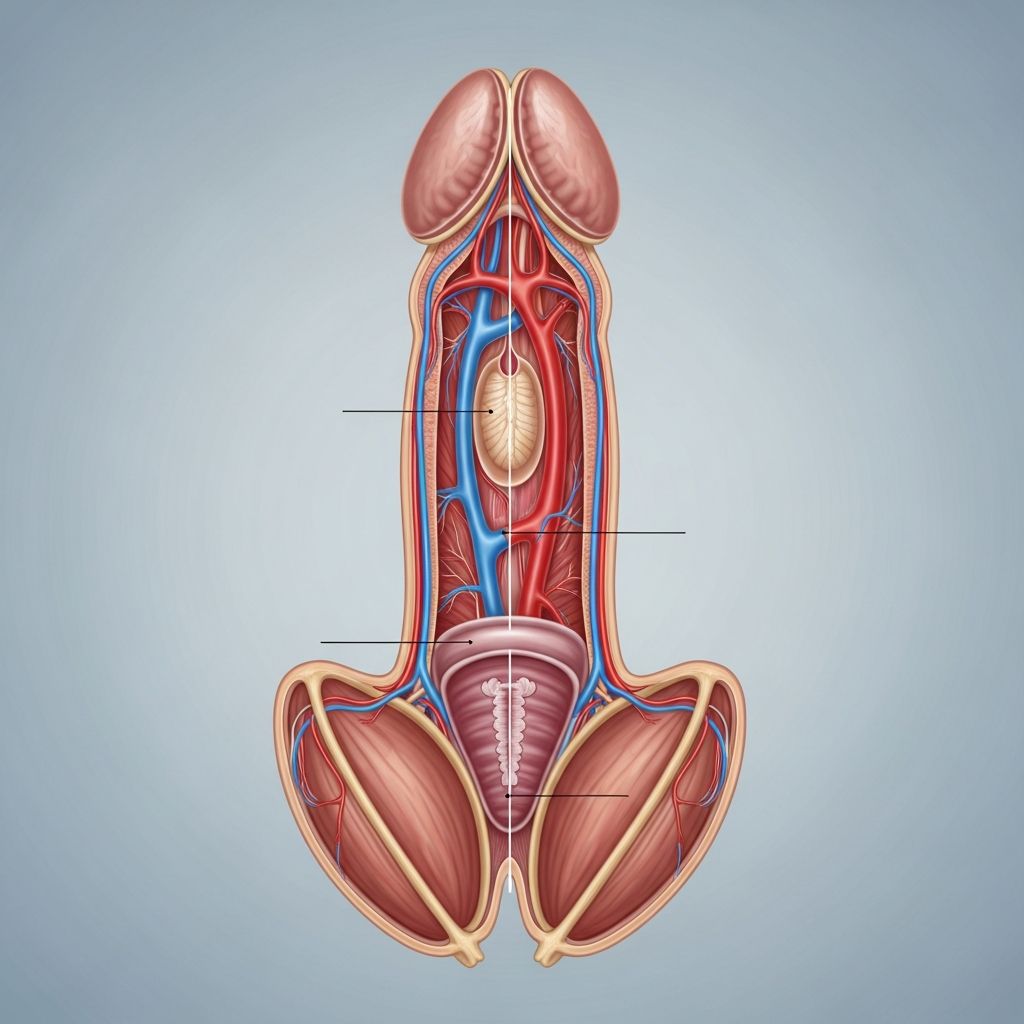
The penis is a normal part of the body, just like your hands, heart, or lungs. Knowing how it looks, how it grows, and how it works can make puberty and sexual development less confusing and easier to talk about with trusted adults or health professionals.
Basic Anatomy: Parts and Their Jobs
The penis is part of the male reproductive system and also part of the urinary system because pee (urine) passes through it.
- Shaft – the long part of the penis extending from the body outward.
- Glans – the rounded tip of the penis, sometimes called the head.
- Foreskin – a fold of skin that covers the glans in people who are not circumcised.
- Urethral opening – the small hole at the tip of the glans where urine and semen leave the body.
- Corpora cavernosa – two sponge-like chambers inside the shaft that fill with blood to create an erection.
- Corpus spongiosum – a softer tissue running along the underside of the penis, surrounding the urethra, and forming part of the glans.
Inside the body, the penis works together with other organs:
- Testes (testicles) – make sperm and the hormone testosterone.
- Epididymis – a coiled tube where sperm mature and are stored.
- Vas deferens – carries sperm from the epididymis toward the urethra.
- Seminal vesicles and prostate – add fluids to sperm to form semen.
- Urethra – carries urine from the bladder and semen from the reproductive system through the penis to the outside of the body.
| Structure | Main Function |
|---|---|
| Penis shaft | Allows urination and sexual penetration; houses erectile tissue. |
| Glans | Highly sensitive area involved in sexual pleasure. |
| Foreskin | Protects the glans; can be gently retracted for cleaning if not circumcised. |
| Urethra | Transports urine and semen out of the body. |
| Testes | Produce sperm and testosterone. |
| Prostate & seminal vesicles | Produce most of the fluid in semen, helping sperm move and survive. |
Puberty and Penis Development
During puberty, the brain sends signals to the testes to start producing more testosterone, the main male sex hormone. This hormone drives many changes:
- Growth of the penis and testes
- Development of pubic, facial, and underarm hair
- Voice becoming deeper
- Increase in muscle mass and height growth spurts
Penis growth does not happen overnight. It usually:
- Starts sometime between about 9 and 14 years old (the timing is different for everyone).
- Continues through the teen years and may finish in the late teens.
It is normal for one testicle to hang a little lower than the other and for the penis to curve slightly to one side when erect. A gentle curve without pain usually is not a problem.
Penis Size: What Is “Normal”?
Many teens worry about penis size, especially when comparing themselves to others or to images online. Medical studies show that there is a wide range of normal sizes, and size is not related to masculinity, fertility, or ability to enjoy sex.
- Penises vary in length and thickness when soft and when erect.
- A smaller soft penis may grow a lot with an erection, while a larger soft penis may change less.
- Appearance when soft is not a good way to judge adult size.
Important points about size:
- There is no medical definition of a “perfect” size.
- Most people fall within common size ranges, but being above or below those ranges can still be normal.
- Penis size does not predict how well someone can have sex, give pleasure, or father children.
Internet ads or videos that claim to make the penis much bigger using pills, pumps, or exercises are not supported by good scientific evidence and can sometimes be unsafe. If you are seriously worried about your size, a health professional can measure and tell you whether your development is within a normal range.
How Erections and Ejaculation Work
An erection happens when the blood vessels supplying the erectile tissue of the penis open wider and let in more blood, while other vessels that drain blood become narrower. This blood fills the corpora cavernosa and corpus spongiosum, making the penis firm and larger.
Erections
- Can occur due to sexual thoughts or touch.
- Can also happen without any sexual reason, especially during puberty.
- Often occur during sleep, particularly in the early morning.
These unplanned erections are normal and not a sign of a problem. Clothing, changing positions, or distracting yourself can help them go away.
Ejaculation
Ejaculation is the release of semen from the penis, usually during orgasm.
- Sperm are made in the testes and mature in the epididymis.
- During sexual arousal, muscles push sperm into the vas deferens.
- Fluid from the seminal vesicles and prostate mixes with sperm to form semen.
- Rhythmic muscle contractions push semen through the urethra and out of the penis.
Many teens ejaculate for the first time during masturbation or in their sleep as a nocturnal emission (a “wet dream”). Wet dreams are a normal part of puberty and do not mean anything is wrong.
Circumcised and Uncircumcised Penises
Some people are circumcised, meaning the foreskin has been removed by a minor surgery, often soon after birth for religious, cultural, or family reasons. Others keep their foreskin. Both circumcised and uncircumcised penises are normal.
- Circumcised penis – the glans is usually exposed.
- Uncircumcised penis – the foreskin covers the glans and can usually be gently pulled back after puberty.
If you have a foreskin:
- Do not force it back if it feels tight or painful.
- When it becomes retractable, gently pull it back during bathing, rinse with warm water, and then pull it forward again.
If the foreskin cannot be retracted by the late teen years, or if it causes pain, tearing, or repeated infections, a doctor can check for phimosis (a tight foreskin) and discuss treatments.
Hygiene and Everyday Care
Keeping the penis clean helps prevent irritation and infection.
- Wash the genital area daily with warm water.
- Mild, fragrance-free soap can be used on the surrounding skin, but harsh soaps may irritate the glans.
- If you have a foreskin, gently rinse underneath it once it is easily retractable.
- Dry the area gently with a clean towel.
- Change underwear every day and after sports or heavy sweating.
Good hygiene is especially important if you are sexually active, along with using condoms to reduce the risk of sexually transmitted infections (STIs).
Common Concerns and What’s Usually Normal
Many worries about the penis turn out to be harmless differences. Some examples of things that are usually normal:
- Small bumps near the head (pearly penile papules) or along the shaft can be a normal variation if they do not hurt, itch, or ooze.
- Slight curve when erect, as long as it does not cause pain or strong bending.
- Color changes such as slightly darker skin on the scrotum and penis compared with the rest of the body.
- Uneven testicles where one hangs lower than the other.
If you are unsure whether something is normal, a healthcare provider can examine you and explain what they see.
When to Talk to a Doctor
Some symptoms should be checked by a health professional. Seek medical advice if you notice:
- Pain, burning, or blood when you pee.
- Thick discharge, pus, or a bad smell from the penis.
- Sores, blisters, or painful ulcers.
- Redness, swelling, or warmth of the penis or scrotum.
- A very tight foreskin that traps urine or causes repeated infections.
- A sudden, strong curve or pain during erections.
- An erection that lasts more than 4 hours without going away (this is an emergency).
- One or both testicles not present in the scrotum or a sudden, severe testicular pain (also an emergency).
Also talk with a doctor if by your mid-teens:
- Your penis and testicles have not started to grow.
- You have no pubic hair or other signs of puberty.
Delays in puberty can often be evaluated and, when needed, treated. Hormonal conditions are usually managed by pediatricians, family doctors, or endocrinologists.
Sexual Feelings, Masturbation, and Privacy
During puberty, many people notice an increase in sexual thoughts and feelings. This is a normal part of development as hormones rise.
- Masturbation (touching your own genitals for pleasure) is a common behavior among teens and adults.
- It does not harm the penis, does not affect penis size, and does not cause infertility.
- It is a private behavior; it should be done in a private place and in a way that does not involve pressure or harm to anyone else.
If you feel guilty or confused about sexual feelings, it can help to talk with a trusted adult, healthcare provider, or counselor. They can answer questions and provide accurate information.
Sexual Health and Protection
If you choose to be sexually active, protecting your sexual health is essential for your own body and for any partners.
- Use condoms correctly every time to lower the risk of STIs and unintended pregnancy.
- Get regular sexual health checkups if you are sexually active.
- Discuss birth control and STI testing honestly with partners.
- Remember that consent must always be clear, freely given, and ongoing.
Even if you are not sexually active, learning about protection now can help you make safer choices later.
Body Image, Self-Confidence, and Myths
Social media, pornography, and jokes can create unrealistic ideas about how the penis should look or perform. Many of these messages are misleading or false.
- Porn often shows a narrow range of body types and does not represent what most people look like.
- Size and appearance do not define your worth, masculinity, or ability to be a caring partner.
- Worrying constantly about size or performance can increase anxiety and make sexual situations more stressful.
Healthy body image includes accepting natural differences and understanding that bodies come in many shapes and sizes. If anxiety about your penis or body image is affecting your mood, relationships, or daily life, talking with a mental health professional can be very helpful.
Frequently Asked Questions (FAQs)
Is my penis too small?
Most people who worry about having a small penis are actually within the normal size range. Medical research shows that size varies widely, and small differences usually do not affect sexual function or fertility. If you are concerned, a doctor can examine you and explain whether your growth is typical for your age.
Is it normal to have erections at school or in public?
Yes. During puberty, erections can happen without any sexual thoughts or touch, including in class or on the bus. This is due to normal hormone and nervous system activity. They usually go away on their own after a short time.
Does masturbation stunt growth or harm the penis?
No. There is no scientific evidence that masturbation stops growth, shrinks the penis, or causes long-term harm. It is a common, normal behavior when done in private and without hurting yourself or anyone else.
What if my foreskin does not pull back yet?
In younger boys, the foreskin often does not retract and gradually becomes more flexible over time. Forcing it can cause pain and tearing. If it is still very tight, painful, or traps urine or semen by the later teen years, see a doctor to check for phimosis and discuss options.
Can I make my penis bigger with pills or exercises?
There is no proven, safe pill, cream, or exercise that will significantly enlarge a normal penis. Many products advertised online lack scientific support and may be harmful. If you think your penis is very small or your puberty is delayed, talk with a healthcare professional instead of trying unproven methods.
References
- Physiology, Male Reproductive System — StatPearls Publishing/NCBI Bookshelf. 2024-01-15. https://www.ncbi.nlm.nih.gov/books/NBK538429/
- The Male Reproductive System: Organs, Function, and More — WebMD. 2023-06-01. https://www.webmd.com/sex-relationships/male-reproductive-system
- Male Reproductive System: Structure & Function — Cleveland Clinic. 2023-08-10. https://my.clevelandclinic.org/health/body/9117-male-reproductive-system
- 51.3: Structure and Function of the Human Male Reproductive System — LibreTexts Biology. 2022-05-12. https://bio.libretexts.org/Bookshelves/Introductory_and_General_Biology/Map:_Raven_Biology_12th_Edition/51:_The_Reproductive_System/51.03:_Structure_and_Function_of_the_Human_Male_Reproductive_SYSTEM
- Male Reproductive System — Healthdirect Australia. 2023-03-20. https://www.healthdirect.gov.au/male-reproductive-system