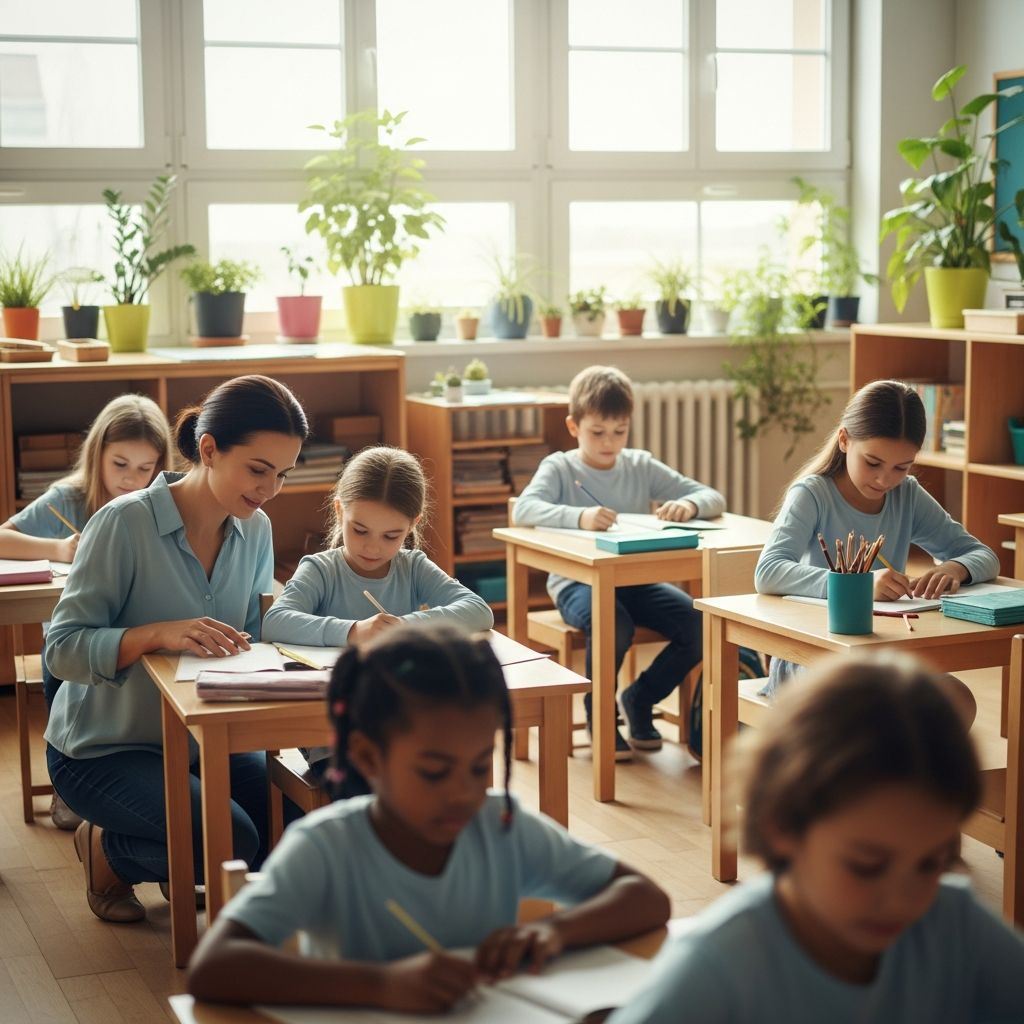
Managing a classroom without relying on threats, bribes, or power struggles is not only possible, it is often more effective and more sustainable. Peaceful teaching centers on connection, prevention, and guidance instead of control and punishment, helping students feel safe enough to learn and responsible enough to contribute.
This guide offers practical strategies to help you build a classroom climate where respect flows in every direction, conflicts are handled calmly, and students learn the emotional and social skills they need to thrive.
Why Peaceful Teaching Works
Research shows that students learn best in classrooms that are emotionally safe, predictable, and built on strong teacher–student relationships. Students in supportive environments display better behavior, stronger motivation, and higher academic achievement compared with those in punitive or chaotic settings.
| Traditional Control-Focused Approach | Peaceful, Relationship-Based Approach |
|---|---|
| Emphasizes obedience and compliance | Emphasizes responsibility and cooperation |
| Relies on punishment, rewards, and fear of consequences | Relies on connection, clear limits, and guidance |
| Short-term behavior fixes | Long-term skill building (self-control, empathy, problem-solving) |
| Teacher as enforcer | Teacher as calm leader and coach |
| Students behave when watched | Students internalize values and expectations |
When students feel seen, respected, and emotionally secure, behavior problems often decrease because students are more engaged and able to regulate themselves.
1. Lead with the Calm You Want to See
Students constantly study their teachers’ faces, tone, and body language. Your emotional state sends a message: either “This is an emergency” or “We can handle this together.” Peaceful teaching starts with modeling the regulation and respect you want your students to learn.
Practical ways to model calm leadership
- Lower your voice instead of raising it when the room gets noisy. A softer voice often draws more attention than shouting.
- Pause to breathe before responding to misbehavior, especially when you feel triggered. A brief pause protects both your relationship and your authority.
- Use neutral, factual language rather than labels or judgments. For example, “I see three students still talking” instead of “You’re all being disrespectful.”
- Admit and repair your own mistakes. A simple “I spoke too sharply earlier; I’m sorry” teaches accountability more powerfully than any lecture.
- Show respectful body language: open posture, relaxed shoulders, and steady eye contact help students feel safe even during correction.
Over time, students learn from your example how to respond to stress with composure rather than escalation.
2. Build Daily Connection Before Correction
Connection is the foundation of influence. Students are more likely to cooperate with teachers they feel know them, like them, and want them to succeed. Strong relationships also act as a buffer against stress and reduce the likelihood of chronic misbehavior.
Quick connection habits that fit into any day
- Warm greetings at the door: Say each student’s name, make eye contact, and offer a brief check-in as they enter.
- Micro-conversations: Ask short questions about their interests, families, or activities (“How did your game go?”).
- Positive notes or comments: Catch students doing something helpful or persistent and briefly acknowledge it.
- Two-minute connections: Spend a couple of uninterrupted minutes with frequently dysregulated students during calm times, just listening and showing interest.
- Student voice moments: Invite student opinions about a task, seating, or project topics to build shared ownership.
When correction is necessary, students who feel connected are less defensive and more open to guidance.
3. Replace Control with Coaching
Many behavioral challenges are not defiance but skill gaps. Students may lack tools for handling frustration, waiting, negotiating, or shifting attention. Coaching treats misbehavior as a teaching moment instead of a moral failing.
Control-focused versus coaching-focused responses
| Control Focus | Coaching Focus |
|---|---|
| “Stop that right now or you’ll lose recess.” | “Pause with me. What’s making it hard to follow the direction? Let’s figure out one thing you can do differently.” |
| Labels the child as the problem | Targets the skill that needs developing |
| Short-term compliance only | Builds long-term self-control and problem-solving |
Coaching moves you can use immediately
- Describe, don’t attack: “You’ve tapped your neighbor three times while I’ve been talking.”
- Ask curious questions: “What were you hoping would happen?” “What could you try instead next time?”
- Practice alternatives: Role-play how to ask for help, handle teasing, or disagree respectfully.
- Focus on impact: “When you call out, your classmates lose their chance to think. How can we fix that?”
- End with a plan: Agree on one small, specific behavior to try for the next similar situation.
4. Prevent Problems with Clear, Shared Agreements
Many conflicts arise not from defiance but from unclear expectations. Students are more likely to follow rules they helped create and that are stated positively and specifically.
Steps to co-create effective classroom agreements
- Invite students to imagine a great class. Ask: “What does it look and feel like when everyone can learn?” List their ideas.
- Group their ideas into 3–5 broad expectations, such as respect, responsibility, and safety.
- Write expectations positively (what to do, not just what to avoid).
- Clarify with concrete examples, e.g., “Respect sounds like one voice at a time during whole-group lessons.”
- Post agreements visibly and refer to them during reminders and reflections.
- Revisit and revise together as needs change over the year.
Because students contributed to these agreements, reminders feel less like arbitrary authority and more like returning to a shared commitment.
5. Use Routines and Structure as a Quiet Support
Predictable routines reduce anxiety and keep attention on learning instead of on guessing what comes next. Well-structured classrooms see fewer behavioral issues because students know what to do and how to do it.
Key routines that support a peaceful classroom
- Start-of-day routine: A consistent way to enter, store belongings, and begin the first task.
- Transition signals: Chimes, call-and-response, or visual timers that signal it is time to shift activities.
- Materials procedures: Clear steps for getting, using, and returning supplies to minimize chaos.
- Noise-level expectations: Simple categories like “silent,” “partner voices,” and “group voices,” with examples.
- End-of-day reflection: A short closing routine to review the day and preview tomorrow.
Once routines are practiced and automated, you spend less time managing behavior and more time teaching.
6. Make Empathy Your First Response
Students who are dysregulated are often in a fight–flight–freeze state; logic and lectures rarely help until they feel safe again. Beginning with empathy calms the nervous system and opens the door to problem-solving.
Empathic phrases that de-escalate quickly
- “This is really hard for you right now.”
- “You look upset; I’m here to help, not to get you in trouble.”
- “It doesn’t feel fair to you, does it?”
- “Let’s take a moment to breathe before we talk about what happened.”
Once the student is calmer, you can collaboratively explore what went wrong and what they might do differently next time, preserving their dignity while still holding them accountable.
7. Create a Calm-Down Space Students Choose, Not Fear
Instead of using punitive time-out chairs, many teachers find it effective to design a small, inviting area where students can go voluntarily to regain their calm. This is not a place of exile, but a tool for self-regulation and emotional literacy.
Elements of a supportive calm-down corner
- A comfortable seat or cushion
- Soothing objects (soft toys, stress balls, textured items)
- Visuals of breathing techniques or calming strategies
- Books or cards about feelings and coping skills
- A simple timer so students can manage their own return
Teach the whole class how and when to use the space, and emphasize that going there is a sign of strength and self-awareness, not punishment.
8. Use Consequences that Teach, Not Shame
Peaceful teaching does not mean the absence of limits. It means using consequences that are respectful, consistent, and logically connected to the behavior, so students can learn from their actions rather than simply fear punishment.
Guidelines for constructive consequences
- Stay proportionate: The response should match the impact, not your frustration level.
- Keep dignity intact: Avoid public humiliation or sarcasm; address behavior privately whenever possible.
- Link to restitution: Ask, “How can we repair the harm done?” (cleaning a mess, redoing work, apologizing, or helping the class).
- Combine with teaching: After calm is restored, briefly review what to try next time.
- Be consistent: Predictable follow-through helps students trust you and the classroom structure.
Restorative and dignity-preserving approaches have been shown to foster a stronger sense of community and reduce repeat misbehavior.
9. Take Care of the Teacher Behind the Strategies
Peaceful teaching is demanding work. Your nervous system is the regulatory anchor for dozens of children, often all day. Sustainable calm requires intentional support for your own emotional health.
Simple self-support practices
- Mini-breaks: Use brief pauses between classes to stretch, breathe, or step outside when possible.
- Reflective routines: Jot down one success and one challenge each day to process and learn.
- Collegial support: Share strategies with colleagues and normalize talking about emotional load.
- Clear boundaries: Protect non-working time when you do not answer school messages.
- Professional learning: Seek training in trauma-informed practices or social-emotional learning to feel more equipped.
A regulated adult is the most powerful classroom management tool; caring for your own well-being is not optional—it is part of your professional practice.
Frequently Asked Questions (FAQs)
How do I stay peaceful when a student is openly defiant?
Start by grounding yourself—take a breath, lower your voice, and remind yourself that this is about the student’s state, not your worth as a teacher. Acknowledge the emotion (“You’re really not okay with this right now”) and set a clear limit (“We’re not going to shout at each other. Let’s take a pause and talk when we’re both calmer”). Follow up later with a private coaching conversation and, if needed, a logical consequence.
What if my class is already out of control? Can peaceful strategies still work?
Yes, but change will be gradual. Begin by resetting one or two critical routines (such as entry and transitions) and co-creating new agreements with your students. Focus first on building connection and modeling calm rather than trying to fix every behavior at once. Consistent, small shifts in your responses and structures can slowly transform the classroom climate.
Do peaceful approaches mean I should never use consequences?
Peaceful teaching includes consequences, but they are respectful, related to the behavior, and combined with guidance. Instead of using consequences to make students suffer, use them to help students notice the impact of their choices and practice repairing and choosing differently next time.
How can I find time for connection when the curriculum is so packed?
Connection does not have to be long or elaborate. A 10-second greeting, a quick comment on a student’s effort, or a brief check-in during independent work can be enough to maintain a relationship. Integrating collaborative learning and class discussions also allows you to connect while teaching required content.
What if some students don’t respond to empathy and coaching?
Some students carry significant stress, trauma, or skill gaps and may need more intensive support. Continue to provide consistency, empathy, and clear limits while collaborating with families, counselors, and support staff. Even when progress is slow, your calm, steady presence remains a vital stabilizing force.
References
- Classroom Management — Peace Corps. 1996-01-01. https://files.peacecorps.gov/multimedia/pdf/library/M0088_Classroom_Mgmt.pdf
- 8 Classroom Management Techniques for a Peaceful & Engaging Environment — De-escalation Training. 2024-02-01. https://deescalation-training.com/2024/02/classroom-management-techniques/
- From Chaos to Calm: Effective Classroom Management Strategies — TCEA. 2023-08-28. https://blog.tcea.org/six-classroom-management-strategies/
- 25 Best Classroom Management Strategies — Schools That Lead. 2023-05-15. https://www.schoolsthatlead.org/blog/best-classroom-management-strategies
- Five Discipline Strategies That Preserve Dignity — Responsive Classroom. 2016-09-21. https://www.responsiveclassroom.org/five-discipline-strategies-that-preserve-dignity/
- Confident Classroom Management — ASCD. 2022-04-12. https://www.ascd.org/blogs/confident-classroom-management
- 34 Ways to Quiet a Rambunctious Class — Edutopia. 2020-02-05. https://www.edutopia.org/article/34-ways-quiet-rambunctious-class/