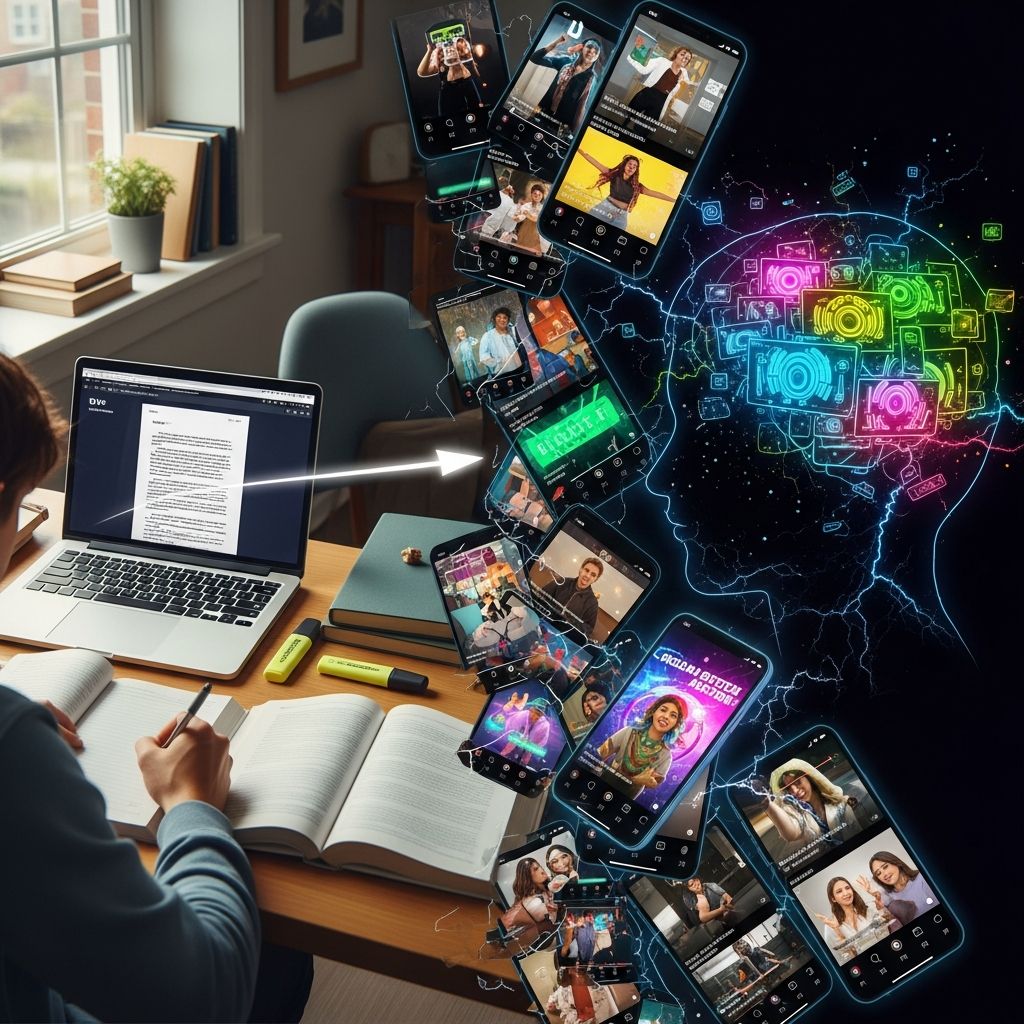
The digital world has birthed a peculiar hybrid: the PDF to Brain Rot trend. This TikTok sensation uses AI to convert dense academic PDFs into hyper-engaging, rapid-fire videos overlaid with absurd, meme-filled narration. What started as a quirky hack for Gen Z students has exploded, raising eyebrows among parents concerned about its ties to ‘brain rot’—the slang for mental fog from endless low-stakes scrolling.
Understanding the Brain Rot Phenomenon
Brain rot describes the cognitive haze from overconsuming trivial online content, leading to shortened attention spans and mental fatigue. Research links it to excessive screen time, particularly among adolescents, causing emotional desensitization, cognitive overload, and impaired executive functions like memory and decision-making. Digital behaviors such as doomscrolling—endlessly consuming negative news—and zombie scrolling—mindless feed swiping—exacerbate this, fostering anxiety and reduced focus.
In children and teens, heavy screen exposure correlates with poorer brain connectivity, especially in regions for executive function and language. Meta-analyses show links to sleep disruptions, aggression, and lower cognitive achievements, with preschoolers facing risks to white matter integrity in the brain. Yet, some experts caution that evidence is correlational, not causal, urging nuance over panic.
How PDF to Brain Rot Tools Work
These AI-powered platforms let users upload PDFs—think textbooks or lecture notes—and generate TikTok-ready videos. The magic? They extract text, then dub it over ‘oddly satisfying’ clips like slime ASMR or sigma male edits, delivered in a chaotic, brain rot voice: exaggerated slang, memes, and absurd humor. Tools like those highlighted in tech reports automate this, blending education with viral absurdity.
- Upload Phase: Drop any PDF; AI parses content instantly.
- Voice Synthesis: Converts text to speech with brain rot flair—think ‘skibidi toilet’ references or ‘rizzler’ jargon.
- Video Overlay: Pairs audio with trending visuals for maximum scroll-stopping power.
- Export: Download for TikTok, Instagram Reels, or study playlists.
This fusion makes dry material addictive, capitalizing on short-form video dopamine hits. It’s iterated from pure brain rot trends, where users narrate trivia in escalating nonsense, into a ‘productive’ twist.
The Appeal for Students in a Distracted World
For overwhelmed teens juggling AP classes and extracurriculars, these tools promise efficiency. Dense PDFs become digestible 60-second bursts, mimicking how youth already learn via TikTok. Proponents argue it boosts retention through multisensory engagement—visuals, audio, humor—countering traditional studying’s monotony.
| Traditional Studying | PDF to Brain Rot |
|---|---|
| Static reading, low engagement | Dynamic videos with memes |
| Long sessions, easy boredom | Short clips, high retention |
| Solitary, passive | Fun, shareable, social |
| Potential for deep focus | Risk of superficial skimming |
Yet, this mirrors brain rot’s core issue: prioritizing entertainment over depth. Adolescents report cognitive overload from info floods, impairing problem-solving. Mitigation like digital detoxes proves effective, but trends like this embed ‘rot’ into learning.
Risks: When Study Hacks Backfire
While innovative, the trend amplifies brain rot risks. The frenetic pace trains fragmented attention, not sustained focus needed for exams. Studies show excessive digital multitasking erodes memory and planning skills. For developing brains, this could accelerate cerebellum volume decline, vital for cognition.
Parents worry about hidden pitfalls:
- Content Quality: AI voices might garble complex concepts with slang, leading to misconceptions.
- Addiction Loop: Gamified studying encourages more screen time, worsening doomscrolling habits.
- Social Pressure: Viral success metrics push creation over comprehension.
- Privacy Concerns: Uploading school docs to third-party AI raises data risks.
Neuropsychiatric reviews note inconclusive long-term data but flag behavioral dysregulation in heavy users. Very young users face amplified threats to neurodevelopment.
Parental Perspectives and Real Experiences
Moms and dads on platforms like Reddit share mixed tales. One parent lauded it for helping a dyslexic teen grasp biology via visual aids. Another bemoaned their child’s descent into full-brain rot mode, prioritizing video edits over homework. Experts recommend balance: use as a supplement, not replacement.
Parents must model healthy habits—set screen limits and discuss content critically to build media literacy.
Expert Insights on Digital Learning Trends
Pediatric guidelines from bodies like the American Academy of Pediatrics cap recreational screen time at 2 hours daily for kids over 5. Yet, educational tools blur lines. AI study aids like PDF converters align with adaptive learning but risk reinforcing passive consumption.
Researchers advocate cognitive training and mindfulness to counter overload. Adolescents favor these over strict detoxes, reporting better focus post-intervention.
Alternatives to Brain Rot Study Videos
Not all digital tools spell doom. Consider these vetted options:
- Anki Flashcards: Spaced repetition for true retention.
- Khan Academy: Structured videos with quizzes.
- Notion Templates: Organized notes without AI gimmicks.
- Forest App: Gamifies focus with tree-planting mechanics.
- Physical Aids: Highlighted printouts for tactile learning.
Hybrid approaches—pairing tech with offline review—yield best outcomes, sidestepping rot entirely.
Frequently Asked Questions
What exactly is brain rot?
Brain rot is slang for mental deterioration from overconsuming unchallenging online content, leading to fogged thinking and poor focus.
Is PDF to Brain Rot safe for kids?
Moderation is key; it aids engagement but risks deepening addictive scrolling patterns, especially under 13.
Can it improve grades?
Anecdotally yes for quick reviews, but lacks depth for mastery—combine with active recall methods.
How to spot brain rot in your teen?
Signs include constant scrolling, forgetfulness, irritability off-screens, and slang-heavy speech.
What if my child loves this trend?
Co-view videos, discuss accuracy, and enforce device-free study zones to harness benefits safely.
Strategies for Healthier Digital Habits
To thrive amid trends like this, families can implement:
- Daily screen audits via apps like Qustodio.
- Tech-free dinners fostering real talk.
- Mindful challenges: 30 minutes reading books daily.
- Goal-setting workshops tying tech to outcomes.
By framing digital tools as servants, not masters, parents empower kids against brain rot’s creep.
References
- Demystifying the New Dilemma of Brain Rot in the Digital Era — National Institutes of Health (NIH). 2024. https://pmc.ncbi.nlm.nih.gov/articles/PMC11939997/
- Brainrot Reality? Evidence-Based Neuropsychiatric Perspectives — SSOAR / Gross et al. 2025. https://www.ssoar.info/ssoar/bitstream/handle/document/101163/ssoar-2025-gross_et_al-Brainrot_Reality_Evidence-Based_Neuropsychiatric_Perspectives.pdf?sequence=1
- PDF to Brainrot study tools are a strange iteration on a TikTok trend — TechCrunch. 2024-11-20. https://techcrunch.com/2024/11/20/pdf-to-brainrot-study-tools-are-a-strange-iteration-on-a-tiktok-trend/
- PDF to Brainrot: A Deep Dive into the AI-Powered Content Revolution — Skywork.ai. 2024. https://skywork.ai/skypage/en/PDF-to-Brainrot-A-Deep-Dive-into-the-AI-Powered-Content-Revolution/1976126190925180928