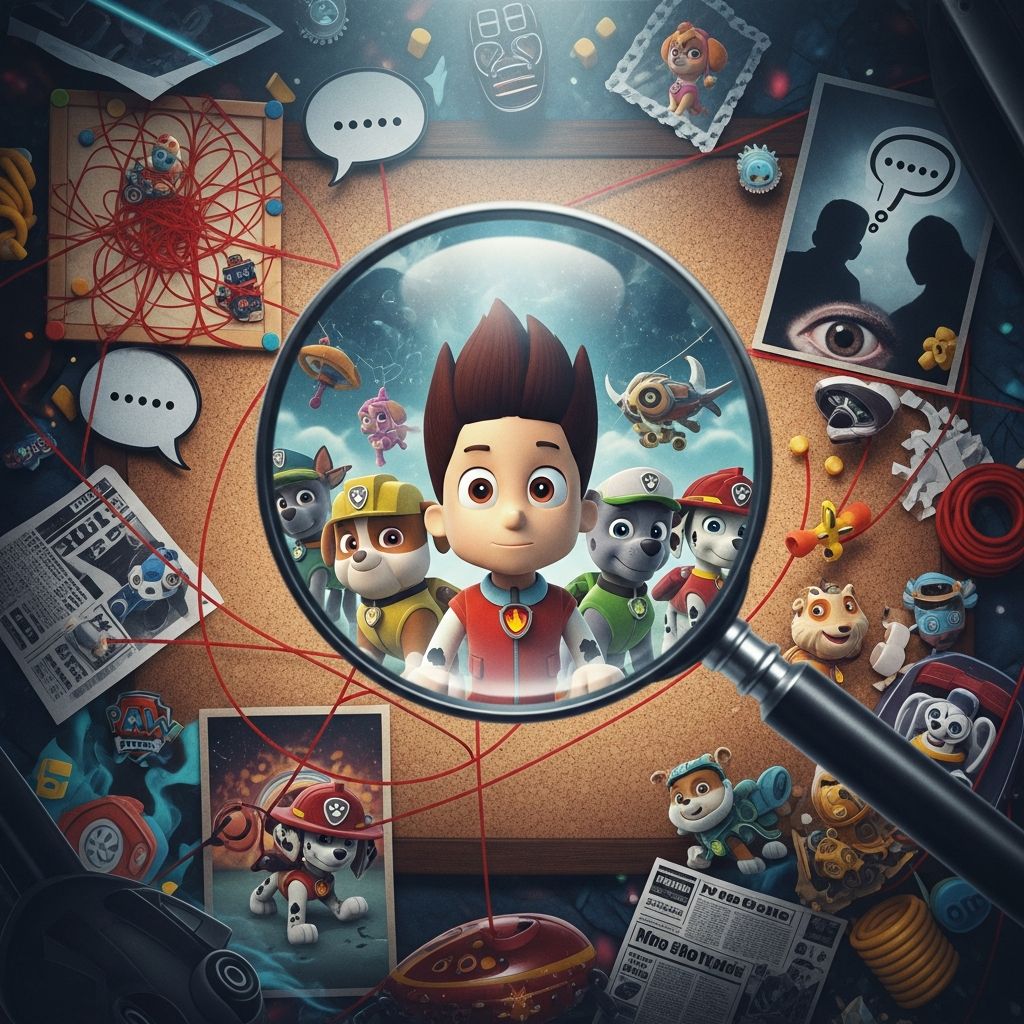
On the surface, Paw Patrol is one of the gentlest shows on children’s television: friendly pups, simple rescues, and a reassuring sense that everything will be okay by the time the credits roll. Yet in online comment sections, fan videos, and parenting forums, this preschool staple has become the unlikely subject of an entire universe of conspiracy theories and over-the-top speculation.
What began as a few tongue-in-cheek jokes about talking dogs and useless adults has grown into an oddly rich subculture: fans puzzling over who funds the team’s high-tech gadgets, critics reading political messages into the characters, and media theorists using the show as a case study in how we watch children’s TV. The result is a surprisingly entertaining collision between a very simple series and very complicated adult imaginations.
Why Paw Patrol Became a Magnet for Theories
There is nothing uniquely sinister about Paw Patrol compared to other cartoons, but several features make it unusually ripe for conspiratorial thinking.
- A wildly unrealistic world: A single boy commands a fully equipped emergency services squad made up entirely of puppies, while most adults seem incompetent, absent, or both.
- Advanced technology with no clear budget: Transforming vehicles, drones, aircraft, submarines, and a mountain of gadgets appear with no explanation of who pays for it all.
- Minimal backstory: Viewers get very little information about how the team formed, who raised Ryder, or how the town is governed, leaving huge narrative gaps to fill.
- Obvious role archetypes: Each pup is tied to a specific public service (police, construction, coast guard, recycling, etc.), which invites symbolic or political interpretation.
Media scholars note that audiences often build elaborate theories when a story world is full of gaps and inconsistencies, especially as fandoms move online and can collaborate on shared headcanon and speculation. Paw Patrol provides exactly that kind of open playground for adults who are half-amused, half-baffled by what their kids are watching.
The Core Questions Driving Paw Patrol Conspiracies
Most of the popular theories orbit a small set of nagging questions that the show never answers directly:
- Who funds all this equipment? The tower, command center, roads, airships, snowmobiles, and submarines must cost a fortune.
- Why are dogs running core public services? A child and his canine team handle policing, firefighting, medical rescues, construction, and marine safety.
- Where are the competent adults? The few adults we see either cause trouble or rely completely on the pups.
- Why are dogs hyper-capable but cats usually villains? The asymmetry between species practically begs for symbolic readings.
Instead of shrugging and moving on, many grown-up viewers take these questions as invitations to invent elaborate backstories and dark explanations hidden beneath the show’s cheerful surface.
Popular Paw Patrol Conspiracy Themes
Although individual theories vary wildly, they often fall into a handful of recurring themes. Each theme reflects a different way adults process the show: satire, criticism, or pure playful absurdity.
| Theme | What It Focuses On | Typical Tone |
|---|---|---|
| Shadowy Funding | Who bankrolls the tech and infrastructure | Economics parody, mild dystopia |
| Dog Rule & Human Decline | Dogs as secret rulers, humans as puppets | Darkly comedic, sci-fi flavored |
| Political Allegories | Police pup, mayor, rival town, and cats | Media criticism, ideological debate |
| Ryder-Centric Theories | His origins, power, motives | Psychological, sometimes horror-tinged |
| Hidden Tragedies | Implied deaths, previous teams, trauma | Grim fan fiction and urban legend |
1. The Mystery Money Pipeline
One of the most common lines of speculation asks how a handful of dogs and a child can afford an entire fleet of specialized vehicles, a high-tech command center, and frequent infrastructure projects. Fans joke that somewhere in the background there must be:
- An unseen billionaire silently sponsoring the team;
- A government black-budget operation disguised as a kids’ rescue squad;
- Or a profitable media empire based on the pups’ heroic brand.
This plays into broader concerns about how media normalizes private, corporate-style control over what are usually public services. Research on children’s programming notes that modern shows often feature private individuals or companies solving crises instead of robust public institutions, which can subtly shape children’s expectations about who holds power and responsibility.
2. Dogs as Secret Rulers of the World
Another recurring theme imagines that the dogs are not just helpful; they are the true dominant species. Humans, in this view, are either too inept to govern or have willingly handed over authority to canine overlords.
This angle often emphasizes:
- The frequency with which the pups save the town while adults look helpless.
- The advanced tech seemingly designed around dogs, not people.
- The idea that Ryder might actually be working for the dogs as their human intermediary.
Fans exaggerate this scenario into comic dystopia: a world where human society slowly outsourced so much responsibility that dogs simply slid into power without anyone noticing. It is an absurd notion, but it humorously reflects real-world anxieties about automation, outsourcing, and dependence on systems we no longer fully understand.
3. Paw Patrol as Political Metaphor
Because the show includes a police dog, a mayor, rival towns, and very clear good guys and bad guys, some critics argue that Paw Patrol unintentionally functions as a political allegory. Academic and journalistic analyses of children’s media have examined Paw Patrol and similar shows as reflections of contemporary attitudes toward authority, policing, and social order.
Common talking points in these interpretations include:
- Chase the police pup: Seen by some as a friendly, unquestioned symbol of law enforcement, smoothing over real-world controversies.
- Mayor characters: One mayor is bumbling but well-meaning; another is ambitious and often framed as self-serving, feeding into simple good vs. bad leadership narratives.
- Cats vs. dogs: Dog heroes and villainous or chaotic cats can be read symbolically as insiders vs. outsiders, though this is likely not intentional.
Media literacy experts often use shows like Paw Patrol to teach parents and educators how even light entertainment carries implicit messages about who protects whom, and what competent leadership looks like.
4. The Enigma of Ryder
Ryder, who appears to be around ten years old, is simultaneously engineer, commander, medic, and teacher. Fans who enjoy darker twists ask how a child plausibly acquired that much power and knowledge, leading to theories that portray him as:
- A gifted but morally ambiguous entrepreneur who built a rescue empire using unpaid dog labor;
- The result of a secret program that pairs enhanced animals with a prodigy handler;
- Or a character whose entire world is imagined, occurring in a coma dream or simulated reality.
These theories are less about literal belief and more about highlighting how outlandish the premise becomes when you treat it like a realistic drama instead of a preschool fantasy.
5. Hidden Tragedies and Dark Backstories
Perhaps the most morbid branch of the conspiracy boom leans fully into horror. Fans point to throwaway details, missing information, or oddly numbered vehicles and spin them into narratives about:
- Previous pups who supposedly died in the line of duty and were quietly replaced;
- Unseen disasters that shaped Adventure Bay into a town perpetually on the brink of chaos;
- Or near-apocalyptic histories that required a specialized dog team to keep what is left of society intact.
These ideas borrow heavily from broader internet culture, where fans routinely craft “creepypasta”—fan-made horror stories—about otherwise innocent media. Media researchers see this as part of a larger pattern in which nostalgic childhood properties become raw material for adult reinterpretation, both affectionate and macabre.
Why Parents and Adults Find These Theories So Appealing
Most of the people swapping Paw Patrol theories online are not confused children; they are adults—often parents—who spend many hours exposed to the same episodes. The conspiracy boom is, in many ways, a coping mechanism and a creative outlet.
Several overlapping motives show up repeatedly:
- Comic relief: After the twentieth rewatch, making dark or absurd jokes about plot holes becomes a survival strategy.
- Intellectual play: Turning a simple show into a puzzle satisfies the same urge that fuels serious fan theories around prestige dramas, just with lower stakes.
- Shared community: Swapping increasingly over-the-top readings creates a sense of in-group humor among parents, caregivers, and older fans.
- Media criticism in disguise: By exaggerating the implications of the show’s world, people indirectly talk about real-world issues like privatization, policing, inequality, and leadership.
Scholars of fandom have long noted that viewers are not passive; they actively rewrite, parody, and extend the stories they consume. The Paw Patrol conspiracy boom is simply a more comedic version of the same phenomenon that drives elaborate theories about science-fiction franchises—only here the source material is a show aimed at preschoolers.
Separating Harmless Fun from Genuine Concern
Not all reactions to Paw Patrol are purely playful. Some educators and commentators raise sincere questions about what messages children absorb from repeated exposure to stories where a private rescue squad, led by a child, replaces public services.
Key points of concern include:
- Whether the show encourages uncritical trust in uniforms and authority figures.
- The near-total absence of functioning public institutions beyond the puppy team.
- The portrayal of constant crises that only a small elite group can solve.
At the same time, developmental psychology research indicates that very young children largely process such shows at the level of simple moral lessons—helping others, teamwork, perseverance—rather than absorbing complex ideological messages. Younger viewers focus more on immediate story outcomes and simple character traits, while symbolic or systemic implications usually register only for older children and adults.
For that reason, many experts emphasize the role of parents and caregivers. Talking casually with kids about what they watch—why characters made certain choices, who helped whom, and whether things seemed fair—can turn even the silliest cartoon into a low-pressure lesson in critical thinking.
How the Internet Supercharged the Paw Patrol Theory Boom
The growth of Paw Patrol conspiracies also reflects broader shifts in how we consume and discuss media. Digital platforms have made it effortless to share jokes, screenshots, and fan analyses. Studies of online fandoms show that social media accelerates the creation and spread of fan theories by enabling quick feedback, remixing, and one-upmanship.
Several dynamics feed into the Paw Patrol theory machine:
- Algorithmic amplification: Once a few theory videos or articles gain traction, recommendation systems keep surfacing similar content.
- Cross-genre blending: Creators borrow tropes from true crime, horror, and political commentary, then overlay them on a kids’ show for contrast-based humor.
- Participatory storytelling: Comments, fan fiction, and memes all build on each other, turning individual theories into shared, evolving storylines.
Rather than treating this as corruption of childhood innocence, many media researchers see it as an example of how modern audiences constantly negotiate, reinterpret, and repurpose mass culture for their own amusement and reflection.
Enjoying the Theories Without Losing the Show
For parents and caregivers who find themselves pulled into this strange subculture, it helps to keep a few basic principles in mind:
- Kids and adults watch different shows at the same time: Children encounter simple, comforting adventure; adults see structural oddities and symbolism.
- Conspiracy jokes do not have to become headcanon: You can laugh at the idea of puppy overlords while still letting the show function as harmless entertainment for your child.
- Use your discomfort as a conversation starter: If something about the show bothers you, that is an opportunity to talk with older kids about fairness, work, or authority in age-appropriate ways.
- Balance is key: Rotating Paw Patrol with other kinds of programming—educational shows, nature docs, or stories with different power dynamics—helps provide a broader media diet.
Seen from this perspective, the Paw Patrol conspiracy boom is not a sign that the show is secretly dangerous. It is evidence that adults are very good at turning anything familiar—even a cartoon about rescue dogs—into material for jokes, critique, and imaginative world-building.
Frequently Asked Questions (FAQs)
Do kids actually believe Paw Patrol conspiracy theories?
No. The elaborate theories exist almost entirely in adult spaces—social media, fan forums, and commentary channels. Young children are far more likely to focus on the bright colors, simple plots, and messages about helping others than on any hidden meaning.
Is Paw Patrol harmful because it shows a police dog as a hero?
Research on children’s understanding of media suggests that preschoolers mainly take away broad lessons such as “helping people is good” and “teamwork matters.” If parents have concerns about policing or authority, they can use the show as a springboard for simple, values-based conversations as kids get older.
Why do adults overanalyze kids’ shows like this?
Media scholars argue that fans naturally expand and reinterpret stories they spend time with, especially when narratives have gaps or unrealistic elements. For parents stuck watching many of the same episodes, spinning wild theories becomes equal parts entertainment, community building, and informal media criticism.
Should I stop my child from watching Paw Patrol because of these theories?
In most cases, no. The theories are adult inventions layered on top of a show designed for very young viewers. As with any screen time, what matters more is overall balance, the child’s age, and whether you occasionally talk together about what they are seeing.
What can Paw Patrol teach kids when viewed thoughtfully?
When moderated and discussed, the show can support simple lessons about cooperation, responsibility, problem-solving, and community care. Parents who are aware of the more complex adult debates can add gentle questions—“Who else could help here?” or “Was that fair?”—to build early critical thinking skills.
References
- Lemish, D. & Götz, M. (eds.), Children and Media Worldwide in a Time of Crisis — Routledge. 2022-06-30. https://www.routledge.com/Children-and-Media-Worldwide-in-a-Time-of-Crisis/Lemish-Gotz/p/book/9781032060963
- Jenkins, H., Convergence Culture: Where Old and New Media Collide — NYU Press. 2006-09-01. https://nyupress.org/9780814742952/convergence-culture/
- Gilliam, F.D. Jr. et al., “The Architecture of Children’s Television News: Building Citizenship Literacy in the Digital Age” — The Joan Ganz Cooney Center at Sesame Workshop. 2013-09-01. https://joanganzcooneycenter.org/publication/the-architecture-of-childrens-television-news/
- Strasburger, V.C., Hogan, M.J. et al., “Children, Adolescents, and the Media” — American Academy of Pediatrics. Pediatrics, 2013-11-01. https://publications.aap.org/pediatrics/article/132/5/958/31752/Children-Adolescents-and-the-Media