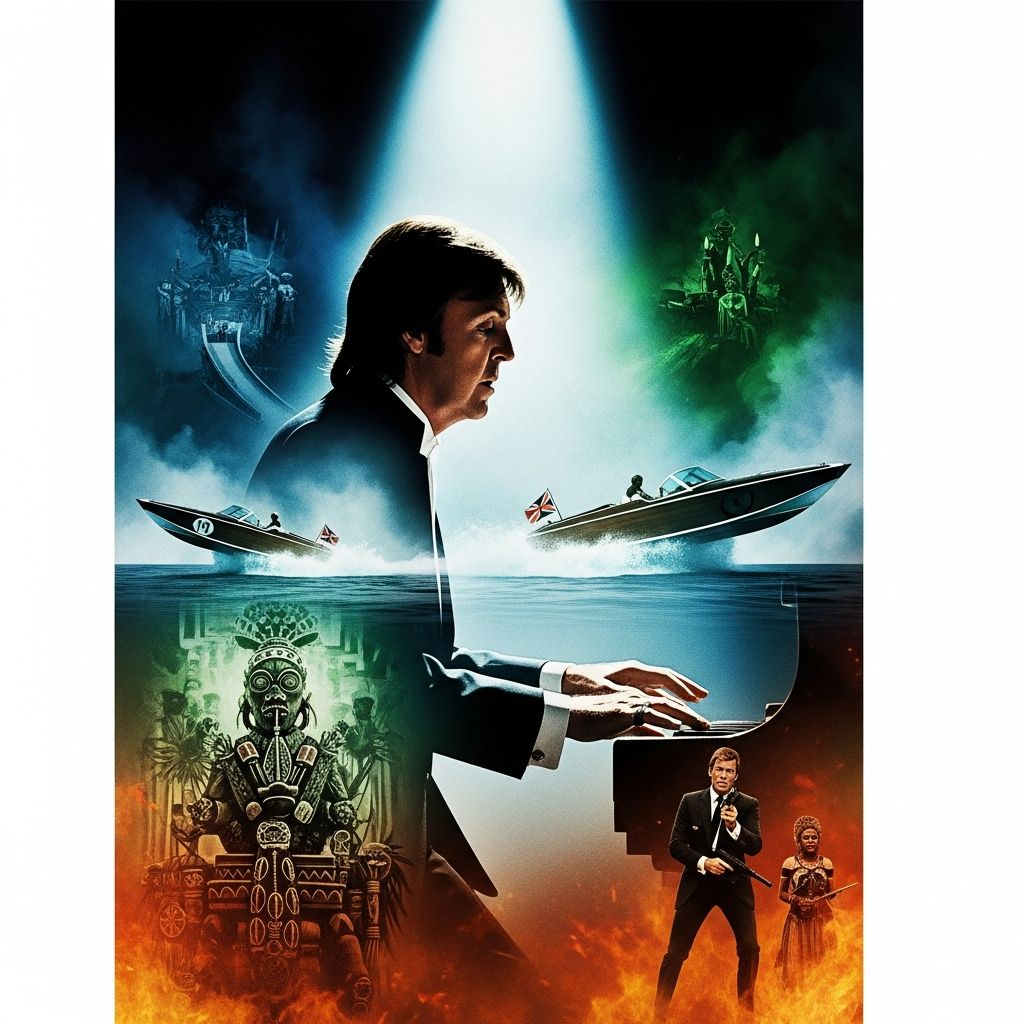
When Paul McCartney accepted the challenge to write a James Bond theme in the early 1970s, he was still carving out his identity beyond The Beatles. Out of that pressure came “Live and Let Die”, a song that did more than open a movie — it fused rock, orchestral drama, and cinematic storytelling into one of the most enduring Bond anthems ever recorded.
The Bond Moment: Why Paul McCartney Was Asked
By 1972, James Bond themes had become a major part of each film’s identity, often performed by established stars like Shirley Bassey and Nancy Sinatra. When composer John Barry, who had scored many earlier Bond films, was unavailable for the eighth movie, Live and Let Die, producers turned to McCartney and his new band Wings.
Several factors made McCartney an ideal choice:
- Global recognition as a former Beatle, bringing instant attention to the film.
- Proven songwriting range, from ballads like “Yesterday” to more experimental work.
- A fresh musical era, with rock becoming more cinematic and ambitious.
Studio and production documents from the time show that McCartney was contracted specifically to perform the title song with Wings, confirming the filmmakers wanted his voice and band front and center over the opening titles.
From Paperback to Piano: Writing the Song
The starting point for McCartney was simple: a copy of Ian Fleming’s novel Live and Let Die. Reading the book gave him a feel for the story’s tone — espionage, danger, and moral ambiguity — and he turned that into the core lyrical question: what does it mean to “live and let die” when the world forces you to grow up and harden?
McCartney reportedly developed the main song idea quickly at the piano, then brought it to his band and producer George Martin, who had also produced many Beatles records. Linda McCartney contributed to the contrasting middle section, helping shape the song’s distinctive multi-part structure.
Inside the Studio: Wings, George Martin, and Orchestral Firepower
“Live and Let Die” was recorded in October 1972 at AIR Studios in London, a facility founded by George Martin. The session brought together rock band energy and full orchestral arrangements in a tightly coordinated recording process.
| Role | Musician | Contribution |
|---|---|---|
| Lead vocal & piano | Paul McCartney | Main melody, lyrics, piano performance |
| Backing vocals & keyboards | Linda McCartney | Vocal harmonies, middle-section ideas, keyboard textures |
| Bass & backing vocals | Denny Laine | Rhythmic foundation and harmony vocals |
| Guitar | Henry McCullough | Rock guitar lines and accents |
| Drums | Denny Seiwell | Dynamic shifts and dramatic fills |
| Producer & arranger | George Martin | Orchestral scoring, recording oversight |
One of the striking aspects of the recording is how band and orchestra were tracked together, capturing a live feel rather than meticulously piecing together separate layers. This gave the finished record a sense of urgency that matched the high-stakes tone of a Bond film.
How the Song Works: Shifts, Surprises, and Cinematic Drama
“Live and Let Die” stands out among Bond themes because of its multi-section structure. Instead of one continuous mood, it moves through contrasting musical ideas, mirroring the twists and turns of a spy story.
- Reflective opening – A slow, almost introspective beginning, built around piano and voice, posing the question of how one’s worldview changes with experience.
- Explosive rock section – A sudden leap into hard-driving drums, distorted guitars, and dramatic orchestral stabs, emphasizing danger and action.
- Reggae-tinged middle – A lighter, unexpected groove, adding a hint of playfulness and contrast, often linked to Linda McCartney’s input.
- Return to drama – The song swings back into orchestral-rock intensity to close with a sense of unresolved tension.
This kind of rapid stylistic shift was unusual for mainstream rock singles, but became one of the track’s defining strengths. It also made the song a natural fit for accompanying action sequences and quick visual edits on screen.
Release, Charts, and Awards
The single was released in 1973, aligned with the debut of Roger Moore’s first Bond film, also titled Live and Let Die. Both movie and song benefited from cross-promotion: the theme gave the film a contemporary rock presence, and the movie gave the record a cinematic spotlight.
Key release facts include:
- UK single release: early June 1973 on Apple Records, where it spent weeks on the charts and reached the Top 10.
- US release: mid-June 1973, where it rose to the upper reaches of the Billboard charts and held a Top 10 position for multiple weeks.
- Awards impact: The song received major award nominations, including recognition at the Oscars for Best Original Song, confirming Bond themes as serious contenders in film music.
The commercial success was crucial for Wings. Coming after mixed critical reactions to McCartney’s earliest solo and band projects, “Live and Let Die” reaffirmed his relevance in the 1970s rock landscape.
Myth, Memory, and the Producer Story
Over the years, a widely repeated anecdote suggested that Bond producers initially treated McCartney’s finished recording as a “demo” and floated the idea of having a different singer — usually described as a female vocalist — perform the theme. McCartney and George Martin both told versions of this story, which became part of Bond lore.
However, modern research into Studio and production files has painted a more nuanced picture. Music historians examining original contracts and internal memos found that the agreement clearly specified that Wings would perform the title song under the opening credits, while a separate version could appear in a club scene.
Those documents suggest:
- The plan for a second version (performed by another singer within the film’s narrative) was separate from the main title track.
- Any confusion likely came from differing perspectives between producers, the music team, and later recollections.
- McCartney, like many artists, sometimes favored a memorable story when recounting events, even if paperwork shows a tidier reality.
The result is a classic example of how music mythology can evolve: the legend of the “almost replaced” Bond theme lives alongside the more documented version of events.
Bond, Rock, and the 1970s: Why the Song Mattered
“Live and Let Die” did more than add another entry to the Bond songbook. It also marked a turning point in how rock music interacted with blockbuster cinema.
Its impact can be seen across several dimensions:
- Brand synergy – Having a former Beatle front the theme gave the film instant cultural weight, while the movie reinforced McCartney’s stature as a solo-era icon.
- Genre blending – The song’s mix of rock band, orchestra, and Caribbean-flavored rhythms anticipated later film scores that relied more heavily on popular music idioms.
- Template for future themes – Subsequent Bond songs, from rock-driven tracks to big pop ballads, followed the idea that a theme could be both chart-ready and dramatically complex.
For McCartney, the song helped bridge his Beatles legacy and his evolving identity as a stadium-filling rock bandleader in Wings.
A Live Highlight: Pyrotechnics, Punchlines, and Audience Shock
Decades after its release, “Live and Let Die” remains a staple of McCartney’s live shows, regularly appearing on his concert albums. It has become synonymous with:
- Massive pyrotechnic blasts timed to the song’s biggest crescendos.
- Sudden lighting shifts that mirror the dynamic changes between quiet reflection and explosive action.
- Audience anticipation — fans know the “BOOM” is coming, but first-timers are often visibly startled.
McCartney has described the joy of watching the front rows jump when the first explosion hits, turning the performance into both a musical and theatrical event for the crowd. This stagecraft keeps the song closely tied to the idea of spectacle, much like the Bond franchise itself.
Legacy: Why “Live and Let Die” Endures
Among Bond themes, “Live and Let Die” consistently appears near the top of rankings compiled by critics and fans alike. Several factors underpin its staying power:
- Instantly recognizable hook – The opening line and orchestral stabs are identifiable within seconds.
- Structural boldness – Its contrasting sections keep it from ever feeling predictable.
- Cross-generational reach – The song is tied both to a classic Bond film and to McCartney’s ongoing tours.
- Influence on film music – It helped prove that a rock artist could deliver a sophisticated, cinematic theme without losing their musical identity.
For McCartney, the track is now inseparable from his public image: equal parts ex-Beatle, songwriter, showman, and collaborator with the long-running Bond franchise.
Quick Facts and Trivia
- The single’s B-side, “I Lie Around,” featured Wings member Denny Laine on lead vocal rather than McCartney himself.
- “Live and Let Die” has appeared on nearly all of McCartney’s major live albums, a rarity even among his biggest hits.
- Another rendition of the song, performed by B. J. Arnau, appears within the film during a club scene, distinct from the title sequence version.
Frequently Asked Questions
Did Paul McCartney really almost lose the “Live and Let Die” theme to another singer?A: Archival contracts and studio documents indicate that McCartney and Wings were contracted from the outset to perform the opening titles, while a separate in-film performance by another singer was always planned as an additional version. Later anecdotes about the producers wanting a different main vocalist appear to conflict with this paperwork.
Q: How quickly did McCartney write “Live and Let Die”?
According to McCartney’s own later accounts, he read Ian Fleming’s novel, then sketched and refined the song over roughly a couple of days at the piano before bringing it to Wings and George Martin. This aligns with his reputation at the time for turning strong melodic ideas around very quickly.
Why does the song change style so dramatically in the middle?
The abrupt shifts — from ballad to hard rock to a lighter, reggae-flavored passage — reflect both the film’s mix of moods and McCartney’s interest in collage-like song structures. Linda McCartney’s role in shaping the middle section helped emphasize that contrast, giving the track its unique, multi-part feel.
How important was “Live and Let Die” for Wings’ career?
It arrived at a key moment, after uneven critical responses to some of McCartney’s early post-Beatles work. The song’s commercial success and high visibility reinforced Wings as a serious, chart-topping band and paved the way toward later acclaimed releases in the 1970s.
Does Paul McCartney still perform “Live and Let Die” in concert?
Yes. The song remains one of the most dependable highlights of his live shows, accompanied by elaborate pyrotechnics and lighting. It has appeared on multiple live albums and continues to be a centerpiece of his setlists.
References
- Live And Let Die | Paul McCartney & Wings — The Beatles Bible. 2023-06-01. https://www.beatlesbible.com/people/paul-mccartney/songs/live-and-let-die/
- Did Paul McCartney Stretch the Truth About ‘Live and Let Die’? — Ultimate Classic Rock. 2022-12-02. https://ultimateclassicrock.com/paul-mccartney-live-and-let-die-producers/
- The Meaning Behind “Live and Let Die” by Paul McCartney & Wings — American Songwriter. 2023-07-07. https://americansongwriter.com/the-meaning-behind-live-and-let-die-by-paul-mccartney-wings/
- Live And Let Die by Paul McCartney & Wings – Songfacts — Songfacts. 2023-05-10 (last updated). https://www.songfacts.com/facts/paul-mccartney-wings/live-and-let-die
- You Gave Me the Answer: ‘Live and Let Die’ 50th Anniversary Special! — PaulMcCartney.com. 2023-06-30. https://www.paulmccartney.com/news/you-gave-me-the-answer-live-and-let-die-50th-anniversary-special