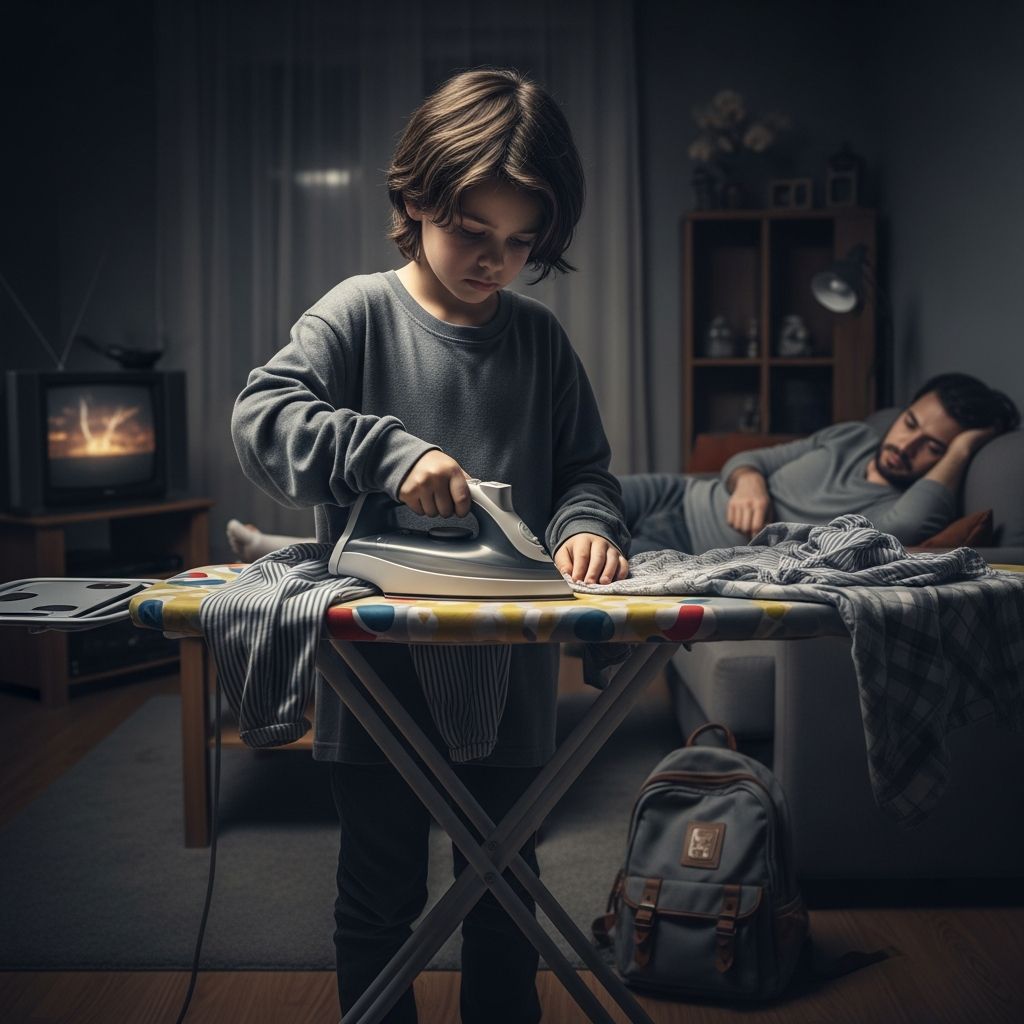
When Children Become the Caretakers: Understanding Parentification
In healthy families, parents provide emotional support, guidance, and practical care while children focus on age-appropriate development and learning. However, in some households, this natural order becomes reversed. Parentification occurs when a child is pressed to assume responsibility for meeting the emotional or practical needs of their parent or other family members, rather than receiving the care and support they require. This role reversal forces children to abandon their own developmental needs and adopt adult-like responsibilities before they are emotionally or cognitively ready. The term itself was introduced by Hungarian-American psychiatrist Ivan Boszormenyi-Nagy, one of the founders of family therapy, who recognized this pattern as a significant disruption to healthy child development.
The phenomenon represents more than just asking children to help with chores or responsibilities. It involves a fundamental breakdown of family boundaries where the child becomes the emotional or practical support system for the parent, often at the expense of their own wellbeing. Understanding this dynamic is crucial for parents, educators, and caregivers who want to protect children from the lasting psychological and emotional consequences of this role reversal.
The Two Distinct Manifestations of Role Reversal
Researchers and mental health professionals have identified two primary categories of parentification, each with distinct characteristics and consequences for child development.
Emotional Support as a Child’s Burden
Emotional parentification emerges when a child fulfills the psychological or emotional needs of their parent. In these situations, the child may serve as a confidant, listening to adult problems and concerns that are developmentally inappropriate for children to process. A child might find themselves mediating conflicts between parents, offering advice on adult matters, or providing comfort when the parent experiences emotional distress. This subtype typically occurs when a parent struggles with mental illness, attachment difficulties, or unresolved personal trauma. While providing emotional support might seem like a positive quality on the surface, it places an impossible burden on the child—they must suppress their own emotional needs to accommodate the parent’s psychological demands. Emotional parentification is particularly difficult to recognize because it develops gradually, before children are developmentally capable of understanding that the dynamic is unhealthy. This invisibility often results in longer-lasting harm, as the pattern may persist for years without intervention.
Practical Responsibilities Beyond Development
Instrumental parentification involves a child assuming practical, household-level responsibilities that are typically reserved for adults. These might include preparing meals, managing household finances, paying bills, cleaning and maintaining the home, or providing care for younger siblings. This form commonly emerges in families facing significant challenges—single-parent households, situations involving parental illness or injury, financial instability, or substance abuse issues within the family. While some household responsibilities can contribute positively to a child’s development through teaching responsibility and life skills, instrumental parentification crosses the line when these duties become excessive or interfere with schooling, social development, and childhood experiences. A child managing household finances or serving as the primary caregiver for younger siblings has been thrust into an adult role that prevents them from engaging in age-appropriate activities and learning.
The Psychological and Physical Toll on Growing Children
The consequences of parentification extend far beyond immediate emotional distress. Research demonstrates that this role reversal creates measurable changes in how children’s bodies and brains function under chronic stress.
Neurological Impact and Stress Response
One of the most significant findings from neuroscience research is that ongoing stress from parentification actually alters brain structure. The hippocampus—the brain region responsible for regulating memory, processing emotion, and managing stress responses—becomes physically smaller in children experiencing chronic parentification stress. This means that parentified children literally develop different brain architecture as a result of their circumstances, which can affect their ability to manage emotions and memories throughout their lives. The constant state of heightened responsibility and worry keeps their nervous systems in a perpetual state of activation, preventing the relaxation and safety necessary for optimal brain development.
Behavioral and Emotional Warning Signs
Parentified children frequently exhibit a constellation of psychological symptoms that can alert observant adults to their situation:
- Persistent anxiety, particularly worry centered on caring for family members or maintaining family stability
- Depressive symptoms and emotional numbness
- Compulsive overworking or perfectionism as children attempt to manage multiple responsibilities
- Overwhelming guilt and shame about family circumstances
- Social withdrawal and isolation from peers
- Intrusive thoughts about family problems and responsibilities
In more severe cases, children experiencing parentification may develop suicidal ideation as the emotional burden becomes unbearable. These psychological symptoms often manifest as physical complaints—children report frequent stomachaches, headaches, and other somatic symptoms reflecting their underlying stress and anxiety.
From Childhood Struggles to Adult Relationship Difficulties
The impact of parentification does not disappear when a child reaches adulthood. Young adults who experienced parentification often struggle significantly with intimate relationships and establishing healthy boundaries with others. Having learned in childhood that their role is to meet others’ needs rather than advocate for their own, they frequently find themselves in relationships where they continue this pattern—becoming over-givers who struggle to ask for support or recognize when their needs are being neglected. They may not understand how to establish appropriate boundaries or communicate their own emotional requirements in relationships. Additionally, parentified individuals may struggle with their own parenting, either by unconsciously repeating the cycle with their own children or by overcorrecting and struggling to provide appropriate structure and guidance.
Recognizing When Role Reversal Has Become Parentification
A critical distinction exists between assigning age-appropriate responsibilities and parentification. Children benefit from household responsibilities that teach them skills and contribute to family functioning. However, parentification crosses this threshold in several ways. Parentification involves tasks or emotional responsibilities that are developmentally inappropriate for the child’s age and cognitive capacity. The child’s own needs for emotional support, guidance, and basic care are consistently deprioritized or ignored. The responsibilities are not supervised or monitored by the parent, but rather the child is left to navigate them independently. The child experiences significant anxiety, guilt, or shame related to these responsibilities, viewing themselves as responsible for family stability or parental wellbeing. The child loses opportunities for typical childhood activities, social development, or educational engagement because they are consumed by adult responsibilities.
Understanding the Root Causes of This Family Dynamic
Parentification rarely emerges from deliberate parental malice. Instead, it typically develops because the parent is struggling with their own unresolved trauma, mental health challenges, or overwhelming life circumstances. A parent who experienced parentification in their own childhood may unconsciously recreate this dynamic with their children. Parents dealing with substance abuse disorders, untreated mental illness, or significant financial stress may look to their children for support because they lack adequate adult support systems. Single parents facing overwhelming demands may inadvertently place inappropriate responsibilities on their oldest child. Understanding these root causes helps shift the focus from blame to recognition that both the parent and child need support and intervention to restore healthier family boundaries.
Pathways to Healing and Restoring Healthy Boundaries
Recovery from parentification requires intentional effort and often professional support. Treatment approaches focus on addressing the trauma, neglect, and chronic stress that resulted from the role reversal. Therapy for parentified individuals or families may include work to process the experiences and emotions associated with inappropriate role assignments. Family therapy can help reestablish appropriate hierarchical boundaries, teaching both parent and child about healthy relationship dynamics. Parents may need individual therapy to address their own trauma or mental health challenges that contributed to the parentification dynamic. In some cases, practical support—such as financial counseling, substance abuse treatment, or mental health services for the parent—becomes necessary to remove the circumstances that necessitated the child’s role reversal. Children benefit from explicit permission to be children again, with reassurance that caring for the parent is not their responsibility and that they are safe even if the parent must manage their own emotional needs.
Building Awareness and Prevention in Family Systems
Prevention of parentification begins with awareness. Parents who recognize their own history of parentification can consciously work to avoid repeating this pattern. Creating strong support networks—with friends, family, or professional counselors—ensures that parents have appropriate sources of emotional support rather than turning to their children. Teaching children about healthy boundaries and validating their right to their own emotional experience strengthens their resilience. Schools and pediatricians can play a role in identifying children showing signs of parentification and connecting families with appropriate resources and support services.
Questions Parents Ask About Role Reversal and Family Boundaries
Q: Is asking my child to help with household chores the same as parentification?
A: No. Age-appropriate chores that are supervised and monitored by parents contribute to healthy development. Parentification occurs when responsibilities are excessive, unsupervised, interfere with school or social development, or when the child experiences anxiety or guilt about meeting family needs.
Q: Can parentification be considered a form of child abuse?
A: In extreme cases, parentification constitutes parental neglect or abuse, particularly when it results in relational trauma—a disruption in the bond between parent and child that creates chronic stress and prevents the child from accessing needed support and protection.
Q: How can I help my child if I recognize signs of parentification?
A: Begin by acknowledging the situation without shame or blame. Seek family therapy to help reestablish healthy boundaries. Address any adult-level problems—such as mental health treatment, substance abuse support, or financial counseling—that contributed to the dynamic. Give your child explicit permission to be a child and reassure them that managing parental emotions is not their responsibility.
Q: Will my child recover from having been parentified?
A: With appropriate intervention and support, children and adults can recover from parentification and develop healthier relationship patterns. Therapy addressing the underlying trauma and stress is often beneficial for long-term healing.
References
- What Is Parentification? Signs of a Parentified Child — Newport Academy. https://www.newportacademy.com/resources/mental-health/parentification/
- Parentification: What It Looks Like and What You Can Do About It — Our Family Wizard. https://www.ourfamilywizard.com/blog/parentification-what-it-looks-and-what-you-can-do-about-it
- Parentification and Its Relationship With Attachment — The Attachment Project. https://www.attachmentproject.com/psychology/parentification/
- Parentification — EBSCO Research Starters. https://www.ebsco.com/research-starters/consumer-health/parentification
- Parentification Vulnerability, Reactivity, Resilience, and Thriving — National Institutes of Health. 2023. https://pmc.ncbi.nlm.nih.gov/articles/PMC10341267/
- What Is Parentification? Signs of a Parentified Child — Cleveland Clinic. https://health.clevelandclinic.org/parentification
- Parentification: Signs and Symptoms of a Parentified Child — Embark Behavioral Health. https://www.embarkbh.com/treatment/therapies/family-therapy/parentification/