Panner’s disease is an uncommon cause of elbow pain in children, most often affecting active kids who throw or put repeated stress on the arm. It involves a temporary disturbance of growth in a part of the elbow called the capitellum, but with proper care it almost always heals fully and does not usually cause long-term damage.3
What Is Panner’s Disease?
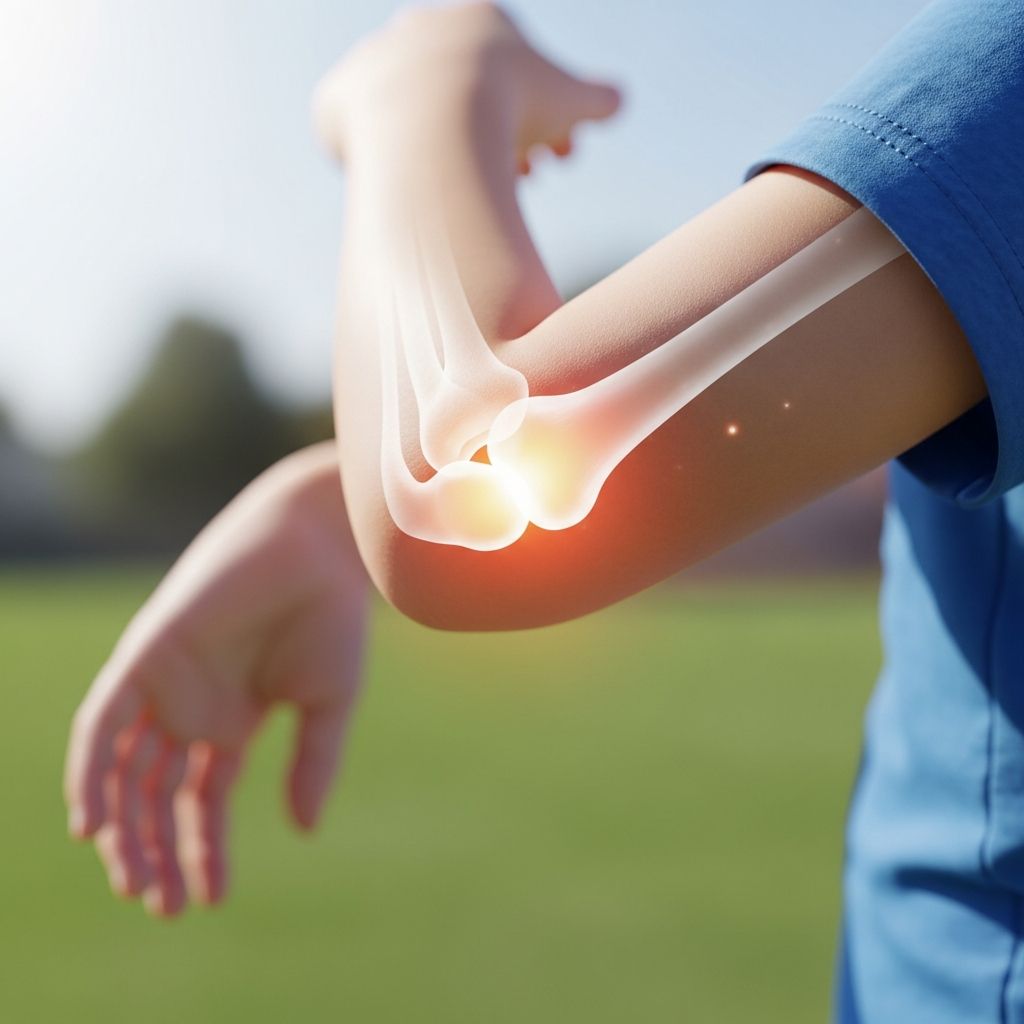
Panner’s disease is an osteochondrosis of the capitellum, meaning there is a short-term problem with the way bone and cartilage are growing at this small, rounded part of the upper arm bone that forms part of the elbow joint.38 The blood supply to this growth area becomes disrupted for a time, leading to softening, small areas of bone breakdown, and changes visible on X-ray.3
Key features include:
- Usually affects children under about 10–11 years old38
- More common in the dominant arm (the arm a child throws with)8
- Causes pain on the outer (lateral) side of the elbow that worsens with activity36
- Is considered a self-limiting condition that typically heals with rest and time34
Although the word “disease” can sound frightening, Panner’s disease behaves more like a temporary growth disturbance than a permanent illness. Most children recover normal elbow function.
Why Does Panner’s Disease Happen?
Experts believe Panner’s disease results from a combination of repetitive stress and the way blood vessels supply the growing capitellum in young children.34
Role of Repetitive Stress
The capitellum is one of several growth centers in the elbow. In active children who throw or bear weight on their arms, this area can be subjected to:
- Repetitive valgus stress (the forearm being pulled outward), such as in pitching, overhand throwing, or serving in racquet sports36
- Axial loading of the elbow, like pushing off the arms in gymnastics or handstands6
- Repeated microtrauma to the cartilage and underlying bone
Over time, this stress can temporarily disturb blood flow to the capitellum’s growth center, leading to small areas of bone death (avascular necrosis) and irregular growth until healing occurs.34
Age and Blood Supply
Young children’s elbow growth centers have a unique blood supply pattern. After around age 5, the capitellum is mainly supplied by small vessels that act like end arteries, meaning they do not have many backup routes.3 If repeated stress disrupts these vessels, localized ischemia (temporary loss of blood flow) can develop and interfere with normal bone formation.
Because of this, Panner’s disease tends to occur in:
- Children younger than 10–11 years38
- Those who play throwing or impact sports that stress the elbow, such as baseball, handball, or gymnastics46
Who Is Most at Risk?
Any child can develop Panner’s disease, but risk is higher when several factors are present:
- Age: usually in elementary-school-aged children, often ages 5–1038
- Sport participation: baseball pitchers, catchers, tennis players, gymnasts, and other overhead or weight-bearing sports on the arms46
- Dominant arm involvement: typically affects the arm used most for throwing or racquet work8
Panner’s disease is considered a rare condition, and many mild cases may go undiagnosed because symptoms can be subtle or mistaken for a simple strain.3
Common Signs and Symptoms
Children with Panner’s disease usually describe pain on the outer side of the elbow that gets worse with activity and improves with rest.36 Parents or coaches may notice that the child suddenly stops throwing as hard or avoids using the affected arm.
Typical Symptoms
- Lateral elbow pain, especially during throwing, hitting, pushing, or weight-bearing on the arm36
- Stiffness or loss of motion, commonly difficulty fully straightening the elbow3
- Swelling or a feeling of fullness at the outer elbow6
- Tenderness when the doctor presses on the capitellum area
- Pain that eases with rest and flares with activity36
The child may not recall a single major injury. Instead, symptoms often develop gradually over several weeks of frequent practice or play.
Red Flags That Need Prompt Evaluation
Parents should seek prompt medical care if a child has:
- Severe elbow pain after a specific fall or trauma
- Inability to move the elbow or obvious deformity
- Fever, redness, or warmth around the joint (could signal infection)
- Numbness, tingling, or weakness in the hand or forearm
These features are not typical of Panner’s disease and may point to fractures, infections, or nerve problems that need urgent attention.
How Doctors Diagnose Panner’s Disease
Diagnosing Panner’s disease involves combining the child’s history, a careful examination, and imaging tests, usually starting with X-rays of the elbow.36
Medical History and Physical Exam
The clinician will usually ask about:
- When the pain started and what makes it better or worse
- Which sports or activities the child plays and how often
- Any past injuries or similar pain episodes
During the exam, the doctor checks:
- Where the elbow is tender, especially over the capitellum
- How far the elbow can bend and straighten, and whether movement is painful3
- Any swelling, warmth, or joint effusion (fluid)
- Nerves and circulation to the hand and forearm
Imaging Studies
| Test | What it shows | Why it is used |
|---|---|---|
| Plain X-rays | Shape and density changes of the capitellum, areas of bone resorption, sclerosis, or flattening36 | First-line test; often sufficient to support diagnosis |
| MRI | Cartilage, bone marrow changes, joint fluid, and more subtle lesions36 | Used if X-ray findings are unclear or to distinguish from osteochondritis dissecans |
Radiographic findings in Panner’s disease may include irregular joint lines, areas of radiolucency (showing bone resorption), and later, re-ossification as healing occurs.36
Panner’s Disease vs. Osteochondritis Dissecans (OCD)
Panner’s disease and osteochondritis dissecans of the capitellum can both cause lateral elbow pain in young athletes, but they are different conditions with different age ranges, imaging patterns, and long-term implications.23
| Feature | Panner’s disease | Capitellar OCD |
|---|---|---|
| Typical age | Under 10–11 years38 | Older children/adolescents (often 12–16 years)23 |
| Area involved | Usually involves the entire capitellum23 | Limited to lateral or central part of the capitellum23 |
| Cause | Temporary growth disturbance from ischemia in younger child | Focal lesion; may progress to loose bodies if untreated |
| Treatment | Conservative (rest, activity modification, pain control)23 | May require surgery if unstable or persistent symptoms23 |
| Long-term outlook | Excellent; usually complete remodeling and recovery34 | Risk of arthritis or chronic symptoms if not managed properly23 |
Because treatment approaches differ, it is important that a pediatric orthopaedic specialist interprets imaging correctly to avoid mislabeling OCD as Panner’s disease or vice versa.23
Treatment: Rest and Symptom Relief First
The cornerstone of care for Panner’s disease is conservative treatment. Research consistently supports rest, activity modification, and pain control as the mainstays of management, with surgery rarely needed.234
Core Treatment Steps
- Activity restriction: Children should avoid painful activities, especially throwing, overhead sports, and weight-bearing on the arm, to allow healing.34
- Rest and possible immobilization: A sling, splint, or short period of casting may be recommended to limit movement and reduce stress on the capitellum.23
- Ice or cold packs: Applying ice for about 15 minutes every 1–2 hours during painful flare-ups can reduce pain and swelling when used with a protective cloth over the skin.46
- Pain medications: Nonsteroidal anti-inflammatory drugs (NSAIDs) such as ibuprofen are commonly used to ease discomfort, along with acetaminophen as needed, following pediatric dosing guidelines and physician advice.24
The Role of Physical Therapy
Once pain has improved and the elbow is no longer very tender, physical therapy or guided home exercises are often introduced to:
- Gently restore range of motion in the elbow
- Strengthen the muscles of the shoulder, upper arm, and forearm
- Correct any technique issues that overload the elbow (e.g., throwing mechanics)
Specialized pediatric sports or orthopedic therapists can provide sport-specific guidance to reduce the chance of recurrence or new overuse injuries.
How Long Does Recovery Take?
The healing process varies by child, but symptoms may last from a few months up to roughly two years in some cases, even though pain usually improves much sooner.3 Over time, the capitellum typically remodels and regains a normal shape on imaging, matching the clinical improvement.
Regular follow-up appointments help the specialist monitor:
- Pain levels and function
- Range of motion of the elbow
- Changes in imaging, if repeat X-rays or MRI are needed
When Is Surgery Considered?
Surgery is rarely required for Panner’s disease because the condition is self-limiting in the vast majority of children.34
Specialists may consider surgical options if:
- Pain remains severe after an extended period of nonoperative treatment
- There is significant, persistent loss of elbow motion
- Imaging suggests a different problem (such as unstable OCD) rather than classic Panner’s disease
Long-Term Outlook and Possible Complications
The long-term outlook for children with Panner’s disease is excellent. Most studies report very good return of elbow motion and function with conservative care, and many children experience complete or near-complete recovery.234
Potential, but uncommon, concerns include:
- Mild, residual stiffness in extension (difficulty fully straightening the arm)
- Occasional aching with heavy use
- Very rare early-onset arthritis if the joint surface heals with irregularities
Routine follow-up and adherence to activity recommendations significantly reduce the risk of long-term problems.
Returning Safely to Sports and Play
Parents and young athletes are often eager to know when sports can resume. There is no single timeline that fits everyone. Instead, clinicians look for a combination of healing signs, including:
- Minimal or no elbow pain at rest or during daily activities
- Near-normal range of motion compared with the other arm
- Improving strength and endurance of the arm and shoulder
- Physician clearance based on exam and, if needed, imaging
When returning to sport:
- Restart with gradual progression of throwing or load-bearing activities.
- Follow pitch counts, rest rules, or practice-time limits provided by coaches and doctors.
- Stop activity and notify the care team if pain returns.
Helping Your Child Cope
Time away from favorite sports or activities can be emotionally hard for children. Parents can help by:
- Explaining that rest is part of the healing process and prevents worse injury later
- Encouraging alternative activities that do not stress the elbow, such as lower-body exercises or non-impact hobbies
- Keeping follow-up appointments and tracking symptoms together in a simple log
Reassurance is powerful: with patience and adherence to the plan, most children return to their usual level of play without lasting problems.
Frequently Asked Questions (FAQs)
Is Panner’s disease permanent?
No. Panner’s disease is generally temporary and self-limiting. The capitellum usually remodels as the child grows, and most children recover full or near-full function with conservative treatment.34
Can my child continue to play sports with Panner’s disease?
Children with active Panner’s disease typically need to avoid pain-provoking activities, especially throwing and impact sports, until symptoms improve and their doctor clears them. Continuing high-stress activities too early can delay healing.34
Will my child develop arthritis later because of Panner’s disease?
The long-term risk of arthritis from classic Panner’s disease treated appropriately is considered low. Most children experience excellent outcomes. Persistent symptoms or atypical imaging should be reviewed with a pediatric orthopaedic specialist.34
How is Panner’s disease different from a growth plate fracture?
Growth plate fractures usually follow a clear injury and show distinct fracture lines on X-ray, often requiring immobilization or other fracture care. Panner’s disease is a more gradual growth disturbance linked to repetitive stress and ischemia, with different radiographic features and a mainly rest-based treatment plan.3
Should siblings or teammates be screened for Panner’s disease?
No routine screening is recommended. However, coaches and parents should pay attention to early elbow pain in any young overhead athlete and encourage rest and medical evaluation if pain persists, rather than pushing through discomfort.
References
- Panner’s disease: literature review and treatment recommendations — Janssen PH et al., Knee Surgery, Sports Traumatology, Arthroscopy. 2015-03-01. https://pmc.ncbi.nlm.nih.gov/articles/PMC4340849/
- Panner’s Disease: A Case Report — Cohen LE et al., The Florida Pediatrician. 2020-10-01. https://floridapediatrician.org/publications/panners-disease-a-case-report/
- Panner’s Osteochondrosis — Rady Children’s Hospital–San Diego, Sports Medicine. 2021-06-01. https://www.rchsd.org/programs-services/sports-medicine/conditions-treated/panners-osteochondrosis/
- Panner Disease (Elbow) — Southern California Orthopedic Specialists. 2022-02-01. https://www.scosortho.com/panner-disease-orthopedic-specialists-orange-county-irvine-huntington-beach-ca/
- Panner’s Disease — Physiopedia. 2023-01-15. https://www.physio-pedia.com/Panner’s_Disease
- panner disease — National Organization for Rare Disorders (NORD). 2016-01-01. https://rarediseases.org/mondo-disease/panner-disease/