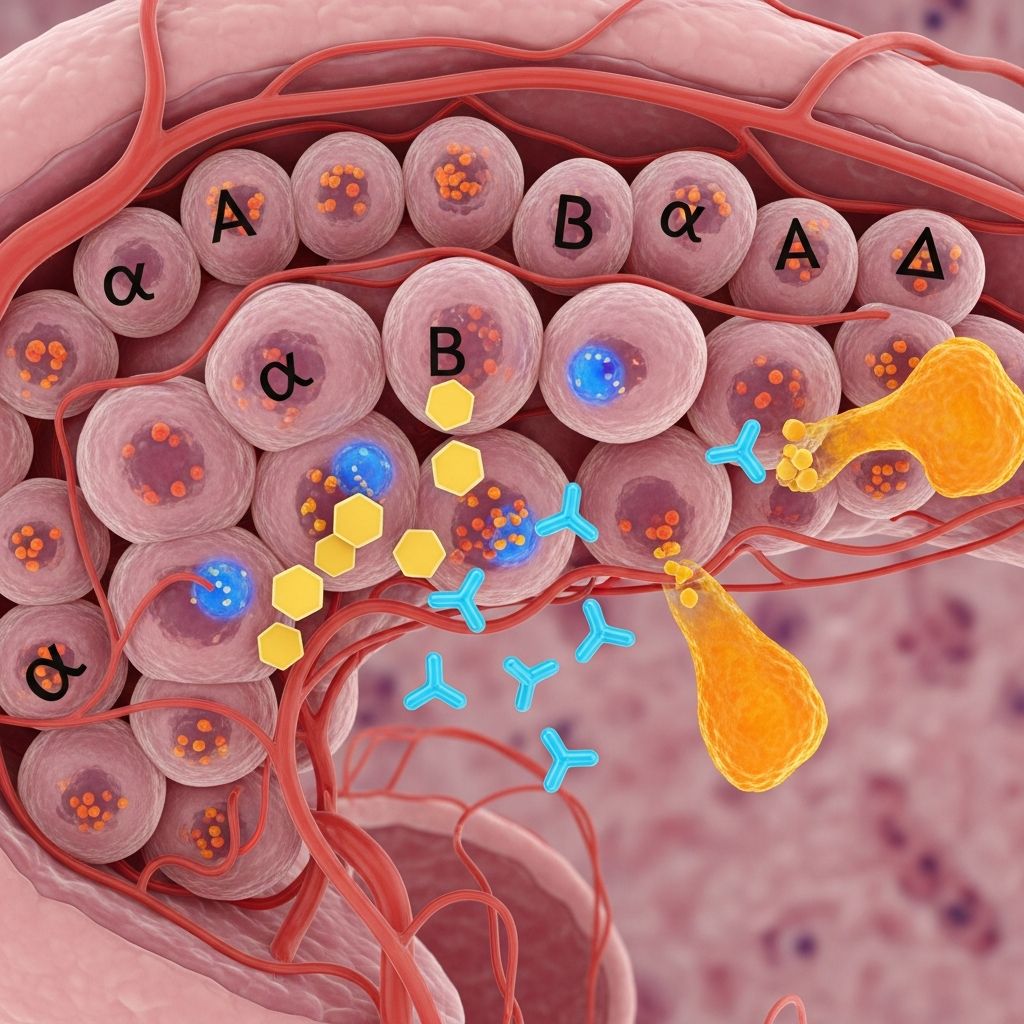
Pancreatic islet cells, also known as islets of Langerhans, form tiny clusters within the pancreas that act as a control center for blood glucose levels. These specialized cells produce and release hormones directly into the bloodstream, ensuring the body maintains energy balance throughout the day.
The Anatomy and Location of Islet Cells in the Pancreas
The pancreas, a glandular organ located behind the stomach, serves both digestive and hormonal functions. Its endocrine portion, comprising just 1-2% of the total pancreatic volume, consists of these islet clusters. Each islet is a self-contained micro-organ, typically 50-500 micrometers in diameter, housing 2,000 to 5,000 cells. Humans possess over one million such islets, distributed unevenly with higher density in the tail region.
Richly supplied with blood vessels—receiving 10-15% of the pancreas’s blood flow despite their small size—islets enable rapid hormone dispersion. Nerve endings also innervate these structures, allowing fine-tuned responses to bodily signals like nutrient levels and stress.
- Size and Distribution: Islets vary from small (under 50 μm) to large (over 500 μm), clustered mainly in the pancreatic tail.
- Vascularization: Dense capillary networks surround islets for efficient hormone delivery.
- Innervation: Sympathetic and parasympathetic nerves modulate cell activity.
Key Cell Types Within Pancreatic Islets
Islets contain multiple endocrine cell types, each secreting specific hormones. Their arrangement differs across species: rodents have beta cells in the core with others on the periphery, while human islets feature intermixed alpha and beta cells throughout.
| Cell Type | Percentage | Main Hormone | Primary Function |
|---|---|---|---|
| Alpha (α) | 15-20% | Glucagon | Raises blood glucose by promoting glycogen breakdown in liver |
| Beta (β) | 65-80% | Insulin, Amylin | Lowers blood glucose by facilitating cellular uptake and storage |
| Delta (δ) | 3-10% | Somatostatin | Inhibits insulin and glucagon release for balanced secretion |
| Gamma (PP/F) | 3-5% | Pancreatic Polypeptide | Regulates pancreatic exocrine and endocrine secretions |
| Epsilon (ε) | <1% | Ghrelin | Stimulates appetite and growth hormone release |
Beta cells dominate, making up the majority and serving as the primary insulin producers. Alpha cells counterbalance by releasing glucagon during low glucose states. Delta cells provide regulatory feedback, preventing overproduction of other hormones.
How Islet Cells Maintain Glucose Homeostasis
Islet cells operate through a sophisticated paracrine system, where hormones influence neighboring cells locally before entering circulation. This feedback loop ensures precise glucose control: high blood sugar stimulates beta cells to secrete insulin, which promotes glucose uptake in muscles, fat, and liver while inhibiting alpha cells. Conversely, low glucose triggers glucagon from alpha cells, mobilizing liver glycogen stores.
Somatostatin from delta cells fine-tunes this by suppressing both insulin and glucagon, avoiding extremes. Pancreatic polypeptide modulates overall pancreatic activity, and ghrelin signals hunger to coordinate eating with energy needs.
- High Glucose: Insulin ↑, Glucagon ↓
- Low Glucose: Glucagon ↑, Insulin ↓
- Regulatory: Somatostatin balances both
Beyond glucose, islets respond to amino acids, fatty acids, and neural inputs, integrating metabolic signals holistically.
The Critical Role of Islet Cells in Daily Life
Every meal challenges the islets to respond swiftly. Post-carbohydrate intake, insulin surges within minutes, shuttling glucose into cells and curbing liver glucose output. Between meals or during fasting, glucagon maintains levels by gluconeogenesis and glycogenolysis. This pulsatile hormone release—coordinated within intact islets—optimizes efficiency; dissociated cells lose this synchrony, impairing function.
Islets also influence appetite via ghrelin and support digestion indirectly through polypeptide regulation of enzyme release.
When Islet Cells Fail: Understanding Diabetes
Dysfunction in islet cells underlies diabetes mellitus. Type 1 diabetes results from autoimmune destruction of beta cells, halting insulin production and causing hyperglycemia. Type 2 involves insulin resistance combined with progressive beta cell exhaustion, often linked to obesity and inactivity.
Alpha and delta cell abnormalities contribute too: excessive glucagon in diabetes worsens hyperglycemia, while impaired somatostatin disrupts balance. Restoring islet function is key to management.
Islet Cell Transplantation: A Promising Therapy
Islet transplantation offers hope for Type 1 diabetes patients with severe hypoglycemia unawareness. Isolated intact islets, preserving their micro-organ structure, are infused into the liver portal vein. These engraft, revascularize, and innervate, often normalizing glucose for years without exogenous insulin.
Success relies on donor matching and immunosuppression. Ongoing research improves isolation techniques and explores stem cell-derived islets for scalability.
- Advantages: Minimally invasive vs. whole pancreas transplant
- Challenges: Limited donors, immune rejection
- Future: Encapsulation to avoid immunosuppression
Protecting Your Islet Cells for Long-Term Health
Lifestyle choices profoundly impact islet health. Regular exercise enhances insulin sensitivity, reducing beta cell stress. A balanced diet low in refined sugars preserves function, while avoiding smoking and excess alcohol protects vascular supply.
Early screening for prediabetes allows interventions like weight loss, which can restore beta cell mass. Monitoring glucose helps detect issues promptly.
Frequently Asked Questions About Pancreatic Islet Cells
What do pancreatic islet cells primarily regulate?
They mainly control blood glucose levels through insulin, glucagon, and other hormones, preventing highs and lows.
How many types of cells are in the islets?
At least five: alpha, beta, delta, gamma, and epsilon cells, each with distinct hormone outputs.
Can islet cells be transplanted?
Yes, isolated islets from donors can be transplanted into the liver to restore insulin production in Type 1 diabetes.
What causes islet cell damage in diabetes?
In Type 1, autoimmune attack destroys beta cells; in Type 2, chronic stress from insulin resistance leads to dysfunction.
Do all islets function identically?
No, their cytoarchitecture varies by species and location, affecting hormone coordination.
Advances in Islet Cell Research
Recent studies emphasize 3D islet structure’s superiority for function, driving bioengineered islets from stem cells. Vascular and neural integration post-transplant remains a focus, promising broader applications.
Understanding paracrine signaling opens doors to drugs mimicking islet harmony, potentially treating early diabetes without cell replacement.
References
- The pancreatic islet: a micro-organ in control — Cabrera O et al. PMC – NIH. 2021-04-07. https://pmc.ncbi.nlm.nih.gov/articles/PMC8017525/
- Pancreatic islets — Wikipedia Contributors. 2023-10-15. https://en.wikipedia.org/wiki/Pancreatic_islets
- Overview of Pancreatic Islets — Boundless Anatomy and Physiology. Medicine LibreTexts. 2023-08-20. https://med.libretexts.org/Bookshelves/Anatomy_and_Physiology/Anatomy_and_Physiology_(Boundless)/15:_Endocrine_System/15.11:_The_Pancreas/15.11A:_Overview_of_Pancreatic_Islets
- The Pancreatic Islet – a Multifaceted Hub of Inter-Cellular Communication — Frontiers Research Topic. 2023-11-01. https://www.frontiersin.org/research-topics/29471/the-pancreatic-islet—a-multifaceted-hub-of-inter-cellular-communication/magazine
- Definition of islet cell — National Cancer Institute. 2024-01-10. https://www.cancer.gov/publications/dictionaries/cancer-terms/def/islet-cell
- Pancreas Functions, Location & Disease — Columbia Surgery. 2023-05-12. https://columbiasurgery.org/pancreas/pancreas-and-its-functions
- Pancreas: Function, Location, Anatomy & Living Without One — Cleveland Clinic. 2024-02-28. https://my.clevelandclinic.org/health/body/21743-pancreas