Choosing the right toys shapes a child’s world, sparking curiosity and building essential skills. While tech toys dazzle with lights and sounds, open-ended toys invite endless imagination. This article dives into their differences, benefits, and how to balance them for healthy growth.
Defining the Toy Landscape
Toys fall into two main camps: those that guide play with built-in rules and those that let children lead. Understanding these helps parents make informed decisions.
Open-Ended Toys: Boundless Horizons
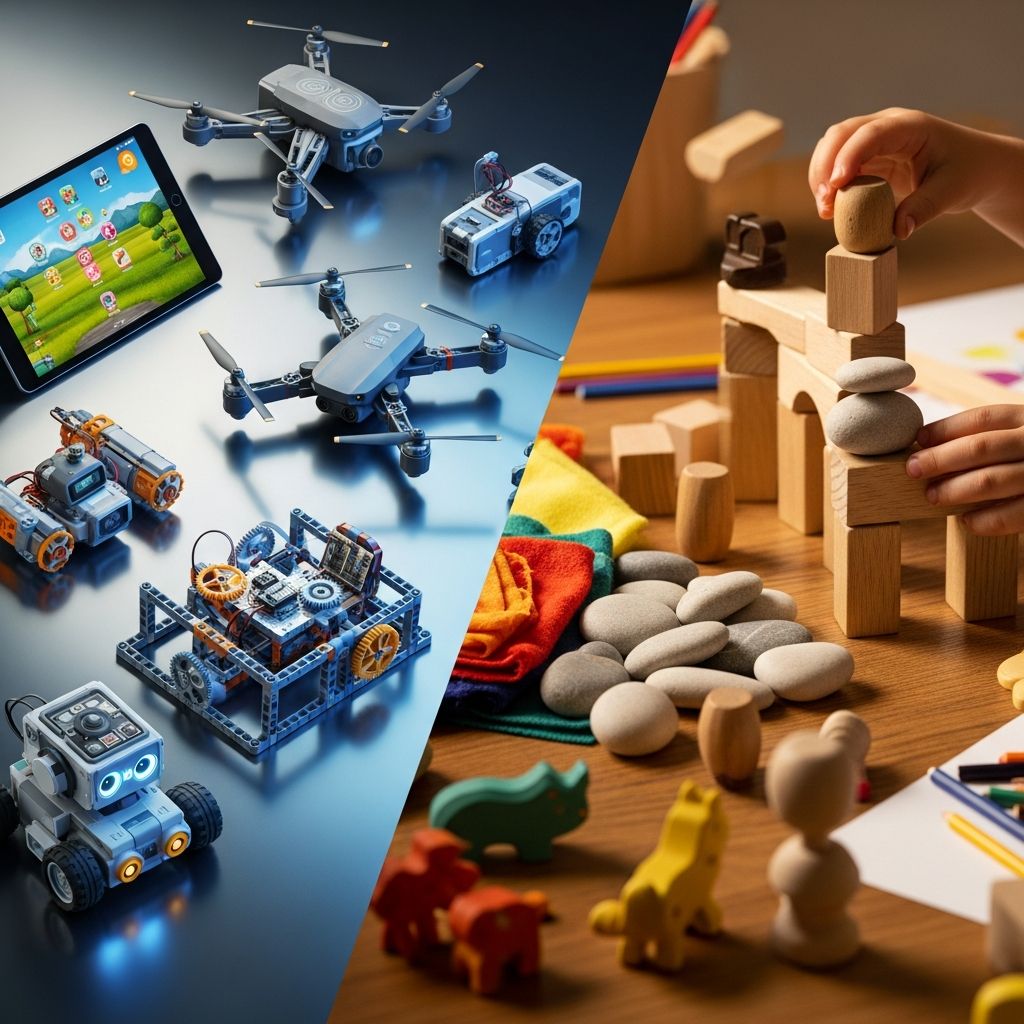
Open-ended toys lack fixed outcomes, empowering kids to invent scenarios. A simple set of wooden blocks can become a castle, spaceship, or cityscape, depending on the child’s vision. These toys shine in fostering self-directed exploration, where children experiment freely without prompts or endings dictated by the toy.
- Wooden blocks or stacking rings for building adventures.
- Simple dolls or animal figures for storytelling.
- Art supplies like clay or blank canvases for creation.
- Natural items like fabric scraps or pinecones for sensory play.
Such toys grow with the child, offering new challenges at every age and encouraging replay value over years.
Tech and Closed-Ended Toys: Structured Fun
Tech toys, often electronic, feature buttons, screens, or apps that provide specific feedback. Closed-ended toys, even non-tech ones, follow set paths like puzzles with one solution. They teach targeted skills through repetition and guidance.
- Tablets with educational apps for letter recognition.
- Interactive robots that respond to commands.
- Light-up shape sorters or talking books.
- Video games with levels and rewards.
These provide quick wins and structure, ideal for introducing concepts like numbers or sequences.
Boosting Key Developmental Areas
Both toy types contribute uniquely to growth. A comparison reveals where each excels.
| Skill Area | Open-Ended Toys | Tech/Closed-Ended Toys |
|---|---|---|
| Creativity & Imagination | Excels: Kids invent stories and uses, building divergent thinking. | Limited: Follows toy’s script, convergent focus. |
| Problem-Solving | High: Child-defined challenges spark innovative solutions. | Task-specific: Solves toy-set problems like sequences. |
| Language & Social Skills | Strong: Role-play and group narration enhance vocabulary and cooperation. | Variable: Can isolate or prompt scripted talk. |
| Motor Skills | Comprehensive: Fine and gross motor from manipulating varied objects. | Targeted: Often button-pressing or swiping. |
| Focus & Independence | Builds sustained attention via child-led pace. | Guided: Relies on toy prompts, potential overstimulation. |
Research highlights open-ended play’s edge in holistic development, with studies showing richer interactions and creativity. Tech toys, however, shine in skill drills.
Strengths of Each Approach
Why Open-Ended Toys Captivate
These timeless pieces promote deep engagement. Children narrate elaborate tales with a wooden kitchen set, practicing negotiation during pretend shopping. Unlike button-mashing on electronic versions, this leads to sustained, meaningful play. They build resilience as kids troubleshoot self-created issues, like balancing a wobbly tower. Socially, they draw peers into collaborative worlds, boosting empathy and sharing. Durability is a bonus—passed down generations without batteries.
Valuable Roles for Tech Toys
Not all tech is villainous. Well-designed ones introduce STEM early, like coding bots teaching logic. For children with disabilities, adaptive tech opens doors to interaction. They offer instant feedback, motivating quick learners. In moderation, apps expand creativity beyond paper, letting kids design 3D models. Parental involvement turns solo screen time into joint learning.
Potential Downsides and Pitfalls
No toy is perfect. Open-ended ones may frustrate beginners needing more guidance, while lacking clear wins. Tech toys risk shortening attention spans with constant stimuli, leading to button-focused repetition over invention. Overuse correlates with reduced social skills and isolation, as solo play replaces group fun. Screen glare harms eyes during extended sessions. Balance is key—tech as supplement, not staple.
Age-Appropriate Picks and Strategies
Tailor choices to stages for maximum impact.
Infants and Toddlers (0-3 Years)
Focus on sensory open-ended: soft blocks, nesting cups. Avoid screens; hands-on builds neural connections.
Preschoolers (3-5 Years)
Mix wooden trains with simple tech like shape sorters. Encourage storytelling with figures.
School-Age (6+ Years)
Introduce STEM kits alongside art supplies. Programmable toys teach coding without dominating play.
Pro Tip: Set tech limits—15-30 minutes daily—and co-play to enhance benefits.
Blending Worlds for Optimal Play
The ideal toy box mixes both. Use open-ended as foundation (70%), tech as enhancer (30%). A block set pairs well with a light-up projector for shadow stories. Observe your child’s cues: thriving invention signals balance. Shop sustainably—wooden over plastic for longevity.
Real Parent Insights
Many report kids ditching flashy gadgets for blocks after initial hype. One study noted electronic cash registers prompted mere button presses, while wooden ones ignited role-play markets. Traditional play comforts, processing emotions through dolls. Tech boosts confidence in tech-savvy skills.
Frequently Asked Questions
Are open-ended toys better than tech toys?
They often outperform in creativity and social growth, but tech aids specific skills like coding when limited.
Can tech toys be educational?
Yes, for STEM intros, but pair with hands-on to avoid passive use.
How much screen time for toy tech?
Under 1 hour daily for ages 2-5; focus on interactive, not passive.
What if my child prefers tech?
Gradually introduce open-ended via joint play to build interest.
Do expensive toys mean better development?
No—simple, versatile ones deliver most value long-term.
Building a Future-Proof Playroom
Prioritize versatility, safety, and joy. Watch play evolve: from stacking to architecting. Both toy types have merit, but open-ended reigns for nurturing innovators. Empower kids to dream big.
References
- Open-Ended vs. Tech Toys: Which Is Better for Development? — Busy Buddy Toys. 2023-05-15. https://www.busybuddy.toys/blogs/news/open-ended-vs-tech-toys-development
- The Benefits of Simple, Open-Ended Toys in Child Development — Rad Children’s Furniture. 2023-08-22. https://radchildrensfurniture.com/blogs/news/the-benefits-of-simple-open-ended-toys-in-child-development
- Tech Toys Vs Traditional Toys — Le Toy Van. 2024-02-10. https://letoyvan.com/blogs/news/tech-toys-vs-traditional-toys
- Tech vs. Traditional Toys and the Benefits of Both — BD Peds. 2023-11-05. https://www.bdpeds.com/updates-news/tech-vs-traditional-toys-and-the-benefits-of-both
- STEM & Montessori Toys: A Comparative Analysis — Wonder Kids Toy. 2024-01-18. https://wonderkidstoy.com/blogs/news/stem-montessori-toys-a-comparative-analysis
- What is The Difference Between Educational Toys and Traditional Toys — WhalesBot. 2023-09-30. https://www.whalesbot.ai/blog/what-is-the-difference-between-educational-toys-and-traditional-toys