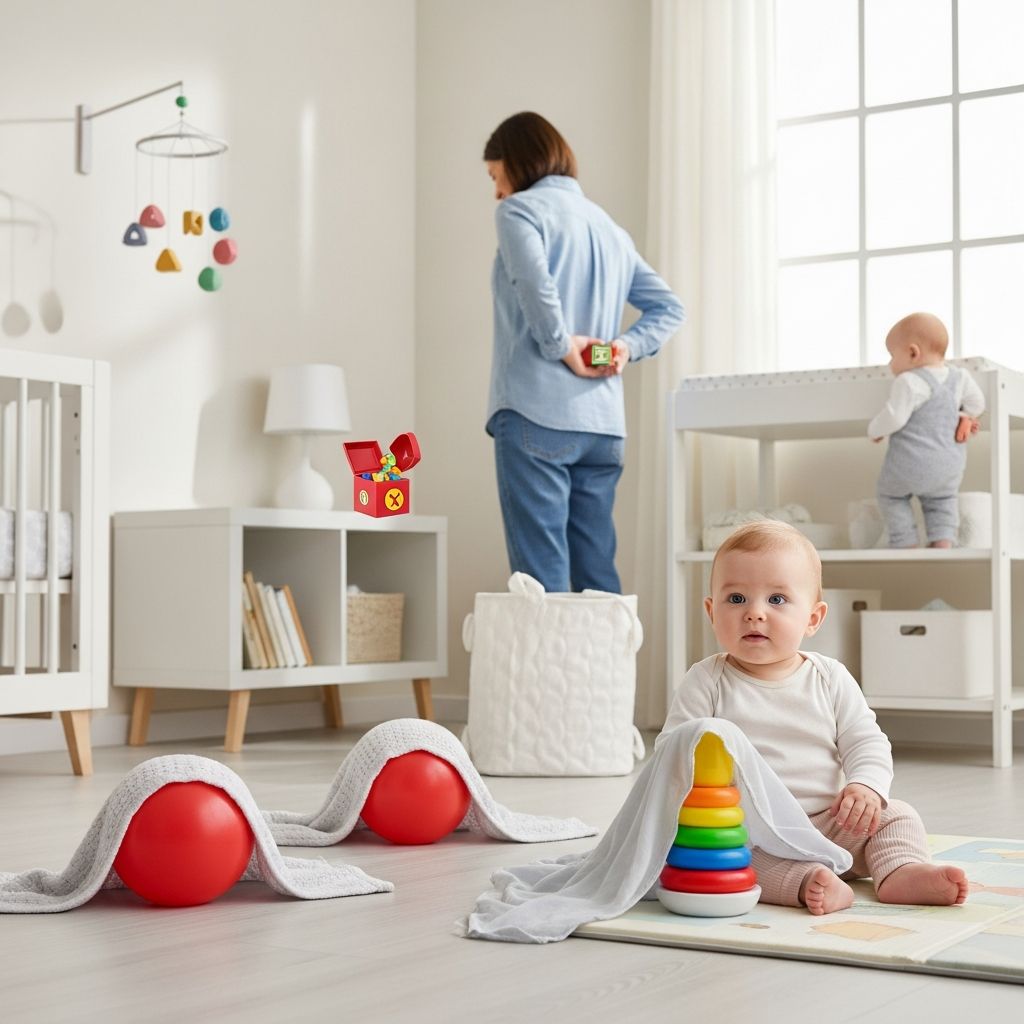
Object permanence is the understanding that people and things continue to exist even when a baby can no longer see, hear, or touch them. This key cognitive skill develops gradually over the first two years of life and is closely linked to memory, problem-solving, and emotional attachment.
Psychologist Jean Piaget described six stages within the sensorimotor period (birth to about two years), and object permanence slowly unfolds across all of them. Each stage builds on the last, taking your baby from a world of pure reflexes to a world where they can mentally picture you—even when you are in another room.
What Is Object Permanence?
Object permanence means that your baby understands that objects and people do not simply vanish when they move out of sight; they still exist even when hidden or absent. Without this concept, once a toy rolls under the couch or a parent leaves the room, it effectively stops existing in the baby’s mind.
This ability depends on growing memory skills and the capacity to create mental images. As babies develop object permanence, they begin to search for hidden objects, anticipate people’s return, and show stronger attachments and separation anxiety because they remember who is missing.
Piaget’s Sensorimotor Stages Overview
Piaget divided the first two years into six substages, each marked by changing ways of acting, exploring, and thinking. Object permanence does not appear all at once; it slowly strengthens as your baby moves through these substages.
| Stage | Approx. Age Range | Main Focus | Object Permanence Status |
|---|---|---|---|
| Reflex Schemes | Birth – 1 month | Basic reflexes, simple responses | No object permanence; world is \”here and now\” |
| Primary Circular Reactions | 1 – 4 months | Repetition of actions centered on own body | Very limited awareness of objects; brief tracking |
| Secondary Circular Reactions | 4 – 8 months | Repetition of actions on objects | Will reach for partially hidden objects |
| Coordination of Secondary Reactions | 8 – 12 months | Goal-directed behavior, simple problem-solving | Searches for hidden objects, but makes “A-not-B” errors |
| Tertiary Circular Reactions | 12 – 18 months | Experimenting with new actions | Searches for objects in new places it has seen them hidden |
| Mental Combinations | 18 – 24 months | Mental problem-solving and symbolic thought | Full object permanence; can imagine hidden movements |
Stage 1: Reflex Schemes (Birth – 1 Month)
In the first few weeks, babies rely almost entirely on inborn reflexes such as sucking, grasping, and looking. Their vision is fuzzy, attention spans are very short, and they respond mainly to immediate sensations like hunger, light, and sound.
At this point, object permanence is essentially absent. When something disappears from their field of view, it simply “drops out” of their experience. A face that moves away, a pacifier that falls, or a light that turns off is not mentally tracked or remembered.
Parent Tips for Stage 1
- Hold your baby close during feedings so they can see your face, building early recognition.
- Offer high-contrast toys briefly; follow their lead and do not expect them to search for anything hidden yet.
- Focus on comfort and bonding, not on teaching games or expectations about memory.
Stage 2: Primary Circular Reactions (1 – 4 Months)
During this stage, babies discover that some of their actions feel good and start repeating them. They might suck their thumb, wave their arms, or kick their legs in a rhythmic way, mainly exploring their own bodies rather than objects.
Object awareness is still fragile, but it is improving. Babies may start to follow a moving object with their eyes or briefly look where something was, yet they do not actively look for it once it disappears. Their world is still driven by what is directly in front of them.
Signs of Early Awareness
- Watching a familiar face move and turning their head slightly to keep it in view.
- Pausing and looking for a moment at the spot where a toy was just a second before.
- Responding to familiar sounds, like a parent’s voice, from just out of sight.
Parent Tips for Stage 2
- Use slow, gentle movements such as moving a rattle across their field of vision.
- Talk or sing as you temporarily move your face away, then reappear to build recognition.
- Keep hidden-object expectations low; brief tracking, not searching, is typical now.
Stage 3: Secondary Circular Reactions (4 – 8 Months)
Now babies become fascinated with the effects they can create on the world around them. They may shake a rattle repeatedly to hear the sound, kick to move a mobile, or bang objects together, enjoying the feedback from their environment.
This is also when object permanence clearly starts to emerge. Babies will reach for an object that is partially hidden, such as a toy that is half-covered by a blanket. However, if the object is fully covered or disappears completely, they usually do not search for it yet.
What Object Permanence Looks Like Now
- Reaching or leaning toward a toy that has rolled just out of reach but is still visible.
- Pulling at a cloth to uncover a toy that is only partly hidden.
- Showing surprise or interest when something reappears that had briefly disappeared.
Simple Activities for Stage 3
- Play gentle “now you see it, now you don’t” games by partially covering a toy and letting your baby uncover it.
- Roll a ball back and forth, letting it pause briefly out of sight and then return into view.
- Use transparent or mesh containers so your baby can see toys inside and practice reaching for them.
Stage 4: Coordination of Secondary Reactions (8 – 12 Months)
At this stage, babies begin to combine actions in more deliberate, goal-directed ways. They might push an obstacle aside to reach a toy, open a cabinet to get to what is inside, or pull on a string to bring an object closer.
The early, more solid understanding of object permanence usually appears here. Babies can search for and retrieve an object that has been completely hidden right in front of them. However, they often make a classic mistake called the “A-not-B error,” where they keep searching in a familiar hiding place even after seeing the object moved to a new spot.
The A-not-B Error Explained
- Hiding a toy in location A several times: your baby finds it easily and expects it there.
- Then, in full view, you hide the same toy in location B: your baby watches this happen.
- When asked to find the toy, many babies still look in the first spot (A) instead of the new one (B), showing that their memory and understanding are still developing.
Games to Strengthen Object Permanence in Stage 4
- Play peekaboo by hiding your face behind your hands, a cloth, or a door, then reappearing with a smile.
- Use simple hiding games: place a toy under one cup, then occasionally move it to another while your baby watches.
- Hide-and-find routines with favorite objects, always keeping the mood playful and low-pressure.
Stage 5: Tertiary Circular Reactions (12 – 18 Months)
In this stage, toddlers become little experimenters. They try new actions just to see what will happen, like dropping food from different heights, placing objects into various containers, or testing different ways to get a stuck toy out.
Object permanence is much stronger now. Children can track objects that are hidden in increasingly complex ways, as long as the hiding and moving occur within their view. They can search multiple possible locations and will often persist until they find what they are looking for.
Typical Object Behaviors in Stage 5
- Watching the path of a toy as it is hidden in one container, then moved to another in front of them.
- Checking more than one place for a missing item they just saw.
- Repeating “experiments” like opening boxes or lids to see what is inside.
Parent Tips for Stage 5
- Offer nesting cups, simple boxes, and containers for your child to open, close, fill, and empty.
- Play “treasure hunt” games where a toy is hidden in one of several boxes, all within your child’s view.
- Encourage safe exploration and accept some mess as part of learning how objects behave.
Stage 6: Mental Combinations (18 – 24 Months)
By this final sensorimotor stage, toddlers are beginning to think before acting. They can mentally try out solutions and imagine where a hidden object might be, even when they do not directly see all the steps of its movement.
Object permanence is now fully developed. Children understand that objects and people continue to exist even when out of sight, and they can search in logical places for things that were moved when they were not looking. This mental representation of the world paves the way for language, pretend play, and more advanced problem-solving.
What Full Object Permanence Looks Like
- Looking for a toy in the last place they saw it and then in other likely spots.
- Remembering that a favorite person is in another room and going to find them.
- Understanding that something inside a container still exists even when the container is closed or moved.
Supporting Thinking Skills in Stage 6
- Play simple hide-and-seek with objects: hide a toy while your child is briefly out of the room and let them search when they return.
- Encourage pretend play with dolls, animals, or toy cars to build symbolic thinking.
- Use everyday routines, like putting items away, to talk about where things are and where they will be later.
Why Object Permanence Matters
Object permanence is not just a cute milestone; it is a foundation for many later skills. When children know that people and things still exist when out of sight, they can form stronger attachments, anticipate routines, and begin to understand cause and effect over time.
This understanding also supports memory development, language learning, and the ability to think about past and future events. It is deeply connected to emotional experiences such as separation anxiety, comfort from knowing a caregiver will return, and joy when someone reappears.
How Parents Can Support Object Permanence
You do not need special equipment to help your baby build object permanence. Everyday interactions, predictable routines, and simple games are powerful tools for developing this skill across all six stages.
- Respond consistently when your baby calls, cries, or looks for you, reinforcing that people “come back.”
- Use short separations—such as stepping briefly into another room while talking to your baby—to gently introduce the idea that you still exist even when unseen.
- Play age-appropriate hiding and finding games with toys, household objects, and your own face or hands.
- Give time and space for exploration, allowing your child to repeat actions and experiments as often as needed.
Common Questions About Object Permanence
When do babies usually develop object permanence?
Object permanence begins to emerge during the middle of the first year and continues to develop through about two years of age. The clearest signs—such as searching for completely hidden objects—typically appear between 8 and 12 months, then become more sophisticated in the toddler years.
How can you tell if your baby understands object permanence?
Signs include looking for or reaching toward a toy that has rolled out of sight, uncovering a partially hidden object, and searching at a familiar hiding place. Later signs include checking more than one spot for a toy, looking for people who have left the room, and becoming upset or anxious when a parent leaves because the child now realizes the parent still exists but is temporarily absent.
Is it a problem if my baby does not search for hidden objects yet?
There is a wide range of normal development, and many babies show skills at slightly different times. If your baby is otherwise growing, engaging with you, and meeting other milestones, a delay in searching for hidden objects alone is often not a cause for concern. If you worry about your child’s development, talk with a pediatrician or early childhood specialist for personalized guidance.
Does playing peekaboo really help?
Yes, peekaboo and similar games are classic for a reason: they give your baby repeated, safe practice with seeing someone disappear and then return. Over time, these playful experiences support the idea that people and objects continue to exist even when they are covered or briefly out of sight.
What if my child seems very distressed when I leave?
Increased separation distress can actually be a sign of growing object permanence, because your child now realizes you still exist and can miss you more intensely. Keeping goodbyes brief and consistent, offering a predictable routine, and reuniting with warmth can help your child gradually feel more secure during separations.
Key Takeaways for Parents
- Object permanence develops slowly across six sensorimotor stages, from birth to about two years.
- Early stages involve simple reflexes and brief tracking, while later stages bring deliberate searching and full mental representation.
- Seeing, hiding, and finding games, along with consistent caregiving, are powerful ways to support this development.
- Every child progresses at an individual pace; use stages as a guide, not a strict timetable.