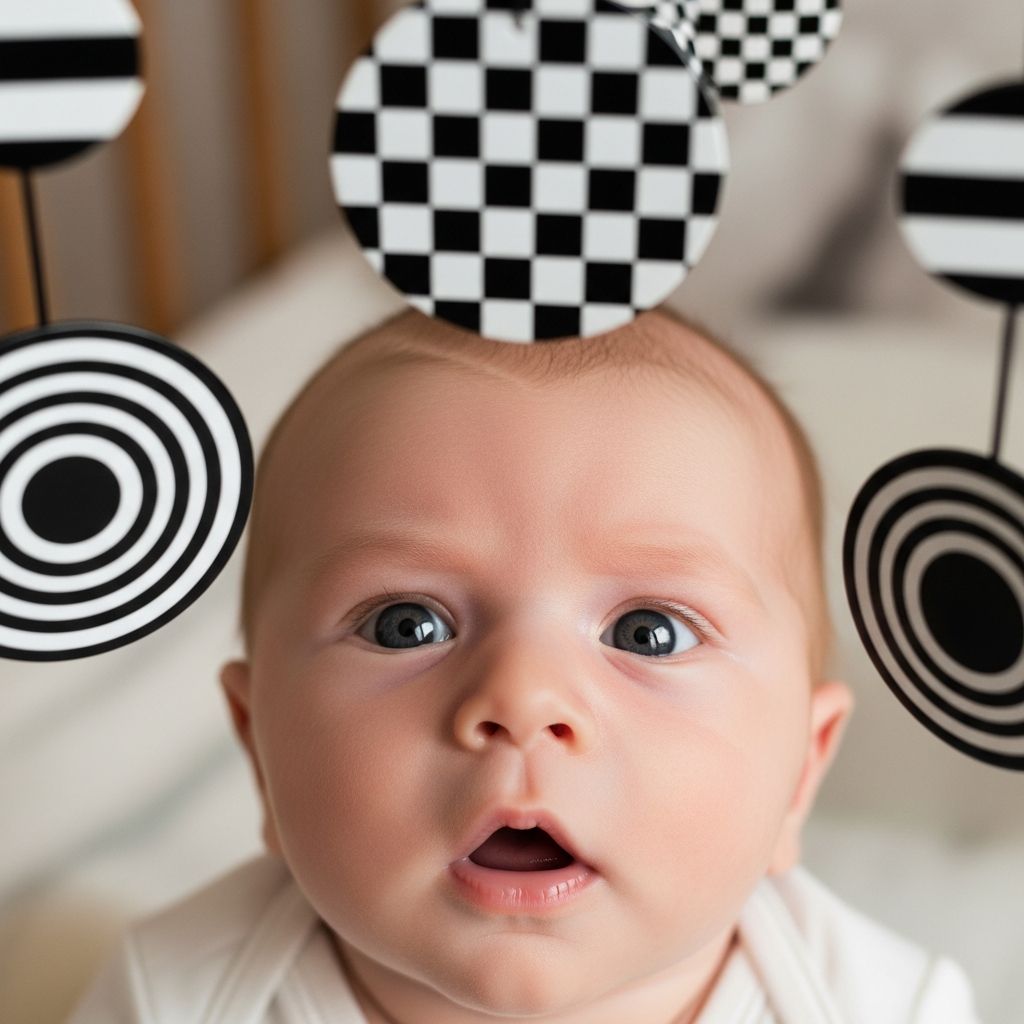
Newborns possess remarkably limited yet purposeful visual abilities, with a strong preference for high-contrast patterns and sharp edges during their first two months. This innate attraction supports foundational eye development and brain-visual connections.
Understanding the Foundations of Infant Eyesight
At birth, a baby’s visual system is immature compared to adults. Their eyes are approximately 65% of adult size, yet the neural pathways linking eyes to brain are still forming. Vision starts as blurry and monochromatic, tuned primarily to detect light, dark areas, and bold boundaries rather than fine details or colors.
Infants see best at 8 to 12 inches, aligning perfectly with a caregiver’s face during feeding. Beyond this range, clarity fades quickly. This setup evolved to prioritize faces and movement, essential for bonding and survival.
- Key initial traits: Black-and-white perception, low light sensitivity, occasional eye wandering due to uncoordinated muscles.
- By one week, subtle color hints emerge, expanding to about 10 inches focus.
- At 6 weeks, range extends to 12 inches, with better fixation.
These early constraints highlight why simple, high-impact visuals captivate babies most effectively.
Why High-Contrast Patterns Captivate Newborns
High-contrast elements—think stark black against white or bold edges—stand out vividly in a newborn’s fuzzy world. Research demonstrates infants turn heads toward such patterns, ignoring low-contrast ones. This preference stems from retinal cells optimized for luminance differences over hues.
Bold patterns activate the visual cortex efficiently, fostering neural growth. Faces, with their curved high-contrast features like eyes and mouth, naturally draw attention, promoting social engagement.
| Visual Stimulus | Newborn Response | Developmental Benefit |
|---|---|---|
| High-contrast stripes or checks | Prolonged gaze, head turning | Strengthens eye muscle control |
| Simple edges (e.g., bull’s-eyes) | Fixation and tracking attempts | Builds focus and attention |
| Low-contrast pastels | Limited interest | Minimal early stimulation |
| Faces at 8-12 inches | Staring, early smiling by 2 months | Enhances bonding and recognition |
This table illustrates prioritized stimuli, guiding parents in selecting toys and decor.
Critical Milestones from Birth to 2 Months
Visual progress accelerates rapidly. Here’s a month-by-month outlook:
Birth to 1 Month
Newborns detect light, shapes, and motion but struggle with coordination. Eyes may cross or drift as muscles mature. They follow slow-moving high-contrast objects briefly, preferring patterns over uniformity.
- Focus: 8-10 inches max.
- Perception: Grayscale dominance.
- Achievement: Blinking to light, turning to faces.
1 to 2 Months
By 2 months, tracking improves; babies follow objects horizontally past midline. Binocular vision emerges intermittently, reducing wandering. They recognize familiar faces and start reaching.
- Enhanced color detection begins.
- Preference for circular contrasts like spirals.
- Social cues: Smiling response to smiles.
These shifts lay groundwork for depth perception and hand-eye coordination later.
Practical Activities to Boost Early Vision
Parents can actively nurture this phase with everyday interactions. Position yourself 8-12 inches away during talks, exaggerating expressions for contrast.
Home-friendly ideas:
- Contrast mobiles: Suspend black-and-white cards or spirals above cribs for passive tracking.
- Face time: Daily close-up play, mimicking expressions to elicit focus.
- Pattern cards: Flash bold zebra stripes or polka dots, slowly moving them side-to-side.
- Mirrors: Safe, high-contrast baby mirrors encourage self-discovery by 2 months.
- Textured toys: Black/red rattles for emerging color and grasp attempts.
Avoid pastels or complex prints initially; stick to simplicity for maximum engagement. Alternate activities to prevent overstimulation—sessions of 5-10 minutes suffice.
Integrating Vision into Daily Routines
Weave stimulation into feeding, diapering, and tummy time. During feeds, maintain eye contact; post-feed, dangle a high-contrast toy for reach practice. Tummy time on a patterned mat builds neck strength alongside gaze following.
Track progress weekly: Note if baby fixes on your face, tracks a rattle, or quiets to patterns. Apps or journals help log these for pediatric visits.
Recognizing Potential Concerns
Most eye wandering resolves by 2 months, but persistent crossing, constant drifting, or no tracking warrants a check. Other red flags: No response to light, unequal pupil size, or excessive tearing.
Early intervention via pediatricians or ophthalmologists can address issues like strabismus effectively. Routine screenings at well-baby visits catch 90% of problems timely.
Frequently Asked Questions
Why does my newborn stare at edges and patterns?
Their visual system prioritizes luminance contrasts for easiest processing, stimulating brain development efficiently.
When should my baby start tracking objects?
Basic following by 1 month, smoother by 2-3 months. If absent at 2 months, consult your doctor.
Are colors important in the first 2 months?
Less so initially; high-contrast black/white/red suffice until full color vision matures around 4 months.
How can I tell if my baby’s eyes are misaligned?
Look for consistent inward/outward turning post-2 months or head tilting to focus. Professional evaluation confirms.
Do screens help early vision development?
Not recommended under 2 months; prioritize real-world contrasts and faces for healthy growth.
Long-Term Impact of Early Visual Stimulation
Strong foundations in these weeks correlate with advanced motor skills, attention, and cognition later. Babies engaged with contrasts show better fixation by 3 months, paving for reaching, crawling, and exploration.
By 3-4 months, expect full-field tracking and color appreciation; by 6 months, adult-like acuity. Consistent stimulation amplifies these gains.
Expert Insights and Evidence
Pediatric authorities like Mayo Clinic note faces and motion as prime attractors, with tracking solidifying by 3 months. Nationwide Children’s emphasizes reaching for bright toys to hone binocular vision. Pathways.org highlights polka dots and red for 0-3 months focus.
These align with experiments showing preferential turning to high-contrast visuals, underscoring their role in neural wiring.
References
- Vision Development Timeline: A Guide for New Mothers — Insight Vision OC. 2023-05-15. https://www.insightvisionoc.com/vision-therapy/vision-development-timeline-a-guide-for-new-mothers/
- Infant Vision Birth to One Year — Nationwide Children’s Hospital. 2024-08-20. https://www.nationwidechildrens.org/family-resources-education/health-wellness-and-safety-resources/helping-hands/infant-vision-birth-to-one-year
- Infant Vision Development: What Can Babies See? — HealthyChildren.org (American Academy of Pediatrics). 2025-01-10. https://www.healthychildren.org/English/ages-stages/baby/Pages/Babys-Vision-Development.aspx
- Infant development: Birth to 3 months — Mayo Clinic. 2024-11-05. https://www.mayoclinic.org/healthy-lifestyle/infant-and-toddler-health/in-depth/infant-development/art-20048012
- Your Baby’s Hearing, Vision, and Other Senses: 2 Months — KidsHealth (Nemours). 2023-12-18. https://kidshealth.org/en/parents/senses-2mos.html
- Parents’ Guide to Baby’s Vision Development — Pathways.org. 2024-03-22. https://pathways.org/videos/parents-guide-babys-vision-development
- Your Baby’s Vision — ZERO TO THREE. 2024-07-30. https://www.zerotothree.org/resource/your-babys-vision/