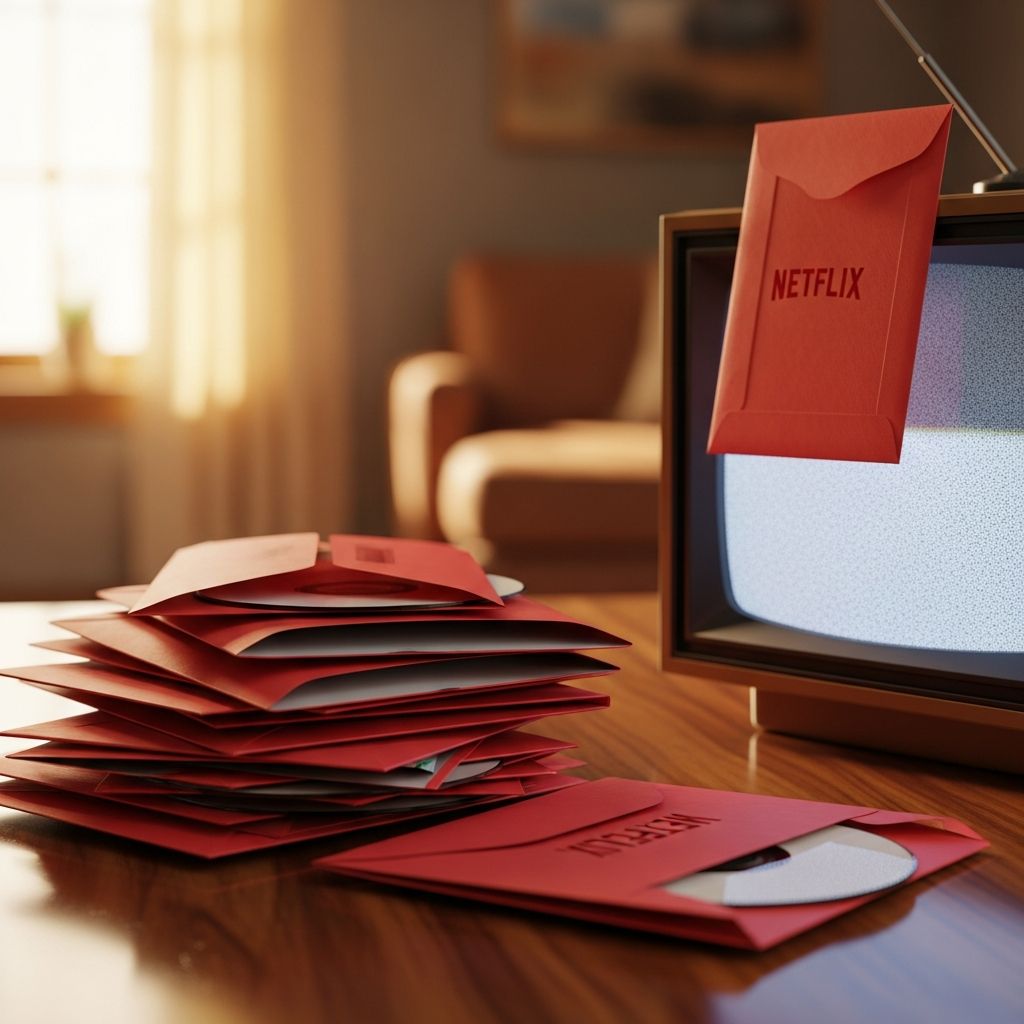
When Netflix announced the shutdown of its DVD-by-mail business, it marked the quiet end of a 25-year experiment that reshaped how people watch movies at home. Long before binge-watching and autoplay, those red envelopes carried the seeds of the streaming revolution.
This article looks back at how the DVD service started, why it mattered, what its end tells us about technology and media, and why a surprising number of people still miss it.
From Mailbox to Couch: How Netflix DVDs Began
Netflix did not start as a streaming giant. In 1997, it was launched as an online DVD rental company, leaning on the then-new digital disc format and the U.S. Postal Service to bypass physical video stores.
Why DVDs in the Mail Were Radical
At the time, VHS tapes still dominated, and only a small share of U.S. homes even owned a DVD player. Still, mailing DVDs unlocked several powerful advantages:
- No stores required – Movies came straight to your mailbox, eliminating the drive to a rental shop.
- Huge catalog potential – Without shelf constraints, Netflix could eventually offer tens of thousands of titles instead of the limited stock of a neighborhood store.
- Flexible delivery – The U.S. Postal Service became the backbone of the logistics system, allowing national reach without retail leases.
In April 1998, Netflix started renting discs by mail, betting that DVD adoption would rise quickly enough to justify the gamble.
The Subscription Twist that Changed Everything
Initially, Netflix used a pay-per-rental model. That changed in 1999, when the company introduced a subscription system: one flat monthly fee for unlimited rentals, with no due dates or late charges.
This model solved several problems that plagued traditional rental stores:
- Late fees were eliminated, removing a major source of customer frustration.
- Subscribers could keep discs as long as they wanted, but had to return them to receive new ones, creating a built-in incentive loop.
- Recurring monthly revenue gave Netflix a more predictable business base than one-off rentals.
In 2000, Netflix doubled down with an all-you-can-watch style plan: unlimited monthly rentals for a fixed price, with several discs out at a time and no per-DVD fees. That simple promise—no late fees, no trips, just movies—became central to Netflix’s identity.
Beating Blockbuster: The Quiet Disruption
At the height of the video store era, chains like Blockbuster relied heavily on late fees and in-store impulse rentals. Netflix attacked both pillars at once.
What Made the Red Envelopes So Dangerous to Video Stores
| Feature | Traditional Rental Store | Netflix DVD-by-Mail |
|---|---|---|
| Access | Drive to physical store | Movies delivered via mail |
| Fees | Late fees and per-title charges | No late fees, flat-rate subscription |
| Selection | Limited shelf space | Vast catalog with deep backlist |
| Convenience | Fixed store hours | Order anytime online |
By delivering via mail and eliminating due dates, Netflix made rental stores feel instantly inconvenient. As more users joined, Blockbuster’s model—built around store visits and fees—struggled to keep up.
The Queue, Algorithms, and the Long Tail
Another innovation was the online queue: subscribers could create a prioritized list of movies they wanted to see next, allowing Netflix to ship the next available title automatically.
This subtle feature had outsized effects:
- It smoothed demand: when new releases were out of stock, older titles could fill in.
- It encouraged discovery of back-catalog films and niche genres.
- It provided Netflix with data on viewing preferences, informing its recommendation system.
Netflix also built an early recommendation engine (Cinematch) to suggest movies based on user ratings, aligning with the emerging concept of the “long tail” — making a business out of less popular titles by surfacing them to the right viewers.
From Discs to Data: The Streaming Transition
Almost from the beginning, Netflix’s founders viewed DVDs as a temporary phase, waiting for internet speeds to catch up to the idea of streaming video on demand.
Planting the Streaming Seed
By the mid-2000s, Netflix was already investing a portion of its revenue into online delivery, even though most customers still relied on physical discs. In 2007, the company officially launched its streaming service, initially as a supplement to DVD subscriptions, with a much smaller catalog than the disc library.
Over time, several turning points shifted the business from discs to data:
- In 2008, subscribers with disc plans gained access to unlimited streaming at no extra fee, seeding the habit of watching online.
- By 2009, streaming views overtook DVD shipments, signaling a decisive change in consumer behavior.
- By 2018, roughly 96% of Netflix’s revenue came from streaming, with DVDs accounting for only a small fraction of its business.
Meanwhile, Netflix moved into producing its own original content, further strengthening the streaming side of the company and reducing reliance on third-party catalogs.
Splitting Services and Rebranding Discs
As streaming grew, Netflix had to reconfigure how discs fit into its identity:
- In 2011, it unbundled pricing, requiring separate subscriptions for DVD rental and streaming access.
- In 2012, Netflix acquired the DVD.com domain and later branded the disc operation as “DVD.com, A Netflix Company,” quietly nudging the DVD business into the background.
For a shrinking but dedicated group of subscribers, the DVD service remained valuable—offering a deeper library and access to films not always available on streaming.
The Long Goodbye: Ending the DVD-by-Mail Era
On April 18, 2023, Netflix announced it would discontinue its DVD-by-mail service on September 29 of the same year. With that final shipping date, the company closed the book on the business model that started it all.
Why Netflix Finally Shut Down the Red Envelopes
Several forces made the decision inevitable:
- Streaming dominance – The vast majority of Netflix revenue and viewing time comes from streaming subscribers worldwide, not DVDs.
- Operational complexity – Maintaining warehouses, disc inventories, and postal distribution for a relatively small user base became harder to justify.
- Changing hardware – Many newer laptops and devices lack DVD drives, and Blu-ray/DVD players are no longer standard purchases for younger households.
- Strategic focus – Shutting down discs allowed Netflix to concentrate resources on streaming, original content, advertising tiers, and new ventures like games.
Over the life of the DVD service, Netflix shipped more than 5 billion discs, a staggering number considering its modest beginnings.
What Happened to the Last Discs?
When the service wound down, subscribers were informed that they could keep any remaining DVDs they had when shipping stopped. This turned many red envelopes into instant keepsakes—a physical reminder of a digital company’s analog roots.
Netflix also had to decide what to do with massive disc inventories and infrastructure that were suddenly obsolete. While details of the internal logistics have been kept modestly framed, the shutdown underscored how quickly technology can turn once-critical hardware into surplus.
Why Some Viewers Still Miss DVDs
To many, the end of Netflix DVDs hardly registered; streaming had already become the default. But for a loyal base of disc subscribers, the closure felt like losing a favorite local video store all over again.
Advantages DVDs Still Had Over Streaming
Even in a world of ultra-fast broadband, the disc model quietly offered benefits that streaming has not fully replicated:
- Richer catalogs – The DVD library carried many classic, foreign, or niche titles that never made it onto streaming platforms.
- Higher bitrates for some content – Physical media can offer more stable image quality and special features than many streaming encodes, especially on slower connections.
- Less fragmentation – With DVDs, you could watch films without juggling multiple apps and subscriptions.
- No sudden removals – Discs aren’t subject to the rotating licensing agreements that cause shows and movies to disappear from streaming libraries.
For rural households or regions with less reliable broadband, DVDs also remained a more dependable way to watch movies without buffering.
Nostalgia and the Ritual of Movie Night
Beyond technical factors, there was an emotional rhythm to the red envelopes:
- Checking the mailbox to see if a new film had arrived.
- Curating and reshuffling a queue of future titles.
- Physically opening the envelope and loading the disc into a player.
That small delay—waiting a day or two for the disc to arrive—often built anticipation. In contrast, infinite streaming choice can sometimes feel overwhelming, leading to endless scrolling instead of intentional viewing.
What the DVD Era Taught Streaming Giants
Netflix’s DVD experiment did far more than move plastic discs around. It fundamentally rewired expectations about home entertainment.
Business Lessons from the Red Envelope Years
Several key principles emerged from the DVD era that still shape streaming services today:
- Customer-friendly pricing wins – Flat-rate, no-late-fee subscriptions proved more appealing than punitive rental models, pressuring competitors to adapt.
- Data is a strategic asset – Queues, ratings, and viewing patterns on discs provided the data foundation for today’s highly tuned recommendation engines.
- Logistics can be a competitive moat – Building a nationwide disc distribution network, then a global streaming infrastructure, demonstrated the value of execution at scale.
- Self-disruption is necessary – Netflix willingly undermined its profitable DVD business to invest in streaming, a risk that many incumbents have struggled to take.
The Legacy of the Red Envelope
By the time the final envelopes went out, Netflix had evolved from a mail-order DVD company into a global entertainment studio. Yet it was the humble disc that allowed the company to:
- Displace entrenched video rental chains.
- Train millions of households to think of movies as something ordered online rather than picked off a shelf.
- Gather the user data and capital required to launch large-scale streaming and original productions.
In that sense, the end of the DVD service is less a failure than the completion of a long-planned transition from physical media to digital delivery.
Frequently Asked Questions (FAQs)
Q1: When did Netflix stop shipping DVDs?
Netflix ended its DVD-by-mail service on September 29, 2023, after 25 years of operation, following an April announcement earlier that year.
Q2: How many DVDs did Netflix send out in total?
Over its lifetime, the DVD-by-mail business shipped more than 5 billion discs to customers in the United States.
Q3: Could subscribers keep their last Netflix DVDs?
Yes. When the service was discontinued, subscribers were allowed to keep the discs they had when shipping stopped, effectively turning them into souvenirs.
Q4: Why did Netflix shut down the DVD service if some people still used it?
The DVD business had become a small part of Netflix’s revenue compared with streaming, and maintaining the logistics network for a shrinking user base no longer fit the company’s long-term strategy.
Q5: Does Netflix still offer any physical media options?
No. After the 2023 shutdown, Netflix fully exited the physical rental space and now focuses on streaming, original programming, and related digital offerings.
References
- Netflix is winding down its DVD-by-mail service for good — Strategyzer. 2023-09-20. https://www.strategyzer.com/library/netflix-is-winding-down-its-dvd-by-mail-service-for-good
- History of Netflix – Founding, Model, Timeline, Milestones — VdoCipher Blog. 2025-01-10 (updated). https://www.vdocipher.com/blog/2017/06/netflix-revolution-part-1-history/
- Netflix — Wikipedia (citing Netflix and other primary sources). 2024-08-01 (updated). https://en.wikipedia.org/wiki/Netflix
- Netflix shutters its DVD rental business, marking the end of the red envelope era — ABC7 / Associated Press. 2023-09-29. https://abc7chicago.com/post/netflix-dvd-service-movies-entertainment/13845216/
- How a DVD rental company changed the way we spend our free time — Business Models Inc. 2018-03-05. https://www.businessmodelsinc.com/en/inspiration/blogs/netflix-how-a-dvd-rental-company-changed-the-way-we-spend-our-free-time