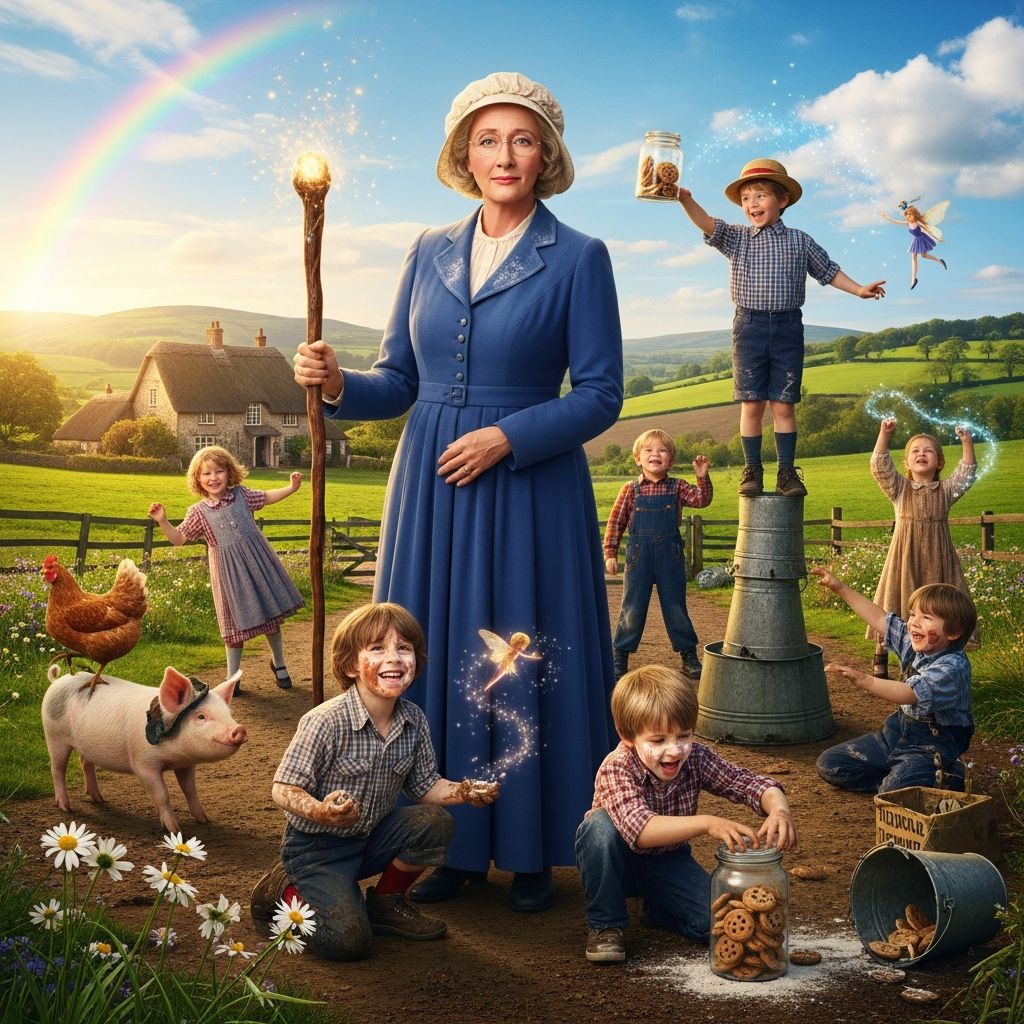
When a mysterious, warty nanny appears at the door of an overwhelmed mother on a battered English farm, chaos slowly transforms into cooperation, courage, and compassion. Nanny McPhee Returns (also known in some regions as Nanny McPhee and the Big Bang) is much more than a simple children’s movie; it is a layered family story that uses fantasy to talk about real emotions, wartime anxiety, and the wild unpredictability of parenting.
Why This Sequel Still Matters for Families
At first glance, Nanny McPhee Returns looks like light entertainment: a farm, some unruly kids, a bit of magic, and a quirky nanny with a walking stick. Underneath that, however, it quietly handles themes that parents recognize all too well—single-handedly juggling work, caregiving, money problems, and children pushing boundaries in every possible way.
The movie is set during wartime, which adds a constant, low-level tension that mirrors the pressures modern families feel in less dramatic but still very real ways—job insecurity, distance between loved ones, and the fear of losing the life they know. Watching this film as a parent is a different experience from watching it as a child; adults see the tired eyes, the overdue bills, and the internal tug-of-war between being patient and simply wanting a moment of quiet.
The Story in a Nutshell (Without Spoilers)
The film follows Isabel Green, a mother trying desperately to keep her small farm and household running while her husband is away at war. Her own children are energetic and often at odds with each other. When wealthy, city-bred cousins unexpectedly arrive, the class clash and personality differences raise the tension even higher. The house becomes a battlefield of pranks, arguments, and emotional outbursts.
Into this whirlwind steps Nanny McPhee: mysterious, stern, and frankly a little alarming to look at. Her approach is not to cushion the children from the consequences of their actions, but to stretch them—sometimes literally and often magically—until they discover their own capacity for teamwork, bravery, and empathy. The magic is silly and spectacular, but its purpose is always to support a lesson rather than overshadow it.
Key Themes Parents Will Recognize
One of the reasons this movie continues to resonate is that it speaks directly to the emotional load of parenting in a way children can also enjoy. Below are some of the most striking themes running through the story:
- The invisible work of caregiving: Isabel’s constant rushing from one responsibility to the next captures the feeling of being needed by everyone, all the time, with never quite enough of yourself left to give.
- How children act out when they are scared: The kids are not simply naughty for the fun of it. Their pranks and rivalry often sit on top of deep worries about war, separation, and whether the adults in their lives can actually keep them safe.
- Blending different worlds: Country children and city cousins start off disliking each other intensely. Their journey toward understanding hints at how kids can learn to respect differences in class, culture, and upbringing.
- The importance of truth and trust: Rumors, half-truths, and outright lies threaten the family’s security. Several characters are forced to choose between self-protection and honesty, showing young viewers how integrity can change the direction of a story.
- Letting children prove themselves: Nanny McPhee repeatedly steps back at critical moments, allowing the children to rise to challenges that even adults around them fear.
The Magic Formula: Humor, Fantasy, and Real Emotion
Much of the movie’s charm comes from how it balances slapstick comedy with emotionally grounded moments. There are scenes involving highly inventive farm animals, impossible physics, and absurdly heightened situations that make children roar with laughter. Just when the jokes threaten to tip into pure chaos, the story shifts back to something quieter: a worried child, a frightened adult, or a hard truth about wartime uncertainty.
This rhythm matters for family viewing. It allows younger children to enjoy the surface fun while older kids and parents pick up on the more subtle shifts in tone. The magical nanny becomes a guide through both moods. Her facial expressions are often understated, but the film uses her presence as a kind of emotional barometer—when she softens, you know a breakthrough has happened; when she hardens, a lesson is on its way.
Emma Thompson’s Signature Touch Behind the Story
The film benefits enormously from the guiding presence of Emma Thompson, who not only plays Nanny McPhee but also shaped the character’s voice and worldview in the series. That dual role helps explain why the nanny never becomes a mere visual gimmick. She feels like a firmly rooted character with consistent beliefs, a clear sense of justice, and a quiet tenderness she rarely shows outright.
Thompson’s take on this magical figure resists the temptation to make her perfect or endlessly cheerful. Instead, Nanny McPhee is slightly intimidating, unbending when necessary, and disarmingly funny when the situation calls for it. Her imperfections—warts, unibrow, and all—become an intentional statement that authority and wisdom do not have to look glossy or glamorous to deserve respect.
Character Relationships That Drive the Plot
Beneath the spectacle, the film is held together by a network of relationships: between siblings, between cousins, between adults and children, and between those who tell the truth and those who do not. These bonds and fractures quietly shape every decision.
| Relationship | Initial State | How It Evolves | Key Lesson |
|---|---|---|---|
| Isabel and her children | Stressed mother, resentful and unruly kids | Gradually shift toward mutual understanding as each side sees the other’s struggles more clearly | Communication and empathy turn chaos into cooperation. |
| Country kids vs. city cousins | Snobbery on one side, suspicion on the other | Shared danger and shared responsibility break down class and personality barriers | Common goals matter more than background or status. |
| Children and Nanny McPhee | Fear, defiance, and skepticism | Respect grows as they see she believes in their abilities, not just punishes their mistakes | Real guidance challenges children but never writes them off. |
| Isabel and certain adult relatives | Unequal power and financial pressure | Truth-telling slowly exposes manipulation and greed | Standing up for what is right may be risky but is often necessary. |
The power of these dynamics is that none of them are resolved purely by magic. The magic creates opportunities—sudden crises, absurd challenges, and visual metaphors—but the emotional work still belongs to the characters.
Lessons the Film Gently Teaches Children
Unlike some overtly didactic movies, this film usually lets children deduce the message from what happens on screen rather than having a character spell it out. That subtlety makes the lessons easier to discuss afterward, because young viewers feel they discovered the insight themselves.
Five Big Ideas Kids Can Take Away
- Teamwork beats trickery: The children spend much of the movie either sabotaging or competing with one another. They only make real progress once they stop trying to score points and start sharing burdens.
- Appearances are misleading: Nanny McPhee looks frightening at first, but her actions steadily prove her to be the safest adult in the room. The same goes for other characters who appear polished yet hide questionable motives.
- Bravery is not loud: Some of the bravest choices in the film are quiet—telling the truth when it might upset someone, trusting a friend when the outcome is uncertain, or admitting a mistake.
- Everyone carries worries: Country kids, city cousins, and adults all have private fears—war, divorce, money troubles, loneliness. The movie hints that recognizing this shared vulnerability is the first step toward kindness.
- Help often arrives in unusual forms: Nanny McPhee’s arrival is not comfortable or convenient, but she is exactly what the family needs. Children see that support may not look like what they expect, yet still be deeply valuable.
Is Nanny McPhee Returns Right for Your Kids?
For families considering a movie night, it helps to know that this film mixes slapstick humor and fantasy with more serious themes, including war, separation from a parent, and some moments of genuine peril. While nothing is graphic or gratuitous, sensitive or very young children may have questions or feel uneasy during certain scenes.
On the positive side, the movie models resilience, honesty, and compassion, and it offers plenty of visual comedy to soften the heavier moments. It lends itself to follow-up conversations about why the characters behaved the way they did, what bravery looks like, and how families cope when someone is far from home.
Quick Parent Checkpoints
- Expect a few sequences involving danger, but they are framed in a way that emphasizes courage and problem-solving.
- Wartime context is present but not graphically depicted; it operates more as emotional background than as a focus of action.
- Comic set pieces with magical animals and exaggerated physical humor keep the tone accessible for school-aged children.
- The movie is especially well-suited for ages old enough to follow the emotional arcs (roughly early elementary and up), though slightly younger siblings may still enjoy the colorful chaos.
Conversation Starters After the Credits Roll
One of the film’s great strengths is that it leaves families with plenty to talk about, without feeling like homework. Turning a fun movie night into a gentle conversation can help children process what they have seen and link it to their own experiences.
- “Why do you think the kids were so mean to each other at first?” This opens a door to discussing jealousy, fear, and how big transitions (like moving house or changing schools) can fuel unkind behavior.
- “Which character changed the most?” Kids might point to a cousin who becomes kinder or a sibling who steps up in a moment of danger, giving you a chance to highlight the idea that people are not stuck being one way forever.
- “What do you think Nanny McPhee believed about kids?” This question nudges children to notice that she always assumes they are capable of growth, even when they mess up.
- “If you had her magic stick, what problem would you solve at home or school?” A playful way to uncover worries or frustrations your child might not otherwise share.
Frequently Asked Questions About Nanny McPhee Returns
Is it necessary to watch the first Nanny McPhee film before this one?
No, the story in Nanny McPhee Returns stands on its own, with a new family, a new setting, and a fresh set of challenges. Children and adults can fully understand the plot and emotional stakes without any prior knowledge of the earlier movie. Fans of the original may notice small nods to the previous installment, but they function more as fun bonuses than essential plot points.
How scary are the intense scenes for young viewers?
The film includes moments of danger and wartime anxiety, but they are presented with restraint and generally resolved through teamwork and courage. For most school-aged children, the tension is likely to feel exciting rather than overwhelming, especially when watched with a trusted adult who can offer reassurance or pause to talk things through.
What makes Nanny McPhee different from other magical nannies in movies?
Unlike some more whimsical, endlessly cheerful magical caretakers, Nanny McPhee initially appears strict, even forbidding, and her magic often disrupts comfort rather than providing it instantly. Her main goal is not to entertain, but to awaken responsibility, empathy, and self-belief in the children she helps. That sharper edge gives the film a distinctive tone while still leaving plenty of room for warmth and humor.
Is the movie only for children, or will adults enjoy it too?
Adults, especially parents and caregivers, are likely to see themselves in Isabel’s exhaustion, her love for her children, and her occasional moments of doubt. The script includes plenty of subtle jokes and emotionally resonant beats that land most strongly with older viewers. For many families, the real magic lies in watching different generations respond to the same story in their own ways.
What values does the movie promote?
The film champions cooperation, honesty, kindness across class and background, and the courage to stand up for what is right even when it is inconvenient or scary. Instead of delivering these messages as lectures, it lets them grow naturally out of the characters’ choices and the consequences they face. Children leave with the impression that goodness is an active practice, not just a label.
Final Thoughts on This Wartime Fairy Tale
Nanny McPhee Returns wraps everyday parenting struggles and childhood anxieties in a warm, funny, and occasionally chaotic magical package. Its enduring appeal comes from its willingness to take children’s feelings seriously while still giving them plenty to laugh at. For families looking for a movie that entertains while gently opening the door to deeper conversations, this warty nanny and her stubborn, lovable farm kids are well worth inviting into the living room.