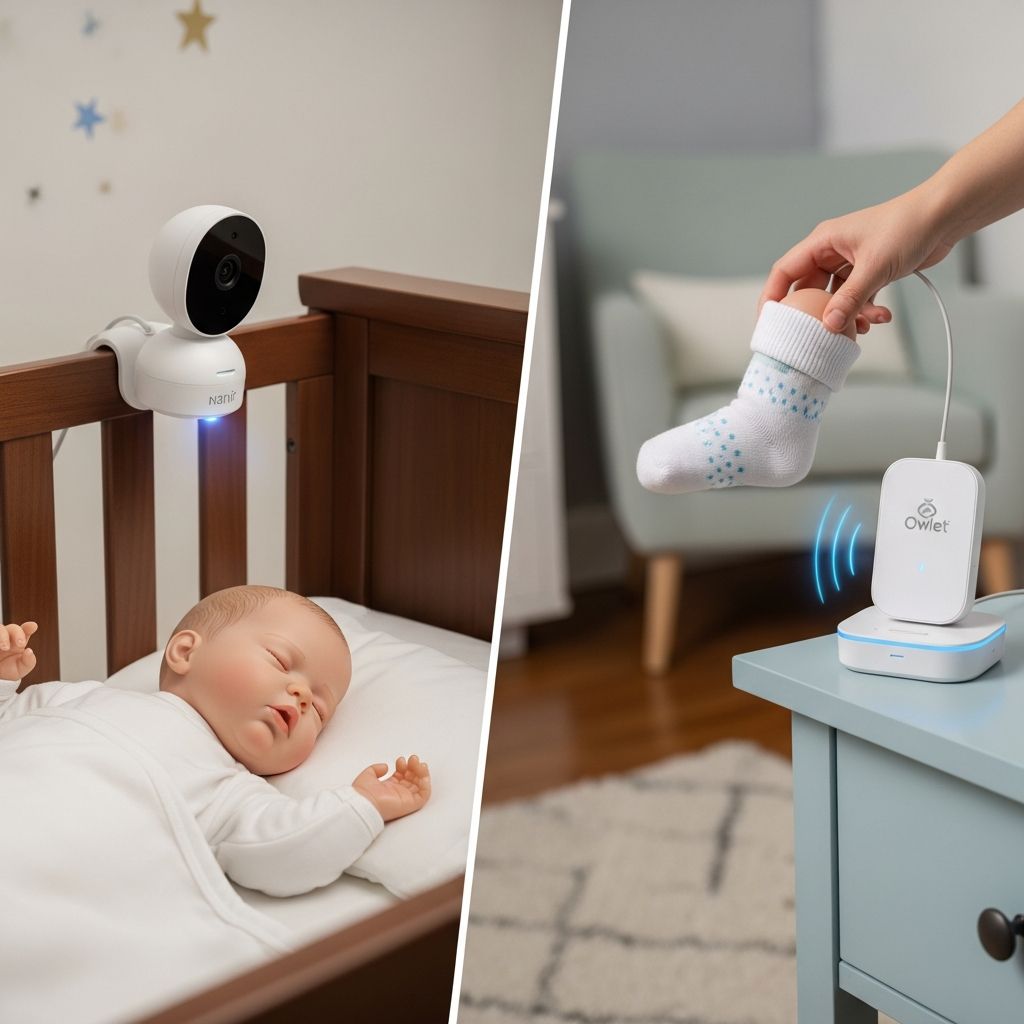
Smart baby monitors like Nanit and Owlet promise better sleep and more peace of mind by combining cameras, apps, and health or sleep tracking. This guide walks through how they differ, what they do well, and which one may be a better match for your family’s needs.
Understanding What These Monitors Actually Do
Both Nanit and Owlet go far beyond a basic audio or video monitor. They connect to your home Wi-Fi, stream video to your phone, and analyze sleep. Where they differ most is in how they track your baby:
- Nanit focuses on sleep environment, behavior, and breathing motion using a camera plus special patterned sleepwear, without measuring vital signs directly.
- Owlet centers on monitoring heart rate, oxygen saturation, and sleep trends through a wearable smart sock, plus a separate camera for video.
Major pediatric organizations emphasize that no consumer monitor can prevent sudden infant death syndrome (SIDS) and that safe sleep practices (firm surface, back sleeping, empty crib) remain the most important factors. Treat these products as tools for observation and convenience, not as medical devices or guarantees of safety.
Core Differences at a Glance
| Feature | Nanit (e.g., Nanit Pro) | Owlet (e.g., Dream Duo / Dream Sock + Cam) |
|---|---|---|
| Main focus | Sleep analytics, breathing motion tracking, video | Heart rate & oxygen trends, sleep metrics, video |
| Health data type | Monitors chest motion via patterned fabric; no vitals | Monitors pulse and oxygen saturation via smart sock sensors |
| Wearables | Breathing band / sleepwear with printed pattern | Soft sock worn on foot for babies roughly 1–18 months |
| Sleep coaching | Detailed coaching and personalized tips based on sleep data | Uses age and recent sleep to suggest wake windows and bedtimes |
| Security | 256-bit AES encryption with two-factor authentication | 128-bit encryption for video and data |
| Mounting & stands | Wall mount, floor stand, and portable stand options | Magnetic base with wall mount; fewer stand styles |
| Video & streaming | HD video with night vision; split-screen for multiple kids | HD video with night vision; no split-screen |
| Age range focus | Newborn through toddler and early childhood | Primarily newborns and infants up to about 18 months |
How Nanit Works: Camera-Centered Monitoring
Nanit is built around an overhead camera that looks down into the crib, paired with an app that interprets what it sees.
Key Nanit Features
- High-definition video with night vision and secure streaming.
- Sleep analytics summarizing how long your baby slept, how often they woke, and when they settled.
- Breathing motion monitoring using special sleepwear or a band with a geometric pattern the camera can track.
- Room sensors for temperature and humidity, which can influence infant comfort and sleep quality.
- Smart alerts for sound, motion, crying, standing, or leaving the bed, tailored to age and stage.
- Developmental milestone clips capturing events like rolling, sitting, or standing.
Independent product reviewers often highlight Nanit’s video clarity and sleep analytics. Thorough testing in consumer labs has found that HD video and well-designed apps can make it easier for parents to monitor sleep without constantly going into the nursery.
How Owlet Works: Sock-Centered Monitoring
Owlet’s defining feature is the Dream Sock, a soft wrap that goes around your baby’s foot and uses sensors to detect heart rate, oxygen saturation, and sleep trends.
Key Owlet Features
- Wearable smart sock that tracks pulse and oxygen levels while your baby sleeps.
- Sleep trend data like total sleep time, awakenings, and approximate sleep cycles.
- Notifications when readings move outside preset ranges or when your baby cries or moves.
- HD camera (sold as part of bundles) for live video with night vision and two-way audio.
- App-based insights such as wake-window suggestions based on age and recent sleep.
Baby-gear testers frequently note that Owlet is particularly appealing to parents of preterm or medically fragile infants because it tracks physiological signs, though professional bodies caution that data from consumer wearables should not replace medical care or clinical monitoring.
Privacy, Security, and Data Protection
Any Wi-Fi–connected monitor raises questions about who can see your video feed and how data is protected.
- Nanit uses 256-bit AES encryption and offers two-factor authentication, which aligns with best practices for consumer IoT security.
- Owlet uses 128-bit encryption, which is still encrypted but technically less robust than 256-bit.
Security-focused consumer testing organizations advise parents to keep firmware updated, use strong unique passwords, and enable multi-factor authentication when available, regardless of brand.
Everyday Usability: Setup, Mounting, and App Experience
Camera Placement and Stands
- Nanit offers several mounting options: a fixed wall mount, an adjustable floor stand, and a portable stand for travel or moving between rooms.
- Owlet typically provides a camera with a magnetic base and wall mount, with fewer stand configurations.
Overhead mounting, as used by Nanit’s main configuration, helps minimize blind spots and can improve consistency of sleep and motion tracking.
App Design and Multi-Child Viewing
- Nanit app: emphasizes detailed sleep graphs, milestone clips, and multi-camera split-screen viewing for families with more than one child.
- Owlet app: focuses on live heart rate and oxygen numbers, sleep summaries, and short video clips tied to notifications.
For families with twins or multiple young children, split-screen support can make a noticeable difference in day-to-day monitoring convenience.
Sleep Coaching and Education
Both brands try to turn raw data into practical tips, but the depth of coaching differs.
- Nanit provides in-app guidance written by pediatric sleep specialists, plus personalized tips and age-based plans that adjust with your child’s development.
- Owlet offers more lightweight guidance, using age and recent sleep history to recommend nap and bedtime windows.
Research in pediatric sleep medicine shows that consistent routines, appropriate bedtimes, and a calm sleep environment have strong evidence for improving infant sleep, regardless of the specific brand of monitor used. Monitors can support these efforts by helping parents identify patterns and stick with changes.
Cost Considerations and Ongoing Expenses
Pricing changes frequently, but both systems are considered premium baby monitors.
- Hardware: Expect higher upfront costs than basic audio or non-smart video monitors.
- Accessories: Nanit breathing wear and Owlet socks may need additional sizes or backups as your baby grows.
- Subscriptions: Each brand may offer optional paid tiers unlocking longer video history or more advanced analytics.
Independent lab testing of baby monitors consistently shows that advanced features like sleep tracking and HD video push prices up compared with simpler monitors, so families should weigh how much they will truly use analytics versus basic audio and video.
Safety, Limitations, and What Pediatric Experts Say
It is crucial to understand what these devices can and cannot do.
- The American Academy of Pediatrics (AAP) advises against relying on consumer heart rate or oxygen monitors as a strategy to reduce SIDS risk.
- Safe sleep recommendations include back sleeping, a firm flat surface, and an empty crib without loose bedding or bumpers.
- Studies of so-called “smart” monitors show variability in accuracy compared with clinical-grade equipment, particularly for oxygen saturation readings.
Parents who choose Owlet for physiologic monitoring should treat alerts as prompts to check on their baby and, when concerned, to seek medical advice rather than assuming normal readings guarantee safety.
Who Nanit May Be Best For
Nanit tends to suit families who:
- Want detailed sleep analytics and coaching to improve overnight routines.
- Prefer no wires or electronics on the baby, relying instead on camera-based breathing motion tracking.
- Have more than one child and value split-screen viewing.
- Plan to keep using the monitor into the toddler and preschool years.
Who Owlet May Be Best For
Owlet may be a better fit for families who:
- Strongly value seeing heart rate and oxygen saturation trends while baby sleeps.
- Are comfortable with a wearable sock and committed to using it consistently.
- Want simple, quick insights into wake windows and basic sleep patterns.
- Primarily care about monitoring during the first 12–18 months of life.
Checklist: Questions to Ask Before You Choose
- Do I care more about sleep coaching and environment, or about vital sign trends?
- Will I realistically keep up with a washable wearable, or is a camera-only solution more practical?
- How many children will I monitor now or soon, and do I need multi-camera or split-screen options?
- Is my home Wi-Fi strong and reliable enough for HD video streaming?
- What is my total budget, including possible subscriptions and accessories?
Frequently Asked Questions (FAQs)
Can either Nanit or Owlet prevent SIDS?
No. According to the American Academy of Pediatrics, no home monitor has been proven to reduce SIDS risk, and the safest approach is following established safe sleep guidelines such as back sleeping and an empty crib.
Is a smart baby monitor necessary, or will a basic monitor do?
Many families manage well with a simple audio or standard video monitor. Smart monitors like Nanit or Owlet mainly add convenience, remote access, and data about sleep or physiology. Testing by independent reviewers shows that while smart features can be helpful, they are not required for healthy infant sleep.
Are the oxygen and heart rate readings from Owlet medical-grade?
Owlet is marketed as a consumer product, not as a medical device. Studies of consumer baby vital-sign monitors have found variable accuracy compared with hospital-grade equipment, and professional societies recommend not using them as substitutes for medical monitoring or diagnosis.
Will Nanit’s breathing motion monitoring work if my baby rolls over?
Nanit is designed to track chest and torso motion through a high-contrast pattern in its breathing wear, and it can function in different sleep positions. However, any camera-based system can face challenges if the pattern is obscured or out of view, so it should always be used in combination with direct supervision and safe sleep practices.
What if my Wi-Fi goes down?
Both Nanit and Owlet depend on Wi-Fi for app streaming. If your network drops, you can lose access to live video and some alerts. Consumer testing organizations recommend placing the router where it can reach the nursery reliably and considering backup options like a basic audio monitor if your connection is frequently unstable.
References
- Nanit vs. Owlet: How Do They Compare? — Nanit Labs. 2024-05-01. https://www.nanit.com/blogs/parent-confidently/nanit-vs-owlet
- Nanit Pro Complete Monitoring System Review — ParentCalc. 2025-01-10. https://parentcalc.com/best/baby-monitors-2025
- Best Baby Monitors of 2025 — Consumer Reports. 2025-02-15. https://www.consumerreports.org/babies-kids/baby-monitors/best-baby-monitors-a8598638140/
- The 10 Best Baby Monitors of 2025 | Tested & Rated — BabyGearLab. 2025-03-20. https://www.babygearlab.com/topics/health-safety/best-baby-monitor
- Sleep-Related Infant Deaths: Updated 2022 Recommendations for Reducing Infant Deaths in the Sleep Environment — American Academy of Pediatrics. 2022-06-21. https://publications.aap.org/pediatrics/article/150/1/e2022057990/188435
- Smart Home Infant Monitors: A Systematic Review — Journal of Clinical Sleep Medicine. 2020-08-15. https://jcsm.aasm.org/doi/10.5664/jcsm.8464