In 1986, at the height of toy-driven cartoons, Hasbro released the first theatrical My Little Pony: The Movie—a surprisingly dark, witch-heavy fantasy quest packed with songs, celebrity voices, and blatant toy synergy. What arrived in theaters was not just an extended commercial, but a bizarre mix of cute ponies, body-horror slime, and apocalyptic stakes that confused critics, unsettled some kids, and quietly reshaped how studios approached animated toy movies.
The High-Stakes World Behind the Ponies
To understand why this film exists, you have to start with the 1980s toy and TV ecosystem. The decade saw a surge in cartoons that doubled as long-form advertisements; U.S. deregulation of children’s TV advertising in the early 1980s loosened rules that had previously limited program-length commercials, allowing toy companies to tightly integrate shows and products. My Little Pony fit directly into this wave, joining other Hasbro lines like Transformers and G.I. Joe, which also leapt from toy shelves to television and then to theatrical films.
By mid-decade, the first generation of My Little Pony toys had become a massive hit. Hasbro’s next logical step was a feature film meant to:
- Reinforce the brand with a big-screen event
- Introduce new characters and creatures that could be turned into toys
- Compete with other studio-backed animated features for family audiences
On paper, it looked like a can’t-miss strategy. In practice, the film’s tone and box-office performance told a different story.
A Fairy-Tale Plot with Surprisingly Grim Edges
The story is set in Ponyland, where pastel ponies prepare for a bright and cheerful spring celebration. Their happiness is threatened by a trio of witches—Hydia and her bumbling daughters Reeka and Draggle—who live in a volcanic lair and want to turn the land “dark, dank, and dreary.”
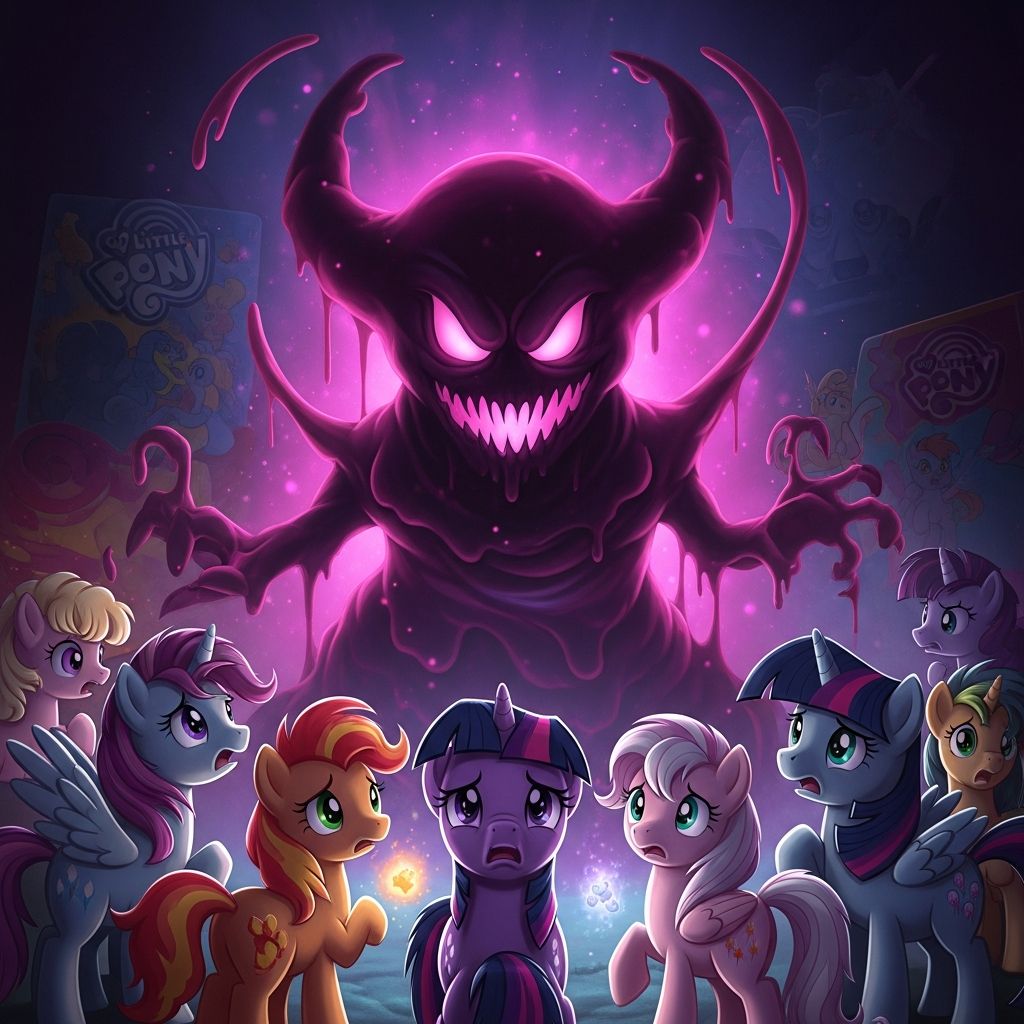
Instead of a simple prank or minor disruption, the witches unleash the Smooze, a massive, corrosive purple sludge that behaves like a living flood. It engulfs the ponies’ homes, ruins their festival, and literally buries their world under sticky doom. For a movie marketed to young children, the imagery is surprisingly intense: structures are consumed, characters are nearly overwhelmed, and the sense of creeping inevitability feels almost apocalyptic.
To stop the Smooze, the ponies must:
- Seek help from their human friend Megan and her siblings
- Consult eccentric allies like the Moochick for guidance
- Embark on a quest to find the elusive Flutter Ponies, whose magic is the only force powerful enough to halt the slime.
Amid this, a parallel emotional plot follows Baby Lickety-Split, a young pony who ruins a dance performance, is scolded, and runs away in distress. Her personal journey intersects with the larger battle, giving the film a blend of character drama, fantasy quest, and disaster movie pacing.
Meet the Cast: Ponies, Witches, Dragons, and Grundles
One of the film’s oddest charms is its sheer variety of creatures and personalities. The world feels crowded, often confusingly so, but also vividly imaginative.
| Character / Group | Role in the Story | Notable Traits |
|---|---|---|
| Little Ponies | Central heroes defending their home | Pastel colors, musical numbers, strong group identity |
| Hydia, Reeka, Draggle | Witches who create and unleash the Smooze | Comedic cruelty, slapstick failures, volcanic lair |
| Flutter Ponies | Reclusive saviors with unique magic | Delicate design, powerful “Utter Flutter” ability |
| Spike the Baby Dragon | Comic-relief companion and emotional anchor | Snarky, loyal, frequently in danger |
| Grundles | Grotesque-looking but friendly creatures | Initially mistaken for monsters, ultimately allies |
The witches’ lair, carved into an active volcano, looks like it belongs in a very different film, especially when contrasted with the ponies’ candy-colored world. The Grundles, who resemble lumpy trolls, introduce a theme of “don’t judge by appearances,” but their design also contributes to the movie’s unexpectedly eerie aesthetic.
Animation, Music, and the “Too Much of Everything” Problem
The film was produced by Sunbow Productions and Marvel Productions, with animation work handled by both AKOM and Toei Animation. That split results in stylistic shifts: some sequences are smoother and more detailed, while others look cheaper or more limited, a contrast that can pull attentive viewers out of the story.
Stylistically, the movie leans heavily on:
- Big ensemble musical numbers that repeatedly halt the plot so characters can sing about feelings, plans, or comic mishaps
- Slapstick comedy, especially focused on the witch sisters, who are constantly falling, tripping, and miscasting spells
- Visual excess, with swirling slime, flying ponies, living trees, and animated landscapes crowding the frame
For some children, this density was thrilling; for others, it was overwhelming. Adult viewers revisiting the film often note that the movie feels both busy and strangely slow, as songs and gags repeat while the central Smooze crisis slowly escalates.
Star Power in a Toy Commercial
One of the most fascinating aspects of the 1986 movie is its cast. Hasbro and the production teams recruited an impressive roster of performers more commonly associated with prestige projects or adult-leaning comedy.
Notable voices include:
- Cloris Leachman as Hydia, bringing a mix of menace and sarcasm
- Rhea Perlman as Reeka, giving the character a chaotic, bickering energy
- Danny DeVito as the Grundle King, lending gravelly humor and unexpected charm
- Charlie Adler as Spike the dragon, early in a long voice-acting career
This strategy mirrored a broader trend in animation, where recognizable live-action actors were increasingly used to help market family films. However, for a brand aimed primarily at young girls and tied closely to toy aisles rather than to box-office prestige, the star power did not translate into ticket sales.
Box Office Reality: From Big-Screen Bet to Modest Footnote
Despite the marketing push and the popularity of the toys, My Little Pony: The Movie struggled in theaters. It earned an estimated $6 million worldwide against a production budget of around $5.5 million, leaving very little room for profit once marketing and distribution costs are considered. Its limited initial release and stiff competition from other family titles did not help.
The film’s poor performance mattered beyond Ponyland. Paired with the disappointing theatrical return of The Transformers: The Movie, it contributed to a shift in strategy: Hasbro’s planned G.I. Joe: The Movie skipped theatrical release entirely and went direct to video, a lower-risk route for toy-based stories.
In other words, the 1986 pony film quietly helped close the brief window in which toy companies were willing to gamble on big theatrical runs for animated spin-offs.
Too Scary? The Film’s Reputation Among Kids and Parents
One reason often cited for the film’s failure is that it may have misjudged its core audience. Visually and thematically, the movie leans darker than many parents expected from a brand known for rainbows and hearts. The Smooze functions like an unstoppable, encroaching force that even magical artifacts struggle to slow, and the fear of total annihilation hangs over multiple sequences.
For some children, this level of threat was exhilarating. For others, it was nightmare fuel. When combined with:
- Witches who openly revel in causing misery
- Grotesque allies like the Grundles
- Extended scenes of destruction and entrapment
the overall tone edges toward psychological intensity rather than lighthearted adventure. Anecdotal accounts from adults who saw the film as kids often recall specific images—the rising slime, the looming volcano, the frantic attempts to find the Flutter Ponies—as strikingly frightening compared with what they expected from a pony movie.
The Toy Logic Beneath the Fantasy
Despite its narrative oddities, the film is carefully structured around toy logic. Every major new faction or environment corresponds neatly to a potential product line:
- The Flutter Ponies introduce a winged, delicate subset of ponies with unique powers
- The Grundles add a contrasting, monster-adjacent group for play scenarios
- The Smooze and volcanic lair supply antagonistic playsets and story hooks
- Multiple background ponies appear briefly but memorably, functioning as catalog cameos
In that sense, the film is a textbook example of 1980s transmedia marketing: narrative and merchandise are inseparable, each designed to reinforce the other. Yet the creative teams also snuck in genuine moments of character conflict, like Baby Lickety-Split’s feelings of rejection, that go beyond the simple “buy this” impulse and speak to common childhood anxieties.
From Forgotten Flop to Cult Curiosity
In theatrical terms, the movie vanished quickly. But in the home-video era, it found a second life, especially among:
- Fans of the original G1 My Little Pony toy line and animated specials
- Animation enthusiasts curious about pre-digital, hand-drawn toy tie-ins
- Viewers attracted to unintentionally strange or tonally offbeat children’s films
As later generations discovered My Little Pony: Friendship Is Magic and the franchise regained cultural visibility, the 1986 film became a historical curiosity: a look at how the brand first tried (and failed) to command cinemas. Its witches, Smooze, and Flutter Ponies feel like artifacts from a weirder, less carefully managed era of children’s media.
Today, the movie is often discussed less as a beloved classic and more as a fascinating misstep—a work that is simultaneously cynical in its merchandising goals and oddly sincere in its attempt to tell a grand, perilous story about friendship, fear, and second chances.
Frequently Asked Questions (FAQs)
Q: Is the 1986 My Little Pony: The Movie part of the same continuity as later pony shows?
A: No. The 1986 film belongs to the first generation (G1) of My Little Pony media and serves as a prelude to the 1980s series My Little Pony ‘n Friends. Later shows, such as Friendship Is Magic, reboot the universe with new settings, lore, and character designs.
Q: Why did the movie perform so poorly at the box office?
A: Several factors contributed, including a relatively small theatrical rollout, competition from other family films, and a tone that may have been darker and stranger than parents expected from the brand. Its modest $6 million gross against a production budget near $5.5 million left little room for profit.
Q: Is the movie too scary for young children?
A: That depends on the child. The film includes threatening witches, a destructive living slime, and scenes of large-scale peril that some viewers find more intense than typical pony cartoons. Sensitive kids may find aspects of it frightening, while others might enjoy the heightened stakes.
Q: What makes the 1986 movie interesting to watch today?
A: Beyond nostalgia, it offers a snapshot of 1980s toy marketing, early celebrity voice casting in animation, hand-drawn fantasy visuals, and a surprisingly dark narrative wrapped around a pastel toy brand. It also helps explain why later My Little Pony media took different creative and commercial directions.
Q: Did this film influence other Hasbro projects?
A: Yes. Its weak box-office showing, combined with that of The Transformers: The Movie, led Hasbro and its partners to reconsider theatrical releases for similar projects; most notably, G.I. Joe: The Movie was shifted to a direct-to-video release instead of heading to cinemas.
References
- My Little Pony: The Movie (1986) (Western Animation) — TV Tropes. 2024-05-01 (last updated, approximate). https://tvtropes.org/pmwiki/pmwiki.php/WesternAnimation/MyLittlePonyTheMovie1986
- My Little Pony: The Movie — My Little Pony G1 Wiki. 2023-11-10 (last updated, approximate). https://mylittleponyg1.fandom.com/wiki/My_Little_Pony:_The_Movie
- My Little Pony: The Movie (1986) — Box Office & Trivia — IMDb. 2024-01-15 (last updated, approximate). https://www.imdb.com/title/tt0091584/
- My Little Pony: The Movie (1986) — Moviepedia (Fandom). 2022-06-20 (last updated, approximate). https://movies.fandom.com/wiki/My_Little_Pony:_The_Movie_(1986)
- G1 Media Retrospective: My Little Pony: The Movie — The MLP Arena. 2017-08-14. https://mlparena.com/index.php?topic=390984.0