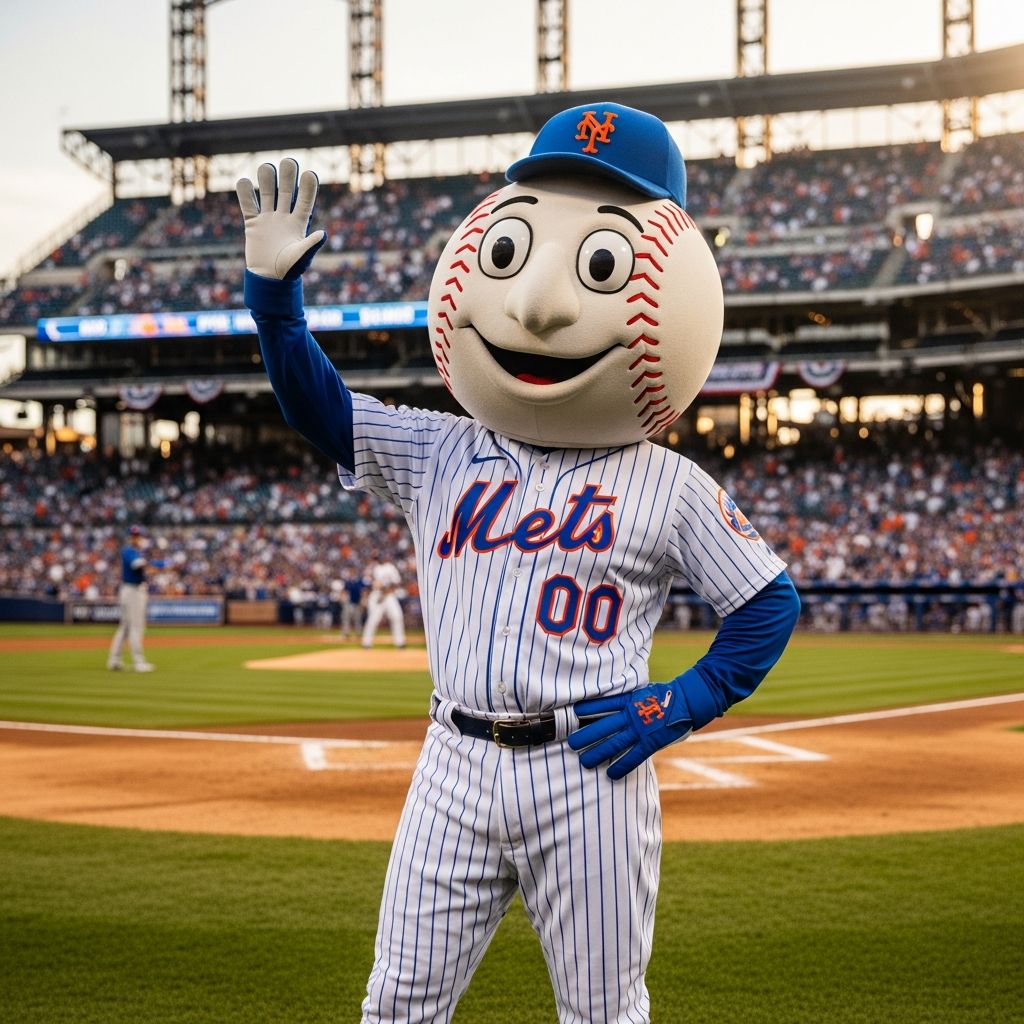
Among the sea of fuzzy creatures racing across dugouts and dance-cam clips, Mr. Met stands out for one simple reason: he isn’t just a mascot, he is the identity of a franchise made human. In a sport built on ritual, nostalgia, and heartbreak, this smiling baseball-headed figure has quietly become one of Major League Baseball’s most enduring symbols of fandom.
The Unusual Appeal of a Man With a Baseball for a Head
Mascots are supposed to be fun, loud, and a little ridiculous. Mr. Met is all of those things, but he is also oddly relatable. There is no animal costume, no mythical creature—just a man, in a uniform, whose head happens to be an oversized baseball. According to the New York Mets’ own historical materials, Mr. Met is widely recognized as the first full-time human-form mascot in Major League Baseball, predating the wave of modern mascots that followed in the late 1970s and 1980s.
His look is simple: a Mets uniform, a big round head, and an unwavering grin. That simplicity has helped him age gracefully. While other mascots have gone through redesigns or been retired, Mr. Met still looks like he belongs in both a black-and-white yearbook and a high-definition scoreboard animation.
From Yearbook Sketch to Ballpark Fixture
Long before Mr. Met was high-fiving fans at Citi Field, he began as a drawing tucked inside team programs and yearbooks. In 1963, when the Mets were still playing at the Polo Grounds, fans first met Mr. Met in printed form on covers, scorecards, and promotional artwork.
A year later, when the team moved into Shea Stadium, he stepped off the page and into real life. A Mets ticket office employee, Daniel Reilly, donned the first costume, becoming the real-world version of the character fans had only seen in ink. The result felt less like a marketing gimmick and more like a cartoon come to life—a friendly neighbor emerging from the program cover and walking the concourse.
| Era | Key Milestone for Mr. Met | Why It Mattered |
|---|---|---|
| 1963 | Debuts as a cartoon in Mets publications | Introduces a visual symbol fans can rally around. |
| 1964 | First live-costume appearances at Shea Stadium | Becomes one of MLB’s earliest full-time in-person mascots. |
| Mid-1970s | Phased out as the team experiments with other branding | Shows how trends and marketing fashions can temporarily sideline tradition. |
| 1990s | Reintroduced after lobbying from fans and a Nickelodeon promotion | Illustrates the strength of fan attachment and nostalgia. |
| 2000s–2010s | Appears in commercials, travels overseas, enters Mascot Hall of Fame | Cements his status as a national, not just local, sports icon. |
How a Mascot Survives Decades of Losing Seasons
The Mets are famous for their dramatic highs and crushing lows. Through near-misses, rebuilding years, and improbable playoff runs, Mr. Met has been there, smiling through it all. That emotional constancy is a big part of why fans have held onto him so tightly.
- He absorbs frustration. When a team struggles, mascots act as lightning rods and pressure valves. Fans might boo a bad play, but they rarely stay mad at the mascot for long.
- He symbolizes endurance. The Mets’ official historical archive highlights how Mr. Met was designed to be “adopted” by fans as one of their own, remaining optimistic through good times and bad.
- He transcends individual players. Rosters turn over constantly, but the mascot stays. For many fans, Mr. Met has been part of their baseball life longer than any single player.
Sports psychologists and fan culture researchers often note that symbols—logos, songs, mascots—help supporters maintain a stable identity even when teams change lineups or stadiums. Mr. Met plays that role for the Mets: a walking, waving reassurance that, whatever happens on the field, you still belong to something.
Family-Friendly Chaos: Why Kids Love Mr. Met
You can explain ERA+, OPS, and win probability to a die-hard fan. A six-year-old, though, is mostly there for the popcorn and the mascot. Mr. Met is often a child’s first tangible connection to the Mets, and that matters for how fandom passes from one generation to the next.
Research on family sports socialization shows that children’s early experiences at games—meeting mascots, getting souvenirs, feeling included—strongly influence whether they become lifelong fans. Mr. Met is built for that role:
- Approachable design: No sharp edges, no intimidating features—just an oversized smiling face and cartoonish gestures.
- Predictable behavior: High-fives, dances, claps, and exaggerated movements that even toddlers can read.
- Photo-ready presence: Families build memories around that one picture of a shy kid next to a giant baseball head.
Other mascots may be more acrobatic or outrageous, but few strike such a careful balance between silly and safe. Parents can roll their eyes at another losing streak yet still feel good bringing kids to see “their buddy” Mr. Met.
Off the Field: Ambassadors in Cleats and Foam
Modern mascots are not just entertainment during timeouts—they are full-time brand ambassadors. Mr. Met’s calendar stretches far beyond the baseball schedule. The Mets’ official materials emphasize his appearances at community events, charity functions, and even international games, such as MLB’s first regular-season series in Japan in 2000.
These appearances achieve several things at once:
- Humanizing the franchise: A mascot can soften the edges of a large organization, making it feel more neighborly and accessible.
- Bridging language and cultural gaps: A smiling, waving figure is instantly understandable, whether he’s in Queens or Tokyo.
- Increasing brand familiarity: Repeated exposure to the same character across TV spots, school visits, and community events strengthens recognition and loyalty.
When Mr. Met shows up at a school assembly or a local fundraiser, he is not selling tickets in a direct way. He is selling the feeling that the Mets are “ours”—a local institution that shows up where people live.
Mr. Met vs. the Mascot Explosion
Today, almost every major sports team has at least one mascot. But that was not always the case. In the late 1970s and early 1980s, characters like the Phillie Phanatic and the San Diego Chicken helped turn mascots into a mainstream part of the in-game experience. By then, Mr. Met had already been around for more than a decade.
This timing matters. Because he appeared early, Mr. Met wasn’t chasing a trend—he helped shape it. His legacy shows up across the league in several ways:
- Human-form mascots became normal. The idea of a character wearing a team uniform rather than a regular costume is now common in MLB, the NBA, and the NFL.
- Story-driven mascots emerged. Many teams now create backstories, families, and scripted personas for mascots, a pattern that traces back to early characters like Mr. Met and his partner Lady/Mrs. Met.
- Merchandising expanded. Mascots now appear on caps, patches, toys, and commercials. The Mets themselves have used Mr. Met on batting-practice caps and sleeve patches, turning him into a visual asset beyond the ballpark.
In 2012, Forbes ranked Mr. Met as the top mascot in all of sports, citing his broad appeal and strong recognition. His induction into the Mascot Hall of Fame further underscores how a character created to cheer up expansion-era fans has become a benchmark for the entire industry.
Imperfect, Human, and Very New York
Part of Mr. Met’s strange charm is that he occasionally reflects the city he represents: passionate, impatient, and not always polished. When video once surfaced of Mr. Met making an offensive hand gesture toward a heckling fan, it became a national talking point and a reminder that even mascots are managed by actual humans.
That moment, awkward as it was, illustrates something deeper:
- Fans project personality onto mascots. People talked about the gesture as if Mr. Met himself had acted, not the performer inside the suit.
- Authenticity beats perfection. New Yorkers are often more forgiving of flaws than of phoniness. The idea of a mascot “losing his cool” felt, in a strange way, on-brand for a frustrated fan base.
- Symbols can survive missteps. After a brief controversy, Mr. Met remained central to Mets marketing and game-day routines.
Over time, that incident has faded into the background of a much larger story: a character who shows up, game after game, no matter how messy the season gets.
Why Mr. Met Still Matters in the Age of Screens
In a world where fans can watch every pitch on a phone and follow advanced metrics on social media, you might imagine that a costumed mascot would feel dated. Yet attendance research and fan-experience studies consistently find that in-person, emotionally resonant rituals—like singing, chanting, and interacting with mascots—are among the main reasons people still go to stadiums instead of staying home.
Mr. Met operates in that sweet spot between tradition and spectacle:
- He anchors the ballpark experience. Whether the Mets are contending or rebuilding, fans know Mr. Met will be there to greet them, dance on the dugout, or pop up on the scoreboard.
- He connects eras. Grandparents who saw him at Shea Stadium can share that same character with grandchildren at Citi Field.
- He makes fandom visible. Wearing Mr. Met merch—or putting his sticker on a laptop—is an easy way to declare allegiance without even showing the word “Mets.”
If the team is the story, Mr. Met is the narrator who never leaves the stage.
Frequently Asked Questions About Mr. Met
Q: When did Mr. Met first appear?
Mr. Met first appeared as a cartoon in Mets publications in 1963, then debuted as a live-costume mascot in 1964 when the team moved to Shea Stadium.
Q: Is Mr. Met really the first MLB mascot?
He is widely recognized as Major League Baseball’s first full-time human-form mascot and one of the earliest consistent in-person mascots in the league, predating the modern mascot boom of the late 1970s.
Q: Does Mr. Met have a family?
Yes. Over the years, the Mets have introduced a partner character (Lady or Mrs. Met) and, in some promotions and commercials, children, presenting them as a mascot family that mirrors the family-oriented nature of the fan base.
Q: Why did Mr. Met disappear for a while?
In the mid-1970s, the Mets gradually phased out Mr. Met and briefly experimented with another mascot concept, a mule named Mettle. Fan lobbying and evolving views on mascots’ marketing value led to Mr. Met’s revival in the 1990s.
Q: What makes Mr. Met different from other mascots?
Unlike many animal or creature mascots, Mr. Met is essentially a baseball fan in uniform with a giant ball for a head. His long history, human-like design, deep integration into team branding, and recognition in national rankings and halls of fame set him apart from newer, flashier characters.
References
- The Story of Mr. Met — New York Mets / MLB.com. 2023-04-01. https://www.mlb.com/mets/fans/the-story-of-mr-met
- NY Mets history: The story of MLB’s first mascot, Mr. Met — Rising Apple. 2019-02-08. https://risingapple.com/ny-mets-history-mr-met-backstory
- Mr. Met — Baseball-Reference / Sports Reference summary via historical note. 2022-08-15. https://www.baseball-reference.com/bullpen/Mr._Met
- Mr. Met, the New York Mets Mascot — Mets Heritage / Mets Virtual Vault. 2020-07-10. https://www.metsheritage.com/collection/mr-met/
- Mr. Met Is the Most Misunderstood Mascot in Baseball — Esquire. 2024-03-28. https://www.esquire.com/sports/a60297984/mr-met-misunderstood-mascot-mlb/
- In his sixth decade, Mr. Met still captures hearts of Mets’ fan base — amNewYork (video via YouTube). 2024-07-18. https://www.youtube.com/watch?v=KRFqOz2z2_A
- Team Identification and Sports Fandom: Psychological and Social Benefits — Wann DL, Social and Personality Psychology Compass. 2006-09-15. https://doi.org/10.1111/j.1751-9004.2006.tb00102.x
- Parent–Child Socialization of Sports Fandom — Funk DC, Journal of Sport Management. 2008-03-01. https://doi.org/10.1123/jsm.22.1.63
- Live Spectatorship and the Role of Entertainment in Sport — Greenwell TC et al., Sport Marketing Quarterly. 2002-12-01. https://journals.humankinetics.com/view/journals/smq/11/4/article-p214.xml