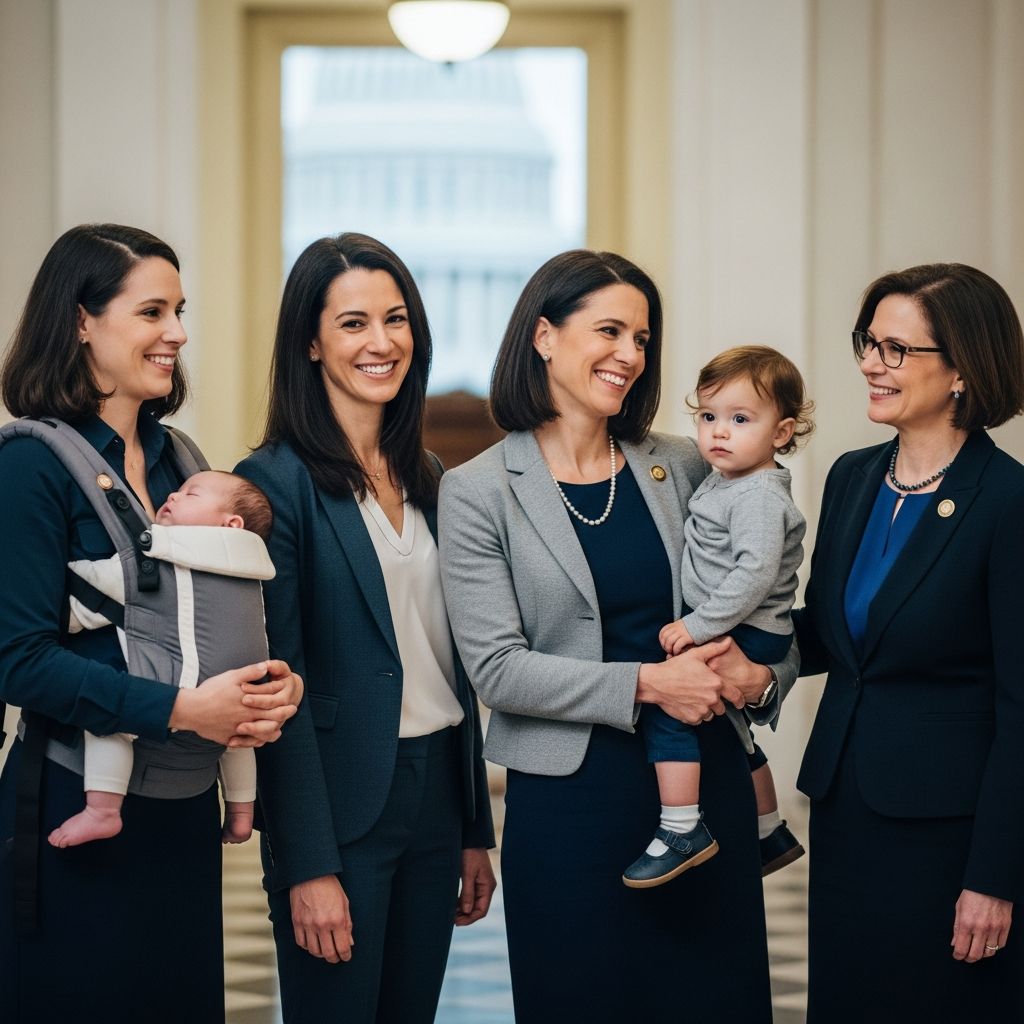
Mothers of young children now hold about 7% of seats in the 119th U.S. Congress, marking a modest increase from 6.7% in the prior session and signaling gradual progress in parental representation. This uptick reflects broader efforts to elect more women, particularly those balancing family and public service, though significant gaps persist compared to fathers and the general population.
Current Landscape of Parental Representation
The 119th Congress, which began in January 2025, features 150 women lawmakers overall, comprising 28% of voting members—unchanged from the previous term but a substantial rise from a decade ago when women held just 104 seats. Among these, mothers with minor children number around 39 in the House and Senate combined, up slightly but still far below fathers, who occupy nearly 23% of seats.
- Senate: 4 mothers vs. 22 fathers of young children.
- House: 35 mothers vs. 102 fathers.
This disparity highlights how fathers of minors are overrepresented relative to the U.S. population, while mothers appear at roughly half their societal rate. Women overall make up 28% of Congress despite being 51% of adults, with Democrats leading at 42% female members versus 15% for Republicans.
Why Mothers Lag Behind in Legislative Roles
Several structural barriers contribute to the low numbers of moms with young kids in Congress. The average age of House members is 58 and Senators 65, placing many beyond prime parenting years. State legislatures mirror this: only 7.9% of legislators are mothers of minors, versus 34.8% of adult women nationally, with moms of kids under six at a mere 1.7%.
Partisan divides exacerbate the issue. Democratic mothers dominate, with 69.5% of state mom-legislators identifying as Democrats and 29% Republican. In Congress, numbers show 110 Democratic women and 40 Republicans as of early 2025. Recent elections saw Republican women decline by three, from 43 to 40.
| Category | 119th Congress | 118th Congress | % of U.S. Women Pop. |
|---|---|---|---|
| All Women | 150 (28%) | 149 | 51% |
| Moms of Minors | ~7% | 6.7-6.8% | 34.8% |
| Fathers of Minors | ~23% | N/A | N/A |
| Democratic Women | 110 (42% Dems) | 107 | N/A |
| Republican Women | 40 (15% GOP) | 43 | N/A |
Data compiled from multiple analyses; population stats for women 25+.
Pioneering Organizations Fueling the Mom Wave
The Vote Mama Foundation plays a pivotal role, tracking parental representation and advocating for policy changes. Their research shows mothers of minors are underrepresented at half their population rate, with even starker gaps for those with preschoolers. Complementing this, the Vote Mama PAC supports Democratic moms running for office, backing candidates like JoAnna Mendoza (AZ-6), Christina Hines (MI-10), and Sarah Trone Garriott (IA-3).
Liuba Grechen Shirley, founder and CEO, emphasizes Congress’s lack of family supports as a key deterrent. Her dual efforts—research via the foundation and electoral via the PAC—aim to normalize motherhood in politics.
Emerging Candidates Spotlighting Family Priorities
A fresh cohort of mothers is campaigning by centering parenthood. Single mom JoAnna Mendoza launched her Arizona bid in February 2025, highlighting resilience as a parent. Christina Hines, mom of three, entered Michigan’s race in April, while Iowa state Sen. Sarah Trone Garriott, with two kids, announced in May.
Recent wins include Arizona’s Adelita Grijalva, mother of three, elected in a September 2025 special election for the 7th District—though not yet in Vote Mama’s April tally. High-profile figures like Rep. Anna Paulina Luna push boundaries, advocating proxy voting for parents, which faced backlash but gained bipartisan traction.
Policy Battles for Parent-Friendly Congress
Mothers in office are challenging norms. Luna’s proxy voting resolution, co-sponsored bipartisanship, sought accommodations for new parents but was criticized by figures like Rep. Chip Roy, who argued lawmakers must ‘show up.’ Such debates expose tensions between tradition and modern family needs.
Advocates call for childcare, flexible schedules, and campaign support to boost recruitment. As Nancy Pelosi demonstrated—raising five before her ascent—it’s possible, but systemic change is needed for scale.
State-Level Trends and National Implications
Statehouses offer clues: 75% of women/nonbinary legislators are mothers, but only 7.9% have minors, mostly in lower chambers (74.9%). Representation improves as kids age, underscoring childcare burdens.
Nationally, 442 women have served in Congress historically (3.3% total), led by California (51) and New York (31). The 119th’s 155 women (updated March 2025: 129 House, 26 Senate) set records, yet proportional parity for parent-moms remains distant.
Impact of Mom Lawmakers on Policy
Mothers bring unique perspectives to issues like paid leave, childcare affordability, and education. Their presence correlates with family-focused legislation, though underrepresentation limits influence. As numbers grow, expect amplified advocacy for working families, mirroring population realities where 85% of women have kids by 45.
Broader gains: Women rose 44% in Congress over 10 years. Sustained momentum could close gaps, especially if Republicans address cultural barriers.
Challenges Ahead for 2026 and Beyond
Heading into 2026 midterms, Democrats eye mom-candidates for edges. Barriers include fundraising, incumbency, and work-life conflicts. Success stories inspire, but scale requires institutional reforms like on-site daycare or virtual voting.
Vote Mama’s data predicts growth tied to visibility: as more serve, more run. With fathers at 24%, equity demands moms match societal shares.
Frequently Asked Questions
What percentage of the 119th Congress are mothers of young children?
About 7%, up from 6.7% previously, versus 23% fathers.
How many women serve in the 119th Congress?
150 voting members (28%), with 110 Democrats and 40 Republicans.
What is the Vote Mama Foundation’s role?
They track mom-legislators and advocate; their PAC elects Democratic moms.
Why are there fewer Republican mom-lawmakers?
Structural and cultural hurdles; GOP women dropped to 15% of party.
Has proxy voting for parents passed in Congress?
No, Rep. Luna’s bipartisan push failed amid conservative opposition.
This analysis draws from 2025 data; numbers may evolve with elections.
References
- Missing from Congress: Moms with young kids — Axios. 2025-09-29. https://www.axios.com/2025/09/29/congress-moms
- A new wave of candidates is putting motherhood front and center — Politico. 2025-06-13. https://www.politico.com/news/2025/06/13/moms-running-vote-mama-pac-00403289
- Women account for 28% of lawmakers in the 119th Congress — Pew Research Center. 2025-02-21. https://www.pewresearch.org/short-reads/2025/02/21/women-account-for-28-of-lawmakers-in-the-119th-congress/
- Has the number of women in Congress hit a ceiling? — Good Morning America/ABC News. 2024 (contextual for 2025). https://www.goodmorningamerica.com/news/story/number-women-congress-hit-ceiling-116373093
- Politics of Parenthood | Representation in State Legislatures — Vote Mama Foundation. 2025 (ongoing). https://www.votemamafoundation.org/popstateleg
- Congress – CAWP Reports – on Gender and Elections — Rutgers CAWP. 2024-11 (updated 2025). https://womenrun.rutgers.edu/2024-report/congress/
- Women In Congress [2025 Update] — Quorum. 2025-03. https://www.quorum.us/data-driven-insights/women-in-congress/