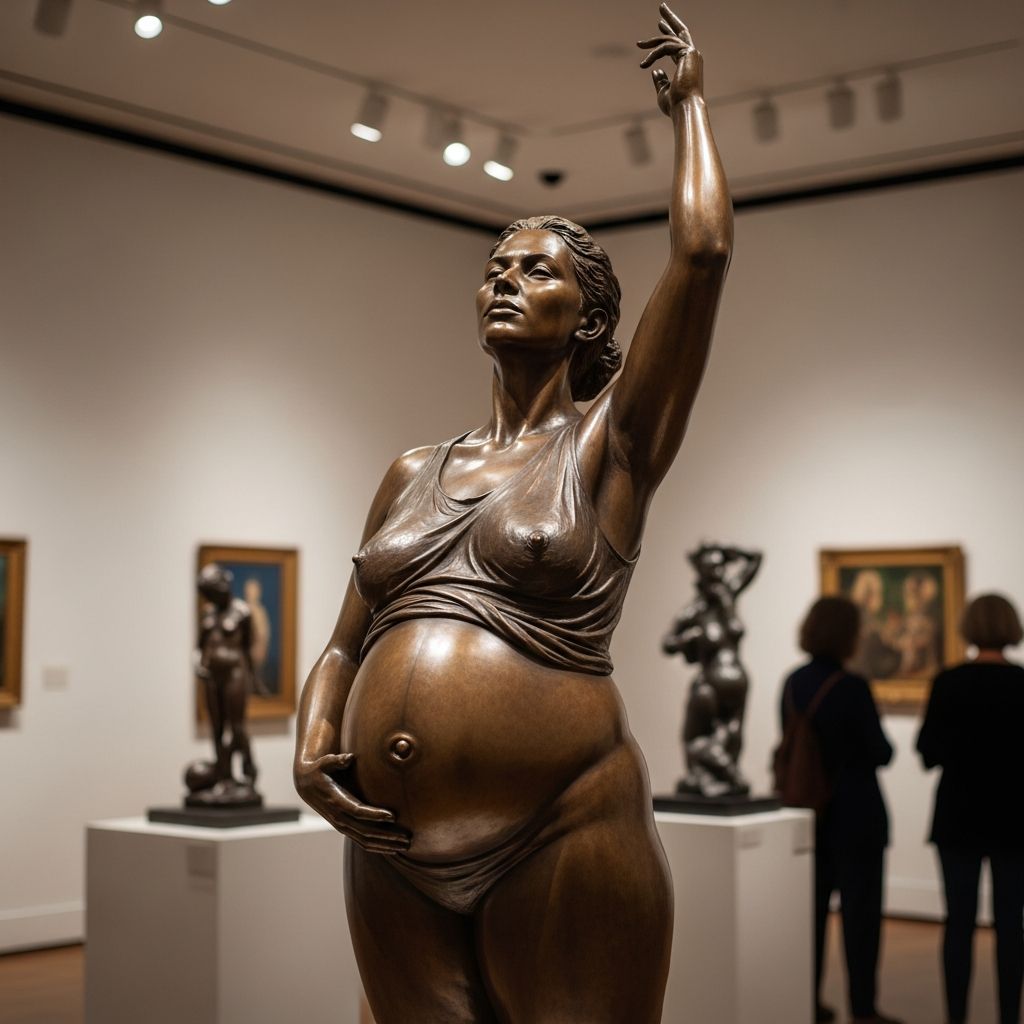
In a world where public monuments often glorify warriors, kings, and abstract ideals, a new bronze statue stands as a revolutionary tribute to the everyday heroism of new mothers. Titled Mother Vérité, this seven-foot-tall sculpture captures the unvarnished essence of the postpartum body—veiny breasts, stretched skin, and all—challenging long-held beauty standards and amplifying voices long silenced in public spaces.
The Genesis of a Groundbreaking Sculpture
Commissioned by Frida, a company dedicated to postpartum care products, and crafted by British digital artist Rayvenn Shaleigha D’Clark, Mother Vérité emerged from a deliberate effort to redefine maternal iconography. D’Clark, a self-taught sculptor, employed innovative techniques like 3D scanning and live casting on multiple postpartum women from diverse backgrounds. This process blended their unique physical stories into a singular, universal figure: a semi-nude mother cradling her newborn, her body marked by the raw physicality of birth—enlarged areolas, cracked nipples, and disposable underwear clinging to postpartum curves.
The statue’s debut outside London’s Lindo Wing at St Mary’s Hospital was no accident. This location, famous for polished royal birth photos, juxtaposes the sculpture’s gritty realism against societal expectations of flawless maternity. After its initial unveiling, it found a permanent home on Portman Square, ensuring its message endures in a prominent public space.
Challenging Monumental Gender Imbalances
Public art has historically sidelined women. In London, a mere 4% of statues portray women, while a staggering 9% honor animals—a disparity that underscores deep-seated cultural priorities. Research from institutions like UCL’s Bartlett Faculty of the Built Environment emphasizes how inclusive public sculptures can foster community bonds and elevate marginalized narratives. Mother Vérité directly confronts this void, not by idealizing motherhood but by presenting its immediate, messy aftermath.
This underrepresentation extends beyond art into leadership realms. With women comprising only a fraction of boardroom executives and government officials, visible symbols like this statue serve as powerful affirmations for young girls, demonstrating that maternal strength merits the same bronze immortality as military conquests.
| Category | Percentage of London Statues | Examples |
|---|---|---|
| Men/Historical Figures | ~70% | Politicians, generals |
| Women | 4% | Rare maternal depictions |
| Animals | 9% | Horses, dogs |
| Mothers (Postpartum) | <1% | None prior to Mother Vérité |
This table illustrates the stark imbalances, highlighting why artworks like Mother Vérité are cultural milestones.
Artistic Innovation Meets Maternal Truth
D’Clark’s method fused ancient bronze casting with modern digital tools, scanning real postpartum bodies to preserve hyper-real details. The result is a figure that radiates quiet power: hair in a disheveled bun, posture weary yet proud, eyes conveying profound exhaustion and joy. “Motherhood is at once everyday and extraordinary,” D’Clark noted, emphasizing the sculpture’s role in recognizing women’s courage.
Frida’s founder, Chelsea Hirschhorn—a mother of four—drove this project to dismantle taboos. The brand has faced advertising censorship for depicting realistic postpartum elements like bleeding and scarring. By immortalizing these in bronze, they elevate what media often conceals, declaring, “This is about putting mothers on the pedestal they deserve.”
Societal Ripples: From Visibility to Validation
The statue’s impact transcends aesthetics, igniting discussions on postpartum mental health, body positivity, and support systems. New mothers often navigate isolation in their “sloppy, wobbly, emotional” early days, feeling invisible amid pressure to “bounce back.” Mother Vérité validates these experiences, fostering empathy and community.
- Normalizing Realities: Details like uneven breasts and stretch marks counter airbrushed ideals, promoting self-acceptance.
- Community Strength: As a composite of many mothers, it symbolizes collective resilience and solidarity.
- Cultural Shift: Placed in bronze—material for heroes—it redefines valor to include birth’s transformative power.
Beyond London, this could inspire global movements. Imagine similar monuments outside hospitals worldwide, reminding society that postpartum women deserve celebration, not scrutiny.
Voices from the Creators and Community
Hirschhorn reflects Frida’s ethos: supporting women through unfiltered postpartum care. D’Clark’s vision honors the “unvarnished physicality” of new motherhood, urging viewers to “see what is usually hidden.” Early reactions praise its honesty, with passersby noting it captures the “extraordinary” in the mundane. Critics of prior maternal art often decry sanitization; this piece flips the script.
Broader Implications for Public Art and Policy
Statues shape cultural memory. By prioritizing postpartum depiction, Mother Vérité influences urban planning and policy, advocating for better maternal leave, healthcare access, and mental health resources. Studies show diverse public art enhances social cohesion; this sculpture proves art’s power to challenge norms and build support networks.
In an era of social media filters, tangible art like this grounds us in truth. It invites families, policymakers, and artists to honor motherhood’s full spectrum—from joy to exhaustion.
Frequently Asked Questions
Where is the Mother Vérité statue located?
Originally unveiled outside St Mary’s Hospital Lindo Wing, it now resides on Portman Square in London.
Who created the statue?
British artist Rayvenn Shaleigha D’Clark, commissioned by Frida founder Chelsea Hirschhorn.
Why is this statue significant for women’s representation?
It addresses London’s 4% female statue rate, using bronze to equate maternal strength with historical heroes.
How was the realistic postpartum body achieved?
Through 3D scans and live casting of diverse real mothers, merging their features into one authentic figure.
What message does it send about postpartum experiences?
It celebrates the raw beauty and challenges of new motherhood, combating invisibility and stigma.
Expanding the Conversation: Motherhood in Modern Art
While Mother Vérité pioneers postpartum realism, it joins a lineage of maternal art pushing boundaries. From ancient Venus figurines emphasizing fertility to contemporary installations exploring grief and joy, art evolves to mirror lived realities. Yet, public permanence remains rare for unidealized bodies.
This statue prompts reflection: How might more such works influence perceptions? For instance, integrating maternal themes in cityscapes could normalize extended parental leave—policies proven to boost women’s workforce participation, per OECD data. Though not directly cited here, such links underscore art’s societal leverage.
Visitors report transformative encounters: mothers tearfully embracing its honesty, children asking about the “strong lady,” men confronting overlooked narratives. It’s not just art; it’s a catalyst for dialogue.
In sum, Mother Vérité doesn’t merely depict a body; it immortalizes a revolution—one stretch mark, one weary gaze at a time. As society grapples with gender equity, this bronze beacon illuminates the path forward, proving that true monuments honor life’s profound, imperfect miracles.
References
- Mother Vérité: Why London’s New Postpartum Statue Matters More Than a Monument — AllBright Collective. 2023-10-01. https://www.allbrightcollective.com/edit/articles/mother-verite-why-londons-new-postpartum-statue-matters-more-than-a-monument
- New London Statue Celebrates the Unseen Strength of Mothers — Positive News. 2023-10-01. https://www.positive.news/society/new-london-statue-celebrates-the-unseen-strength-of-mothers/