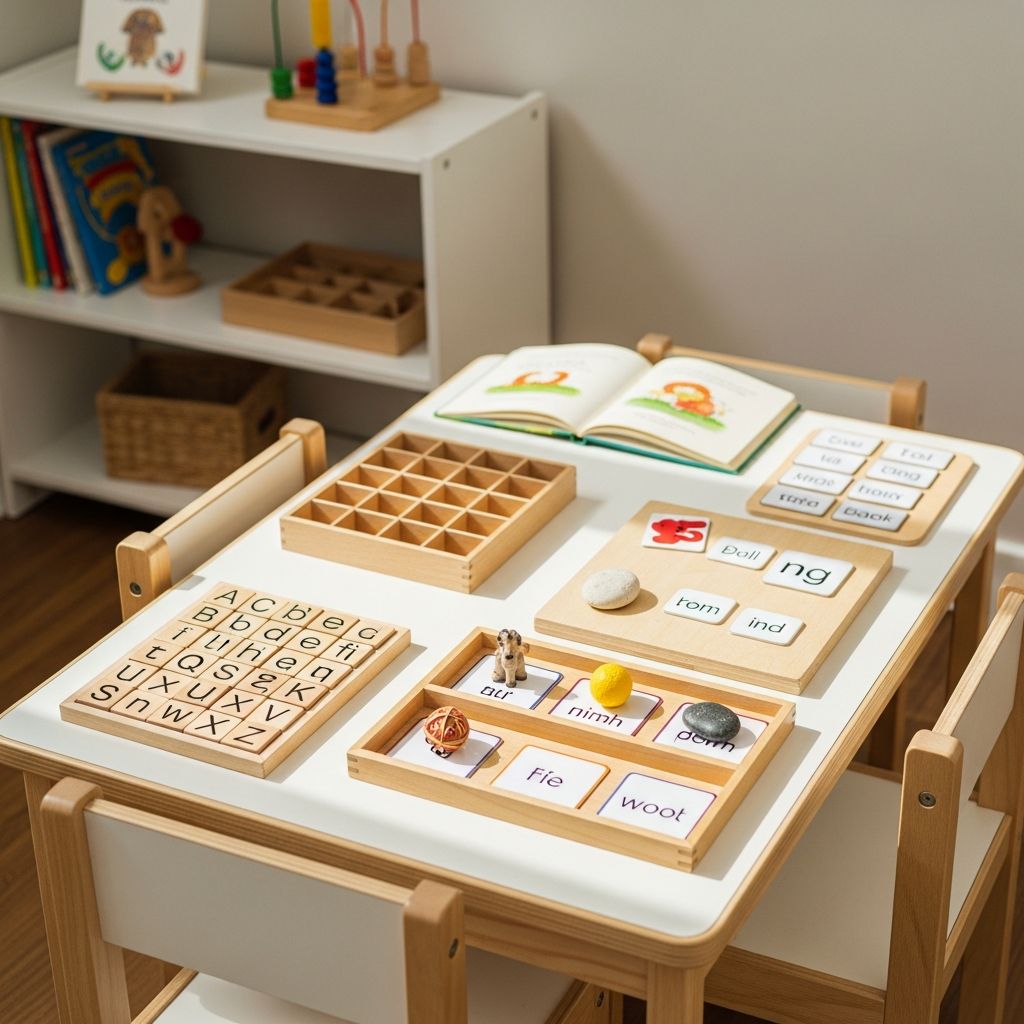
Early literacy development thrives on playful, sensory-rich experiences that respect a child’s natural curiosity. Montessori principles emphasize child-led exploration, focusing on sounds before symbols to cultivate confident readers. These home-based games build foundational skills like phonemic awareness and letter recognition without pressure or worksheets.
Building a Literacy-Rich Environment
Create an inviting space where reading feels natural. Place low shelves with board books at child’s eye level, allowing independent access. Surround your home with print: label shelves, drawers, and toys with simple words using removable sticky notes or a label maker. This subtle exposure connects spoken words to written forms organically.
Daily routines amplify learning. Narrate actions throughout the day—”We’re opening the red door”—to reinforce vocabulary. Sing nursery rhymes and repetitive songs like “Wheels on the Bus” to sharpen rhyme detection and rhythm, key precursors to blending sounds into words. Research from the American Academy of Pediatrics highlights that consistent reading aloud from infancy boosts vocabulary by 1.4 million words by kindergarten.
Essential Sound Games for Phonemic Awareness
Phonemic awareness—the ability to hear and manipulate sounds—is the cornerstone of reading. Montessori “Sound Games” mimic “I Spy” but prioritize initial sounds over colors.
- Level 1: Initial Sounds Say, “I spy something beginning with /b/” (emphasize the sound, not the letter name). Child points to objects like ball or book. Repeat with 3-4 familiar items.
- Level 2: Blends and Ends Advance to “I spy something starting with /t/ and ending with /oy/.” (toy). This hones segmentation skills.
- Level 3: Full Segmentation Slowly enunciate each sound: “/k/ /a/ /t/.” Child blends to say “cat.” Practice with child’s name or favorites like “dog” or “mom.”
Play during car rides or meals—no materials needed. These games, starting around age 2, prepare children for decoding by training the ear first.
Tactile Letter Introduction with DIY Sandpaper Letters
Once sound games are familiar (around age 3), introduce lowercase letters through touch. Montessori sandpaper letters link sight, sound, and muscle memory.
DIY Version: Cut letters from sturdy cardstock, glue sand or textured grit on outlines. Use 3-4 contrasting letters (e.g., m, s, t, a).
- Presentation (3-Period Lesson): Period 1: “This is /m/.” Child traces with index and middle fingers, repeating the sound.
- Period 2: Mix letters; ask, “/s/ where is it?” Child identifies by touch/feel.
- Period 3: Point to /m/ and ask, “What’s this?” Confirm sound.
Limit to vowels plus consonants. Rotate sets weekly. This multisensory method, backed by studies on tactile learning, improves retention over visual-only methods.
Discovery Baskets: Sensory Exploration of Sounds
Curate themed baskets for 2-3 letters, prioritizing child’s name letters first. Fill with real/household objects—no plastic toys if possible.
| Letter | Basket Items | Activity Prompt |
|---|---|---|
| /b/ | Ball, banana, book, brush | “Find something bumpy starting with /b/.” |
| /s/ | Spoon, sock, star (sticker), shell | “Shake the /s/ things!” |
| /m/ | Muffin tin, mouse toy, magnet | “Match the /m/ sounds.” |
Model naming first: “This is a spoon—/s/ spoon.” Let child explore freely, then hunt: “Bring me the /s/ item.” Reintroduce weekly, adding complexity like rhymes. This hands-on play builds vocabulary and sound-symbol links.
Interactive Labeling and Word Hunts
Transform your home into a print-rich scavenger hunt. Label 10-15 child-level items: bed, cup, door. Use colorful paper or sticky notes for appeal.
- Hide-and-Seek Labels: Hide labels; say, “Find the word for where we sleep.” Child matches to object.
- Sound Hunts: “Find something starting with /ch/!” (chair). Celebrates success immediately.
- Word Building: Once familiar, remove labels; child places from memory.
Avoid over-labeling to prevent clutter. Focus on interactive zones like play area or kitchen. This fosters word-object association, a predictor of reading readiness per longitudinal studies.
Movable Alphabet for Creative Encoding
Around age 4, with strong sound/letter foundation, introduce a movable alphabet: printed lowercase letters on cards or wooden tiles (DIY with craft foam).
Progression:
- Model labeling pictures: Segment “fish” (/f/ /i/ /sh/), place letters.
- Child labels 3-period objects: cup, hat, dog.
- Independent: Child thinks of words (e.g., pet’s name), sounds out alone. Capture moments: “What does that say? Say it fast—’dog’!” Magic happens as they self-discover reading.
Store in accessible box. No corrections—errors self-correct through repetition. Complements phonics, accelerating fluency.
Daily Reading Rituals and Shared Storytelling
Read aloud 20 minutes daily, letting child hold/turn pages. Pause for predictions: “What happens next?” Relate to life: “Like when we saw a real dog!” Include rhyming books (Dr. Seuss) and wordless picture books for narration practice.
Extend with puppets or flannel boards retelling stories. Sing alphabet songs emphasizing sounds (/a/ apple, not “ay”).
Age-Appropriate Milestones and Progress Tracking
| Age | Skills | Activities |
|---|---|---|
| 0-2 years | Scribbles, rhymes, vocab explosion | Books, songs, narration |
| 2-3 years | Initial sounds, letter interest | Sound games, baskets |
| 3-4 years | Letter sounds, blending | Sandpaper letters, labeling |
| 4-5 years | Word building, simple reading | Movable alphabet, stories |
Observe, don’t test. Celebrate efforts to nurture intrinsic motivation.
Frequently Asked Questions
What age should I start these games?
Sound games from 2 years; letters from 3-4 when interest emerges. Adapt to child’s pace.
Do I need Montessori materials?
No—DIY with household items works equally well. Focus on process over perfection.
What if my child loses interest?
Follow their lead. Short, joyful sessions prevent burnout. Reintroduce later.
How often should we play?
10-15 minutes daily, integrated into routines. Consistency trumps intensity.
Can this replace formal phonics?
It complements; multisensory Montessori accelerates decoding per early education research.
These games cultivate joyful readers. Patience and play yield lasting literacy love.
References
- Ready, Set, Read! Montessori Methods for Encouraging Emergent Literacy — Inspire Kids Montessori. 2023. https://inspirekidsmontessori.com/ready-set-read-montessori-methods-for-encouraging-emergent-literacy/
- Montessori Language Activities For Home — Fishtown Montessori. 2023. https://www.fishtownmontessori.com/montessori-language-activities-for-home/
- Teach Your Child to Read the Montessori Way — A Montessori Story. 2023. https://www.amontessoristory.com/journal/teach-montessori-reading
- MONTESSORI AT HOME: Learning to Read — YouTube (Montessori Services). 2023. https://www.youtube.com/watch?v=0NcYcol1p4E
- Early Reading Activities — Montessori Services. 2025-02-01. https://www.montessoriservices.com/language/early-reading-activities