Montessori education, with its emphasis on child-led discovery and prepared environments, offers profound benefits for Black children, particularly when blended with nature-based learning. This approach not only boosts academic performance but also instills cultural pride and community interconnectedness, addressing historical inequities in schooling.
The Roots of Montessori in Marginalized Communities
The Montessori method originated from Maria Montessori’s observations in Rome’s impoverished neighborhoods, promoting self-motivation and lifelong learning for all children regardless of background. African American communities have long resonated with this inclusive philosophy, viewing it as a counter to segregated and hostile traditional schools.
Pioneers like Roslyn Williams through Project CHAMP advocated for racial equality and teacher training within Black communities during the 1960s, ensuring access to Montessori certification for parents and educators. Similarly, Lenore Gertrude Briggs and Dr. James Anderson established early Montessori programs for Black children, laying groundwork for inclusive education. These efforts challenged misconceptions that Montessori is an elite, White-only pedagogy, proving its efficacy for diverse learners.
Why Montessori Thrives for Black Students Academically
Research demonstrates that African American students in public Montessori schools outperform peers in traditional settings, especially in reading and math at the lower elementary level. A study of third-graders found Montessori participants achieving significantly higher scores without reliance on test prep, aligning with best practices for culturally diverse students.
This success stems from Montessori’s multisensory materials and freedom of choice, allowing children to follow interests and develop at their pace—key for Black youth facing demoralizing school environments. Nature integration amplifies this by providing hands-on exploration, enhancing sensory learning through sight, touch, and movement in outdoor settings.
| Metric | Montessori Black Students | Traditional School Peers |
|---|---|---|
| Reading Achievement | Significantly higher | Baseline |
| Math Achievement | At least equal, often better | Baseline |
| Environment Focus | Child-led, no test prep | Standardized prep heavy |
The table above summarizes key findings from comparative studies, highlighting Montessori’s edge.
Infusing African-Centered Principles into Classrooms
African-centered values like Ubuntu—emphasizing ‘I am because we are’—perfectly complement Montessori’s cooperative ethos over competition. Schools like Poinciana Montessori weave these through storytelling of African myths, drumming, dance, and art projects that build resilience and cultural pride.
- Community and Interconnectedness: Multi-age classrooms foster mentoring and empathy, mirroring communal African traditions.
- Environmental Stewardship: Nature activities teach respect for the earth, aligning with ancestral reverence for land.
- Cultural Identity: Lessons rooted in African history empower students with self-awareness and global citizenship.
This fusion creates holistic development, where children gain academic skills alongside emotional strength and cultural grounding.
Nature as the Ultimate Montessori Classroom for Black Kids
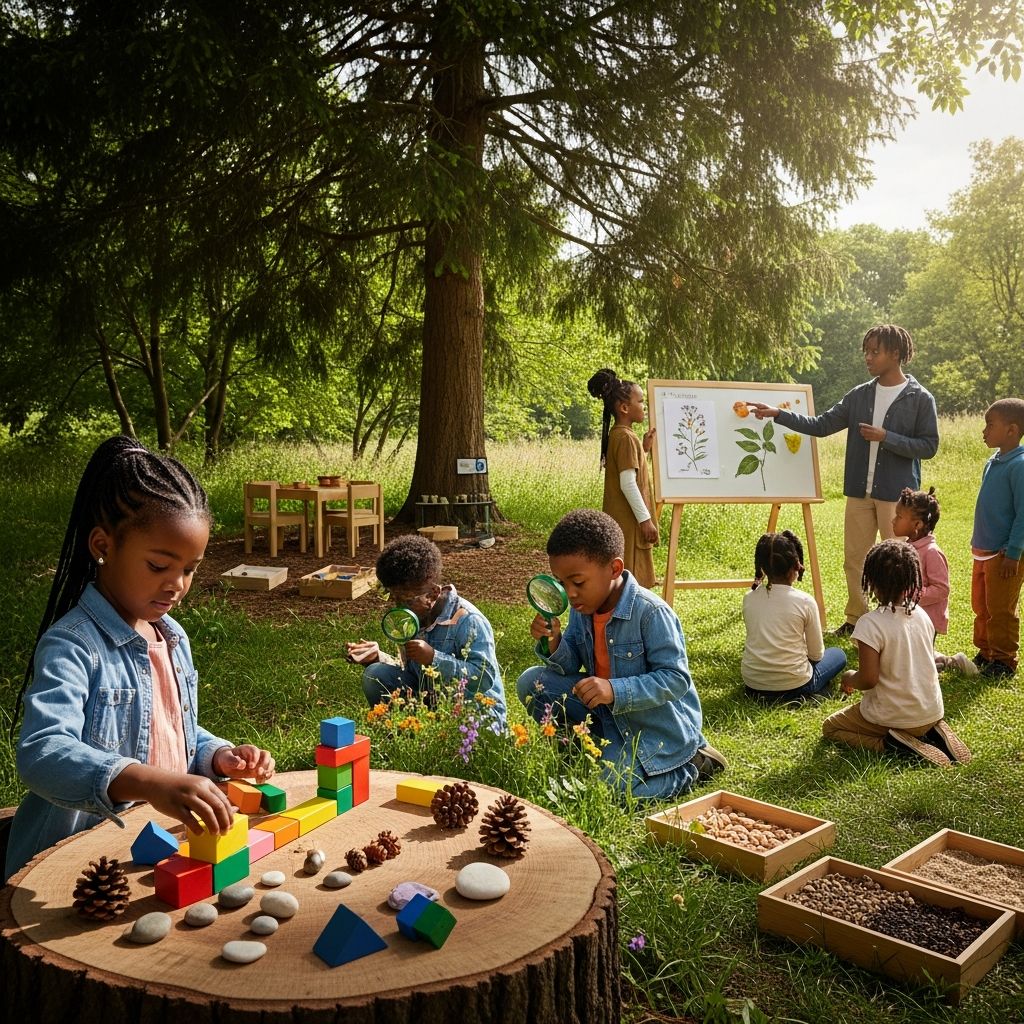
Outdoor immersion transforms Montessori learning by engaging children’s innate curiosity through natural materials—leaves for sorting, streams for scientific inquiry, and forests for collaborative play. For Black youth, this counters urban constraints and reconnects with ancestral ties to nature, promoting mental health and focus.
Programs emphasizing forest schools or garden-based curricula report heightened engagement, as children lead explorations in biodiversity, weather patterns, and ecology. Such hands-on methods outperform rote learning, particularly benefiting kinesthetic learners prevalent in diverse populations. Benefits include:
- Improved concentration via sensory-rich environments.
- Reduced stress through nature’s calming effects.
- Enhanced social skills in group outdoor activities.
- Fostering innovation by solving real-world nature problems.
Overcoming Barriers: Representation and Access
Despite proven benefits, stark disparities persist: only 6% of private Montessori students are Black, with fewer than 10% of teachers sharing this identity. Financial hurdles and lack of awareness exclude families, but initiatives like the Black Montessori Education Fund provide scholarships, training, and networks to dismantle these barriers.
Black educators play a vital role, offering role models and culturally responsive support in Montessori settings. Historical trailblazers from the Civil Rights era continue inspiring growth in Black neighborhoods, ensuring Montessori’s justice-centered roots flourish.
Building Global Citizens Through Heritage and Nature
By grounding education in African heritage while expanding to global perspectives, Montessori-nature programs cultivate compassionate leaders. Students explore diverse cultures via nature-themed projects, developing empathy and inclusivity essential for today’s world.
Parents report children exhibiting greater confidence, cooperation, and environmental awareness, translating to lifelong advantages. This model challenges inequities, proving high-quality, culturally affirming education is possible for all Black youth.
Key Benefits Comparison
| Aspect | Traditional Education | Montessori-Nature for Black Kids |
|---|---|---|
| Curriculum Style | Teacher-directed, competitive | Child-led, collaborative |
| Cultural Integration | Limited or absent | African-centered, heritage-focused |
| Learning Environment | Indoor, desk-bound | Nature-immersed, multisensory |
| Academic Outcomes | Standard for demographics | Superior in reading/math |
| Equity Focus | Often overlooks disparities | Addresses access and representation |
Frequently Asked Questions (FAQs)
What makes Montessori ideal for Black children?
Montessori’s child-centered, non-competitive approach aligns with African values like community and self-determination, leading to better academic results without harsh discipline.
How does nature enhance Montessori learning?
Nature provides authentic, sensory materials for exploration, boosting engagement, health, and real-world problem-solving skills essential for holistic growth.
Are there enough Black Montessori teachers?
Currently under 10%, but funds and programs are increasing representation through training and support.
Can low-income Black families access Montessori?
Public Montessori schools and scholarships via organizations like Black Montessori Education Fund make it feasible.
What research supports outcomes for Black students?
Studies show superior reading/math performance in Montessori vs. traditional schools, validating its use for underserved groups.
References
- Contributions of the African American Community to Montessori Education — Holmdel Montessori School. 2023. https://holmdelmontessorischool.com/blog/contributions-of-the-african-american-community-to-montessori-education/
- Integrating African-Centered Values in Montessori Education — Poinciana Montessori. 2023. https://www.poincianamontessori.org/post/poinciana-montessori-integrating-african-centered-values-in-montessori-education
- Reading and Math Achievement for African American Lower Elementary Students in Public Montessori Programs — Public Montessori. 2016-12. https://public-montessori.org/wp-content/uploads/2016/12/Reading-and-Math-Achievement-for-African-American-Lower-Elementary-Students-in-Public-Montessori-Programs.pdf
- The History of Black Montessorians — Brilliant and Kind. 2023. https://www.brilliantandkind.com/the-history-of-black-montessorians
- Why Black Parents Should Consider Montessori — Montessori Rocks. 2023. https://montessorirocks.org/why-black-parents-should-consider-montessori-2/
- Black Montessori Education Fund — Black Montessori. 2023. https://www.blackmontessori.org