Preparing for a baby often comes with pressure to buy every product on every checklist. A minimalist baby registry flips that script by focusing on what your newborn truly needs, so you can save money, protect your space, and reduce stress.
This guide walks you through each category of baby gear, highlighting essentials, smart extras, and items you can comfortably skip, especially if you live in a small home or simply prefer less stuff.
Why Consider a Minimalist Baby Registry?
Most babies need surprisingly few items in the first months: safe sleep, food, clean diapers, and basic health and safety supplies. A minimalist registry helps you:
- Lower costs by focusing on multi-use, high-impact items.
- Reduce clutter so your home remains functional and peaceful.
- Protect your mental bandwidth with fewer things to store, wash, and manage.
- Adjust as you go once you know your baby’s personality and your own routines.
Many pediatric and public health organizations emphasize that the most crucial early items are a safe sleep space, an appropriate car seat, and feeding supplies, not a room full of gadgets.
Core Principles of a Minimalist Registry
Before you start listing products, use these guiding questions for every potential item:
- Is it required for safety or health? (Example: car seat, thermometer.)
- Will we use it daily or weekly? One-time or rare-use items can often be borrowed or skipped.
- Does it replace multiple other products? Multi-use gear nearly always wins.
- Can we delay this purchase? Buy later once you know what your baby and family actually need.
- Do we have space to store it? If it takes up a lot of space, it must earn that space.
| Type of Item | Add to Registry | Wait or Skip |
|---|---|---|
| Safety-critical (car seat, safe sleep surface) | Yes – prioritize | Never skip |
| Daily-use basics (diapers, basic clothing) | Yes – core list | Only adjust quantities |
| Convenience-only gadgets | Maybe – if budget/space allow | Often delay or skip |
| Single-purpose or novelty items | Usually no | Borrow or skip |
Sleep Essentials: Creating a Safe, Simple Setup
Safe sleep is non-negotiable. Public health guidance is clear that babies should sleep on a firm, flat surface on their backs, with no soft bedding, pillows, or bumpers in the sleep space.
Sleep Items to Prioritize
- Safe sleep surface – A crib, mini crib, or bassinet that meets current safety standards.
- Firm mattress that fits snugly in the sleep space with no gaps.
- 2–3 fitted sheets for quick changes after leaks or spit-up.
- Swaddles or sleep sacks (2–4) suited to your climate.
- Simple nightlight or low lamp to see during nighttime feeds and diaper changes.
Nice-to-Have Sleep Extras
- White noise machine (you can also use a phone app at first).
- Waterproof mattress protector (especially useful once the baby is older and more mobile).
Sleep Items You Can Skip or Delay
- Crib bumpers, pillows, quilts, and stuffed animals in the crib – not recommended for safety.
- Specialty positioners or wedges – these are generally not advised unless prescribed.
- Multiple fancy blankets – one or two lightweight blankets for supervised use is usually enough.
Feeding Basics: Simplifying Breast, Bottle, or Both
Newborns feed frequently, so choose a small set of well-chosen tools instead of every feeding gadget on the market. Both breastfeeding and formula feeding can be done with a minimalist approach.
Feeding Essentials (Regardless of Method)
- Bottles and nipples – Start with a small set (3–6), then adjust based on what your baby tolerates.
- Burp cloths or small towels – 6–10 absorbent cloths you don’t mind staining.
- Bottle-cleaning brush and access to hot, soapy water.
Breastfeeding-Focused Items
- Breast pump if you plan to pump or return to work; in many countries, some pumps may be covered by insurance or health programs.
- Nursing pads (reusable or disposable) to manage leaks.
- Comfort item such as nipple cream or a basic moisturizer safe for breastfeeding.
Formula-Feeding-Focused Items
- Formula approved for your region; discuss specific options with your pediatrician if you have concerns.
- Safe water source and clean bottles; follow local guidelines for formula preparation.
Feeding Gear You Can Wait On
- Bottle sterilizer – many families use boiling water or a dishwasher with a sanitize cycle if available.
- Warmers, mixing gadgets, and specialized drying racks – useful for some, but not required.
- High chair – many babies do not start solid foods until around six months, when they can sit with minimal support.
Diapering: Keeping It Simple and Sanitary
Newborns can go through many diapers daily, but the core supplies are straightforward.
Diapering Essentials
- Diapers – either disposables, cloth, or a combination. Start with modest quantities because sizes change quickly.
- Wipes or soft cloths – choose fragrance-free options if your baby has sensitive skin.
- Diaper cream – a barrier ointment can help prevent rash; talk to your pediatrician about choices if you have concerns.
- Changing surface – a simple, wipeable pad on a dresser, floor, or bed works in most small spaces.
- Small trash can or diaper pail near your main changing area.
Nice-to-Have Diapering Extras
- Portable changing mat for your bag or car.
- Wet/dry bag for soiled clothes or cloth diapers on the go.
Diapering Items You Can Skip or Limit
- Elaborate changing furniture if you lack space – a pad on a sturdy surface works well.
- Large stockpiles of one diaper brand before baby arrives; skin sensitivity and fit vary.
Clothing: A Practical Capsule Wardrobe for Baby
Babies outgrow clothing quickly, and they do not need complex outfits. Simple, comfortable basics are usually best.
Clothing Essentials for the First Months
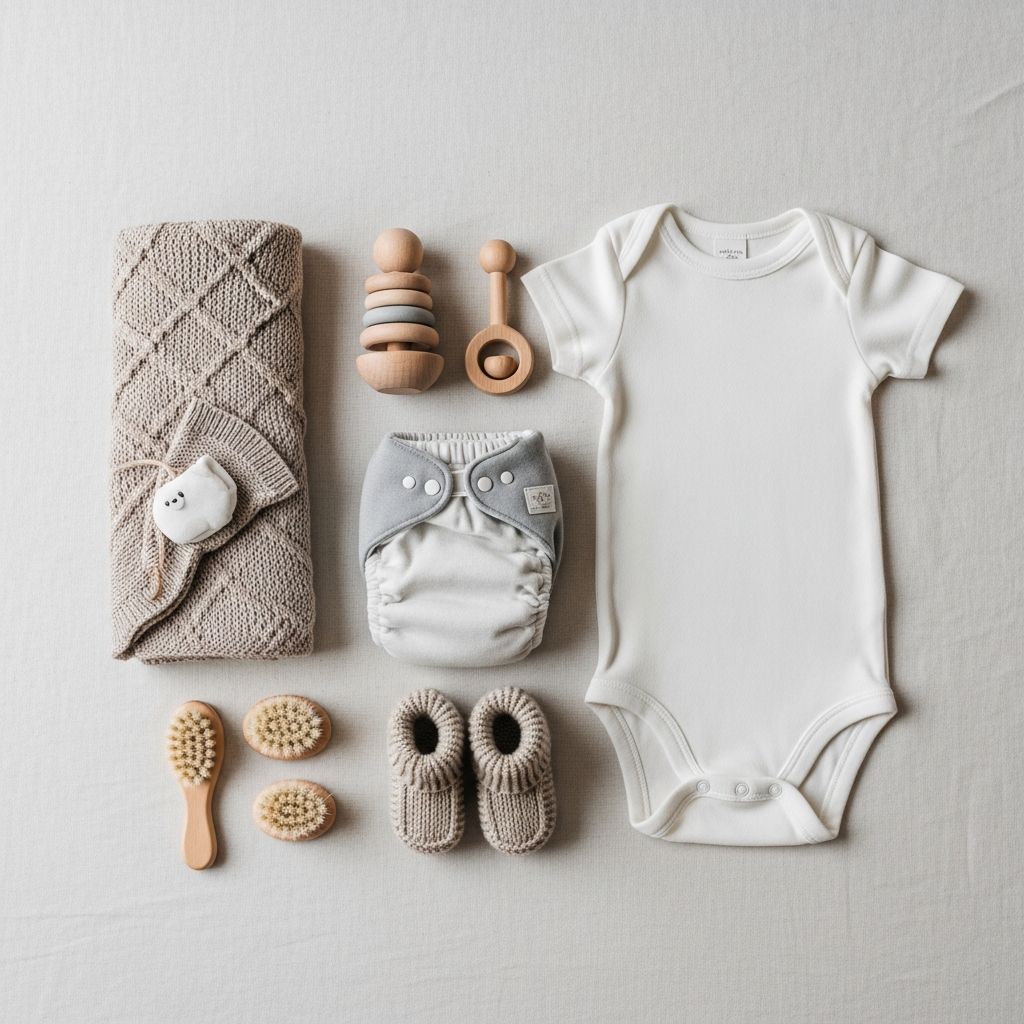
- Onesies or bodysuits – about 6–10, depending on how often you do laundry.
- Footed sleepers or pajamas – 4–6 for day or night.
- Season-appropriate layers – a couple of light sweaters or sleep sacks if cold, or lightweight rompers if warm.
- Hats and socks – 2–3 hats and several pairs of socks to help with temperature control.
Health organizations emphasize keeping babies neither too hot nor too cold; dressing them in one more layer than an adult typically wearing in the same environment is a common guideline.
Clothing You Can Skip or Limit
- Complicated outfits with many buttons, stiff fabrics, or multiple pieces.
- Shoes for non-walking infants; socks and footies usually suffice.
- Large quantities of one size; babies often move quickly through the smallest sizes.
Bathing and Basic Health Supplies
Baby hygiene can stay simple. Daily full baths are not required for newborns; frequent bathing without need can dry out their skin.
Bathing Essentials
- Gentle cleanser designed for babies or people with sensitive skin.
- 2–3 soft towels, regular or hooded, and a few washcloths or small soft cloths.
- Safe bathing spot – a small baby tub or a sink with a non-slip support.
Health and Safety Essentials
- Digital thermometer – rectal or other age-appropriate type; accurate fever measurement is important.
- Nasal aspirator and saline drops for congestion relief.
- Nail care tool – baby nail file or clippers.
- Basic fever-reducing medicine appropriate for infants, only as directed by your pediatrician.
Bath and Health Items You Can Skip
- Specialized bath thermometers if you can test water temperature with your wrist or elbow.
- Multiple lotions, powders, and fragrances; many babies do well with minimal products.
- Complex grooming kits with rarely used tools.
Gear for On-the-Go: Only What You Truly Need
Safe travel is another non-negotiable. A properly installed car seat dramatically reduces the risk of severe injury in a crash.
Travel Essentials
- Rear-facing car seat that meets current safety standards and is appropriate for your baby’s size and your vehicle.
- Simple diaper bag or regular backpack with a few internal pouches.
- Baby carrier or wrap to keep your hands free while moving around.
- Stroller that fits your lifestyle (or consider starting with just a carrier if you have limited space and mostly walk on smooth surfaces).
Gear You Can Wait On
- Travel crib or play yard – helpful for travel, but you can add it later if you discover you need it.
- Multiple types of strollers; one versatile option usually suffices.
Play, Bonding, and Development Without Overload
Newborns mainly need comfort, feeding, and sleep. Simple play and interaction support development; you do not need a room full of toys.
Simple Play Essentials
- Soft blanket or play mat for tummy time and floor play.
- 1–3 simple toys such as a soft rattle, high-contrast book, or crinkly cloth.
Responsive caregiving, talking to your baby, and holding them frequently are among the most important supports for early development, according to global child development organizations.
Play Items You Can Skip
- Large collections of toys for the newborn stage; save those for later milestones.
- Bulky plastic activity centers right away; consider borrowing once your baby is older if you want to try them.
Sample Minimalist Baby Registry Checklist
Use this as a starting point and adjust for your climate, home size, and preferences.
- Sleep
- Crib, mini crib, or bassinet with firm mattress
- 2–3 fitted sheets
- 2–4 swaddles or sleep sacks
- Feeding
- 3–6 bottles and nipples
- Bottle brush
- 6–10 burp cloths
- Breast pump (if needed) and pads, or starter supply of formula
- Diapering
- Diapers (disposable or cloth)
- Wipes or reusable cloths
- Diaper cream
- Changing pad
- Small trash can or diaper pail
- Clothing
- 6–10 bodysuits
- 4–6 sleepers
- 2–3 hats, several pairs of socks
- Bath & Health
- Gentle baby wash
- 2–3 towels, a few washcloths
- Digital thermometer
- Nail file or clippers
- Nasal aspirator and saline drops
- Baby-safe fever reducer (per pediatrician instructions)
- On-the-go
- Rear-facing car seat
- Baby carrier or wrap
- Stroller (if you expect to use one regularly)
- Bag large enough for diapers, wipes, and a change of clothes
- Play
- Soft play mat or blanket
- 1–3 simple toys or books
Frequently Asked Questions (FAQs)
Will a minimalist registry mean my baby is missing out?
No. As long as your baby has a safe place to sleep, consistent feeding, clean diapers, and responsive caregiving, their core needs are met. Extra gear can be helpful but is not a substitute for care and attention.
Is it safe to skip a crib and use only a bassinet at first?
Many families start with a bassinet or portable sleep space for the newborn stage, as long as it meets current safety standards and is used as directed. You will eventually need a longer-term sleep surface once your baby outgrows the bassinet.
How many diapers and wipes should I put on my registry?
It is wise to start with moderate amounts and a mix of smaller sizes rather than a huge stockpile of one brand or size. Babies grow quickly, and skin sensitivities differ. You can always buy more of what works best.
Can I be minimalist if I’m unsure about breastfeeding or formula feeding?
Yes. Register for a small, flexible set of items (a few bottles, basic pumping or formula supplies) and add more later once you know what works for your body, your baby, and your schedule.
Should I register for toys for a newborn?
A few simple items, like a soft rattle and a high-contrast book, are enough at first. You can add more toys later as your baby becomes more alert, starts reaching, and approaches rolling and sitting milestones.
References
- Safe Sleep for Babies — Centers for Disease Control and Prevention (CDC). 2022-12-05. https://www.cdc.gov/sids/about/index.html
- Infant and Young Child Feeding — World Health Organization (WHO). 2023-03-09. https://www.who.int/news-room/fact-sheets/detail/infant-and-young-child-feeding
- Bathing Your Baby — American Academy of Pediatrics via HealthyChildren.org. 2022-10-13. https://www.healthychildren.org/English/ages-stages/baby/bathing-skin-care/Pages/Bathing-Your-Newborn.aspx
- Fever and Your Baby — American Academy of Pediatrics via HealthyChildren.org. 2021-11-02. https://www.healthychildren.org/English/health-issues/conditions/fever/Pages/Signs-and-Symptoms-Fever.aspx
- Car Seats: Information for Families — American Academy of Pediatrics via HealthyChildren.org. 2022-09-06. https://www.healthychildren.org/English/safety-prevention/on-the-go/Pages/Car-Safety-Seats-Information-for-Families.aspx