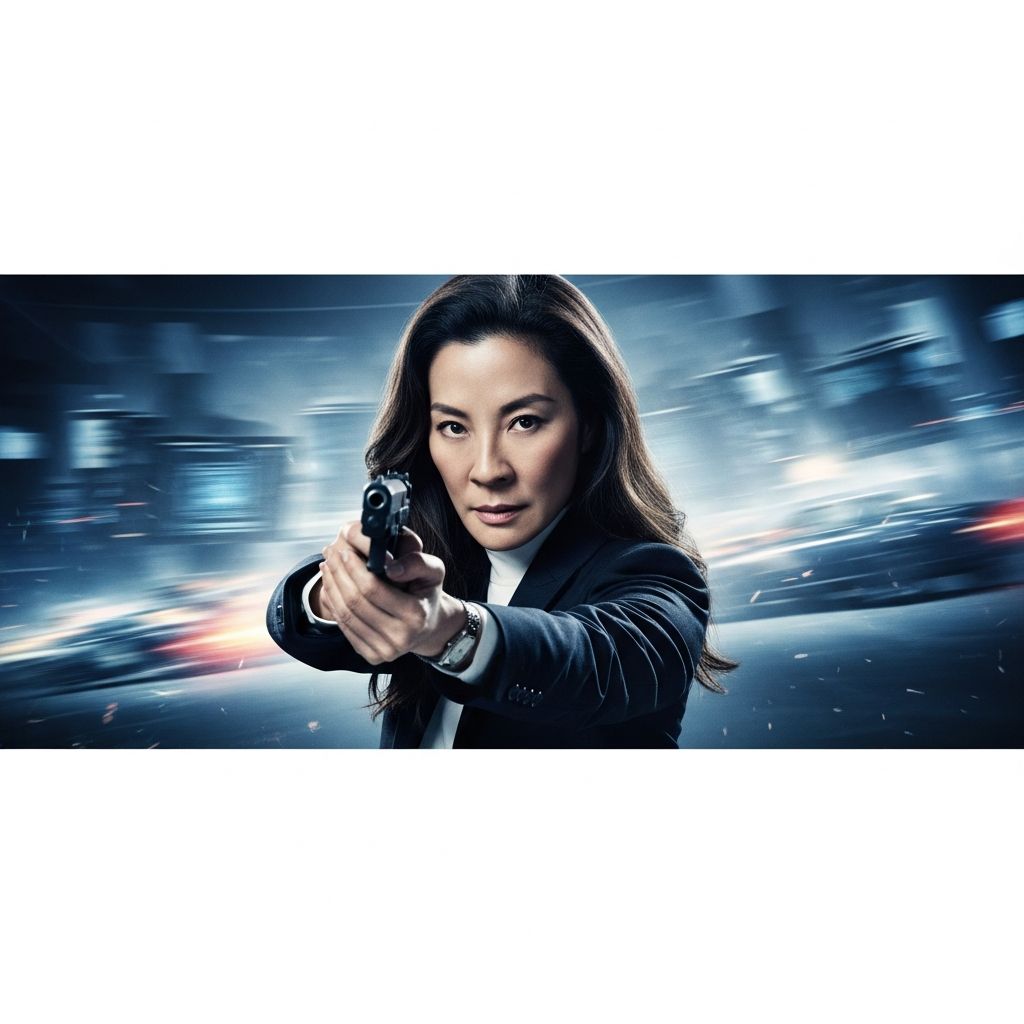
When audiences first met Michelle Yeoh’s Wai Lin in Tomorrow Never Dies, they were not just seeing another Bond “girl” – they were watching the template for the modern action heroine quietly click into place.
In a franchise built on suave spies and disposable love interests, her character arrived as a fully formed equal to James Bond, hinting at what the series – and action cinema in general – could eventually become.
From Hong Kong Action Royalty to Global Spy
Before stepping into the world of 007, Michelle Yeoh had already carved out a reputation in Hong Kong cinema as a fearless, physically committed action star who routinely performed demanding fight sequences.
Her casting as Wai Lin brought that hard-earned credibility into a Western blockbuster, blending the sensibilities of Asian martial arts films with the polished spectacle of a big-budget spy adventure.
Why Her Casting Mattered
- She arrived with a clear on-screen persona as a tough, capable heroine rather than an unknown face slotted into a stock role.
- She represented an Asian superstar being treated as a co-lead in a major franchise, not as a background novelty.
- Her presence signaled that Bond’s world was expanding beyond Eurocentric casting and storylines.
Wai Lin: Not a Sidekick, But a Spy in Her Own Right
Within the story, Wai Lin is introduced as a highly trained agent for the Chinese Ministry of State Security, operating under deep cover and carrying her own independent mission that just happens to intersect with Bond’s.
She is not waiting for rescue, not pining for romance, and not defined by Bond’s affections; instead, she is a parallel protagonist whose priorities only partially overlap with his.
Key Traits That Redefined the “Bond Woman”
- Professional parity: She outruns, outclimbs, and often outplans Bond, matching him skill for skill.
- Emotional restraint: Attraction exists but never eclipses the mission, giving the relationship a mutual respect rare in the series at that time.
- Strategic mindset: She brings her own resources, gadgets, and contacts to the table, operating as a fully autonomous agent.
How Their Partnership Changes the Bond Formula
Once Bond and Wai Lin realize they are chasing the same villain, the film shifts from competition to collaboration, transforming the typical Bond dynamic into something closer to a buddy-spy adventure.
Their alliance is built on grudging respect that slowly evolves into trust, showing Bond working with a woman as an operational equal instead of treating her as an expendable asset.
An Unusual Bond Relationship
| Aspect | Traditional Bond Dynamic | Bond & Wai Lin Dynamic |
|---|---|---|
| Power balance | Bond leads, woman follows or reacts. | Both lead their own operations, often taking turns driving the plan. |
| Competence | Female characters may have one specialty but rely on Bond in combat or strategy. | Wai Lin matches Bond in combat, infiltration, and planning, sometimes surpassing him. |
| Romantic arc | Attraction quickly foregrounded and often drives later scenes. | Romance stays secondary, emerging only after the mission is complete. |
| Cultural lens | Stories framed largely through Western institutions and perspectives. | Chinese intelligence, politics, and locales are central to the plot. |
Action Sequences That Let Her Shine
The film gives Wai Lin multiple opportunities to demonstrate physical skill, from close-quarters combat to large-scale stunt set pieces, emphasizing that she is not merely present in action scenes but integral to their success.
Her fighting style leans more into martial arts precision and agility than brute force, creating a contrast with Bond’s more improvisational brawling that keeps their scenes visually dynamic.
Signature Elements of Her Action Style
- Use of environment, such as scaling structures or manipulating surroundings, rather than relying solely on firearms.
- Choreography rooted in Hong Kong action traditions, giving the fights sharper rhythm and clarity.
- Moments that allow her to rescue herself or save Bond, reversing the usual rescue pattern.
A Story Anchored in Global Anxiety
The plot of Tomorrow Never Dies pivots on a media mogul engineering conflict between global powers to expand his empire, a premise that feels eerily prescient in an age concerned with information warfare and manufactured narratives.
Against this backdrop, having a Chinese agent and a British agent forced to cooperate underlines a theme of reluctant international partnership in the face of privatized chaos.
Geopolitics in the Background
- The villain manipulates technology and news cycles, treating truth as a commodity, which now feels uncomfortably familiar.
- China is not simply a setting but a political stakeholder, with Wai Lin embodying national interests that may not always align with MI6.
Reception: A Fan-Favorite Who Deserved More
Viewers and commentators have frequently highlighted Wai Lin as one of the standout characters of the Pierce Brosnan era, praising her competence, charisma, and chemistry with Bond.
Her popularity has fueled repeated discussions about whether she should have returned in later installments or even led a spin-off, underscoring how memorable the character became despite appearing in a single film.
The Spin-Off That Never Happened
- Ideas circulated about bringing Wai Lin back in a subsequent Bond film, but scheduling and creative shifts ultimately sidelined those plans.
- The absence of a follow-up now reads like a missed opportunity, given the modern appetite for franchise spin-offs and shared universes.
From Wai Lin to Awards Season
In later years, Michelle Yeoh would gain renewed global attention through acclaimed performances in projects that further showcased her range, including genre-blending and dramatic roles that defied easy categorization.
Looking back, Wai Lin feels like an early Hollywood proof-of-concept for what Yeoh could do when allowed to combine physical intensity with wry humor and emotional subtlety.
Legacy Across Her Career
- The character helped introduce Yeoh to a generation of Western viewers who might never have encountered her earlier Hong Kong work.
- Her later success retroactively elevates Tomorrow Never Dies, inviting fresh critical attention to what once seemed like a conventional blockbuster.
How Wai Lin Anticipated Today’s Action Heroines
Contemporary franchises are filled with women who share screen time, leadership, and narrative weight with their male counterparts, but Wai Lin was doing that groundwork in the late 1990s.
Her presence in a long-running, globally recognized series helped normalize the idea that a woman could be both romantic interest and operational equal without sacrificing authority or agency.
Lessons Modern Blockbusters Still Use
- Balance attraction with autonomy so that romance never erases competence.
- Invest in casting performers with strong action backgrounds to make physicality feel grounded.
- Let international characters represent their own institutions and interests rather than acting solely as helpers to Western heroes.
Why Parents and New Fans Discovering Bond Should Care
For viewers introducing younger audiences to the Bond series, Wai Lin offers a gateway into a version of the franchise that feels closer to contemporary values, where partnership and respect take precedence over conquest.
Her character demonstrates that action movies can entertain with gadgets and explosions while still modeling collaboration, cross-cultural teamwork, and mutual trust.
Quick Takeaways for First-Time Viewers
- Watch for how often Wai Lin drives the plot forward instead of merely reacting to events.
- Notice how the film frames her as a professional first and a romantic partner second.
- Compare her role to earlier Bond women to see how drastically the dynamic shifts.
FAQs About Michelle Yeoh, Wai Lin, and Tomorrow Never Dies
Was Wai Lin meant to appear in more Bond films?
There were discussions and at least one invitation for Michelle Yeoh to reprise her role, but practical constraints and shifting creative priorities prevented it from happening.
Is Wai Lin considered a “Bond girl” or something different?
While marketing sometimes grouped her under the “Bond girl” label, many fans and critics regard her as closer to a co-lead, given her narrative importance and independence.
How does Tomorrow Never Dies fit into the Pierce Brosnan era?
The film is often seen as a slick, action-heavy entry that leans into contemporary technology, corporate villainy, and large-scale spectacle, with Wai Lin providing one of its most enduring elements.
Is Tomorrow Never Dies a good starting point for new Bond viewers?
For viewers who want classic Bond elements plus a more modern treatment of its leading woman, the film works well as an accessible entry point that still feels surprisingly current.
What makes Michelle Yeoh’s performance stand out today?
Her blend of physical credibility, dry humor, and grounded emotional presence gives Wai Lin a resilience that holds up against newer action heroines, making the performance feel fresh decades later.