In today’s world, families juggle competing demands from work, school, extracurricular activities, and constant digital connectivity. Parents often describe their days as a blur of meals, errands, homework sessions, and device management, while children face mounting academic pressures, social challenges, and sensory overload from screens. Within this landscape of perpetual busyness, a simple yet powerful tool offers relief: meditation and mindfulness practices. Far from being an indulgence or escape, meditation provides families with concrete strategies to navigate daily stress, enhance emotional regulation, and foster deeper connections with one another.
Understanding the Modern Family’s Stress Landscape
Today’s children experience elevated stress levels, with research consistently showing that young people report feeling overwhelmed by school pressures, peer dynamics, and the demands of balancing multiple responsibilities. Parents, meanwhile, often feel stretched thin—managing household logistics, professional obligations, and the emotional labor of parenting while managing their own anxiety and fatigue. This collective stress ripples through family systems, creating cycles where parental frustration triggers behavioral challenges in children, which in turn increases parental overwhelm.
The American Academy of Pediatrics recognizes this phenomenon and actively encourages parents to explore meditation as a evidence-based tool for family wellness. Neuroscientific research demonstrates that chronic stress impairs children’s developing brains, affecting attention, impulse control, and emotional regulation. Parents, similarly affected by stress hormones, often find themselves responding reactively rather than thoughtfully to their children’s needs and behaviors.
The Science Behind Meditation’s Calming Effects
Meditation works by activating the parasympathetic nervous system—the body’s natural relaxation response. When we meditate, our breathing slows, heart rate decreases, and stress hormones like cortisol diminish. This physiological shift occurs relatively quickly; even brief mindfulness moments create measurable changes in brain activity and stress hormone production.
For children specifically, meditation engages regions of the brain associated with attention, emotional processing, and self-awareness. Research on mindfulness-based cognitive therapy for children (MBCT-C) reveals that structured meditation practice enhances focus and reduces hyperactive behaviors. In one notable study, children diagnosed with ADHD who completed eight weeks of mindfulness training showed significant improvements in concentration and decreased hyperactivity, demonstrating meditation’s potential as a behavioral intervention.
Dr. Rick Hanson’s work on neuroplasticity emphasizes a reassuring truth: even five minutes of focused, mindful awareness creates positive neural changes. A parent taking conscious, deliberate breaths during morning coffee activates the same brain pathways as someone practicing for hours—the difference lies in consistency and intentionality rather than duration.
Benefits for Children’s Academic and Emotional Development
School-based and home-based meditation programs yield measurable improvements across multiple domains of children’s functioning:
Enhanced Focus and Academic Performance
Children who establish meditation routines demonstrate notably improved attention spans at school. Teachers and parents report reduced classroom distractions and increased task completion. These improvements translate directly to academic outcomes—students practicing mindfulness show bumps in attendance and grade point averages. The mechanism appears straightforward: when the mind has fewer scattered thoughts and greater ability to sustain concentration, learning becomes more efficient.
Emotional Regulation and Mental Health
One of meditation’s most valuable gifts is teaching children to distinguish between their thoughts and their identity. Through mindfulness practice, young people learn that anxious thoughts, uncomfortable emotions, or frustrating situations are temporary mental events rather than permanent truths about themselves. Research indicates that children practicing meditation show reduced anxiety and depression symptoms, improved sleep quality, and better overall emotional functioning.
Adolescents, in particular, benefit from meditation’s capacity to provide inner stability during hormonal and developmental changes. Teenagers gain access to what practitioners describe as inner solidity—a sense that challenges are navigable and that their core self remains intact regardless of external circumstances. This becomes especially valuable during the turbulent teen years when peer influence peaks and self-doubt increases.
Relief from Overstimulation and Trauma
Modern childhood includes unprecedented exposure to stimulation: screens, notifications, social dynamics, structured activities, and sensory input. Meditation offers what contemporary children desperately need—protected time without input, without performance expectations, without stimulation. This respite allows the nervous system to reset and the mind to process accumulated experiences. For children exposed to trauma, stress, or difficult circumstances, mindfulness provides tools for returning to the present moment and gaining psychological distance from painful thoughts.
Parental Benefits: Transforming Family Dynamics
When parents establish their own meditation practice, benefits extend throughout the entire family system. Research on parental stress and family wellbeing demonstrates that parents who develop emotional regulation through meditation create positive ripple effects for everyone living in the household.
Shifting from Reactive to Responsive Parenting
Every parent has experienced the cycle: a child misbehaves, triggering parental frustration that escalates the situation further. Meditation breaks this reactive pattern by creating what neuroscientists call the “pause space”—the gap between stimulus and response where conscious choice becomes possible. A parent who meditates regularly develops greater capacity to notice rising anger without automatically expressing it, to recognize their child’s behavior as developmentally normal rather than personally offensive, and to respond with intentionality rather than impulse.
Modeling Emotional Literacy
Children learn emotional regulation not primarily through parental lectures but through witnessing how parents manage their own emotions. When a parent takes mindful breaths before responding to frustration, openly acknowledges their feelings, and demonstrates self-calming strategies, children internalize these approaches. They learn that all emotions are valid, that they can be felt without being acted upon, and that there are tools for managing inner turbulence.
Reduced Parental Stress and Increased Patience
Parents who meditate regularly report feeling less tired, more patient, and more capable of meeting their children’s needs with compassion rather than resentment. This isn’t about lowering parental standards; it’s about approaching parenting from a more resourced, calmer state. A parent who has meditated for ten minutes has more emotional and mental bandwidth to handle the inevitable challenges of family life.
Physical Health Benefits for All Family Members
Beyond emotional and cognitive improvements, meditation produces measurable physical health benefits. Research demonstrates that meditation practices calm the nervous system and decrease stress hormones, leading to improvements in gastrointestinal function, immune response, blood pressure regulation, and pain sensitivity. A study of adolescents at cardiovascular risk found that mindful breathing meditation produced measurable reductions in blood pressure and heart rate.
These physical benefits make meditation relevant for children dealing with stress-related conditions including chronic headaches, digestive issues, and sleep disturbances. For the entire family, meditation becomes a health-promoting practice with benefits extending beyond mental and emotional wellbeing.
Deepening Family Connection Through Shared Practice
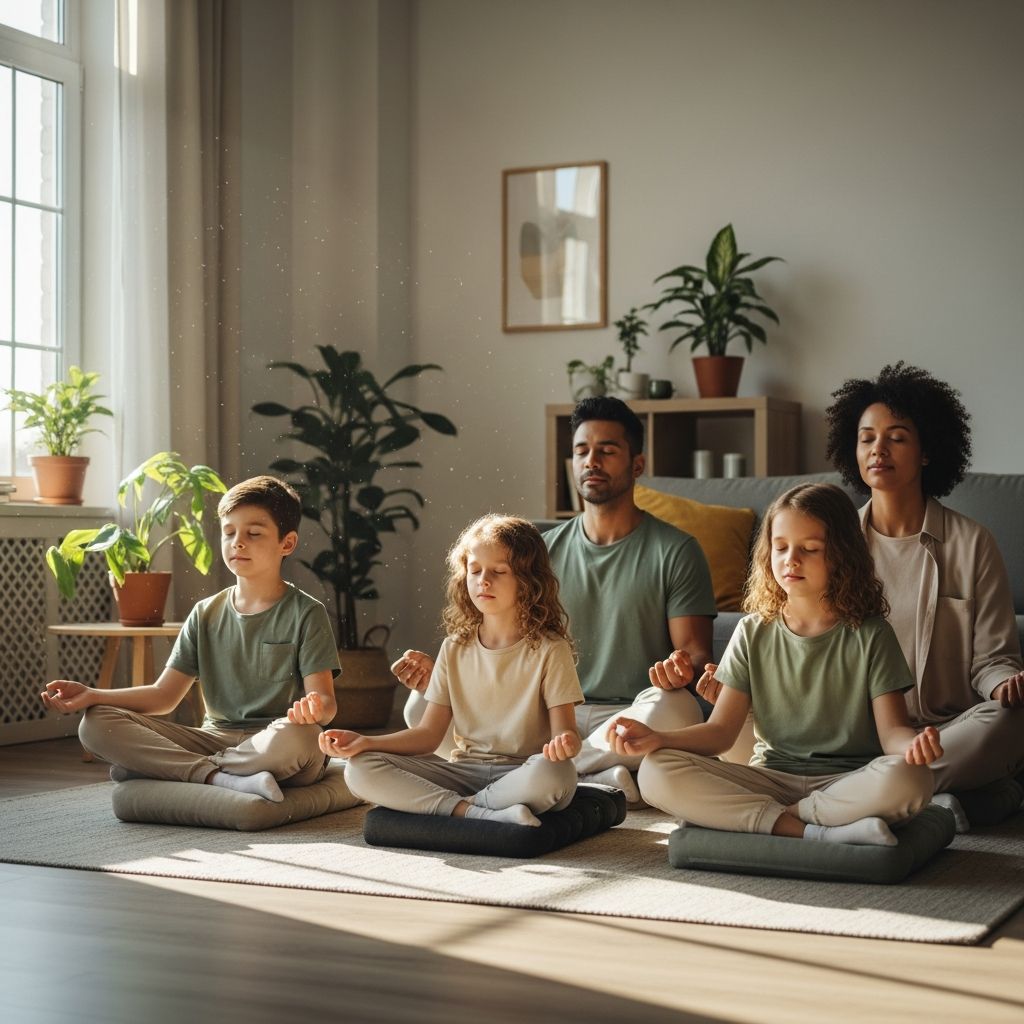
As children mature, parents often sense a growing distance—the close connection of early childhood gives way to adolescent independence. Meditation offers a pathway back to that connection. When parents and children practice mindfulness together, or when parents maintain their own practice while supporting children in theirs, it creates shared language and understanding around emotional experience. Parents recognize that the connection they fear losing is actually ever-present; meditation simply makes this reality tangible again.
Practical Implementation: Meditation Recommendations by Age
The American Academy of Pediatrics offers evidence-based guidance for meditation duration across different developmental stages:
- Preschool children: A few minutes daily, often integrated into existing routines like bedtime.
- School-age children: 3-10 minutes twice daily, potentially including morning preparation and evening wind-down.
- Teenagers and adults: 5-45 minutes daily based on individual preference and schedule.
Incorporating deep breathing into existing routines—particularly bedtime—makes meditation feel less like an additional task and more like a natural family rhythm. A parent might use a few moments of conscious breathing while coffee brews, or guide children in mindful breathing before bed.
Addressing the Busy Parent’s Reality
Parents often dismiss meditation as impractical given their schedules. However, this approach misses an essential point: meditation doesn’t require finding large blocks of uninterrupted time or achieving perfect mental silence. Instead, it involves noticing the small spaces throughout daily life—the moments when breath naturally deepens, the automatic mindfulness that comes with watching a child sleep, or the present-moment awareness required when small hands reach for yours. These brief, unplanned moments of mindfulness are equally valuable as formal practice sessions.
The goal isn’t to add one more task to an already overwhelming to-do list. Rather, it’s to bring mindful awareness to activities already occurring—transitions between tasks, moments of waiting, or the few minutes before sleep.
Frequently Asked Questions
Do children need special training to meditate?
While guided meditation apps and classes can be helpful, children can begin with simple breath awareness. Parents can introduce meditation as “focusing on how your breath feels” without requiring formal instruction or previous experience.
How long until meditation produces noticeable results?
Some families notice improvements in mood and focus within days, though consistent benefits typically emerge within 2-4 weeks of regular practice. Neuroplasticity research shows that even brief moments of mindful awareness create brain changes, though sustained practice produces more dramatic effects.
Can meditation help with specific conditions like ADHD or anxiety?
Research demonstrates benefits for ADHD, anxiety, depression, sleep problems, and eating concerns. Meditation works particularly well as a complementary practice alongside other treatments. Always consult with pediatricians or mental health professionals when addressing diagnosed conditions.
What if my child refuses to meditate?
Rather than forcing formal meditation, introduce mindfulness informally—during walks, while listening to music, or through breathing games. Children often warm to practices presented as games or shared family activities rather than requirements.
Can busy parents realistically maintain a meditation practice?
Yes, by redefining practice to include brief moments of conscious awareness throughout the day rather than requiring long dedicated sessions. Five intentional breaths during morning coffee provide measurable benefits equal in impact to much longer formal practice.
References
- Just Breathe: The Importance of Meditation Breaks for Kids — American Academy of Pediatrics. Accessed January 2026. https://www.healthychildren.org/English/healthy-living/emotional-wellness/Pages/Just-Breathe-The-Importance-of-Meditation-Breaks-for-Kids.aspx
- Meditation and Motherhood — The Wellbeing Collective. Accessed January 2026. https://thewellbeingcollective.com/blog/meditation-and-motherhood