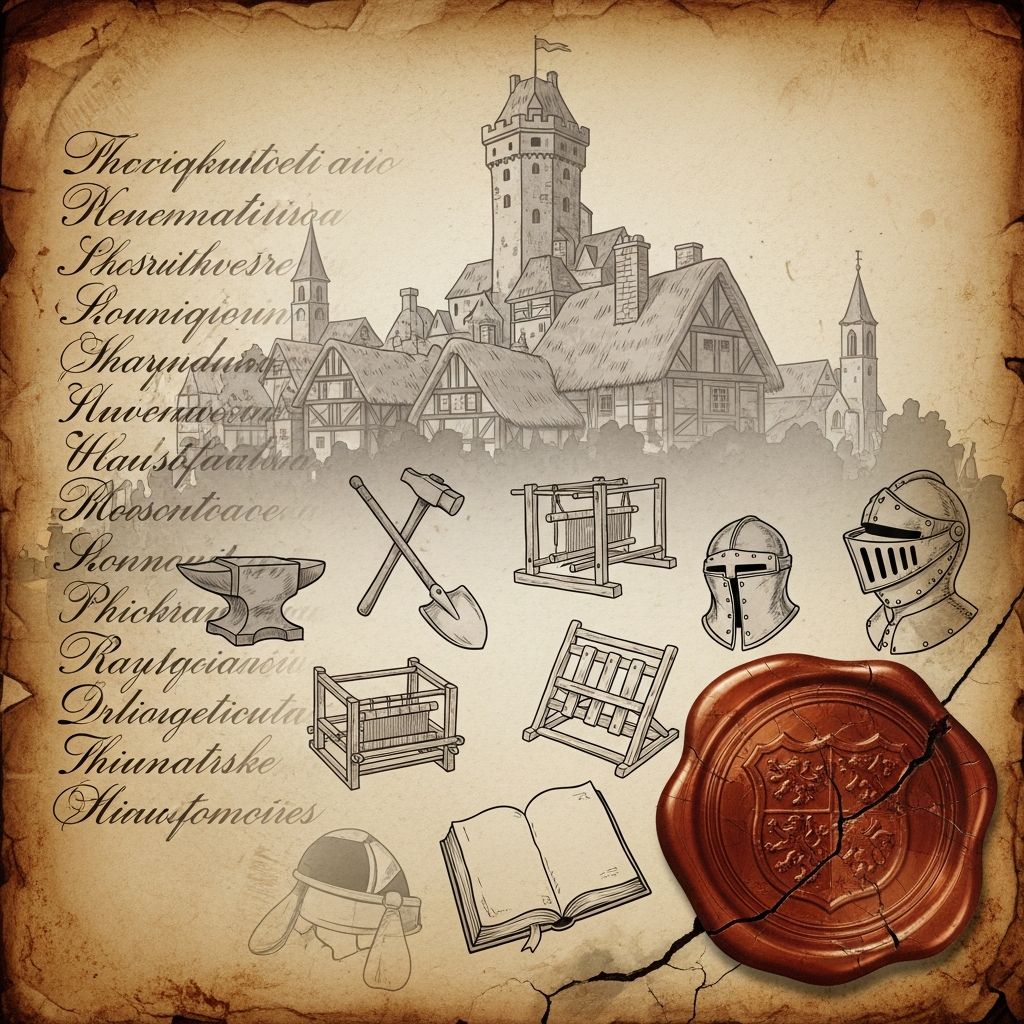
Medieval last names grew out of everyday life in the Middle Ages, turning ordinary details like a person’s job, home village, or father’s name into lasting family identities.
Many modern surnames still preserve these medieval roots, allowing people today to trace family stories back through centuries of social, economic, and cultural change.
Why Surnames Emerged in the Medieval World
For much of early medieval Europe, people usually went by a single given name, sometimes with an informal description added if others shared that name.
As populations increased, governments strengthened, and record-keeping expanded, communities needed more precise ways to distinguish individuals, leading to the gradual adoption of surnames.
- Growing villages and towns made single names impractical when many neighbors shared identical given names.
- Taxation, land ownership, and legal disputes encouraged the use of consistent identifiers in official records.
- Influence from conquering elites and changing languages helped spread the idea of inherited family names.
By the late Middle Ages in many European regions, last names had shifted from informal descriptions to hereditary family markers passed down through generations.
The Four Main Roots of Medieval Last Names
Although medieval Europe was culturally diverse, most surnames developed from four broad sources: occupations, places, family relationships, and personal nicknames.
Understanding these categories helps decode the stories behind many modern surnames and reveals how medieval people saw themselves and one another.
| Type of medieval surname | What it described | Typical medieval context |
|---|---|---|
| Occupational | A person’s trade or role in the community, such as a smith or a miller. | Reflected the importance of skilled crafts, guilds, and specialized labor. |
| Locational | Where someone lived, came from, or owned land, often tied to villages or landmarks. | Linked identity with landscape, feudal holdings, and local geography. |
| Patronymic | Descent from a father or ancestor, often meaning “son of” a particular man. | Emphasized lineage, inheritance, and the patriarchal family structure. |
| Descriptive / Nickname | Distinctive traits—physical, behavioral, or humorous—used to set people apart. | Captured personality, reputation, or appearance as remembered by neighbors. |
Occupational Surnames: Work Turned Into Identity
Occupational surnames grew from the kinds of work that kept medieval communities running, transforming trades into labels that soon became family names.
From the village forge to the lord’s hall, the job someone performed was often the most obvious way to tell them apart from others with the same given name.
Crafts, Tools, and Everyday Trades
Many occupational surnames trace back to skilled craftspeople such as metalworkers, carpenters, bakers, and textile workers, whose products were essential for daily life.
As guilds formalized training and standards in growing medieval towns, trade-based surnames helped mark membership in a particular craft community.
- Metalworking roles such as smiths or armorers linked families to the forging of tools, weapons, and domestic items.
- Food-related roles like bakers, butchers, and millers signaled control over vital stages in the food supply.
- Clothing and textile workers, including weavers, fullers, or tailors, reflected the importance of fabric production.
Occupations and Social Status
While many occupational surnames referred to humble crafts, some also indicated higher social ranks, administrative roles, or specialized court offices.
These surnames show the layered nature of medieval society, from manual laborers to stewards of estates and agents of royal authority.
- Names tied to service in noble households could reflect trusted positions like steward, chamberlain, or marshal.
- Legal or administrative titles sometimes became surnames, marking families involved in governance or record-keeping.
- Over time, descendants might carry the surname even if they no longer practiced the original occupation.
Locational Surnames: Places as Family Signatures
Locational surnames grew out of the tight connection between medieval people and the landscapes they inhabited—villages, valleys, forests, and fields.
As people moved from one area to another, neighbors often identified them by the place they had come from, turning geography into a lasting label.
From Villages, Manors, and Regions
Many medieval surnames derived from the names of towns, parishes, and estates, especially among landholding families and migrants to growing urban centers.
Migrants arriving in a new town might be distinguished by the name of their home village, which then solidified into a surname for their descendants.
- Names linked to manors or estates often signaled ties to a particular lordship or rural community.
- Surnames connected to broader regions could indicate origins from distant parts of a kingdom.
- Some locational names shifted spelling over time as languages and pronunciations changed.
Topographic Features and Landmarks
Other locational surnames referred not to settlements but to prominent natural or man-made features such as hills, bridges, woods, or rivers.
These names may have arisen when several people shared a given name in the same village, making reference to a nearby landmark a convenient way to distinguish them.
- Surnames could reference living near a wood, marsh, hill, or stream.
- Names tied to structures like mills, bridges, or town gates suggested closeness to key local infrastructure.
- As settlements expanded, a family’s landmark-based name might outlast the original feature itself.
Patronymic Names: Lineage in a Single Word
Patronymic surnames grew from phrases that originally meant “son of” or “descendant of” a particular person, transforming family relationships into inherited labels.
These names support genealogical reconstruction by hinting at earlier given names that may have belonged to an ancestor in the first generation to use the surname.
How Patronymics Took Shape
In the early medieval period, people routinely identified themselves by referring to their father, such as through phrases equivalent to “John, son of Robert.”
Over time, these descriptive phrases solidified into fixed surnames, often dropping explicit words like “son” or fusing them into a single unit.
- Different languages developed distinctive endings or prefixes to mark descent, though all conveyed a similar idea of ancestry.
- Some names remained flexible for a while, changing with each generation before finally becoming hereditary.
- In a few regions, patronymic systems persisted in a fluid form longer, delaying the shift to fixed surnames.
Patronymics and Social Structures
Patronymic surnames highlight the centrality of the family line in disputes over land, obligations, and social standing in the medieval era.
They also illustrate how patriarchal patterns shaped naming practices, even though, in some cultures, maternal or clan-based names also appeared.
- Lineage-based names could strengthen claims to inheritance or membership in a recognized kin group.
- Some noble houses used elaborate naming patterns that combined patronymic elements with titles or territorial names.
- When families rose or fell in fortune, the patronymic surname might be one of the few enduring traces of earlier status.
Descriptive and Nickname Surnames: Personality Preserved
Descriptive surnames began as nicknames, capturing striking physical traits, mannerisms, or reputations that set a person apart from others with the same given name.
Over generations, these once-spontaneous labels stabilized into hereditary surnames, even when the original description no longer fit descendants.
Physical Traits, Habits, and Humor
Many nickname-based surnames reflected how neighbors saw someone’s body, behavior, or temperament, offering a candid glimpse into everyday medieval humor and social dynamics.
Some names might have been affectionate, while others carried teasing or critical undertones that reflected the close-knit nature of small communities.
- Names could refer to size, hair color, or distinguishing marks.
- Other surnames might point to perceived character traits such as gentleness, pride, or stubbornness.
- A few nicknames hinted at stories or incidents that neighbors clearly remembered at the time.
Reputation and Social Memory
Descriptive surnames acted as a kind of social record, preserving community judgments about individuals long after the original bearer had died.
For genealogists, these nicknames can hint at lost anecdotes and local lore, even though the specific stories behind them are rarely documented.
- Some families may have embraced a flattering nickname, turning it into a proud identity.
- Less flattering names sometimes endured anyway, showing that medieval communities valued recognizability over diplomacy.
- Over time, spelling changes could soften or obscure the original meaning of a descriptive surname.
Nobility, Conquest, and the Spread of Surnames
The rise of hereditary surnames in parts of Western Europe is closely tied to political change, especially the expansion of centralized rule and the influence of conquering elites.
In some regions, noble families adopted surnames tied to their estates or ancestral seats earlier than commoners, and their naming styles later spread down the social ladder.
Feudal Lords and Territorial Names
Many medieval noble families took surnames from the lands they controlled, using place-based names to emphasize authority and heritage.
As these families acquired new holdings, their surnames could either remain stable or evolve to reflect shifting territorial power.
- Estate-based surnames allowed ruling families to associate their identity with a particular castle, valley, or domain.
- When noble lineages intermarried, compound surnames sometimes merged multiple territorial claims.
- Later, lesser gentry and aspiring families imitated these patterns to project status.
Conquest, Language Contact, and New Names
Military conquest brought new languages and naming customs, helping introduce or accelerate the adoption of hereditary surnames in some areas.
In multicultural regions, surnames often mixed linguistic elements, with older local names adapting to the spelling and pronunciation habits of newcomers.
- Conquering elites imported naming fashions from their homelands, which then blended with local traditions.
- Bilingual or multilingual communities created hybrid surnames that reflected complex identities.
- Over time, administrative records tended to favor standardized spellings, gradually fixing surnames in particular forms.
How Medieval Surnames Evolved Over Time
Once surnames began to stabilize, they still remained subject to gradual evolution through spelling shifts, language change, and regional pronunciation differences.
Clerks, priests, and scribes often wrote names as they heard them, creating many variant forms that could all relate to a single original surname.
Spelling Variants and Regional Flavors
Because spelling was not standardized in the medieval period, even siblings might have slightly different versions of the same surname in official records.
Regional accents, dialects, and later language reforms contributed to the wide diversity of surname forms that appear in documents today.
- Changes in the dominant written language of administration could alter the appearance of surnames.
- Local pronunciation often influenced how scribes chose to represent names in writing.
- Over centuries, some surnames were shortened, merged, or transformed beyond easy recognition.
From Description to Family Heritage
By the late medieval and early modern periods, many communities treated surnames as fixed family identifiers rather than flexible descriptions.
This shift meant that a name originally tied to a job, place, or personality trait became a portable label that followed descendants regardless of their changing circumstances.
- Occupational surnames could persist even when families moved into different trades.
- Locational names followed descendants far from the original village or landscape.
- Nickname-based surnames outlived the stories that first inspired them.
Using Medieval Last Names in Modern Storytelling
Writers, game designers, and role-players often turn to medieval-style surnames to lend authenticity and depth to fictional settings.
Understanding how these names worked historically helps create characters whose names subtly convey background, region, or social status.
Choosing Authentic-Sounding Medieval Surnames
When building a medieval-inspired world, aligning surnames with character roles and settings can make the society feel more believable.
Balancing recognizable patterns with creativity allows names to sound fitting without copying real historical families directly.
- Use occupational-style surnames for artisans, soldiers, or officials whose work defines their place in society.
- Reserve locational or estate-linked surnames for nobles, wealthy landholders, or ambitious merchants.
- Assign nickname-based surnames to colorful personalities, outcasts, or characters known by reputation.
Blending Cultures and Name Types
Fictional settings with multiple cultures can mirror medieval Europe’s mix of languages by varying surname structures across regions.
Combining different naming traditions—such as patronymics in one area and place-based surnames in another—visually signals cultural diversity within a story.
- Design one culture around patronymic endings or prefixes that clearly mark lineage.
- Give another culture surnames rooted in landscapes or city names, highlighting their bond with place.
- Use hybrid or adapted surnames for border regions where cultures meet and intermingle.
Frequently Asked Questions About Medieval Last Names
When did medieval people start using last names?
In many parts of Western Europe, hereditary surnames began appearing between the 11th and 14th centuries, though the pace and pattern varied by region.
Early usage was often limited to elites and urban communities, gradually spreading to the wider population over several generations.
Did everyone in the Middle Ages have a surname?
For much of the medieval period, not everyone consistently used a fixed hereditary surname, especially in rural or less regulated areas.
Some individuals might appear in records with varying descriptive tags before their descendants settled on a stable family name.
Can modern surnames still reveal medieval occupations?
Many modern occupational surnames do preserve the memory of medieval trades, even when descendants work in entirely different professions today.
However, spelling changes and language shifts mean that some professions are now obscured or only recognizable to specialists in historical linguistics.
How reliable are surnames for tracing genealogy back to the Middle Ages?
Surnames provide useful clues for genealogy, but they must be combined with documents such as parish records, legal deeds, and tax lists to build reliable family trees.
Because different families sometimes shared the same surname, and single families used multiple spellings, careful cross-checking is essential.
Why do some medieval-style surnames look similar across different countries?
Similar social needs—identifying people by job, place, or parent—led many cultures to develop parallel naming patterns that resemble one another.
Shared linguistic roots, conquest, and migration also helped spread certain naming styles and personal name elements across borders.
Key Takeaways for Readers and Researchers
Medieval last names developed from practical descriptions into fixed family labels, encapsulating information about work, place, ancestry, and personality in just a few syllables.
Whether used for historical research, creative writing, or personal curiosity, understanding the logic behind these surnames opens a window into the social fabric of the Middle Ages.