The turn of the year can be much more than staying up late and watching fireworks. With a little intention, it can become one of the strongest anchors your family has for connection, reflection, and hope.
Why New Year Rituals Matter for Families
Children remember repeated experiences far more than isolated events. When a family returns to the same set of warm, meaningful activities each New Year, those moments become a source of security and belonging. Over time, these rituals act like emotional landmarks that help kids feel grounded, loved, and seen.
New Year rituals also offer parents a natural opportunity to pause, look back at the year, and gently reset expectations. Instead of focusing on resolutions as a list of self-criticisms, families can frame the new year as a shared adventure shaped by values, strengths, and gratitude.
Principles of a Nourishing New Year Ritual
You do not need a perfect plan or elaborate party to build a meaningful tradition. What matters most is that your rituals are consistent, emotionally safe, and genuinely enjoyable for both adults and kids. Use the following principles as a compass when designing your own version.
- Simplicity over spectacle: Choose a few activities you can repeat each year without burning out, rather than over-scheduling the day.
- Connection as the goal: Let every ritual serve deeper conversation, shared laughter, or quiet togetherness.
- Child participation: Involve kids in planning, decorating, and choosing activities so they feel ownership of the tradition.
- Emotional safety: Make room for mixed feelings about the past year instead of insisting that everyone be cheerful.
- Flexibility: Allow the rituals to evolve as children grow and family circumstances change.
The Heart of the Celebration: Reflection
Many New Year traditions jump straight to goals, but young children benefit most when the focus begins with reflection. Looking back helps them notice how much they have grown, process difficult moments, and see the year as a coherent story rather than a blur of events.
You can think of reflection as gently turning pages in a family album—not to judge the past, but to appreciate it. The aim is to name what mattered, what challenged you, and what you want to carry forward.
Family Memory Sharing Circle
One of the simplest rituals is to sit together and share memories from the year. This works well around the dinner table, in the living room with hot chocolate, or even on a walk if your kids focus better when they are moving.
- Invite each person to share a favorite moment from the year and explain why it felt special.
- Ask about one thing that was hard, and what helped them get through it.
- Encourage siblings to name something they appreciated about one another.
- For young children, offer prompts like “When did you feel really proud this year?” or “What made you laugh the most?”
Highlights and Lessons Table
If your family likes visuals, you can capture reflections in a simple table that you fill in together. This can be drawn on a large sheet of paper or created digitally and printed each year.
| Category | Examples to Share |
|---|---|
| Joyful moments | Trips, celebrations, silly family jokes, new skills learned, favorite outings |
| Challenges | Moves, friendship issues, illnesses, school struggles, big feelings |
| What we learned | Skills, emotional insights, problem-solving strategies, ways you helped others |
| What we’re proud of | Acts of kindness, bravery, perseverance, creativity, teamwork |
When you fill this out together, you help children see that life includes both joy and difficulty, and that both offer important lessons. Over the years you can keep these sheets in a binder to watch your family’s story unfold.
Gratitude Rituals for the Turning of the Year
Gratitude training does not require grand speeches. Small, repeated practices help children notice that goodness exists alongside stress and disappointment. New Year is an ideal time to pause and acknowledge what you want to thank, from people and experiences to inner strengths.
These rituals are especially powerful when paired with a calm, unrushed atmosphere. Consider dimming the lights, lighting candles (or using electric ones), and slowing your pace so children feel that this time is different from the usual rush.
Gratitude Stars or Leaves
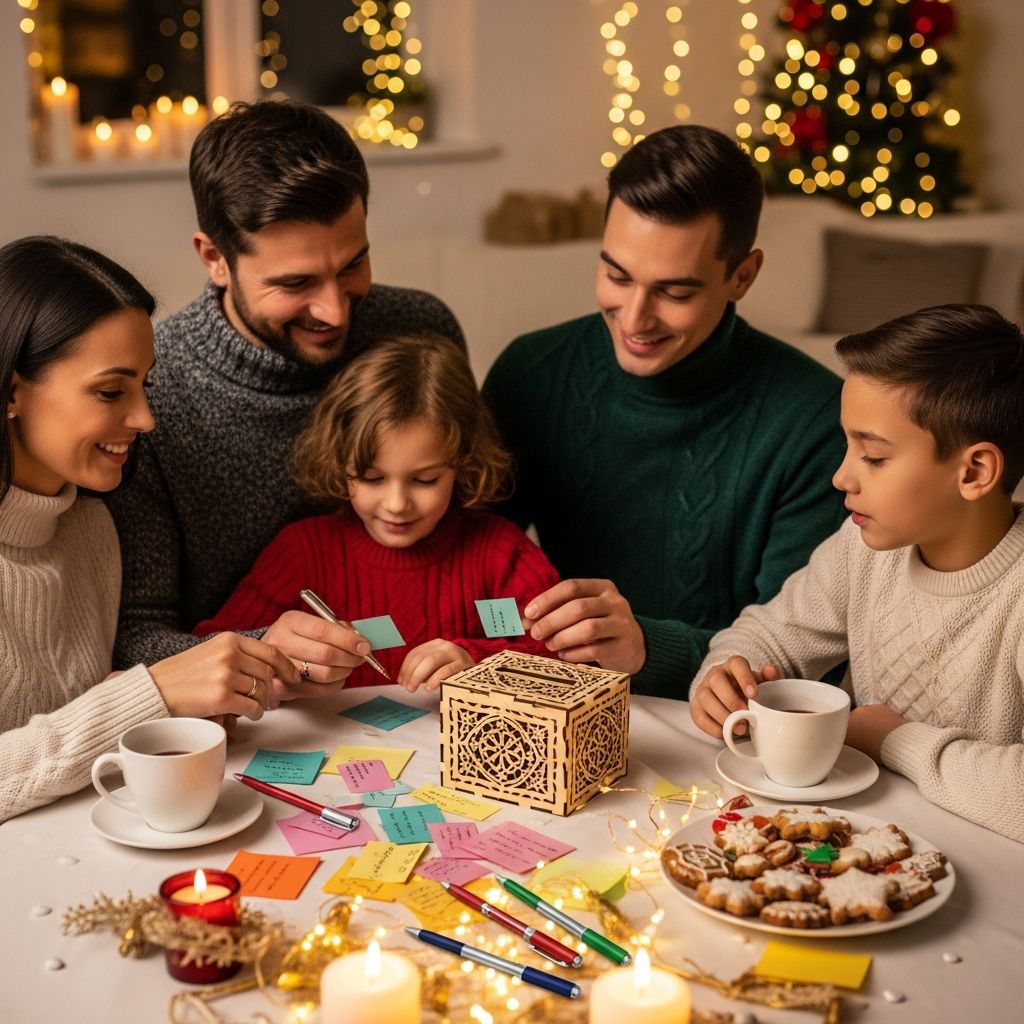
Create a simple gratitude display you can hang for the first week of the new year. Cut out star or leaf shapes from paper, provide markers, and invite everyone to write or draw things they are thankful for from the past year.
- Place the shapes in a bowl and take turns pulling them out and reading them aloud.
- Let young children dictate their ideas while an adult or older sibling writes them down.
- After sharing, string the stars or leaves together as a temporary garland over a doorway or mantle.
Thank-You Messages Ritual
Another option is a “circle of thanks” that gives each family member a chance to feel seen. Each person shares one thing they appreciate about every other person in the room. Keep the tone warm and specific rather than exaggerated.
- Encourage children to notice small gestures, like someone reading them a bedtime story or helping with homework.
- If kids feel shy, invite them to whisper to a parent who can voice their gratitude for them.
- Consider writing some of these compliments down for children to keep in a small envelope marked with the year.
Gentle Goal-Setting: From Resolutions to Intentions
Traditional resolutions tend to focus on what is wrong: eat less, do more, be better. For children, this can easily turn into self-criticism. A healthier approach is to frame the new year around values and intentions, emphasizing growth rather than perfection.
Instead of pushing kids to commit to big changes, invite them to imagine how they want to feel and how they want to show up in relationships, school, and play. The key message is that they already have many strengths they can build on.
Family Intention Board
An intention board is a visual collage that captures the qualities your family wants to nurture in the coming year. Unlike a vision board focused on things to obtain, this is about the kind of people you want to be together.
- Collect magazines, old cards, stickers, or printed words and images that represent feelings and values.
- Invite each person to choose a few images or words that reflect what matters to them (e.g., kindness, adventure, calm, creativity).
- Glue everything on a large sheet labeled with the new year and display it in a common area.
One-Word or One-Value Tradition
Another gentle practice is to choose one word or value for the year individually or as a family. This can be as simple as “bravery,” “patience,” or “curiosity.” Children often respond well to concrete words they can remember.
- Help younger children choose by offering a handful of options and briefly explaining each.
- Once everyone has a word, discuss small, realistic ways that word might show up in daily life.
- Write the words on colorful paper and post them where you will see them during the year, such as on the refrigerator or near the family calendar.
Playful Traditions for Younger Children
While reflection and intention matter, younger children need movement and sensory play to stay engaged. You can weave fun, physical elements into your New Year rituals without losing depth or meaning.
Consider choosing one or two lighthearted activities that repeat every year. The predictability will excite kids, and the silliness helps balance more serious conversations.
Countdown by Connection, Not by Clock
Many kids cannot stay awake until midnight, and forcing it often leads to overtired meltdowns. Instead, create your own earlier “family midnight”—perhaps 7 or 8 p.m.—and build a countdown around connection-focused mini-activities.
- Prepare small envelopes or jars labeled with times leading up to your chosen countdown.
- Inside each one, place a simple activity: a five-minute dance party, a card game, reading a favorite picture book, or a quick family stretch.
- Open one envelope at each time, then celebrate your “midnight” together with sparkling juice and hugs.
Symbolic Letting-Go Activity
Children also carry disappointments and worries from the year. A symbolic letting-go ritual can help them release some of that emotional weight in a safe, concrete way.
- Give each person a small piece of paper and invite them to draw or write something they would like to let go of (a fear, a habit, a hard memory).
- Place the papers into a jar, shred them, or—if it is safe and allowed—burn them in a supervised outdoor fire as you talk about making space for new experiences.
- Emphasize that the hard thing may not vanish completely, but you are choosing not to let it define the new year.
Rituals That Grow with Your Children
New Year traditions do not have to stay frozen in time. As children grow into tweens and teens, they often crave more autonomy and deeper conversation. Adapting your rituals to their developmental stage shows respect for who they are becoming.
Involving older kids in decision-making also increases their willingness to participate. Instead of announcing a plan, invite them to help design the year’s activities and themes.
Year-in-Review Interviews
Older children often enjoy being treated like authors of their own life stories. A yearly interview is a powerful tool for capturing their perspectives and watching their growth over time.
- Create a list of 8–12 open-ended questions about the past year (favorite memories, hardest challenge, new interests, something they changed their mind about).
- Interview each child individually or let them fill out their answers in writing or audio recordings.
- Store the interviews in a folder or digital archive to revisit in future years; teens especially enjoy seeing how their answers change.
Service-Focused Traditions
As children mature, you can add a service element to your New Year rituals. This shifts part of the focus away from self-improvement and toward contributing to the wider world.
- Choose a small act of kindness to repeat around New Year, such as writing thank-you notes to community helpers or donating gently-used items.
- Discuss together which causes matter most to your family and how you might support them in the coming year.
- Keep the first step small and realistic so that it feels doable rather than overwhelming.
Balancing Celebration and Calm
It can be tempting to replicate the high energy of large New Year parties, but young nervous systems often do better with a blend of excitement and calm. Too much sugar, noise, and late-night stimulation can overshadow the emotional meaning of your rituals.
Intentionally alternating active and quiet moments makes the day more sustainable. Think of it as a wave pattern: a burst of fun, then a calm pause, then another burst.
Sample Family-Friendly New Year Flow
The following structure is just an example; adapt the timing and elements to the age and temperament of your children. The key is to weave reflection, gratitude, play, and rest throughout the experience.
- Afternoon: Outdoor walk or play, gathering one small item each child finds meaningful to place on the table for the evening rituals.
- Early evening: Simple festive meal, followed by the family memory sharing circle.
- After dinner: Gratitude stars or leaves, then a brief dance party or game.
- Before bedtime: Letting-go ritual and a final moment of quiet, such as deep breaths together or a short story about hope and resilience.
FAQs: New Year Rituals with Children
What if my kids are not interested in reflective conversations?
Many children, especially when tired or overstimulated, resist serious talk. Instead of forcing a long discussion, sprinkle reflection into playful formats: drawing, short prompts during a game, or quick round-robin questions. Over time, as the rituals become familiar, most children open up more naturally.
How do we handle big emotions about the past year?
New Year can stir sadness, regret, or anxiety for both adults and kids. Make it clear that all feelings are welcome and that no one has to be “positive” the whole time. If strong emotions surface, slow down, validate the feelings, and focus on connection rather than finishing every planned activity.
Do rituals still matter if our family situation is changing?
Yes, perhaps even more. Changes like separation, moving, or loss can make children feel unmoored. Simple, repeatable rituals—no matter how modest—signal that some things remain steady. You can also gently name the changes and invite kids to help shape new traditions that fit your current reality.
What if we miss a year or cannot do everything?
Rituals are meant to support your family, not become another source of pressure. If one year is especially busy or stressful, choose one small element to keep, like a short gratitude circle or reading last year’s intention words. Consistency over time matters more than perfection in any single year.
How can single parents or blended families adapt these ideas?
Single-parent and blended families can select rituals that fit their schedules and co-parenting arrangements. You might repeat a short core ritual in both households or keep one primary New Year tradition in the home where children spend most of that time. Involving kids in these choices helps them feel held rather than pulled between different worlds.
Crafting Your Own Signature New Year Tradition
Ultimately, the most meaningful New Year rituals are the ones that reflect your family’s unique personality, culture, and needs. You might blend elements of storytelling, creativity, nature, food, music, or spirituality into a pattern that feels like home.
If you begin with a clear intention—to connect, to honor the past year, and to welcome the new one with curiosity and kindness—the specific activities will naturally fall into place. Over time, your children will not remember every detail, but they will remember how it felt to step into the new year together, hand in hand.