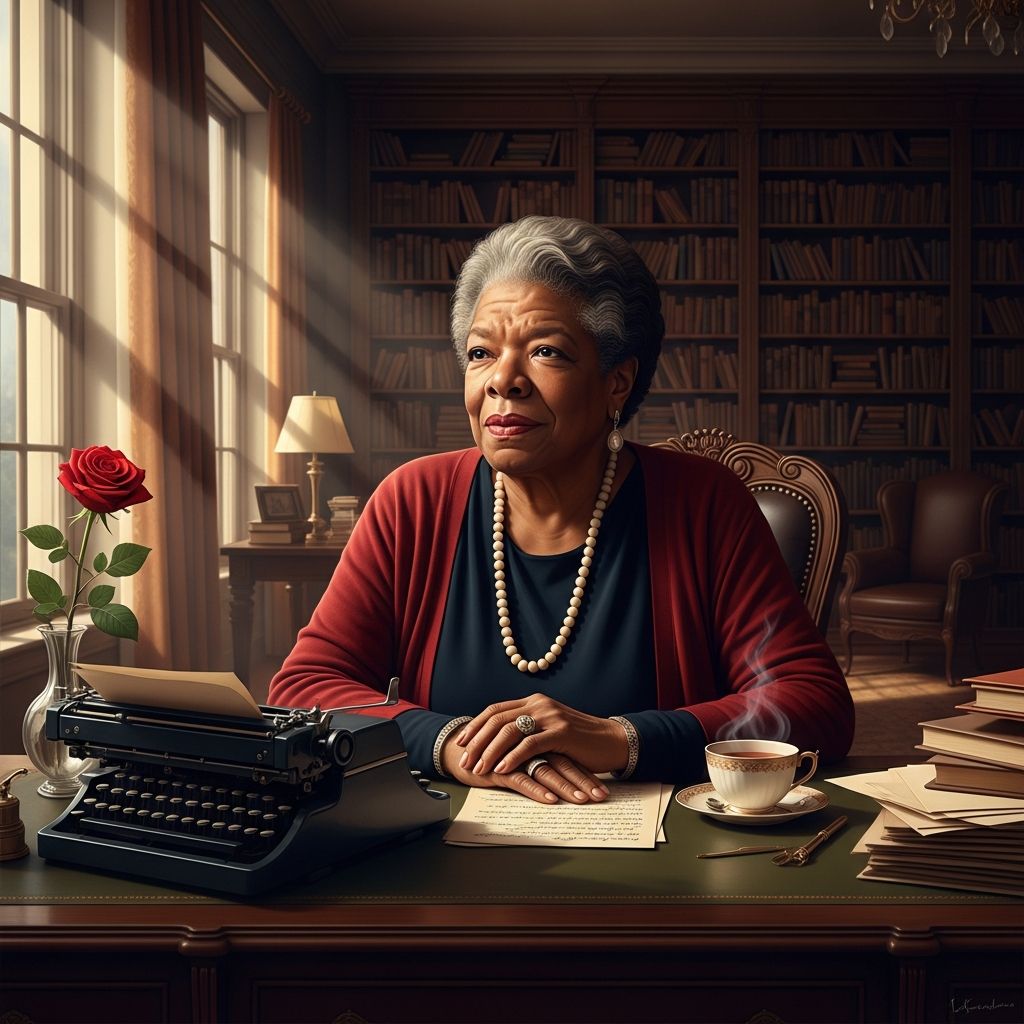
Maya Angelou, born Marguerite Annie Johnson on April 4, 1928, in St. Louis, Missouri, emerged as one of the most influential voices of the 20th century. Her life story, marked by profound adversity, artistic brilliance, and unwavering activism, continues to resonate worldwide.
Early Years: Roots of Strength Amid Adversity
Angelou’s childhood was anything but ordinary. Following her parents’ divorce, she and her brother Bailey were sent to live with their paternal grandmother in Stamps, Arkansas, a small town steeped in the harsh realities of the Jim Crow South. It was here that Bailey affectionately nicknamed her “Maya,” a name that would echo through history.
Life in Stamps exposed young Maya to deep-seated racism and poverty. Yet, her grandmother’s store became a hub of community and wisdom, instilling in her early lessons of dignity and perseverance. Tragedy struck when she was sent briefly to live with her mother in St. Louis. At age seven, she endured a horrific assault by her mother’s boyfriend, an event that led to the perpetrator’s murder and plunged Maya into five years of selective mutism.
During this silent period, literature became her refuge. Encouraged by her grandmother, she devoured books by Shakespeare, Poe, and Dickinson, finding voice through the written word. This transformative phase forged her unyielding spirit, turning personal silence into a lifetime of eloquent expression.
Teenage Motherhood and the Hustle for Survival
By age 16, Maya had returned to California, determined to build a life for herself. She graduated from high school and gave birth to her son, Guy, shortly thereafter, becoming one of the youngest mothers in her circle. Single motherhood in the 1940s presented immense challenges, but Angelou tackled them with grit.
To support Guy, she took on diverse jobs: from crepe-soled shoes salesperson to waitress and even streetcar conductor—the first Black woman to hold that role in San Francisco. These experiences honed her adaptability and fueled her observations of human struggle, themes central to her later works.
- Key early jobs: Streetcar conductor, cook, and dancer.
- Impact of motherhood: Instilled responsibility and deepened her empathy for the marginalized.
- Transition to arts: Dance classes led to professional performances.
Artistic Awakening: Dance, Song, and Global Stages
Angelou’s talents blossomed in the performing arts. In the late 1940s, she married Tosh Angelos, adopting a variant of his surname. Though the marriage ended in 1952, it marked her entry into professional entertainment. Excelling in calypso and cabaret, she toured the U.S., Europe, and North Africa, releasing albums like Miss Calypso.
Her dance career peaked with roles in productions like Porgy and Bess, where she performed internationally. These years abroad exposed her to diverse cultures, enriching her worldview and artistic palette. Harlem’s vibrant scene, with luminaries like Billie Holiday and Alvin Ailey, further shaped her multifaceted identity.
Angelou’s voice—both literal and literary—carried rhythms of jazz and blues, blending performance with profound storytelling.
Literary Breakthrough: The Caged Bird Takes Flight
The pinnacle of her literary career arrived in 1969 with I Know Why the Caged Bird Sings, the first of seven autobiographies. This raw memoir chronicled her life up to age 17, confronting racism, trauma, and identity with unflinching honesty. Nominated for the National Book Award, it sold millions and was translated globally, though often banned for its candid depictions.
Subsequent volumes, including Mom & Me & Mom (2013), explored motherhood, relationships, and growth. Her poetry collections, like And Still I Rise, celebrated resilience. Angelou’s style—lyrical, rhythmic, and accessible—made complex emotions universally relatable.
| Key Works | Publication Year | Significance |
|---|---|---|
| I Know Why the Caged Bird Sings | 1969 | Breakthrough autobiography on childhood trauma |
| The Heart of a Woman | 1981 | Explores civil rights era and career |
| Mom & Me & Mom | 2013 | Final volume on mother-daughter bond |
| And Still I Rise | 1978 | Iconic poetry affirming Black strength |
Activism and Civil Rights: A Voice for Justice
Angelou’s commitment to justice was lifelong. In the 1960s, she worked with Martin Luther King Jr. in the Southern Christian Leadership Conference and Malcolm X in his Organization of Afro-American Unity. Her friendships with Nelson Mandela and other global leaders amplified her advocacy.
She organized Cabaret for Freedom to fund civil rights efforts and lent her pen to causes worldwide. Her recitations, including at Bill Clinton’s 1993 inauguration, showcased poetry as protest and hope.
Academic Legacy and Honors: Scholar Without a Degree
Though never formally college-educated, Angelou received over 50 honorary doctorates, earning the title “Dr.” organically. From 1982, she served as Reynolds Professor of American Studies at Wake Forest University, mentoring generations.
Awards poured in: three Grammys for spoken word, the Presidential Medal of Freedom (2010), and the Literarian Award (2013). In 2022, she graced U.S. quarters in the American Women Quarters Program, cementing her iconic status.
Motherhood: The Heart of Her Narrative
Central to Angelou’s story was her role as mother to Guy Johnson, whom she raised amid chaos. Their bond, tested by travels and traumas, evolved into profound mutual respect. Mom & Me & Mom details this, revealing how motherhood mirrored her life’s themes of forgiveness and growth.
Angelou emphasized nurturing resilience in her son, traveling with him globally and prioritizing his education. Her experiences underscored universal maternal strength, inspiring readers facing similar trials.
Enduring Influence: Lessons for Today
Angelou passed on May 28, 2014, at 86, but her words endure. Phrases like “I’ve learned that people will forget what you said… but people will never forget how you made them feel” guide countless lives. Her legacy bridges literature, activism, and personal triumph, urging authenticity amid adversity.
Today, her works combat censorship, empower marginalized voices, and celebrate Black excellence. Educational programs and tributes keep her spirit alive.
Frequently Asked Questions
What was Maya Angelou’s real name?
Maya Angelou was born Marguerite Annie Johnson; “Maya” was a nickname from her brother.
Why is ‘I Know Why the Caged Bird Sings’ controversial?
It openly addresses sexual abuse, racism, and identity, leading to bans in some schools despite its acclaim.
Did Maya Angelou attend college?
No, but she earned over 50 honorary degrees for her contributions.
How did Maya Angelou contribute to civil rights?
She coordinated with MLK and Malcolm X, organized fundraisers, and used her platform for advocacy.
What is Maya Angelou’s most famous poem?
‘Still I Rise’ is iconic for its themes of empowerment and defiance.
References
- Dr. Maya Angelou’s Legacy through the National Archives — National Archives. 2014-06-04. https://rediscovering-black-history.blogs.archives.gov/2014/06/04/dr-maya-angelou/
- Biography: Maya Angelou — National Women’s History Museum. N/A. https://www.womenshistory.org/education-resources/biographies/maya-angelou
- Maya Angelou’s Great Legacy — National Underground Railroad Freedom Center. N/A. https://freedomcenter.org/voice/maya-angelous-great-legacy/
- Maya Angelou — National Women’s Hall of Fame. N/A. https://www.womenofthehall.org/inductee/maya-angelou/
- Maya Angelou’s Life, Legacy and Language — Wall Street Journal via YouTube. 2014. https://www.youtube.com/watch?v=PDamqgSacTQ
- Maya Angelou — Wikipedia (informational). N/A. https://en.wikipedia.org/wiki/Maya_Angelou
- Dr. Maya Angelou Spoke Her Truth through Art and Activism — Smithsonian National Museum of American History. N/A. https://womenshistory.si.edu/blog/dr-maya-angelou-spoke-her-truth-through-art-and-activism