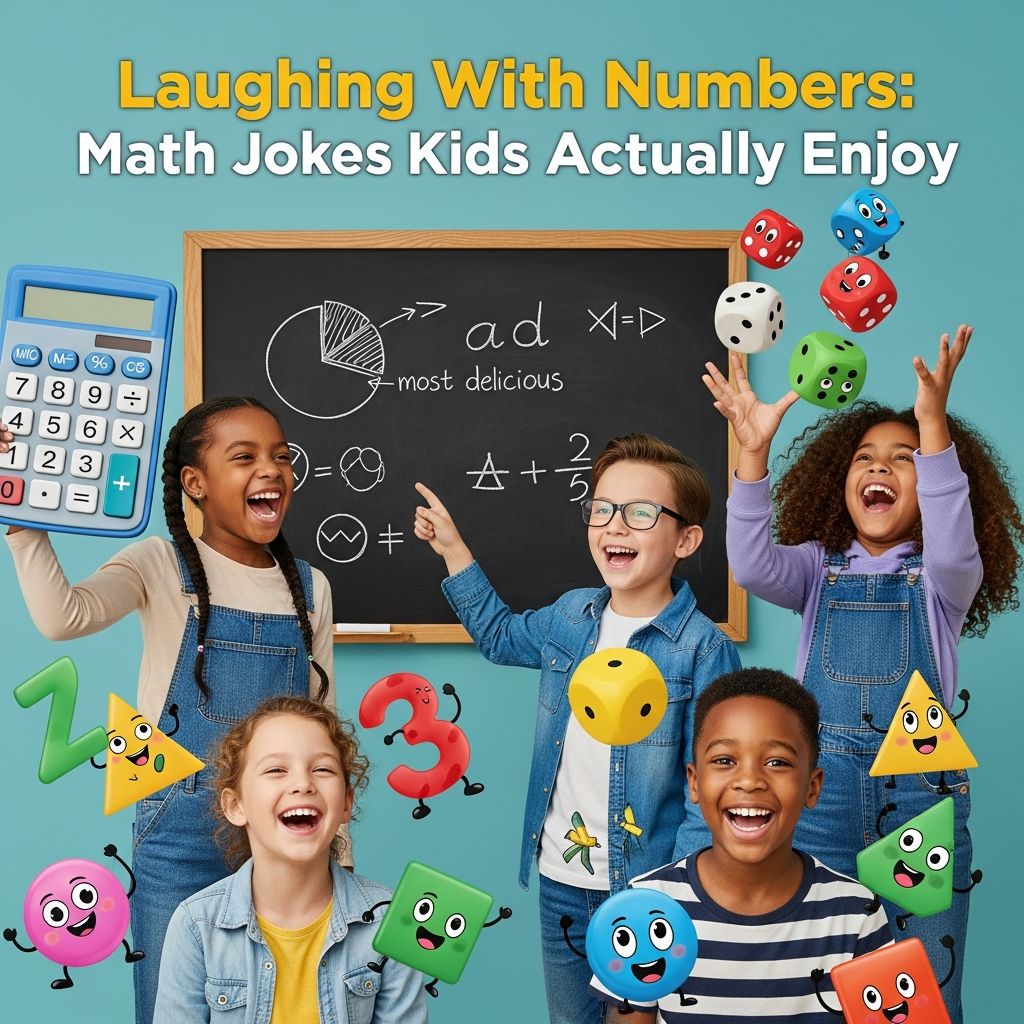
Math does not have to be the serious, silent subject many adults remember. Mix in some playful jokes and clever puns, and suddenly numbers, shapes, and equations turn into a great excuse to laugh together. This guide explores why math humor works for kids, how parents and teachers can use it, and what kinds of jokes land best at different ages.
Why Math and Humor Belong Together
At first glance, math and comedy look like opposites. One is about rules and logic; the other is about surprise and absurd ideas. Put them together, though, and they support each other in surprising ways.
- Lowers anxiety: Light-hearted jokes can make tough topics feel less intimidating for kids who are nervous about math.
- Builds memory: A silly pun or riddle is easier to remember than a dry definition, which helps concepts stick.
- Encourages attention: When kids expect something funny, they listen more closely for the twist or punchline.
- Normalizes mistakes: Laughing about wrong answers or ridiculous scenarios shows that errors are part of learning.
Research on classroom humor suggests that appropriately used jokes can support motivation and engagement, especially when they are clearly tied to the subject rather than random distractions.
What Makes a Good Math Joke for Kids?
Not every joke works well with numbers. The best math jokes for kids share a few key traits.
1. A Clear Math Hook
Strong math jokes rely on a recognizable element of math: a number, symbol, shape, or familiar classroom phrase. That hook gives kids something to grab as they work toward the punchline.
- Numbers kids see early: 0–10, simple fractions, basic operations.
- Shapes and terms: circles, triangles, angles, lines.
- Classroom life: homework, calculators, rulers, and math teachers.
2. A Simple Language Twist
Most math puns are built on words that sound alike or have double meanings. For younger kids, that wordplay has to be short and obvious. Older kids can handle more layered or abstract puns.
3. Age-Appropriate Complexity
The best joke is the one a child can almost solve before the punchline. That “almost” feeling makes the surprise more satisfying and gives kids a sense of cleverness when they get it.
| Age Range | Best Joke Style | Typical Math Ideas |
|---|---|---|
| 5–7 years | Very short puns and visual jokes | Counting, basic shapes, simple adding |
| 8–10 years | Riddles with clear punchlines | Multiplication, basic fractions, place value |
| 11–13 years | Algebra jokes and logical twists | Variables, equations, geometry terms |
| 14+ years | Self-aware, nerdy, or ironic humor | Functions, proofs, probability, statistics |
Types of Math Jokes Kids Love
Math humor is more varied than a single list of one-liners. Thinking in categories makes it easier to match a joke to your child’s current skills.
Number and Counting Jokes
These are the easiest math jokes to start with, especially for younger kids who are still mastering basic counting and place value.
- They use small numbers and familiar situations.
- They often hinge on words like “count,” “add,” or “more.”
- They’re perfect warm-ups before homework or a quiz.
Because the math is simple, the joke helps kids feel successful and reinforces early numeracy in a low-pressure way.
Shape and Geometry Puns
As soon as kids learn about circles, angles, and polygons, you can add shape-based jokes. These introduce geometry vocabulary without making it intimidating.
- Play with words like “point,” “angle,” “line,” and “square.”
- Use everyday objects: pizza slices, wheels, windows, floors.
- Encourage kids to draw simple diagrams to go with the joke.
Visual learners, in particular, can benefit when humor connects shape names to easy-to-picture images they already know from daily life.
Fraction, Decimal, and Percent Humor
Fractions and decimals can be stressful for many students, so humor is especially valuable once these topics appear in school.
- Jokes might treat fractions as characters with personalities.
- They can highlight the difference between halves, quarters, and wholes.
- They help kids remember that 50% is the same as one-half, and so on.
By turning these abstract ideas into playful stories, kids are more likely to recall the relationships between different representations of the same value.
Algebra and Variable Jokes
Once letters start appearing in math class, students often feel like the subject has suddenly changed. Algebra jokes can soften that moment.
- Personify the letter x as something everyone is always trying to “find.”
- Use relationships between x, y, and other variables as mini-stories.
- Highlight how equations “balance” like a scale or a friendship.
These jokes help frame algebra as a puzzle or mystery to solve rather than a strange new language.
Epic Pi and Infinity Puns
Some math ideas inspire their own entire genre of jokes. Pi and infinity are two of the biggest stars.
- Pi jokes often hinge on the idea that the number never ends or repeat around circles and pies.
- Infinity jokes use the idea of “forever” to exaggerate homework, lines, or waiting for a teacher to stop talking.
Because these ideas show up in many advanced topics, keeping them wrapped in humor can reduce fear when students meet them again later.
How Parents Can Use Math Jokes at Home
You do not have to be a comedian or a math expert to bring playful number talk into everyday family life. A few simple habits can make a big difference.
Turn Car Rides Into Joke Time
Short trips are perfect moments for light practice and connection.
- Ask each child to share one math joke before you arrive.
- Keep a small notebook of favorites in the glove compartment.
- Take turns trying to invent new puns using the numbers on license plates.
Add Humor to Homework Without Replacing It
Jokes are most helpful as a warm-up or break, not as a substitute for actual practice.
- Start a homework session with one quick riddle connected to the day’s topic.
- If frustration rises, pause for a funny question that uses the same skills.
- End by asking your child to rate which joke of the day was “most mathematical.”
Create a “Math Funny Wall”
Giving math humor a visible place in your home sends the signal that this subject belongs in everyday life.
- Post hand-drawn cartoons with talking numbers or shapes.
- Invite kids to rewrite old jokes in their own words and hang them up.
- Rotate jokes monthly so the wall feels fresh and fun to look at.
Bringing Math Humor Into the Classroom
Teachers can harness math jokes strategically to support attention, motivation, and recall—without turning lessons into stand-up routines.
Use a “Joke of the Day” as a Warm-Up
A short, focused joke at the beginning of class can signal that math time is starting while keeping the atmosphere low-stress.
- Write the joke on the board before students arrive.
- Give students one minute to predict the punchline in pairs.
- Connect the joke to the lesson: a geometry joke on angle day, for instance.
Turn Jokes Into Mini Discussion Prompts
Instead of just reading punchlines, ask a follow-up question that forces students to unpack the math.
- “Why is that joke about ‘rounding up’ funny in terms of place value?”
- “What does this joke tell us about the difference between area and perimeter?”
- “How does understanding exponents make this pun work?”
These quick reflections can reinforce vocabulary and concepts while students are still smiling.
Assign “Design Your Own Math Joke” Projects
Creative tasks give students ownership over both the humor and the math content.
- Have students invent a joke that uses at least one term from the current unit.
- Allow comic-strip formats, short skits, or mock advertisements.
- Display the best jokes on a class bulletin board or in a shared digital slideshow.
Project-based work like this can deepen understanding and strengthen communication skills.
Why Math Jokes Help Kids Learn
Behind the giggles, there is real cognitive work happening. Understanding a joke and appreciating why it is funny involves several thinking skills that overlap with strong math performance.
- Pattern recognition: Kids must notice how words or situations change from what they expect.
- Flexible thinking: Many puns require switching quickly between meanings.
- Inference: Students fill in missing steps between the setup and punchline.
- Metacognition: Laughing at a joke can make kids more aware of how they are thinking.
Educational research has found associations between certain kinds of humor and creative problem-solving, especially when humor invites students to play with ideas, not just recite facts.
Tips for Keeping Math Humor Inclusive and Kind
Like any classroom or family tool, humor works best when it is safe and respectful. A few simple boundaries help ensure that everyone can enjoy the joke.
- Avoid targeting classmates: Focus on numbers and shapes, not individual people.
- Skip jokes that mock confusion: The goal is to normalize struggle, not to shame wrong answers.
- Invite multiple cultures of humor: Encourage students to bring or translate math jokes from home.
- Model laughing at yourself: When adults chuckle at their own slip-ups, kids learn that mistakes are survivable.
FAQ: Math Jokes and Kids
Do math jokes actually improve test scores?
Jokes alone will not replace practice, but research suggests that appropriate humor can increase attention and reduce anxiety, which indirectly supports better performance when combined with solid teaching and study habits.
What if my child does not “get” the joke?
Take that as an opportunity to explain the math idea behind the joke. Turn the punchline into a mini-lesson, then try a simpler joke next time so your child can experience success.
Are some math topics better for jokes than others?
Word-rich areas like number names, geometry terms, and fractions often generate the easiest puns. More symbolic topics, like algebra or calculus, can still be funny but usually appeal to older kids who understand the underlying ideas.
How often should I use jokes in class or at home?
A small, regular dose tends to work best—for example, one quick joke at the start or end of a lesson or study session. Too many jokes can blur the main idea, but a consistent touch of humor signals that math time is a safe, welcoming space.
My student keeps making up wild, “nonsense” math jokes. Is that helpful?
Yes—within reason. Even silly or incorrect puns show that kids are experimenting with language and symbols. Guide them gently toward jokes that still respect basic math truths, but keep encouraging creativity.
References
- Wanzer, M. B., & Frymier, A. B. “The relationship between student perceptions of instructor humor and students’ reports of learning” — Communication Education. 1999-07-01. https://doi.org/10.1080/03634529909379170
- Banas, J. A. et al. “A review of humor in educational settings: Four decades of research” — Communication Education. 2011-10-01. https://doi.org/10.1080/03634523.2011.554513
- Geary, D. C. “Consequences, Characteristics, and Causes of Mathematical Learning Disabilities and Persistent Low Achievement in Mathematics” — Journal of Developmental & Behavioral Pediatrics. 2011-10-01. https://doi.org/10.1097/DBP.0b013e31822bf6a7
- Boaler, J. “Mathematical Mindsets: Unleashing Students’ Potential through Creative Math” — Jossey-Bass. 2015-01-01. https://www.youcubed.org/mathematical-mindset-teaching-resources/
- National Research Council. “Adding It Up: Helping Children Learn Mathematics” — National Academies Press. 2001-01-01. https://doi.org/10.17226/9822