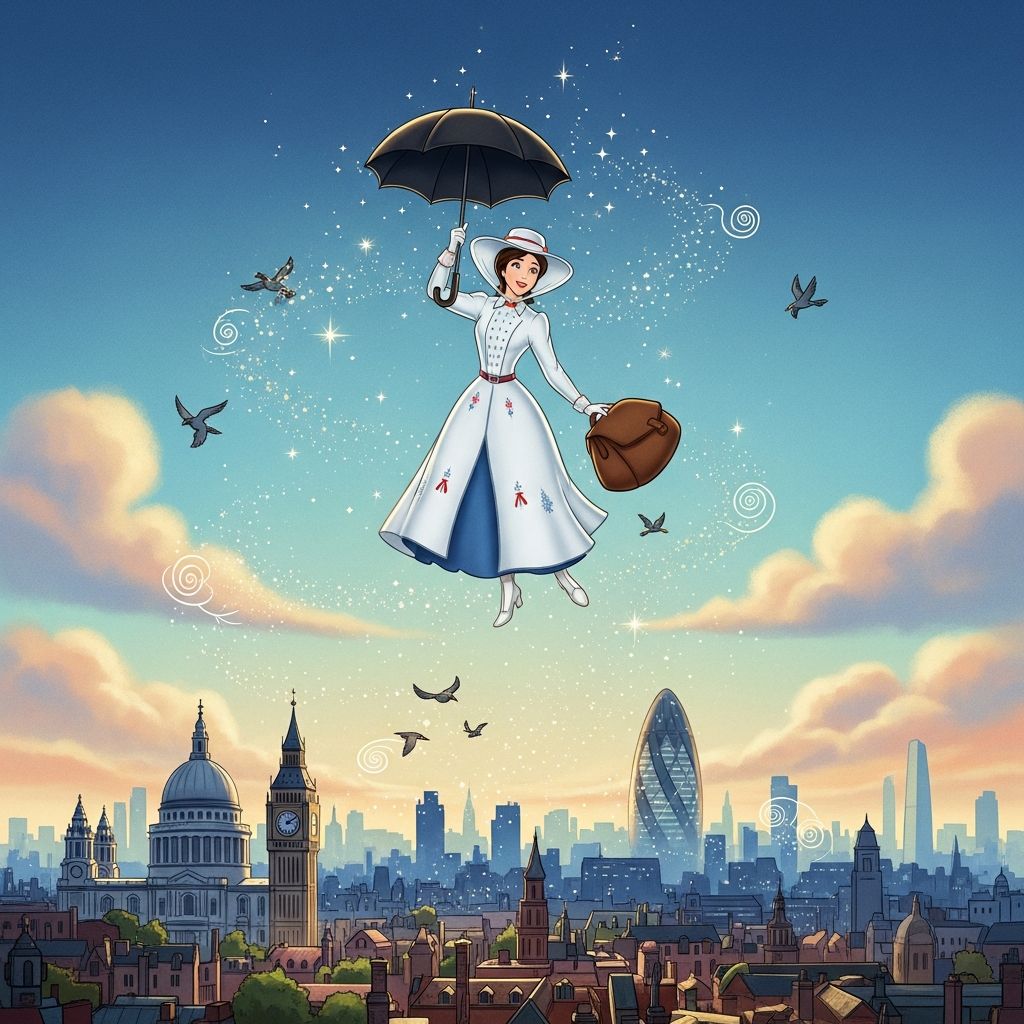
In an era ruled by computer-generated imagery, Mary Poppins Returns stands out for something that, at first glance, looks old-fashioned: a lavish, hand-drawn animated sequence woven into a modern live-action blockbuster. That artistic decision is more than a nostalgic wink. It plays like a love letter to 2D animation and a quiet warning about what film culture stands to lose as the craft fades from mainstream cinema.
The Sequel That Reaches Backward to Move Forward
As a follow-up to the 1964 classic, Mary Poppins Returns carries heavy expectations. It must continue the story of the Banks family, honor the original’s tone, and still justify its own existence for a new generation of viewers. The film uses familiar tools of the modern musical—star casting, large-scale effects, and digital spectacle—but its most distinctive moment comes when the story slips into a vibrant 2D world that feels like a postcard from Disney’s past.
This choice matters because it does three things at once:
- It mirrors the original film’s blend of live action and traditional animation.
- It reconnects audiences with the look and rhythm of hand-drawn cartoons.
- It underlines a theme rooted in memory, imagination, and childhood creativity.
Instead of relying exclusively on digital tools, the filmmakers decided that the return of Mary Poppins should also mark a temporary return of a nearly vanished art form.
The Craft Behind the Live-Action and 2D Blend
The celebrated sequence in Mary Poppins Returns sends the characters into a painted world inspired by a piece of decorated china. Inside that fantasy space, the movie combines live performers with animated surroundings, animals, and props. Director Rob Marshall has explained that the sequence is entirely hand-drawn, then carefully integrated with complex camera movements and visual effects so that the characters feel like they truly inhabit a 2D environment rather than standing in front of it.
Several veterans of the classic Disney era returned to make this possible:
- Retired animators were brought back because so few artists now specialize in traditional feature animation.
- Industry legend James Baxter, known for work on Beauty and the Beast, contributed to the sequence, emphasizing both fidelity to the original Mary Poppins and sheer entertainment value.
- Costume designer Sandy Powell had costumes hand-painted to look flatter and more graphic, helping the live actors visually blend into the illustrated world.
The filmmakers also used digital tools in a supporting role. While the characters and backgrounds are drawn by hand, computer techniques help synchronize nuanced camera movements with the 2D artwork, achieving a sense of depth that was much harder to stage during the 1960s. The result is a sequence that feels classic but not dated: it looks like a drawing springing to life, yet it moves with the fluidity of contemporary cinema.
Why Hand-Drawn Animation Feels Different From CGI
2D and 3D animation are both capable of telling powerful stories, but they shape the viewing experience in different ways. Hand-drawn work often tempts audiences to imagine the artist’s hand moving across paper; every line and shape carries traces of an individual gesture. This can produce a sense of intimacy and imperfection that feels especially appropriate for stories about childhood, dreams, and magical caretakers like Mary Poppins.
Computer animation, by contrast, tends to emphasize physical realism and consistent three-dimensional space. The dominant studios in 3D animation, such as Pixar and Walt Disney Animation Studios in their contemporary form, have created critically acclaimed films that push technical and emotional boundaries. Still, their images rarely resemble a sketch come to life. That specific sensation—the illusion that a drawing itself is moving—is what Mary Poppins Returns briefly resurrects in its animated interlude.
For many viewers, that difference is deeply tied to memory. Classic Disney features from the mid-20th century, like Cinderella and The Jungle Book, were drawn on paper and photographed frame by frame. The pastel colors, visible pencil lines, and slightly unstable edges of those images are an integral part of how several generations learned to recognize “cartoons.” When Mary Poppins Returns dives into 2D, it taps into that stored visual memory—even for children who may only know those older films from streaming or home video.
A Dying Art in a Digital-First Industry
Although hand-drawn animation dominated feature filmmaking for decades, it has become increasingly rare in major studio productions. The shift from 2D to computer-generated 3D at large North American studios occurred gradually in the late 1990s and early 2000s, as movies like Toy Story and Shrek proved the box-office appeal of fully digital imagery. By the early 2010s, Walt Disney Animation Studios had effectively halted regular hand-drawn feature production, despite a brief revival attempt with films such as The Princess and the Frog.
Several forces accelerated this decline:
- Market expectations: Families increasingly associated big-budget animation with the slick depth and textures of CGI, affecting studio risk calculations.
- Production pipelines: Once studios invest heavily in 3D infrastructure and talent, maintaining parallel teams for 2D becomes expensive.
- Global competition: International studios adopting 3D quickly narrowed the window where 2D could dominate mainstream box office returns.
As studios pivoted to digital pipelines, many classically trained animators retrained, moved into television, joined smaller studios, or retired. When Mary Poppins Returns sought artists capable of producing feature-quality hand-drawn work, the team had to track down veterans and persuade them to return to the drawing desk. That scramble underlines how fragile the talent base for traditional animation has become.
How Mary Poppins Returns Honors Disney’s Animated Legacy
The new film’s 2D sequence does more than evoke its own predecessor. It subtly references a broader history of Disney and hybrid productions, tracing a lineage of films where drawings and live actors share the same frame. From a viewer’s standpoint, the sequence can function as a compact tour of classic influences, even if they are never named on screen.
| Aspect | Original Mary Poppins (1964) | Mary Poppins Returns (2018) |
|---|---|---|
| Core hybrid device | Characters step into chalk drawings with animated animals. | Characters enter a painted ceramic world animated in 2D. |
| Animation style | Traditional Disney hand-drawn imagery on film. | New hand-drawn animation integrated with digital effects. |
| Tonal goal | Introduce children to whimsical fantasy and musical spectacle. | Rekindle a sense of classic Disney magic for adults and kids. |
| Technical context | Hand-drawn animation was the industry norm. | Hand-drawn feature work is now a rarity. |
Beyond Mary Poppins, the sequence also recalls other hybrids like Who Framed Roger Rabbit, which famously placed animated characters and live actors in the same noir-style setting. The visual language of Disney’s mid-century shorts and the moody tones of older anthology films also surface in the color palettes and brushwork of the animated backgrounds.
Nostalgia, Commerce, and the Business of Remembering
Nostalgia is now a central business strategy in mainstream entertainment. Many current studio projects resurrect or repackage familiar properties, from live-action remakes of animated favorites to sequels that arrive decades after the original. Films like the live-action iterations of Beauty and the Beast and Alice in Wonderland have earned enormous box-office returns by promising audiences a chance to revisit beloved stories in a new visual key.
Against that backdrop, Mary Poppins Returns is part of a broader trend—but its embrace of 2D animation is less predictable than the decision to revive a well-known character. Where many remakes translate hand-drawn films into fully digital 3D, this sequel does the opposite for one pivotal sequence: it briefly abandons 21st-century visual norms to restore something that had nearly vanished from the blockbuster toolkit.
The effect is paradoxical:
- To younger audiences, the hand-drawn segment can feel surprisingly fresh because they rarely see it at this scale.
- To adults, the same segment can trigger a flood of memories associated with older Disney films and Saturday-morning cartoons.
By designing the film this way, the studio effectively sells more than a story; it sells the experience of remembering what animation used to look like. The hand-drawn sequence becomes both an emotional centerpiece and a carefully deployed nostalgia engine.
Childhood, Drawing, and the Power of Imagination
On a thematic level, Mary Poppins Returns links drawing itself with memory, grief, and resilience. The Banks children’s art becomes a conduit to another world and a clue within the family’s adult troubles. That storytelling decision resonates with how psychologists and educators understand children’s drawings: as tools for emotional expression, meaning-making, and cognitive development.
Research in developmental psychology notes that drawing can help children:
- Rehearse and process events that might be confusing or frightening.
- Externalize imaginative worlds they cannot easily express in words.
- Strengthen fine motor skills and visual-spatial reasoning.
By staging a major sequence inside a drawing, the film literalizes this function of art. The animated space becomes a shared imaginative environment where adults and children can briefly operate under different rules. It is not just decorative; it advances the plot, deepens the emotional stakes, and models how creative acts can reshape experience.
What We Lose If Hand-Drawn Animation Disappears
When critics describe traditional animation as a “dying art,” they rarely mean that drawings will vanish entirely. Independent filmmakers, small studios, and artists in regions with strong 2D traditions—such as parts of Europe and Japan—continue to produce hand-drawn works for festivals, television, and streaming platforms. The concern focuses more on the loss of 2D as a widely supported, mainstream form at the largest studios.
If that trend continues, several risks emerge:
- Narrowing of visual diversity: Fewer big-budget projects will experiment with styles outside the 3D norm, reducing the range of images seen by mass audiences.
- Skills erosion: As older animators retire without apprentices, specific techniques of draftsmanship, timing, and motion may fade.
- Historical amnesia: Younger viewers may experience classic 2D films as isolated curiosities rather than part of a living tradition.
Mary Poppins Returns briefly reverses that trajectory by demonstrating that hand-drawn animation still has the power to captivate modern audiences when given adequate resources and narrative importance. The film does not argue that 2D should replace 3D, but it does implicitly ask whether there is room for both.
How Audiences and Creators Can Keep the Tradition Alive
Preserving hand-drawn animation as a vibrant practice will require interest from both creators and viewers. Several ongoing efforts point in that direction:
- Educational programs at art and film schools continue to teach classical animation principles—squash and stretch, timing, anticipation—often as a foundation for both 2D and 3D work.
- Archives and restorations by organizations such as the Library of Congress and major studios help keep earlier hand-drawn films in circulation, sometimes in high-resolution formats that reveal the original artwork’s texture.
- Independent productions and international films show that 2D can still attract critical acclaim and niche audiences when marketed effectively.
For viewers moved by the animated centerpiece of Mary Poppins Returns, supporting hand-drawn work can be as simple as seeking out traditionally animated features, purchasing legal copies of older films, or following contemporary artists who work in the medium. Each act of attention signals that this form still matters.
Frequently Asked Questions (FAQs)
Is the animated sequence in Mary Poppins Returns really hand-drawn?
Yes. The major animated sequence was created with traditional 2D hand-drawn techniques, then combined with digital effects to integrate live-action performers and complex camera moves.
Why did the filmmakers choose 2D instead of CGI for that scene?
The creative team wanted to honor the original film’s hand-drawn aesthetic and evoke the feeling of classic Disney animation, which they saw as central to the character of Mary Poppins and to the story’s nostalgic themes.
Is traditional hand-drawn animation still used in major studio films?
In North America, large studios rarely produce fully hand-drawn theatrical features today, preferring CGI pipelines, though exceptions and hybrid projects exist. Hand-drawn techniques remain more common in television, independent cinema, and some international industries.
Does 2D animation appeal to modern kids, or is it mainly for adults who grew up with it?
While adults often experience 2D animation through nostalgia, children generally respond to story, character, and color rather than specific production methods. When executed with energy and clarity, hand-drawn animation can be just as engaging for young viewers as CGI.
What can aspiring animators learn from Mary Poppins Returns?
The film demonstrates that classical drawing skills, combined with an understanding of digital tools, can open doors to unique hybrid projects. It also shows that stylistic diversity—knowing both 2D and 3D—can be an asset in a rapidly evolving industry.
References
- ‘Mary Poppins Returns’ Is a Cautionary Tale For a Dying Art Form — Fatherly. 2018-12-20. https://www.fatherly.com/entertainment/mary-poppins-returns-review-2d-animation-scene
- Watch Emily Blunt Sing With Animated Birds in ‘Mary Poppins Returns’ | Anatomy of a Scene — The New York Times. 2018-12-28. https://www.nytimes.com/video/movies/100000006264923/mary-poppins-returns-emily-blunt.html
- ‘Mary Poppins Returns’ uses hand-drawn animations in the spirit of first film — ABC News. 2018-12-23. https://abcnews.go.com/2020/video/mary-poppins-returns-hand-drawn-animations-spirit-film-59988073
- Animation — Encyclopaedia Britannica. Last updated 2024. https://www.britannica.com/art/animation
- Drawing and Children’s Development — American Psychological Association. 2019. https://www.apa.org/research/action/drawings
- National Film Registry: Complete List of Films — Library of Congress. Updated 2023. https://www.loc.gov/programs/national-film-preservation-board/film-registry/complete-national-film-registry-listing/