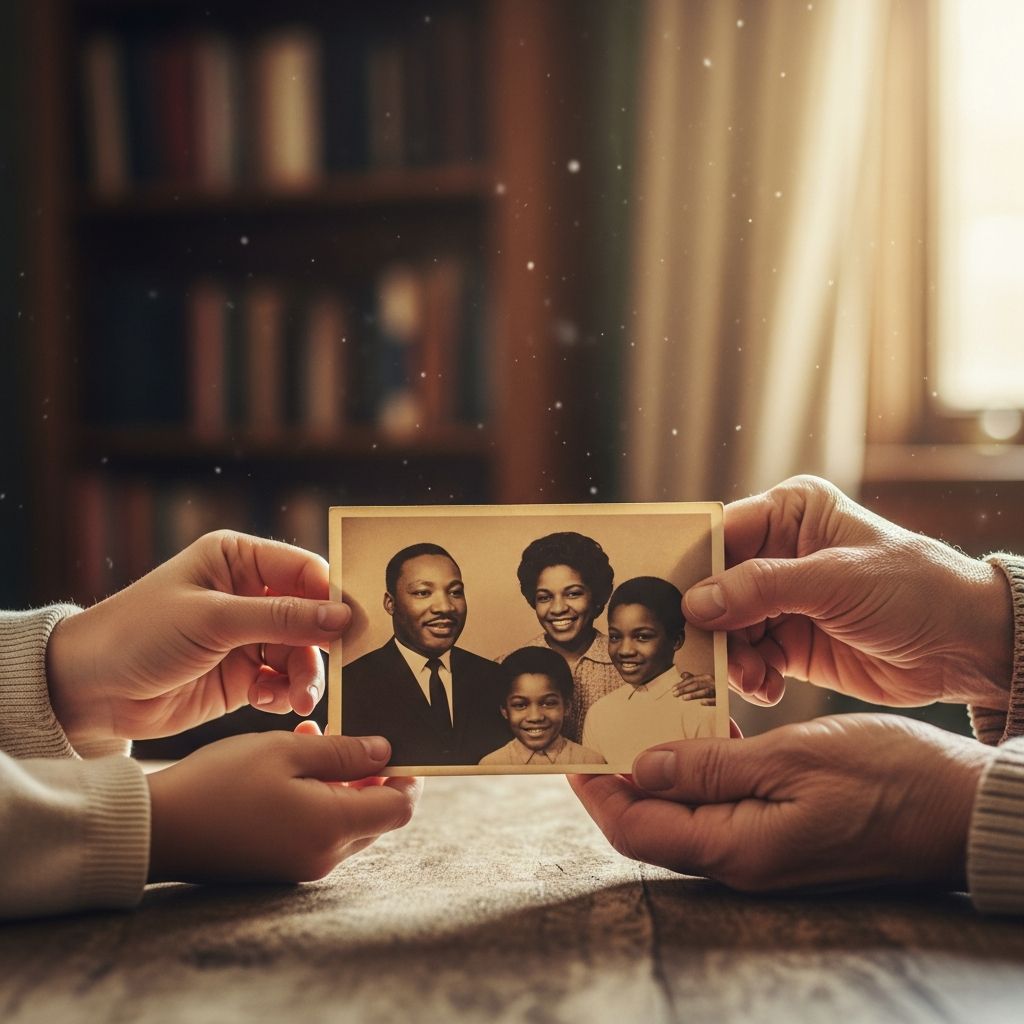
Most people know Martin Luther King Jr. as the powerful voice behind the podium, framed by microphones and crowds. Far fewer picture the quiet, unrecorded moments: a young father holding his baby, a husband laughing in the kitchen, a son walking arm in arm with his parents after church. This article reimagines those private scenes, using the idea of family photos as a lens to explore how King’s home life shaped his public courage.
A Different Way of Seeing Martin Luther King Jr.
Historical images so often flatten famous people into symbols that it is easy to forget they once spent more time at dinner tables than at podiums. Thinking of King through family photographs restores the texture of his life: cluttered living rooms, church clothes, birthday candles and road-weary suitcases left by the door. These mental snapshots help explain how love, discipline and faith at home gave him the stamina to challenge injustice in public.
When we imagine his life in pictures, the story expands beyond milestones and marches. Each imagined frame invites questions: Who stood just outside the camera’s view? What jokes were told between speeches? How did his family shoulder the weight of danger and fame while still trying to have something like a normal life?
Roots in a House Full of Faith
Before he became a global figure, Martin was a son and a grandson in a tight-knit, church-centered family. His parents, both deeply involved in religious and community life, created a home where the Bible, newspapers and dinner-table debates all had a place. A childhood photo from that house would likely show books stacked next to hymnals, signaling that spiritual grounding and intellectual curiosity were treated as partners, not rivals.
Both parents modeled a quiet but firm resistance to injustice in everyday situations. Their example taught their children that dignity was not just a word for speeches but a standard for how to respond when a shopkeeper, a bus driver or a school official tried to place them in a lesser place. A family snapshot after church, everyone still in their Sunday best, would capture this blend of pride, composure and readiness to push back against disrespect.
Growing Up Between Protection and Reality
As a boy, Martin grew up in a segregated city where the world outside his front door did not match the values preached inside it. Early experiences with racial humiliation cut deeply, yet his parents tried to frame these events as evidence of a broken system, not of his personal worth. Imagining a photograph of him returning home upset, framed in a doorway with his mother’s arm around his shoulders, captures this tension between the harshness of the outside world and the protective circle of home.
His father’s insistence on self-respect and his mother’s insistence on compassion gave young Martin an emotional toolkit: righteous anger tempered by empathy. Over time, those tools became the emotional scaffolding behind his later commitment to nonviolent resistance. A family album from his youth would show a boy smiling with classmates, practicing speeches, and playing games with siblings—ordinary scenes that quietly nurtured an extraordinary sense of responsibility.
Meeting Coretta: A Partnership in Mission
Years later, when Martin met Coretta Scott, he did not simply find a spouse; he found a partner who brought her own artistic gifts, political awareness and personal courage. Coretta had dreams that went beyond the traditional roles expected of women at the time, and the couple’s early conversations reportedly ranged from theology to music to the future of racial justice. If captured in a photo, their courtship might look like two students in coats walking across a campus lawn, mid-discussion, hands full of books and possibilities.
From the outset, their relationship wove together romance and movement work. They were building a marriage and a mission at the same time, aware that public struggles would soon intersect with private decisions about where to live, how to raise children and how much risk they were willing to share. An early wedding-day snapshot would show more than smiles; it would hold a quiet recognition that they were committing not only to each other but to a future of organized struggle.
Home as Headquarters and Sanctuary
Once the civil rights movement accelerated, the King home was never simply a private refuge. It doubled as a meeting place, strategy room and refuge for visiting organizers. A wide-angle photo from their living room might show children’s toys pushed to one side to make space for folding chairs, ashtrays and coffee cups surrounding a worn-out map of Southern bus routes or voting districts.
Yet amid those late-night meetings and phone calls, Martin and Coretta worked intentionally to protect a sense of normalcy for their children. Family dinners, bedtime routines and birthday celebrations continued, despite the churning chaos on the other side of the front door. The challenge was not to choose between activism and parenting, but to braid them together so their children experienced both struggle and stability.
The Children in the Frame
The King children grew up recognizing their father not only from news photos but also from the man who tucked them in at night, told stories and tried to attend their milestones. In one imagined picture, a young child might be sitting on his lap while he reviews notes for a sermon, the pages partly crumpled from tiny hands. Such a scene illustrates how King constantly moved between roles—minister, strategist, father—often within the same hour.
Family albums from those years would likely feature scenes that look ordinary at a glance but were extraordinary in context: a father pushing his children on swings while reporters waited at the curb, or a mother calming a crying toddler during a phone call about threats to the family. These moments reveal that the children were not just observers of history; they were living inside its turbulence, learning resilience and empathy in real time.
Intimate Moments History Rarely Shows
Most public images of King emphasize formal occasions: official portraits, marches, press conferences and meetings with presidents. What is mostly absent are images of domestic tenderness—Martin braiding a daughter’s hair, reading a bedtime story or washing dishes alongside Coretta after guests leave. Reconstructing these unseen pictures helps recover the full range of his humanity.
These imagined scenes matter because they remind us that emotional warmth and vulnerability are not weaknesses in a leader; they are sources of strength. A man who could stoop to tie his child’s shoe with patience was also capable of speaking to strangers with deep compassion, even when they opposed him. Through this lens, the small acts of care at home echo in the tone of his public speeches.
Balancing Danger and Fatherhood
No family photograph can fully capture the constant undercurrent of danger that surrounded the Kings during the height of the civil rights struggle. Bomb threats, surveillance and harassment were not occasional events; they were part of the background of everyday life. A late-night image of Martin and Coretta whispering at the kitchen table, the children asleep upstairs, would show two parents measuring risks—deciding which marches to attend, which trips to take and how much their children needed to know.
The children’s own expressions in family photos from that era would likely be a complex mix of innocence and awareness. They would have sensed tension even when adults tried to shield them. In this way, the family album doubles as a record of emotional strain, documenting how each child learned to navigate fear while still being encouraged to hope and to play.
How Photographs Shape Collective Memory
The images that circulate widely in textbooks, documentaries and public murals shape how the world remembers Martin Luther King Jr. Iconic pictures of him speaking to vast crowds can inspire awe, but they can also create distance, as if he belonged to history more than to the ordinary fabric of family life. When we center family photos, real or imagined, we draw him closer and see the human costs and supports behind those impressive moments.
For families today, revisiting King’s story through domestic scenes can make his legacy more relatable. Parents and children can look at pictures of him with his own kids and ask, “What conversations did they have at home?” and “How do we talk about fairness at our dinner table?” In this way, photographs become teaching tools, bridging past and present.
Table: Public Images vs. Family Images
The table below contrasts the common public images of Martin Luther King Jr. with the quieter family-centered images that often stay in the background of historical memory.
| Type of Image | Typical Setting | What We Usually Notice | What Family Photos Reveal |
|---|---|---|---|
| Public speech photos | Podiums, rallies, marches | Charisma, leadership, crowds | The emotional weight he carried home after inspiring others |
| News conference images | Press rooms, offices, government buildings | Formality, strategy, political stakes | The hours of family time sacrificed to travel and meetings |
| Arrest or jail photos | Police stations, courtrooms | Defiance, risk, confrontation with power | The fear and uncertainty his spouse and children endured at home |
| Family snapshots | Living room, yard, church, vacations | Smiles, play, ordinary routines | The support system and love that made his public courage sustainable |
| Candid home photos | Late-night kitchens, cluttered desks | Fatigue, quiet conversation | The constant negotiation between duty to family and duty to movement |
Coretta Scott King’s Own Story in Pictures
Too often, Coretta appears in the margins of photographs of her husband, even though she sustained and expanded the work of the movement in her own right. A more honest album would include solo images of her speaking at rallies, organizing cultural events and, later, preserving her husband’s legacy while advancing causes such as peace and economic justice. These pictures highlight her transition from partner-in-struggle to globally recognized leader.
Photos of Coretta at home after Martin’s death, surrounded by their children, reveal another kind of leadership. She was now both a public symbol and a single parent, guiding her family through grief under the bright and often intrusive light of public attention. Her resilience helped ensure that the King story remained a living, evolving narrative rather than a closed chapter.
The Next Generations: Children and Grandchildren
As the King children became adults, their lives unfolded partly in the shadow and partly in the illumination of their father’s reputation. Photographs of them speaking at events, leading organizations or simply standing together at commemorations show how they have wrestled with, and embraced, the responsibility of carrying forward a powerful name. Each child has found a different way to honor the values they inherited.
The arrival of grandchildren added yet another layer to the visual story. Images of younger family members participating in marches, giving speeches or visiting historic sites demonstrate that the family’s public role did not end with the first generation. The King legacy lives not just in monuments and national holidays but in the way descendants continue to speak out about racism, poverty and violence.
Lessons Modern Families Can Draw
Seeing Martin Luther King Jr. primarily through family-centered images offers useful lessons for families today. It shows that world-changing work often begins in small, personal habits: listening carefully to children’s questions, talking openly about what is right and wrong, and modeling courage in daily interactions. A family does not need to be famous to nurture a sense of responsibility toward others.
Parents can use King’s story to spark conversations about fairness, empathy and perseverance. Looking at photos of him with his children and spouse becomes an invitation to ask: How can our household become a place where love and justice are practiced, not just preached? In this way, the King family album becomes less a relic of the past and more a guide for building compassionate homes in the present.
Practical Ideas for Using Family Photos to Teach Justice
Families inspired by the King story can use their own photos as tools to talk about values. Everyday images—first days of school, birthday parties, visits to grandparents—can open space to discuss kindness, inclusion and courage. The key is to treat photos as conversation starters rather than just decorations or digital clutter.
- Choose a few favorite family photos and ask children what they remember about the moment and how people treated each other.
- Print or display images that show caring actions, such as helping a neighbor or supporting a classmate, and talk about why those memories feel important.
- Pair historic images of King and his family with your own family photos to highlight both similarities and differences in experience.
- Create a small “family values album” where each picture is labeled with a word like courage, kindness, fairness or faith, and add to it over time.
By intentionally curating and reflecting on family photos, households can keep discussions of justice close to everyday life, just as the King family once did amid their own extraordinary circumstances.
FAQs About Martin Luther King Jr.’s Family Life
Did Martin Luther King Jr. spend much time with his children?
His schedule was demanding and often kept him on the road for long stretches, but family accounts describe a father who tried to be fully present when he was home. He played with his children, listened to their stories and tried to attend important milestones, even though the pressures of the movement meant that he inevitably missed some events.
How did Coretta Scott King contribute to the family and the movement?
Coretta balanced caregiving with activism, managing the household while also speaking, organizing and advocating alongside her husband. After his death, she became a central guardian of his legacy and emerged as a prominent voice for civil rights, peace and human rights around the world.
Were the King children involved in public events during their childhood?
Yes. Although their parents tried to preserve family privacy, the children were occasionally visible at marches, church services, commemorations and public gatherings. These experiences exposed them early to both the hope and the hostility that surrounded their father’s work.
What can families today learn from the way the Kings raised their children?
The King household shows that strong values are taught most powerfully through consistent example. Even under intense external pressure, Martin and Coretta emphasized education, faith, nonviolence and respect, demonstrating that a family can nurture empathy and courage even when the surrounding society falls short.
Why focus on family photos when discussing Martin Luther King Jr.?
Family photos, whether archival or imagined, humanize a figure who is often treated as an untouchable icon. They remind us that behind every famous speech was a father, a husband and a son whose daily experiences of love and responsibility helped shape his vision of justice.