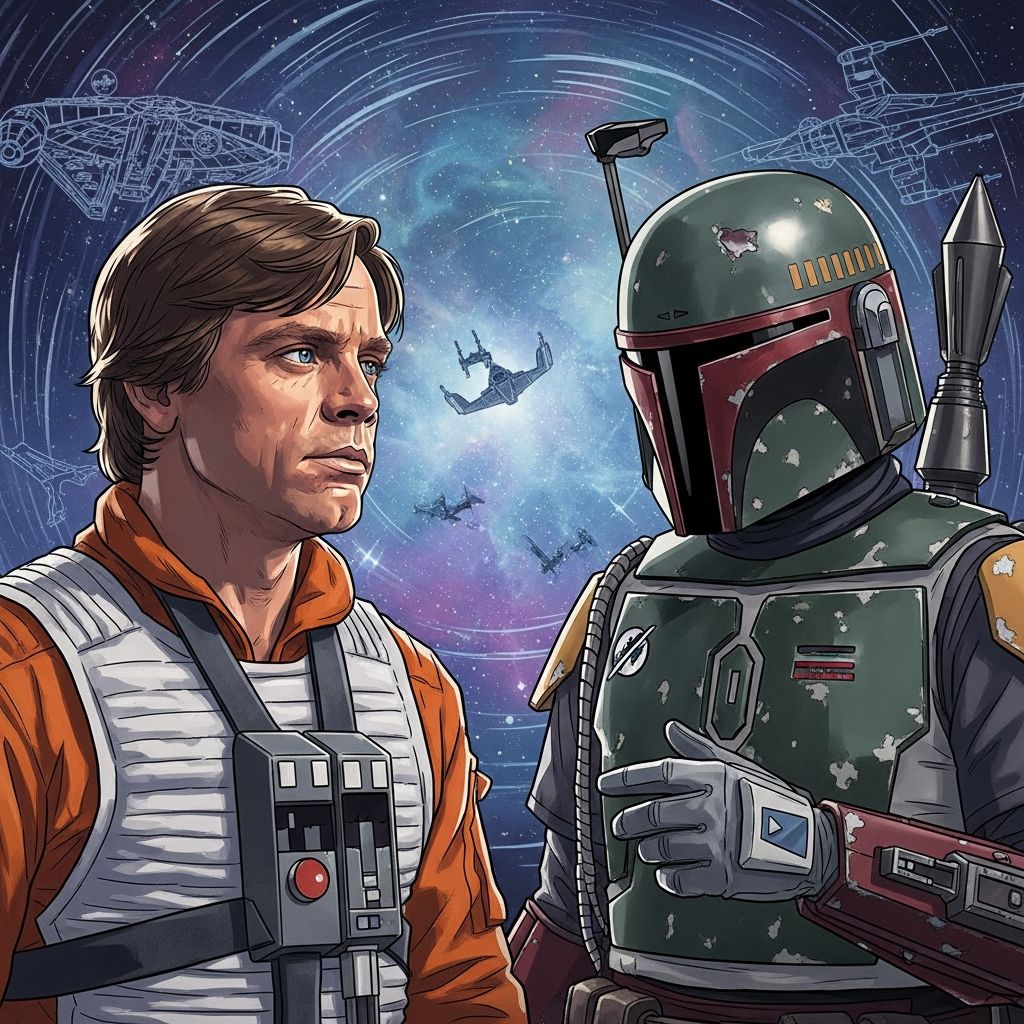
Star Wars has always inspired intense debate, but lately the loudest and most entertaining fan theorist might be one of the saga’s original heroes: Mark Hamill. His playful idea about Boba Fett has become a perfect case study in how fan theories work, why people care about them, and what happens when an actor starts playing in the same speculative sandbox as the audience.
Why Star Wars Theories Refuse to Die
From the moment fans started guessing that Darth Vader was Luke’s father before The Empire Strikes Back came out, Star Wars has been a franchise built on speculation, twists, and retrospective reinterpretation. Star Wars’ narrative gaps, off-screen events, and mysterious characters are ideal fuel for elaborate theories.
Some common reasons these theories thrive include:
- Ambiguous storytelling: The films often tease ideas without over-explaining them, leaving room for fan interpretation.
- Expanded universe sprawl: Decades of comics, novels, and games create contradictions and unanswered questions that people want to solve.
- Iconic but underdeveloped characters: Figures like Boba Fett became fan favorites despite minimal screen time, inviting fans to imagine deeper backstories.
- Shifting canon rules: Disney’s 2014 canon reset and later clarifications about what “counts” encourage fans to fill gaps and reconcile changes.
In that volatile mix, any bold or clever idea can spread quickly — and when it comes from Mark Hamill, it spreads even faster.
Mark Hamill as an Unofficial Fan Theorist
Mark Hamill has long been more than just the actor who played Luke Skywalker. Over the years he has become a kind of unofficial ambassador for Star Wars fandom. On social media, in interviews, and at conventions, he frequently:
- Comments on obscure continuity details.
- Jokes about plot twists and character arcs.
- Playfully critiques or reimagines decisions made in the newer films.
His Boba Fett idea sits perfectly in that space: it is not official canon, it is not a demand that Lucasfilm change anything, but a playful “what if” that reflects how fans engage with the saga.
Boba Fett: From Background Bounty Hunter to Theory Magnet
Boba Fett’s rise from minor background figure to mythic icon is one of the clearest examples of fan-driven storytelling in blockbuster cinema. In the original trilogy he had few lines, limited screen time, and an almost comically anticlimactic exit. Yet his distinctive armor and stoic demeanor captured imaginations.
Over time, his role expanded dramatically through:
- Legends stories: Pre-Disney novels and comics imagined Fett as a nearly unstoppable hunter who survived the Sarlacc and roamed the galaxy.
- Prequel-era backstory: The prequels introduced Jango Fett and established Boba as his clone “son,” connecting Fett to the clone army and to Mandalorian culture.
- Live-action streaming series: The Mandalorian and The Book of Boba Fett reintroduced him as a more nuanced character: older, injured, and trying to reinvent himself.
Because so many versions of Boba Fett have existed — Legends, canon, and everything in between — he is a natural lightning rod for theories about identity, survival, and legacy.
What Makes Hamill’s Boba Fett Idea So Appealing?
Hamill’s Boba Fett notion (as reported and discussed widely in fan circles) is less important for its exact plot mechanics than for what it represents: an actor creatively reinterpreting one of the saga’s most mysterious figures. The appeal comes from several angles:
| Element | Why Fans Respond |
|---|---|
| Playful re-reading of old scenes | Invites viewers to watch classic moments again and notice details they might have missed. |
| Character rehabilitation | Gives new depth or purpose to a character some fans felt was “wasted” on screen. |
| Actor insight | Feels like a peek behind the curtain, even if it is not canon. |
| Compatibility with existing canon | Works best when it does not obviously break established continuity and can coexist with current stories. |
When an idea checks all of these boxes, the fandom is much more likely to treat it seriously, even if it began as an offhand comment.
How Fan Theories Change the Way We Watch Star Wars
Strong fan theories do not just exist on message boards. They subtly alter how people experience the original films and shows. Several prominent examples beyond Boba Fett illustrate this:
- Leia as the primary Force presence in The Empire Strikes Back: One widely discussed theory suggests that Darth Vader may have sensed Leia’s emerging power rather than Luke’s, turning his pursuit of the Millennium Falcon into a hunt for an untrained Force prodigy.
- Jar Jar Binks as a secret mastermind: The idea that Jar Jar is a hidden Sith or manipulator changes every comedic scene into something sinister, no matter how implausible it is in canon.
- R2-D2 as the ultimate chess player: Another theory reframes R2-D2 not as a loyal helper but as a long-game strategist quietly guiding galactic events.
In each case, the canon does not officially confirm the theory, but the interpretation is compelling enough that it affects how some viewers read character choices and line deliveries.
Canon, Legends, and the Space Between
To understand why theories like Hamill’s carry so much weight, it helps to look at how Lucasfilm describes canon. In 2014, the company formally distinguished the then-new official continuity from the older “Legends” material (the previous expanded universe). According to Lucasfilm’s statements and later clarifications:
- The films and key series such as The Clone Wars form the backbone of official continuity.
- Newer novels, comics, and games are coordinated to fit that continuity, though they have still contradicted each other at times.
- Some projects, like the animated anthology Visions, are explicitly outside both canon and Legends, existing as creative “what if” stories.
This flexible but sometimes inconsistent system creates a gray area where fan theories, actor ideas, and loosely canon-adjacent projects can live. Hamill’s Boba Fett notion comfortably occupies that middle ground: it is not meant to overwrite anything, but it is also not pure fan fiction, given its origin with a central actor.
What Makes a Star Wars Theory Feel Credible?
Not all theories are equal. Some are quickly dismissed as pure wish-fulfillment, while others gain traction and are discussed in major outlets. Theories that resonate often share a few traits:
- Textual grounding: They point to specific lines, visual cues, or editing choices to support their arguments.
- Respect for established events: They work with what is on screen rather than rewriting entire plots.
- Thematic alignment: They reinforce core Star Wars themes like redemption, destiny, and the tension between light and dark.
- Emotional payoff: They offer satisfying explanations for confusing or unpopular story choices, such as controversial twists in recent films.
Hamill’s Boba Fett speculation is appealing precisely because it feels like something that could have been true behind the scenes, even if it never was canonically intended.
Actors, Creators, and the Ownership of Meaning
When actors share personal interpretations, fans often treat them as semi-authoritative, especially when those actors are as closely associated with a role as Hamill is with Luke. Yet from a media studies perspective, there is a distinction between:
- Authorial intent: What George Lucas, Disney-era creators, or specific writers and directors say they meant.
- Performer interpretation: How actors understood and internally motivated their characters.
- Audience reception: How viewers collectively decide what a story means, often independently of creator statements.
Contemporary film and cultural studies have long argued that audience interpretation plays a central role in meaning-making, sometimes referred to as the “death of the author” in literary theory. Modern fan cultures, including Star Wars fandom, exemplify this: viewers remix, reinterpret, and theorize far beyond anything officially written down.
Hamill’s Boba Fett idea is therefore less a revelation of hidden canon and more an expression of this collaborative meaning-making. It is an invitation to play.
When Fan Theories Influence Future Storytelling
While not every theory changes the course of the franchise, studios do sometimes respond to or acknowledge popular ideas. Scholars studying franchise storytelling have noted that large media properties increasingly operate in dialogue with fan communities, especially as social media makes audience reactions highly visible in real time.
Recent Star Wars examples include:
- New projects set in underexplored eras after fans called for stories far removed from the Skywalker saga.
- Ongoing attempts to contextualize or soften controversial twists, such as the handling of Emperor Palpatine’s return and Rey’s lineage in additional novels and commentary.
Even if Hamill’s Boba Fett theory never becomes canon, it contributes to a larger ecosystem of ideas that creators may draw from, remix, or nod to in future shows, comics, or games.
How to Enjoy Star Wars Theories Without Losing the Fun
For some fans, theorizing is a game; for others, it can turn into frustration when the “wrong” ideas become canon. A healthier approach treats theories as optional lenses rather than demands. To keep things fun:
- Hold your hypotheses loosely: Enjoy the speculation, but let go when new stories go in a different direction.
- Separate canon from headcanon: Recognize the difference between what you like and what the films or shows officially depict.
- Respect multiple readings: Allow room for others to enjoy different interpretations, including ones that conflict with your own.
- Use theories to deepen, not police, enjoyment: The goal is richer engagement, not gatekeeping.
Seen in that light, Hamill’s Boba Fett speculation is a model: smart, playful, and non-dogmatic.
Frequently Asked Questions (FAQs)
Is Mark Hamill’s Boba Fett idea official Star Wars canon?
No. Hamill’s Boba Fett interpretation is a fan-style idea shared by an actor closely tied to the saga, but it has not been adopted as official canon by Lucasfilm.
Why do fans care so much about Boba Fett theories?
Boba Fett became iconic despite limited dialogue and screen time, which left many narrative gaps. Those gaps invite fans to imagine hidden motives, survival stories, and identity twists that give the character more depth.
Can fan theories ever become canon?
Occasionally, popular fan ideas or long-running assumptions influence official stories, but this is relatively rare and usually heavily adapted. More often, creators borrow the spirit of a theory rather than its exact details.
How does Lucasfilm define Star Wars canon today?
Lucasfilm treats the films and major series as the core of canon, with newer books, comics, and games coordinated to fit that continuity. Older expanded universe works were reclassified as “Legends” in 2014, and some projects like Visions are explicitly outside canon.
Do I need to follow every theory to enjoy Star Wars?
No. Theories are optional. Many fans enjoy the saga purely through the films and shows, while others like to explore speculative ideas. Both approaches are valid; theories are there to enhance enjoyment, not to replace the original stories.
References
- Lucasfilm FINALLY Addresses Star Wars “Canon” in 2025! — Star Wars Meg / YouTube (discussion of Lucasfilm canon policy and Visions). 2025-11-04. https://www.youtube.com/watch?v=wJwlQdnnETo
- There Are A Lot Of Ridiculous Star Wars Theories Out There, But I’m Absolutely Convinced This One Is True — Screen Rant. 2024-04-27. https://screenrant.com/star-wars-ridiculous-theory-convinced-op-ed/
- This Star Wars Fan Theory Will Change a Major Darth Vader Scene For You — The Flagship Eclipse. 2025-04-20. https://www.theflagshipeclipse.com/2025/04/20/this-star-wars-fan-theory-will-change-a-major-darth-vader-scene-for-you/
- 10 Star Wars Theories That Will Change How You Watch It — ComicBook.com. 2023-05-04. https://comicbook.com/movies/list/10-star-wars-theories-that-will-change-how-you-watch-it/