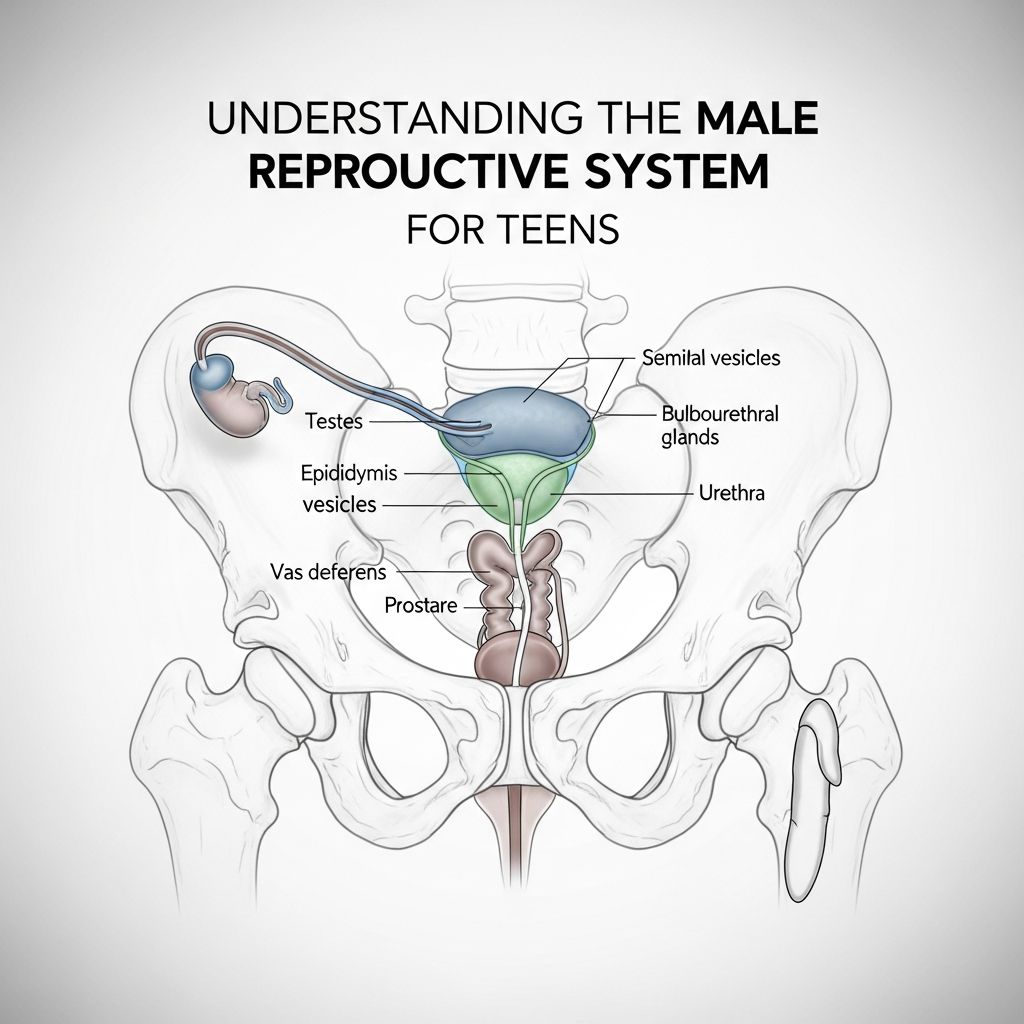
The male reproductive system is a group of organs and hormones that work together to make sperm, produce sex hormones, and allow for sexual reproduction. It also plays a major role in the physical and emotional changes that happen during puberty.13
This guide is written for teens and preteens who want straight answers about how this part of the body works. You do not need any medical background—just curiosity and respect for your own body and others’.
Big Picture: What Does the Male Reproductive System Do?
Although there are many individual parts, they share a few main jobs:13
- Make sperm, the cells that can join with an egg to start a pregnancy.
- Produce hormones, mainly testosterone, which drive puberty changes and support fertility.
- Store and transport sperm from where they are made to where they leave the body.
- Produce semen, the fluid that carries and protects sperm.
- Allow sexual function, including erections and ejaculation.
Many of these functions start working gradually during puberty, usually between ages 9 and 14, but the exact timing is different for everyone.3
External Parts: What You Can See
The external (outside) organs of the male reproductive system are the ones you can see from the outside of the body. They include the penis, scrotum, and testicles (testes).36
The Penis
The penis is the organ that allows urine and semen to leave the body. It is made of spongy tissue, blood vessels, nerves, and skin. When a person becomes sexually aroused, extra blood flows into the spongy tissue, making the penis firm and larger—this is called an erection.15
- Soft (flaccid) penis: Common when someone is relaxed or not sexually aroused.
- Erect penis: Happens when blood fills the spongy tissue; erections can occur because of sexual thoughts, physical touch, or sometimes seemingly for no reason, especially during puberty.
- Urethral opening: The small opening at the tip of the penis where urine and semen come out, but not at the same time.15
The Scrotum
The scrotum is the loose pouch of skin that hangs behind the penis and holds the testicles. Its main job is to help keep the testes at a slightly cooler temperature than the rest of the body, which is important for healthy sperm production.34
- The scrotum can tighten and pull the testes closer to the body when it is cold or when the person is nervous.
- It can relax and hang lower when it is warm.
The Testes (Testicles)
The testes are oval-shaped organs found inside the scrotum. Most people with male reproductive anatomy have two testes. They have two major roles:13
- Sperm production: Millions of sperm cells are made in tiny, tightly coiled tubes called seminiferous tubules.
- Hormone production: The testes make testosterone, the main male sex hormone, along with a few others that help control sperm production and sexual development.14
Because the testes are delicate, injuries to this area can be very painful. Protective gear during sports is important.
Internal Parts: What You Cannot See
The internal organs of the male reproductive system help sperm mature, mix with fluids, and exit the body. Even though you cannot see them, they are busy behind the scenes whenever sperm and semen are made and released.123
Epididymis
The epididymis is a long, tightly coiled tube that sits on the back of each testis. New sperm leave the seminiferous tubules and move into the epididymis, where they:
- Mature and learn to swim properly.
- Are stored until ejaculation (release in semen) happens.56
Vas Deferens
The vas deferens is a muscular tube that carries sperm from the epididymis up into the pelvis. There is one vas deferens from each testis. During ejaculation, the muscles in the wall of the vas deferens squeeze and push sperm forward toward the urethra.356
Seminal Vesicles
The seminal vesicles are two small, sac-like glands near the base of the bladder. They add a thick, sugary fluid to the sperm as they pass by. This fluid:13
- Provides energy (fructose) for sperm.
- Helps sperm move and survive after ejaculation.
Prostate Gland
The prostate is a gland about the size of a walnut that sits just below the bladder and surrounds part of the urethra. It adds additional fluid to semen that helps:
- Nourish sperm and support their movement.
- Protect sperm in the vagina by adjusting the fluid’s properties.345
Because the urethra passes through the prostate, problems with the prostate later in life can sometimes affect urination. This is usually not a concern for teens, but it becomes important as men get older.5
Bulbourethral (Cowper’s) Glands
The bulbourethral glands are two small glands located below the prostate. They release a clear fluid (sometimes called “pre-ejaculate” or “pre-cum”) into the urethra before ejaculation. This fluid:
- Helps lubricate the urethra.
- Neutralizes small amounts of acid in the urethra left over from urine.15
The Urethra
The urethra is a tube that runs from the bladder, through the prostate and penis, to an opening at the tip of the penis. In males, it has two roles:35
- Carries urine out of the body when a person pees.
- Carries semen out of the body during ejaculation.
The body has a built-in system that keeps urine and semen from leaving the urethra at the same time.
How the Parts Work Together: From Sperm to Semen
The male reproductive system works like a coordinated team. Here is a simple overview of the pathway:
| Step | Location | What Happens |
|---|---|---|
| 1 | Testes | Sperm cells are produced in the seminiferous tubules, and testosterone is released.14 |
| 2 | Epididymis | Sperm mature, gain the ability to swim, and are stored. |
| 3 | Vas deferens | During ejaculation, sperm are pushed up toward the pelvis. |
| 4 | Seminal vesicles | Fluids rich in sugar and other substances are added. |
| 5 | Prostate & bulbourethral glands | More fluid is added, creating semen and helping protect sperm. |
| 6 | Urethra & penis | Semen is ejaculated through the tip of the penis during orgasm. |
The Role of Hormones and Puberty
Hormones are chemical messengers that travel in the blood and tell organs what to do. Several hormones control the male reproductive system:34
- Testosterone: Made mainly in the testes; responsible for many physical changes in puberty, including muscle growth, facial and body hair, and a deeper voice.1
- FSH (follicle-stimulating hormone): Helps start and maintain sperm production in the testes.
- LH (luteinizing hormone): Signals the testes to make testosterone.
During puberty, these hormones increase, leading to:
- Growth of the penis, scrotum, and testes.
- Appearance of pubic, underarm, and facial hair.
- Growth spurts and increased muscle mass.
- Voice deepening.
- More frequent erections and the start of ejaculation.
Common Experiences and Questions During Puberty
As the male reproductive system matures, many normal—and sometimes confusing—changes occur. These include:
- Spontaneous erections, even without obvious reason.
- Wet dreams (nocturnal emissions), which are involuntary ejaculations during sleep.
- Uneven growth—one testis may hang lower than the other, which is normal.
- Increased interest in sex or questions about sexuality and identity.
These changes are a standard part of puberty. If something feels painful, very different from usual, or worries you, talking to a trusted adult or healthcare professional is a good idea.
Basic Care and Health Tips
Taking care of the male reproductive system is part of overall health. Simple habits can make a difference:
- Good hygiene: Gently wash the penis, scrotum, and area around them daily. If uncircumcised, foreskin can usually be gently pulled back for cleaning once it retracts easily—never force it.
- Protection in sports: Wear an athletic cup when playing contact sports to reduce the risk of injury to the testes.
- Safe sex practices: When sexually active, using condoms correctly every time helps reduce the risk of pregnancy and sexually transmitted infections (STIs).2
- Regular check-ins: Notice any big changes such as pain, large lumps, or a sudden difference in size; these are reasons to see a doctor.
- Healthy lifestyle: Adequate sleep, regular exercise, and not smoking or vaping support hormone balance and fertility over time.
Frequently Asked Questions (FAQs)
Q1: Is it normal for one testicle to hang lower than the other?
Yes. In most people, one testis naturally hangs a little lower—usually the left. This helps prevent them from pressing directly against each other and is considered normal unless there is pain or sudden swelling.
Q2: Can someone pee and ejaculate at the same time?
No. The body has a system of muscles and valves that normally keeps urine and semen from flowing out of the urethra at the same time. During ejaculation, the pathway for urine from the bladder is temporarily blocked.5
Q3: What is semen made of?Semen is a mix of sperm from the testes and epididymis plus fluids from the seminal vesicles, prostate gland, and bulbourethral glands. Most of semen is fluid; sperm are a small part by volume but are crucial for fertilization.13
Q4: When does sperm production start?
Sperm production typically begins sometime after puberty starts, often a year or more after the first signs such as testicular growth. The exact age is different for everyone, but it is usually in the early to mid-teen years.3
Q5: When should a teen see a doctor about their reproductive organs?
It is important to seek medical advice if there is strong or ongoing pain in the testes or scrotum, sudden swelling, a hard lump that was not there before, problems urinating, or any discharge, redness, or sores on the penis. A general physical checkup is also a good time to ask private questions.
References
- The Male Reproductive System: Organs, Function, and More — WebMD. 2023-09-14. https://www.webmd.com/sex-relationships/male-reproductive-system
- The function and anatomy of the male reproductive system — Medical News Today. 2023-03-28. https://www.medicalnewstoday.com/articles/male-reproductive-organ-anatomy
- Male Reproductive System: Structure & Function — Cleveland Clinic. 2022-08-01. https://my.clevelandclinic.org/health/body/9117-male-reproductive-system
- 51.3: Structure and Function of the Human Male Reproductive System — LibreTexts Biology. 2019-06-20. https://bio.libretexts.org/Bookshelves/Introductory_and_General_Biology/Map:_Raven_Biology_12th_Edition/51:_The_Reproductive_System/51.03:_Structure_and_Function_of_the_Human_Male_Reproductive_System
- Structure of the Male Reproductive System — Merck Manual Consumer Version. 2023-02-01. https://www.merckmanuals.com/home/men-s-health-issues/biology-of-the-male-reproductive-system/structure-of-the-male-reproductive-system
- Male reproductive system — Healthdirect (Australian Government). 2021-10-21. https://www.healthdirect.gov.au/male-reproductive-system