Magnets often live on the refrigerator door, holding shopping lists and artwork, but they can do much more than that. Moving magnet play away from the fridge opens up space for calmer, more focused exploration and turns a simple household item into a powerful learning tool for kids.
This guide walks you through safe, engaging, and screen-free magnet activities you can set up anywhere in your home. It focuses on practical ideas that build curiosity, fine motor skills, and early STEM understanding while keeping play fresh and fun for toddlers through early elementary ages.
Why Play With Magnets?
Magnets feel like everyday magic to children. They pull, push, and move objects without touching them, which naturally invites questions and experimentation. That curiosity is the perfect doorway into early science and problem-solving skills.
When kids play with magnets away from the busy kitchen hub, they often focus longer and try more variations. A small magnet kit in a quiet corner or on a table can become a mini science lab where children test ideas and invent their own games.
Safety First: Magnet Play Guidelines
Before introducing any magnet activity, it is essential to think about safety. Small, powerful magnets can be very dangerous if swallowed, so adult supervision and age-appropriate materials are non-negotiable.
- Choose large, chunky magnets designed for children, especially for toddlers and preschoolers.
- Avoid loose, tiny magnets or broken magnetic toys that can become choking hazards.
- Store magnets in a closed container when not in use so little hands cannot access them unsupervised.
- Keep magnets away from electronics and credit cards to avoid damage.
Setting Up a Portable Magnet Station
Moving magnet play off the fridge is easier when everything your child needs is gathered in one place. A simple portable magnet station lets you bring the activity to the living room, a bedroom, or even outdoors on a dry day.
Materials for a Basic Station
- Metal baking sheet or metal serving tray (this becomes your portable “magnet board”)
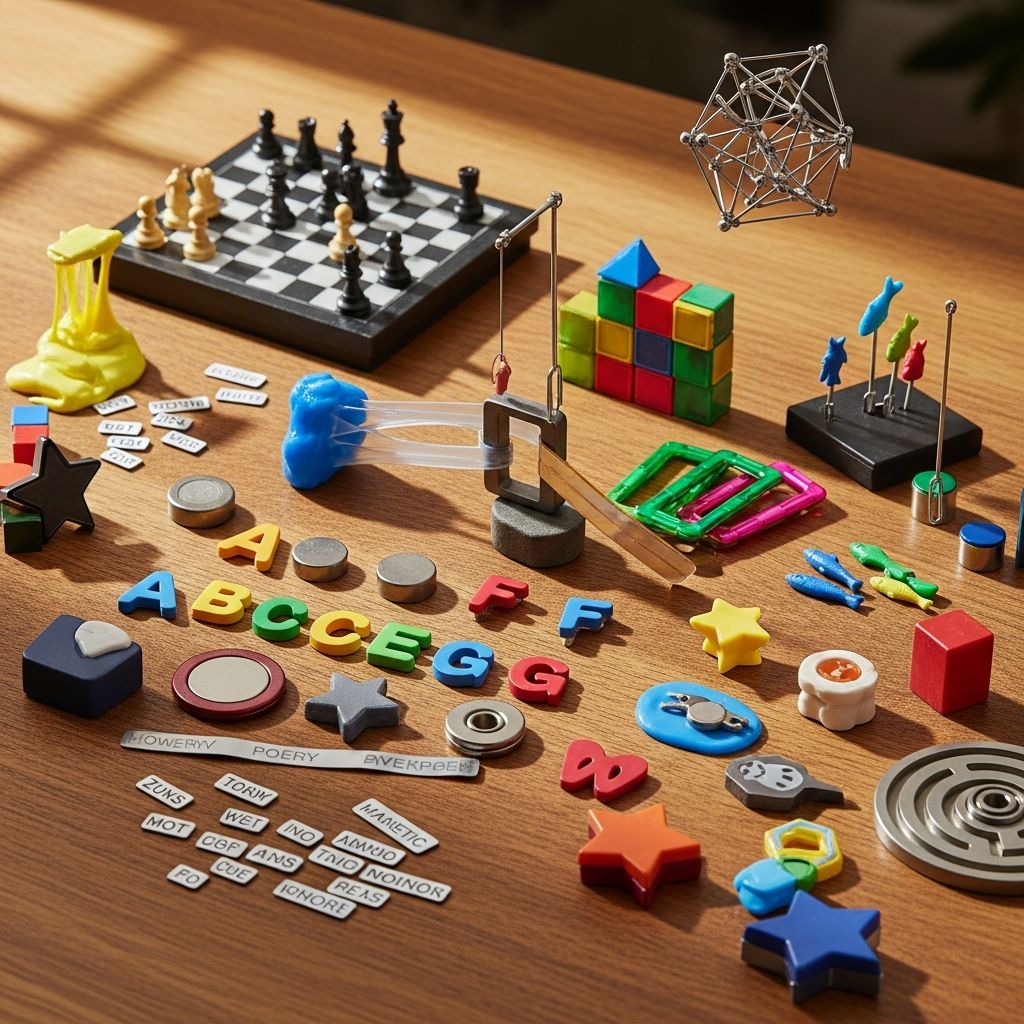
- Assortment of kid-safe magnets (letters, shapes, bars, wands, or tiles)
- Small containers or cups for sorting and storing magnetic pieces
- Optional: washi tape or painter’s tape to mark zones, paths, or grids on the tray
How to Use the Station
Place the metal tray flat on a table, on the floor, or across your child’s lap for couch play. Add only a limited number of magnets at first to prevent overload and help your child focus. As they get used to the station, rotate in different types of magnets or change the activities to keep things interesting.
This simple setup keeps magnets contained, minimizes the risk of pieces getting lost, and lets you quickly pack everything into a cupboard or shelf when playtime ends.
Magnet Sorting Adventures
Sorting is one of the easiest magnet activities to set up, and it teaches kids to notice patterns, classify objects, and use descriptive language. Sorting also helps build fine motor control through repeated picking up and placing motions.
Color and Shape Sorting
Spread a mix of magnetic shapes or tiles across the tray and invite your child to group them in different ways. Guide them with simple prompts:
- “Can you make a group of all the red magnets?”
- “Let’s put circles in one corner and squares in another.”
- “Which group has more pieces? Which has fewer?”
Magnetic vs. Non-Magnetic Hunt
Older preschoolers and early elementary children enjoy testing what “sticks” to a magnet. Offer a small pile of safe household items such as paper clips, wooden blocks, plastic bottle caps, and coins (if age-appropriate and supervised).
Invite your child to test each item on a magnet and then sort them into two groups: magnetic and not magnetic. Ask them to describe what they notice and guess which items will attract before testing.
Quiet-Time Magnet Play Ideas
Magnet play does not always have to be loud or active. It can also become a soothing quiet-time activity, especially useful during rest time, travel days, or waiting periods when you need your child to play calmly.
Magnet Story Boards
Create a simple story board by placing printed or hand-drawn images on cardstock, laminating them if possible, and attaching a small piece of magnetic tape to the back. Animals, vehicles, and simple characters work well.
Offer the story pieces and a metal tray. Encourage your child to move characters around and “act out” simple scenes. You can narrate, or let them lead the storytelling. This blend of imaginative play and magnet movement is especially calming for children who like to organize and rearrange.
Design and Pattern Challenges
Use magnet tiles, geometric shapes, or letter magnets to invite quiet design challenges. Present prompts like:
- “Can you make a house using only triangles and squares?”
- “Create a pattern that goes circle–square–circle–square.”
- “Build a picture using five magnets only.”
These challenges engage visual-spatial thinking and help children practice noticing order, sequence, and symmetry.
Active Magnet Games for Energy to Burn
When kids are full of energy, magnet play can be turned into movement-based games instead of sitting activities. A hallway, living room floor, or outdoor table can become a magnet playground.
Magnet Rescue Mission
Arrange several magnetic objects (such as paper clips or magnetic chips) on a tray or scattered within a shallow box. Give your child a magnet wand or bar magnet and explain that they are on a rescue mission to collect all the “stranded” pieces.
- Time the mission with a gentle countdown and cheer when all pieces are collected.
- Increase difficulty by placing objects slightly under tissue paper, fabric scraps, or shredded paper for a “buried treasure” experience.
- Encourage teamwork by letting siblings take turns as the rescuer and the “spotter.”
Rolling Magnet Races
Use a small metal ball or a large paper clip on top of a metal cookie sheet. Place the sheet at a slight angle by propping one end on books or a low box. Let your child move a magnet underneath the tray to guide the ball or clip down the surface.
You can tape simple “lanes” or paths on the sheet and challenge your child to keep the rolling object within the track. This type of game strengthens hand–eye coordination and encourages children to predict how the object will move.
Simple STEM Concepts With Magnets
Children do not need formal lessons to absorb early STEM ideas during magnet play. The hands-on actions of attracting, repelling, sorting, and guiding objects naturally introduce basic physics and problem-solving skills.
| Skill Area | What Children Experience | Example Activity |
|---|---|---|
| Science | Cause and effect, attraction and repulsion, testing predictions. | Guess which objects are magnetic, then test them one by one. |
| Technology | Understanding that invisible forces can move objects. | Use a magnet to move a paper clip through cardboard or under a tray. |
| Engineering | Building, problem-solving, and designing tools or structures. | Create magnet mazes or obstacle courses that objects must travel through. |
| Math | Counting, comparing, and recognizing patterns. | Sort magnets by shape or color and count how many are in each group. |
Travel-Friendly Magnet Kits
Magnets make excellent travel companions because they do not roll away easily and can be contained in small spaces. Creating a compact travel kit can transform car rides, waiting rooms, or visits to restaurants into opportunities for quiet play.
DIY Travel Tin
Use a clean metal lunch box or a small tin with a secure lid. Line the inside with plain paper or decorative card stock if you want a themed background (like a city, farm, or outer space scene). Add a selection of magnets that fit the box.
- Include a mix of alphabet magnets for older kids who enjoy spelling.
- Add simple shapes for pattern building and designs.
- Keep the number of pieces limited to avoid clutter and reduce clean-up.
Children can place the tin on their lap and use both the bottom and the lid as magnet surfaces. When finished, all the pieces go back into the box, and the lid snaps closed for easy storage in a bag.
Integrating Magnets Into Learning Routines
Magnets blend easily into daily learning without feeling like formal lessons. By pairing them with books, numbers, and letters, they support school readiness in a playful way.
Letters and Words
For children who are curious about letters, provide a small set of magnetic alphabet pieces. Start with the letters in their name and familiar words such as “mom,” “dad,” or the names of pets.
- Invite your child to line up the letters of their name on the tray and point to each one as you say the sounds together.
- Play a simple game where you remove one letter and they guess which is missing.
- Let older children create silly words and then read them aloud.
Counting and Simple Math
Use identical magnets (such as small discs or tiles) as counters. Draw simple boxes or number lines on a piece of paper placed on the tray. Ask your child to match the number of magnets to each numeral.
For children ready for more challenge, create tiny addition and subtraction stories using magnets as characters. For example, “Two magnets go on a picnic and one more joins. How many are there now?” Let them move the magnets and count the total.
Adapting Magnet Play for Different Ages
Magnet play can grow with your child from toddlerhood into the early school years by shifting the materials and complexity of activities. Keeping developmental needs in mind ensures play stays safe and interesting.
| Age Group | Recommended Materials | Sample Activities |
|---|---|---|
| Toddlers (with close supervision) | Large, chunky magnets, big tiles or blocks, oversized magnet wands. | Simple sticking and pulling, basic color sorting, moving one magnet at a time on a tray. |
| Preschoolers | Shape magnets, letters, bar magnets, metal and non-metal items for testing. | Sorting by category, magnetic vs. non-magnetic hunts, rescue games, and simple mazes. |
| Early elementary | Stronger bar magnets (used safely), more varied objects, basic recording sheets. | Designing their own mazes, creating experiments, building patterns, and simple word or math games. |
Keeping Magnet Play Fresh
Even the most exciting activity can lose its charm if it appears in the same form every day. Rotating materials and changing small details can renew your child’s interest without requiring new purchases.
- Swap out the background of the magnet tray (e.g., different colored paper or themed scenes).
- Introduce one new type of magnet at a time, such as vehicles, animals, or geometrical shapes.
- Offer occasional “challenges of the day,” like building the tallest magnet tower or creating a picture with exactly ten pieces.
Simple changes like these signal to your child that the activity is new again, which often leads to longer, more engaged play sessions.
Frequently Asked Questions
Are magnets safe for young children?
Magnets can be safe for young children when they are large, well-constructed, and used under close adult supervision. The greatest risk comes from small, powerful magnets that can be swallowed, so those should be kept away from toddlers and children who still put objects in their mouths.
Where should I store magnets when not in use?
Store magnets in a closed box, bin, or container out of reach of unsupervised children. Keeping all magnet pieces together prevents them from wandering into places where younger siblings might find them and reduces the chance of losing small parts.
Do I need special magnets for these activities?
Specialty magnets are not required. Many families find that a mix of alphabet magnets, basic shapes, and one or two magnet wands provide more than enough variety for creative play. The key is to choose sturdy, child-friendly pieces that are large enough to handle safely.
How long do kids usually stay engaged with magnet play?
Engagement time varies by age and personality, but many children will play with magnets longer than with other toys because of the open-ended possibilities. Rotating activities and offering fresh prompts can keep their interest high over multiple play sessions.
Can magnet play really support learning, or is it just for fun?
Magnet play is both fun and educational. Through hands-on experiments and games, children naturally practice observation, prediction, counting, pattern recognition, and basic scientific thinking—all while enjoying themselves.