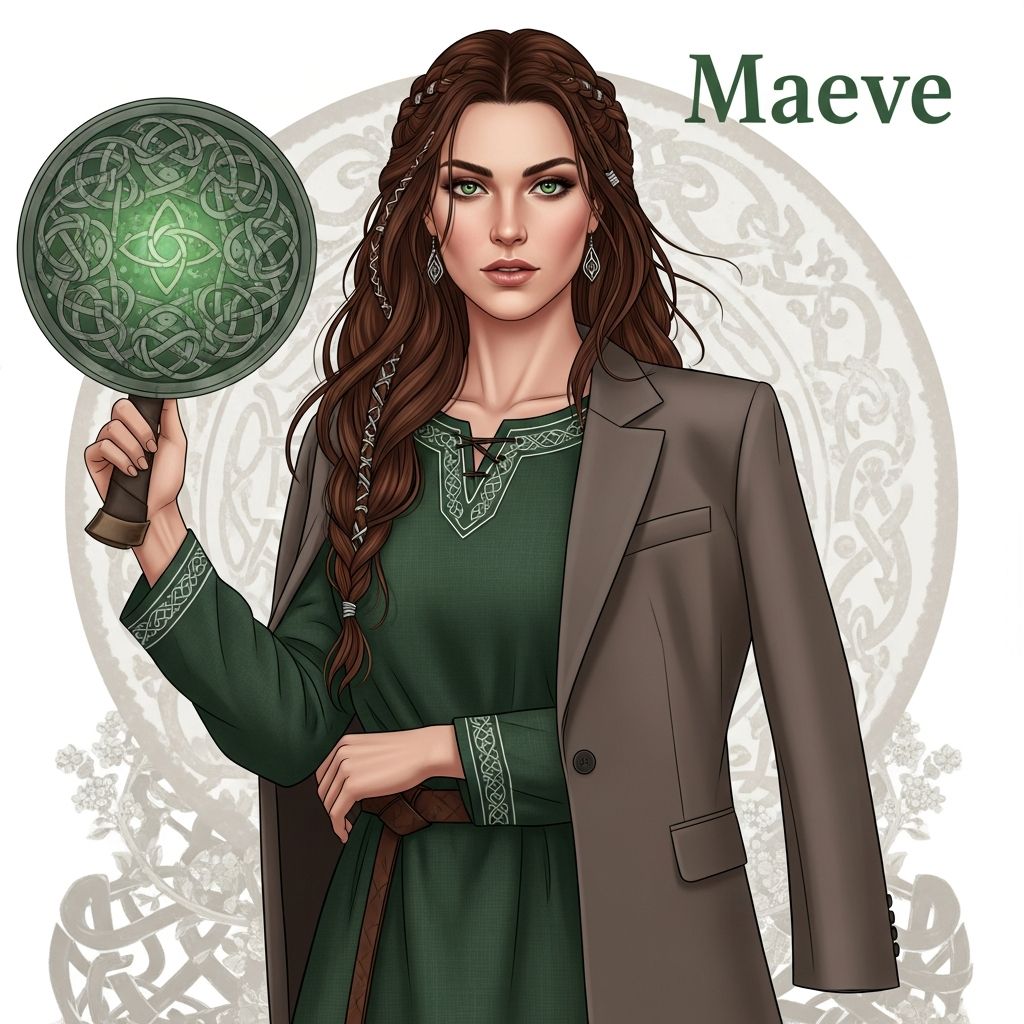
Uncovering the Linguistic Roots of Maeve
The name Maeve carries a fascinating linguistic heritage that connects modern parents to ancient Celtic traditions. Derived from the Irish Gaelic name Medb or Meadhbh, this feminine name encompasses layers of meaning that have evolved across centuries. The etymology reveals a connection to the Indo-European root *medhu*, which relates to mead and honey wine, suggesting qualities of sweetness, intoxication, and delight. Scholars interpret the name as meaning ‘she who intoxicates’ or more poetically, ‘the cause of great joy.’ This dual interpretation reflects how ancient cultures understood the power of names to convey both literal and metaphorical qualities. In Latin contexts, Maeve translates to ‘purple flower,’ while Celtic language traditions associate it with the concept of ‘queen,’ emphasizing sovereignty and rulership. Such multifaceted meanings make Maeve an exceptionally rich choice for parents seeking a name with cultural depth.
The Mythological Foundation: Queen Maeve of Connacht
The legendary status of Maeve originates from one of the most compelling figures in Irish mythology. Queen Maeve of Connacht stands as a warrior queen whose influence permeates the Ulster Cycle, one of Ireland’s most important literary traditions. Her most famous appearance comes in the epic tale Táin Bó Cúailnge, known in English as ‘The Cattle Raid of Cooley,’ a narrative that showcases her as a formidable military strategist and ruler. Within this legendary context, she is portrayed not merely as a wife or supporter but as an independent political and military force, commanding armies and making decisive choices that shaped the course of events. Her character combines beauty with intelligence and ambition, presenting a model of feminine power that resonates across generations.
Historians and scholars theorize that the mythological Queen Maeve may have originated as a sovereignty goddess in pre-Christian Irish religious traditions, later transformed into a historical or semi-historical figure through storytelling and literary adaptation. This transformation from divine being to warrior queen enriches the name with spiritual and archetypal dimensions. The association with Queen Maeve has consequently endowed the modern name with connotations of strength, independence, and sovereign authority, making it appealing to contemporary parents who wish to instill qualities of leadership and self-determination in their daughters.
Navigating Multiple Spellings and Regional Variations
One of the distinctive features of the name Maeve is its abundance of spelling variations, each reflecting different stages of linguistic evolution and regional preferences. Understanding these variations helps parents choose a spelling that aligns with their cultural preferences and practical concerns.
- Meadhbh — The original Irish Gaelic spelling, which many find challenging to pronounce without familiarity with Irish phonetics.
- Medb — The Old Irish form, representing the earliest documented version of the name.
- Meabh — A spelling that maintains closer ties to traditional Irish roots while being more accessible to English speakers.
- Maebh — A transitional form between ancient and contemporary spellings, offering a middle ground.
- Mave — A simplified, modernized version that streamlines pronunciation for English-language contexts.
- Maive — A contemporary adaptation that modifies the traditional form for modern naming sensibilities.
- Mabb — The Scottish variant, reflecting how the name traveled and adapted across Celtic regions.
- Mavis — A European adaptation that has taken on a somewhat different character while maintaining etymological connection.
- Maeva — The Latin-influenced version that has gained popularity in France and other Romance-language countries.
- Mabyn — A Welsh variant reflecting regional linguistic patterns.
This multiplicity of options allows parents considerable flexibility. Those prioritizing authentic Irish heritage might select Meadhbh or Meabh, accepting the pronunciation challenge as part of honoring the name’s origins. Parents seeking easier pronunciation in English-speaking contexts might prefer Maeve, Mave, or Mavis. Regional heritage becomes another consideration, with Scottish parents potentially gravitating toward Mabb and those with French connections considering Maeva.
Contemporary Nicknames and Affectionate Forms
The name Maeve has inspired a creative array of diminutives and nicknames that reflect both traditional Irish naming customs and contemporary creativity. In Ireland, traditional pet forms include Meadha and the endearing Mea, preserving linguistic connections to the full name. Among English-speaking communities, Mae has become a popular shortened form, offering simplicity and charm. More playful variations include Maverick for a Maeve with a bold or adventurous personality, and Queen M, a nickname that nods directly to the name’s royal heritage and mythological associations. Some parents and friends simply use M as an initial-based nickname. The diversity of nickname options means that a child named Maeve can have different name presentations at different life stages, from formal Maeve in professional contexts to the intimate Mea among family members.
Global Popularity Trajectory and Regional Adoption
The ascent of Maeve in naming preferences represents a significant shift in how parents worldwide engage with Celtic cultural heritage. In the United States, Maeve has demonstrated remarkable growth over recent decades. The name entered the top 1,000 names for girls around 1997, subsequently broke into the top 500 by the early 2000s, and has risen to achieve top 150 status as of 2021. This trajectory reflects both the expanding interest in distinctive names and the cultural influence of Irish heritage in American society.
Ireland itself has embraced Maeve as a foundational part of its naming tradition. Between 1964 and 2009, the spelling Maeve appeared in Ireland’s top 100 girls’ names for all but 12 of the 46 years surveyed. The variant Meabh ranked 99th among the most popular Irish girls’ names as of 2020, demonstrating sustained preference for the name among Irish parents. In Northern Ireland, Maeve maintained top 100 status between 1997 and 2004, with Meabh achieving 44th place in 2017.
Beyond Ireland, Maeve has gained considerable traction throughout the British Isles. In England and Wales, the name climbed from 218th position in 2020 to 94th by 2020, representing rapid growth. Scotland has similarly embraced the name, with Maeve ranking among the top 100 names for girls since 2020, achieving 72nd place in 2021. The Netherlands presents an interesting case of international adoption, where Maeve moved from being among the top 500 names in 2014 to achieving 44th place as the most common name for newborn Dutch girls in 2021. This global expansion demonstrates how names rooted in specific cultural traditions can transcend geographic boundaries and resonate with parents across diverse backgrounds.
Cultural Influences and Pop Culture References
Modern popularity of the name Maeve has been substantially influenced by its appearances in contemporary media and popular culture. Several prominent fictional characters bearing this name have introduced it to broader audiences and contributed to its rising status. Maeve Millay from the HBO series Westworld portrays a highly intelligent host character who becomes self-aware and pursues freedom, embodying themes of autonomy and intelligence. Maeve Wiley from the Netflix series Sex Education represents a brilliant yet troubled student who demonstrates intelligence and agency in unconventional ways. Criminal Minds features Maeve Donovan, a geneticist who becomes the love interest of SSA Dr. Spencer Reid, representing intellectual sophistication. The Secret Circle novel series includes Maeve Rourke, a powerful witch with mysterious depths. These fictional characters present Maeve as intelligent, complex, and often independent-minded, reinforcing the name’s associations with strength and capability.
Numerological Perspectives on Maeve
In Pythagorean numerology, the name Maeve carries specific numerical vibrations that enthusiasts believe offer insights into personality and life path. The letters of Maeve correspond to numerical values: M(4) + A(1) + E(5) + V(4) + E(5), which sum to 19, reducing further to 1, then to a single digit of 5. The consonants M(4) + V(4) yield 8, which represents the personality number. Those interested in numerological interpretations associate the number 8 with confidence, ambition, and authority. According to this framework, someone named Maeve projects an image of someone capable of achieving material success through determination and practicality, appearing strong and decisive with natural inclinations toward leadership and business-oriented pursuits. While numerological systems lack scientific validation, they provide one lens through which parents might contemplate the symbolic dimensions of names they choose.
Why Modern Parents Choose Maeve
The growing preference for Maeve among contemporary parents reflects several converging factors. First, parents increasingly seek names that balance familiarity with distinctiveness, and Maeve achieves this equilibrium effectively. The name is recognizable enough to avoid constant mispronunciation corrections, yet sufficiently uncommon to provide individuality. Second, the cultural revival of interest in Celtic traditions and Irish heritage has made names rooted in these traditions more appealing across diverse populations. Third, the mythological associations provide narrative richness; parents who select Maeve can share the story of the legendary queen with their daughters, creating a connection to historical and cultural traditions. Fourth, the single-syllable pronunciation, despite the potentially challenging spelling, makes the name practical for everyday use. Finally, the abundance of nickname options and spelling variations allows parents to personalize the name to their specific cultural context and family values.
Pronunciation Guide for English Speakers
For those unfamiliar with Irish naming conventions, the name Maeve is pronounced as a single syllable: MAYV. The ‘ae’ combination in Irish Gaelic produces the long ‘a’ sound heard in words like ‘day’ or ‘say,’ followed by a ‘v’ sound. The final ‘e’ is silent in English pronunciation, though in traditional Irish it would have been pronounced. This straightforward phonetic pattern means that despite the potentially daunting spelling variations, English speakers can confidently pronounce the most common spelling with relative ease once they understand this basic rule.
Common Questions About the Name Maeve
Q: Does the spelling of Maeve affect how the name is perceived?
A: Yes, different spellings carry different cultural implications. Meadhbh and Meabh signal stronger Irish heritage credentials, while Maeve or Mave indicate English-language adaptation. Parents should choose based on whether they prioritize authentic Irish representation or practical English usability.
Q: Is Maeve still considered uncommon?
A: While Maeve has risen significantly in popularity, reaching top 150 in the United States and top 100 in several other countries, it remains less common than traditional names like Emma or Olivia, offering a balance between familiarity and distinctiveness.
Q: What does the name Maeve mean in different cultures?
A: The meaning varies by language and cultural context. In Irish Gaelic, it means ‘she who intoxicates’ or ‘joyous.’ In Celtic traditions, it translates to ‘queen.’ In Latin, it means ‘purple flower.’ These diverse meanings reflect how the name traveled and was adapted across cultures.
Q: Are there any practical considerations when choosing Maeve?
A: Parents should consider spelling preferences based on geographic location and whether they want to preserve Irish linguistic authenticity or prioritize ease of spelling and pronunciation. The abundance of nickname options provides flexibility as the child grows.
Q: How does Maeve compare to other Irish baby names?
A: Maeve offers stronger mythological associations than many Irish names and carries royal connotations. It appeals to parents seeking names with specific cultural narratives and historical depth rather than purely contemporary popularity.
References
- Maeve Baby Name Meaning, Origin, Popularity Insights — Momcozy. Accessed January 2026. https://momcozy.com/blogs/baby-names/maeve
- Maeve: Name Meaning, Origin, & Popularity — FamilyEducation. Accessed January 2026. https://www.familyeducation.com/baby-names/name-meaning/maeve
- Maeve — Wikipedia. Accessed January 2026. https://en.wikipedia.org/wiki/Maeve
- Maeve – Baby Name Meaning, Origin and Popularity — The Bump. Accessed January 2026. https://www.thebump.com/b/maeve-baby-name