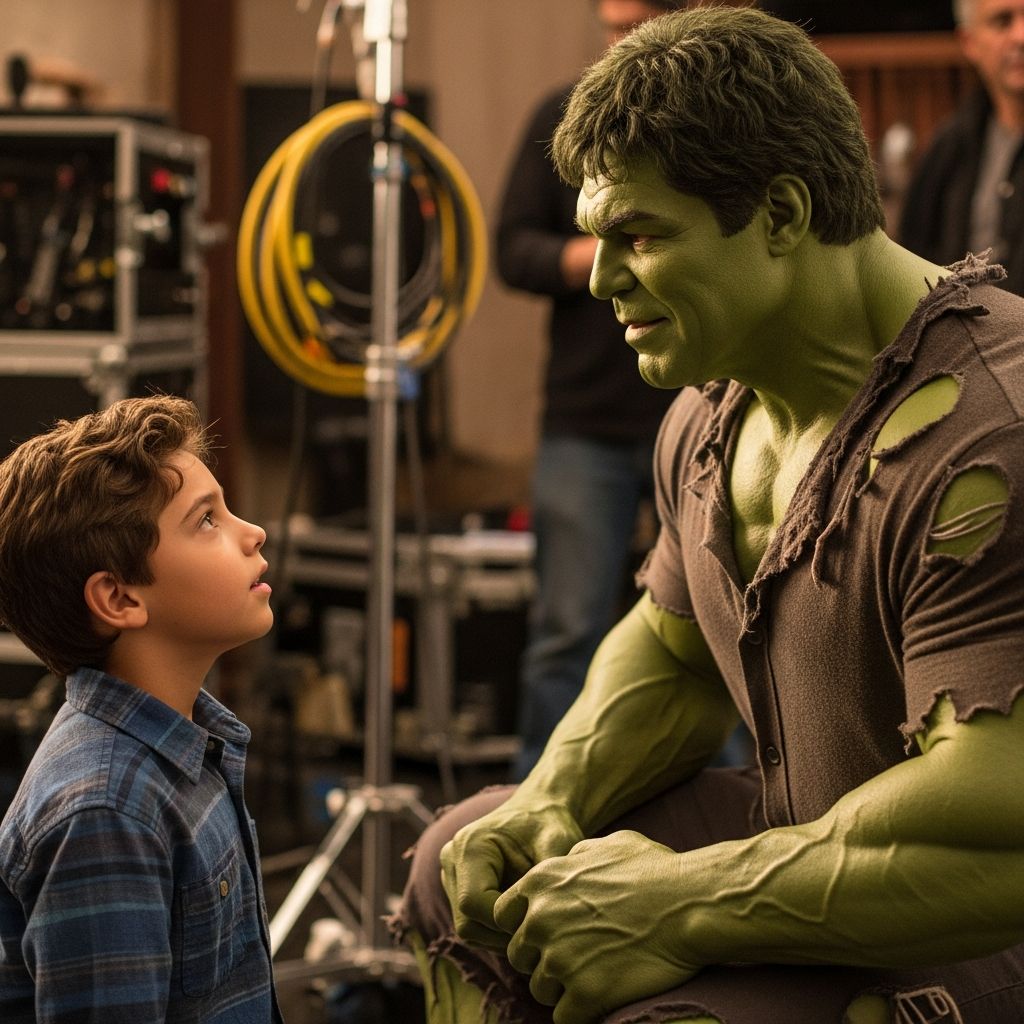
Before Lou Ferrigno Jr. became a working actor, most people knew his last name from a single image: a towering green superhero roaring across TV screens in the late 1970s and early 1980s. That superhero, of course, was his father, Lou Ferrigno, the professional bodybuilder who transformed himself into the live-action Incredible Hulk and became a pop-culture icon.
This article explores what it feels like to grow up with a literal superhero for a dad, how that shaped Lou Ferrigno Jr.’s identity, and the ways he has learned to step out of the shadow of the Hulk while still honoring the legacy behind it.
A Childhood Framed By Green Paint and Camera Lenses
For many kids, their first memory of their father might be throwing a ball in the backyard or learning to ride a bike. For Lou Ferrigno Jr., some of the most vivid memories involve trailers, makeup chairs, and a father disappearing behind layers of green paint.
By the time Lou Jr. was born in 1984, his dad had already cemented his fame as the Hulk on the CBS television series that ran from 1977 to 1982. Even after the series ended, TV movies and public appearances kept the character alive, which meant the line between Dad and Hulk was never entirely clear.
- Home was often wherever production happened to be.
- Visits to set doubled as family time.
- Strangers reacted to his father with awe long before they knew his name.
To a young child, the surreal quickly became ordinary: it was normal that Dad sometimes left the house as Lou and came back as a giant green superhero who made adults whisper and stare.
Lou Ferrigno Sr.: From Bullied Kid to Pop-Culture Icon
Understanding Lou Jr.’s story requires knowing a little about his father’s extraordinary journey. Lou Ferrigno Sr. lost much of his hearing after ear infections in infancy, leading to a speech impediment and severe bullying as a child. He later described being obsessed with comic book heroes like Hulk and Spider-Man, drawn to their power and ability to fight back against a world that underestimated them.
Bodybuilding became his escape and his armor. He won IFBB Mr. America and two consecutive Mr. Universe titles, competing against legends like Arnold Schwarzenegger and starring in the seminal bodybuilding documentary Pumping Iron in 1977.
The leap from bodybuilding stages to prime-time television came when he was cast as the Hulk, a role that required him not only to be enormous, but also to convey pain, rage, and compassion without many lines. This persona—physically invincible, visually unforgettable—was the version of his father that the world handed to Lou Jr. before he ever really knew the man at home.
Living With a Public Father: When Your Parent Is Everyone’s Hero
Celebrity children often grow up with a split reality: the parent they know at home and the icon the public projects onto them. Psychologists note that kids in high-profile families can face unique pressures around privacy, expectations, and identity, especially when a parent is associated with a powerful or larger-than-life persona.
For Lou Jr., that persona was the Hulk—rage and strength wrapped in green skin. Public encounters revolved around his father’s character:
- Fans approached with nostalgia and excitement, often reacting to the Hulk more than to Lou Sr. himself.
- Conversations with strangers started not with “What does your dad do?” but “Is your dad really the Hulk?”
- Even casual outings could turn into mini fan conventions as soon as someone recognized the broad-shouldered figure across the room.
This kind of attention can be intoxicating, but it can also be disorienting for a child who is still trying to answer a basic question: Who is my father when he’s not the Hulk?
Untangling Fear, Awe, and Confusion
Every child eventually realizes their parents are human, but that realization is much more complicated when your dad’s job is to play an unstoppable monster. Lou Ferrigno Jr. has described moments from his early years when the sight of his father in partial makeup—green skin, distorted features, the familiar voice emerging from an unfamiliar face—triggered instinctive fear.
Psychologists who study children’s responses to masks and costumes note that young kids, especially toddlers and preschoolers, often struggle to reconcile familiar voices with unfamiliar appearances, which can provoke intense fear even when they logically know the person is safe. The emotional wiring that tells them “this looks like a monster” can override the rational message that says “this is Dad.”
For Lou Jr., the fear gradually softened into fascination. As he spent more time on sets and saw crew members treating the Hulk as just another colleague, he began to understand that the monster was a role, not a separate creature. The day he noticed green makeup smudged on his own hand—evidence that the Hulk was literally just paint on his father’s skin—was a turning point in realizing that the difference between Lou and the Hulk was something that could be washed off.
Strength, Vulnerability, and Masculinity Inside the Ferrigno Home
Publicly, Lou Ferrigno Sr. embodied raw physical power. Privately, he was still the kid from Brooklyn who had been teased for his hearing loss and speech, now determined to never be powerless again. That history inevitably filtered into the way he raised his son.
Lou Jr. grew up with an intense, visible example of traditional strength:
- Physical training was part of family life. Weights, gyms, and nutrition weren’t hobbies; they were woven into everyday routines.
- Discipline and work ethic were non-negotiable. His father’s bodybuilding career had taught that progress comes from repetition, sacrifice, and consistency.
- Resilience was modeled, not preached. The same grit that carried his father from bullied kid to global icon became an unspoken family standard.
Yet behind the muscles was a man shaped by vulnerability. Hearing loss, communication barriers, and childhood rejection left scars. For a son watching all of this unfold, the lesson was complicated: real strength wasn’t just about lifting heavier weights or looking more imposing—it was about surviving pain and still showing up.
Finding His Own Path: From Famous Last Name to Working Actor
With a father so closely identified with a single character, Lou Ferrigno Jr. faced an obvious question: follow in his footsteps or run the other way? Like his dad, he developed an interest in fitness and performance, eventually pursuing acting and training professionally.
But forging his own path required careful choices:
- He embraced training and athleticism, but not as a carbon copy of his father’s bodybuilding career.
- He looked for roles that allowed for humor, vulnerability, and complexity, rather than simply playing strong, silent types.
- He used the Ferrigno name as a door-opener, but knew that staying in the room would depend on his own talent and work ethic.
In interviews, he has spoken about the need to earn his place in the industry, rather than coasting on nostalgia. That balance—leveraging a legacy without being defined solely by it—is a central tension for many children of famous parents, documented across entertainment and sports.
Respecting the Legacy Without Being Trapped By It
Lou Ferrigno Sr. didn’t just play the Hulk; he continued to voice the character in animated projects and even made cameo appearances in later film adaptations, such as the 2003 Hulk movie and the 2008 film The Incredible Hulk. This meant the character never truly left the Ferrigno family’s orbit, even as new actors and technologies reimagined the role.
For Lou Jr., this created a layered relationship with the Hulk:
| Aspect | As a Child | As an Adult |
|---|---|---|
| Emotional Response | Fear, confusion, awe | Respect, nostalgia, pride |
| View of His Father | Dad and monster blurred together | Sees the man behind the makeup and the years of work it represents |
| Career Impact | Living in the shadow of a famous character | Using the story as depth and texture, not a cage |
In conversations about his father, Lou Jr. often emphasizes that the Hulk is only part of the story. The real legacy, in his view, lies in the way his dad turned disadvantage—hearing loss, bullying, rejection—into a platform for global recognition and lifelong work.
Lessons From a Superhero Household
Growing up Ferrigno meant that certain life lessons arrived early and often. Among them:
- Hard work beats myth
Behind every “overnight success” story is a decade of routine, repetition, and resilience. Watching his father train and consistently maintain an elite level of fitness long after the Hulk series ended drove this point home. - Visibility isn’t the same as worth
Public applause comes and goes. The stability of family and the quieter moments at home matter more than fleeting recognition, a common theme in research on celebrity families and child development. - Vulnerability and strength can coexist
The same man who played an unstoppable force on screen also dealt with very human struggles—hearing aids, speech therapy, and the lingering memory of childhood bullying. - Identity is something you build, not inherit
A famous surname opens doors but doesn’t answer the question of who you are. That part, Lou Jr. has had to define for himself.
Advice for Parents: Raising Kids Under a Big Shadow
While most families don’t have a superhero in the house, many parents cast large shadows—through success, public visibility, or simply strong personalities. Insights from child psychology and family research suggest a few principles that can help kids thrive in those circumstances:
- Make room for your child’s interests
Encourage exploration, even if it leads away from the parent’s field or passion. - Separate public role from private self
Talk openly about what a job, title, or achievement means—and what it doesn’t. This helps children understand that a parent’s public persona is not the whole person. - Normalize mistakes and vulnerability
When kids see that even their larger-than-life parent struggles sometimes, they learn that imperfection is part of being human, not a failure. - Protect private time
In high-visibility lives, consciously carve out spaces where no one is performing and no cameras are present.
The Ferrigno story illustrates these ideas in an amplified form. The Hulk is as public as it gets; the relationship between father and son is as private and evolving as any other.
Frequently Asked Questions (FAQs)
Who is Lou Ferrigno Jr.?
Lou Ferrigno Jr. is an American actor and fitness professional, and the son of Lou Ferrigno, the bodybuilder and actor famous for playing the Incredible Hulk on television.
How did Lou Ferrigno Sr. become famous?
Lou Ferrigno Sr. first gained recognition as a champion bodybuilder, winning titles like IFBB Mr. America and Mr. Universe before being cast as the Hulk in the 1970s CBS television series The Incredible Hulk.
Did Lou Ferrigno Jr. follow his father into bodybuilding?
He embraced fitness and strength training much like his father, but focused primarily on acting rather than competitive bodybuilding, taking on roles across television and film.
What challenges did Lou Ferrigno Sr. face growing up?
He experienced significant hearing loss as a child, resulting in a speech impediment and bullying, which fueled his drive to become strong and ultimately led him into bodybuilding and acting.
How has the Hulk role continued to affect the Ferrigno family?
The character remains central to Lou Ferrigno Sr.’s public identity, through voice work and cameos, and has shaped Lou Jr.’s life as part of a unique family legacy in pop culture.
References
- Lou Ferrigno — Wikipedia. 2024-06-09. https://en.wikipedia.org/wiki/Lou_Ferrigno
- My Father the Incredible Hulk – Lou Ferrigno Jr. — Fatherly. 2018-05-02. https://www.fatherly.com/entertainment/my-father-the-incredible-hulk-louis-ferrigno-jr
- Lou Ferrigno Shared His Best Advice for Raising a Strong Kid — Men’s Health. 2021-06-10. https://www.menshealth.com/fitness/a36651705/lou-ferrigno-jr-father-son-interview/
- Hearing Loss in Children — Centers for Disease Control and Prevention (CDC). 2022-03-17. https://www.cdc.gov/hearingloss/children/index.html
- Growing Up in a Celebrity Family: Understanding Identity and Privacy — American Academy of Child & Adolescent Psychiatry. 2018-09-01. https://www.aacap.org/AACAP/Families_and_Youth/Facts_for_Families/FFF-Guide/Growing-Up-in-a-Celebrity-Family-119.aspx
- Why Children Fear Masks and Costumes — American Psychological Association. 2016-10-20. https://www.apa.org/topics/children/masks-costumes
- Lou Ferrigno | Marvel Cinematic Universe Wiki — Fandom / Marvel Studios Canon Info. 2023-04-01. https://marvelcinematicuniverse.fandom.com/wiki/Lou_Ferrigno