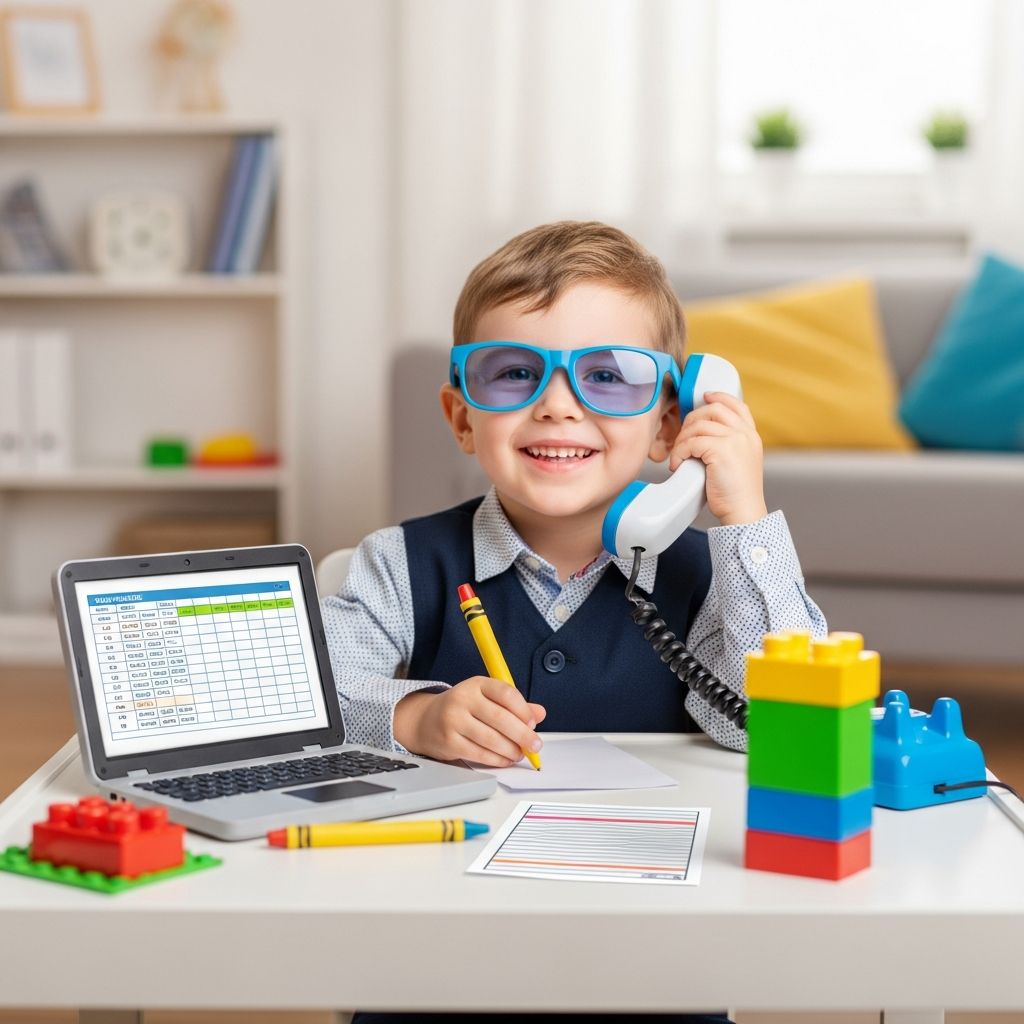
In a world where many adults take video calls from the kitchen table and answer emails while kids color beside them, it is no surprise that children now have their own miniature home office playsets complete with toy laptops, tiny coffee cups, and pretend headsets.
These toys blend the realities of work-from-home life with preschoolers’ natural instinct to copy what they see, turning adult routines into playful, kid-sized adventures.
The Rise of the Mini Home Office Toy
Over the last few years, work-from-home culture has moved from an emergency solution to an everyday norm for many families, and children have watched that shift from the front row at the dining room desk.
To match what kids now see at home, toy makers have introduced small office playsets that typically include items like pretend laptops with fabric icons, toy smartphones, headsets, and mugs, all scaled to preschool hands and designed for safe, open-ended play.
What Is a Kids’ Home Office Playset?
A children’s home office playset is an all-in-one pretend workstation that mimics the basic tools adults use to work remotely, but reimagined in soft, durable, kid-friendly materials.
Instead of functioning electronics, these sets focus on simple shapes and props that invite storytelling—laptops that open and close, small fabric pieces that act as “apps,” and accessories like wooden or plastic phones and headsets for imaginary calls.
- Age range is usually around three years and up, aligning with the stage when kids love to copy adult behavior and invent elaborate pretend scenarios.
- Materials often include a mix of plastic, fabric, and sometimes wood, emphasizing safety, durability, and tactile variety for small hands.
- Pieces are typically lightweight and compact, so the entire setup can sit beside a parent’s real workstation or travel to another room with ease.
Core Pieces You’ll Usually Find
While every brand designs its set a bit differently, many home office playsets share a handful of signature components that instantly signal “work time” to kids.
These elements give children familiar anchors for role play while leaving plenty of room for imaginative twists and personalized stories.
Typical Components
- Pretend laptop with a screen where fabric icons or “apps” can be placed and rearranged to represent different programs or projects.
- Toy smartphone for taking imaginary calls from bosses, clients, or grandparents who “need a meeting.”
- Headset or earbuds so kids can mimic video meetings or customer calls, often a highlight of real work-from-home days.
- Mini coffee cup or mug to copy a parent’s morning ritual, sometimes doubling as a juice or hot chocolate cup in pretend play.
- Small accessories like document folders, pens, or mouse shapes that encourage kids to act out typing, clicking, and organizing tasks.
Developmental Benefits of Pretend Office Play
These toys might look like tiny versions of adult work tools, but their value lies in how they support preschool development rather than in any real technology they offer.
When kids open their toy laptops or take a make-believe conference call, they are practicing social, emotional, and cognitive skills in ways that feel fun, not forced.
Skill Building in Disguise
- Language and communication: Kids narrate what they are doing, invent conversations with pretend coworkers, and repeat phrases they hear adults use, strengthening vocabulary and expressive language.
- Social understanding: Role playing as a “boss,” “coworker,” or “client” helps children grasp turn-taking, politeness, and collaboration.
- Executive function: Planning their “workday,” organizing their pretend tasks, and switching between roles builds early skills related to focus, sequencing, and flexible thinking.
- Emotional processing: Kids often act out moments they found confusing or stressful, like a parent being too busy to play, which can help them process those feelings in a safe way.
How These Toys Reflect Real Family Life
Home office playsets are not just cute novelties; they are a snapshot of what modern family life looks like, especially in households where parents routinely work remotely.
For many kids, watching a parent juggle emails and video meetings has become as normal as seeing them drive a car or cook dinner, making office role play feel just as natural as playing house or school.
Identity and Imitation
- Children learn who they are partly by imitating who their caregivers are, and a toy workstation lets them explore the idea of being a “worker” or a “professional.”
- Copying real routines—like putting on a headset or typing on a keyboard—helps demystify adult tasks that might otherwise feel distant or confusing.
- Sharing a side-by-side “office” setup can be a bonding experience, turning potentially stressful work hours into moments of connection.
Comparing Home Office Playsets to Traditional Pretend Toys
Kitchen sets, doctor kits, and tool benches have long dominated the pretend-play aisle, but home office toys now sit alongside them as another way to mirror everyday adult roles.
Rather than replacing classic toys, these sets expand the range of scenarios kids can act out, especially for families where laptops have become as iconic as stethoscopes or spatulas.
Pretend Play Toy Types
| Toy Type | Typical Theme | Key Skills Encouraged | Common Setting |
|---|---|---|---|
| Home office playset | Work-from-home, digital tools, meetings | Communication, executive function, social understanding | Living room, shared desk area |
| Play kitchen | Cooking, serving meals, family routines | Sequencing, fine motor skills, cooperation | Playroom or bedroom corner |
| Doctor kit | Medical care, checkups, healing | Empathy, body awareness, coping with fear | Anywhere in the home or backyard |
| Tool bench | Building, fixing, construction | Problem solving, spatial skills, hand strength | Playroom, garage, or outdoor area |
What to Look for When Choosing a Set
Not every home office toy is created with the same priorities, so parents should look beyond the cute factor and consider safety, durability, and play value.
A thoughtful choice helps ensure the set holds a child’s attention and supports development instead of becoming another forgotten prop at the bottom of the toy bin.
Key Buying Factors
- Age appropriateness: Check recommended ages and avoid small detachable parts if younger siblings might be nearby.
- Material quality: Look for sturdy plastic or well-finished wood, smooth edges, and non-toxic finishes that can withstand drops and enthusiastic pretend typing.
- Number and variety of pieces: A mix of core items (like a laptop and phone) plus a few extra props (like documents or a mug) can spark richer storytelling.
- Storage solutions: Sets that include a carrying case, laptop sleeve, or compact tray make cleanup easier and allow kids to transport their office around the house.
- Open-ended potential: Fewer electronics and more simple, versatile pieces give children freedom to invent their own rules, jobs, and workplaces.
Using Pretend Offices to Ease Real Work Time
One of the biggest advantages of these toys is how they can turn potential friction—like a child interrupting a video call—into an opportunity for shared play.
With a small amount of planning, parents can use toy workstations to create rituals that make remote work hours feel predictable and less frustrating for everyone.
Practical Strategies for Parents
- Set up a “kid desk” next to your own workspace with the home office playset, paper, and crayons, framing certain times of day as “everyone’s work time.”
- Give your child simple “assignments,” such as drawing a picture of their team or pretending to send a message to a stuffed animal coworker.
- Let kids know when an important call is coming and invite them to take a pretend call at the same time, turning a moment of potential interruption into parallel play.
- Use the toy set as a reward for short periods of independent play, praising any small steps toward patience and self-directed activity.
A Healthy Balance: Work Themes Without Work Pressure
Because these toys echo adult work life so closely, parents sometimes worry that they might encourage kids to “grow up too fast” or think of productivity as the main goal of play.
The key is to treat office role play as one option among many, not as a replacement for more physical, messy, or fantastical play experiences.
Keeping Play Childhood-Centered
- Rotate the home office set with other toys like blocks, dolls, and outdoor gear so it becomes part of a wider play diet.
- Let kids be the bosses of their imaginary companies and encourage silly twists, such as running a dinosaur design studio or a unicorn bakery from their pretend desk.
- Avoid tying the toy to real performance expectations; keep it about stories, not productivity or behavior charts.
Eco and Design Considerations
Some modern office playsets incorporate wooden elements or simpler mechanical features instead of electronics, which can appeal to families prioritizing sustainability and screen-free play.
These design choices also tend to emphasize tactile experiences and imagination rather than flashing lights or sound effects, which can make the toys more calming and versatile across ages.
Why Simpler Can Be Better
- Wood or fabric pieces often age more gracefully than thin plastic, standing up to years of pretend meetings and conference calls.
- Non-electronic sets avoid battery changes and beeping noises, which many caregivers appreciate during long workdays at home.
- Minimalist designs invite kids to fill in the gaps with their imagination, inventing what is on the screen or who is on the other end of the call.
Frequently Asked Questions About Kids’ Home Office Toys
Are pretend office toys educational or just cute?
Pretend office playsets are educational in the sense that they promote language development, social understanding, planning, and emotional processing, even though they do not teach specific academic content.
The open-ended nature of role play gives children space to experiment with identities and scenarios that help them make sense of the adult world around them.
What age is best for a home office playset?
Most sets are recommended for preschoolers around three years old and up, when kids are less likely to put small pieces in their mouths and more able to sustain simple narratives.
Older siblings can still enjoy these toys by adding more complex stories, such as running their own companies or staging pretend interviews and presentations.
Will these toys make my child think work is more important than play?
Pretend offices do not inherently send that message; children treat them as another stage for imagination, much like a toy kitchen or doctor kit.
Parents shape the meaning by how they talk about work, how often they invite kids into playful versions of their routines, and how balanced the overall play environment feels.
Can a home office toy actually help my child interrupt less during calls?
There is no guarantee, but many families find that giving kids a parallel task—”You take your important call while I take mine”—reduces interruptions because children feel involved rather than excluded.
Consistency is crucial; if the toy only appears during high-stress calls, kids may link it to tension rather than to calm, special playtime.
Should I choose a set with sounds and lights?
That depends on your child’s preferences and your tolerance for noise during work hours, but simpler sets without electronics usually offer more flexible, longer-lasting pretend play.
Silent props make it easier for kids to keep playing while adults are on quiet calls, and they encourage children to supply the sound effects with their own voices.
Final Thoughts on Tiny Desks and Big Imaginations
Home office playsets represent a new chapter in the story of pretend play, reflecting how laptops, video calls, and remote meetings have become part of everyday family life.
When used as one tool in a rich mix of toys and experiences, these miniature workstations can help kids feel connected to their caregivers, gain confidence in social roles, and turn adult routines into something playful, manageable, and uniquely their own.