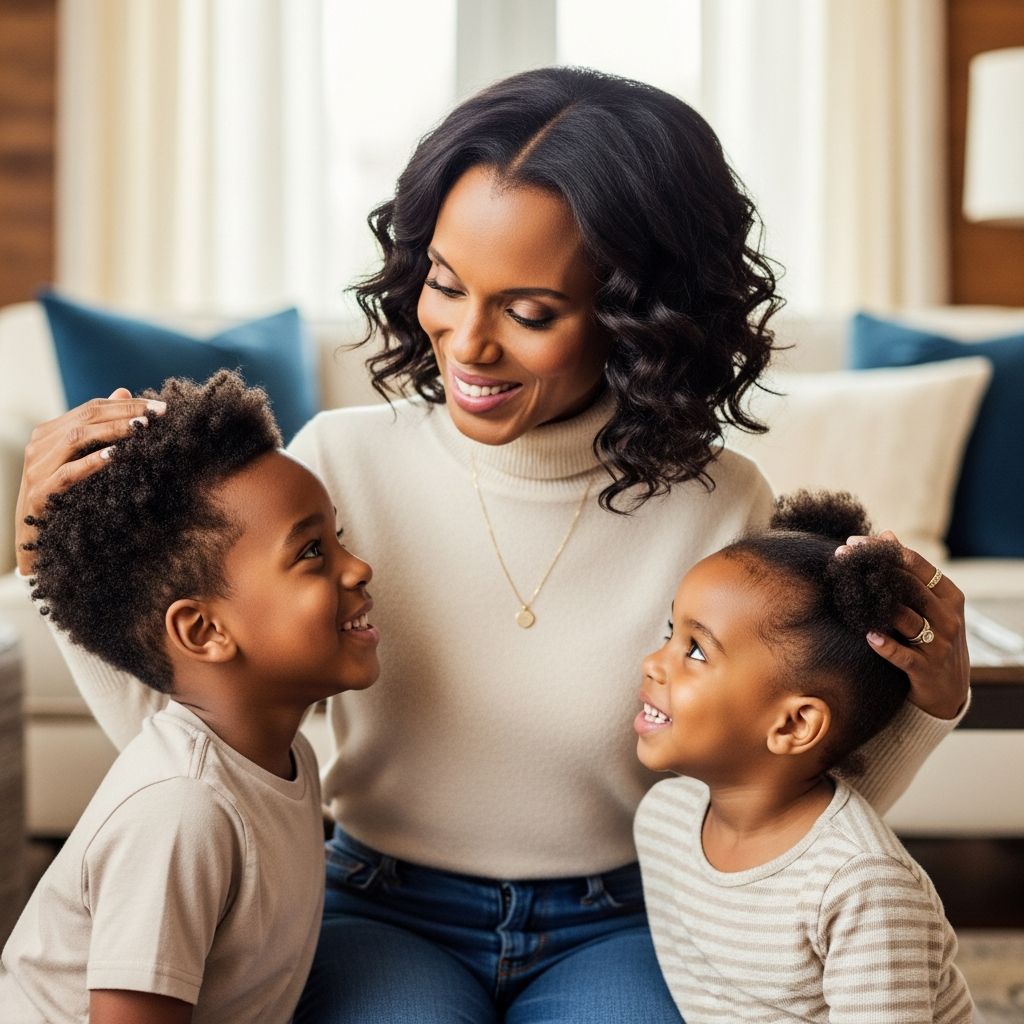
Kerry Washington, the acclaimed actress known for roles in Scandal and Ray, has made a powerful choice to wear her natural hair texture publicly. This decision transcends celebrity fashion; it serves as a deliberate message to her two young children, Isabelle Amarachi and Caleb Kelechi, emphasizing that their natural crown is beautiful and worthy of celebration. By choosing authenticity over conformity, Washington models self-acceptance, challenging industry norms and cultural expectations around Black hair.
The Personal Shift to Natural Textures
Washington’s journey to embracing her curls began as a practical response to motherhood. In interviews, she revealed that going natural not only simplified her routine but also aligned with her values as a parent. ‘I like to wear my natural texture, especially now because I have children and I want them to know that their hair is perfect as it is. They don’t have to change it or straighten it. They can, but they don’t have to,’ she shared in a prominent magazine feature. This shift saved her time amid a busy career and family life, allowing healthier hair growth without chemical relaxers or excessive heat styling.
For many Black women, the transition to natural hair involves unlearning decades of pressure to straighten for professionalism or acceptance. Washington’s visibility amplifies this narrative, showing that high-profile success doesn’t require altering one’s roots. Her stylist of many years noted she hasn’t relied on weaves for a decade, opting instead for clip-ins to add versatility while prioritizing her scalp’s health.
Why Natural Hair Matters in Family Dynamics
Parenting through example is central to Washington’s approach. With children entering an impressionable age, she uses her hair as a daily lesson in pride. Her daughter, now in school years, and son witness a mother who confidently manages 4C coils—tight, kinky patterns common in Black hair—without apology. This visibility counters media portrayals that often favor sleek, Eurocentric styles.
- Building Confidence: Seeing a parent embrace natural features helps kids internalize self-worth early.
- Cultural Connection: It reinforces heritage, linking hair rituals to ancestral traditions.
- Practical Lessons: Children learn care routines, from detangling to moisturizing, as family bonding activities.
Experts in child psychology note that such modeling reduces body image issues later in life, particularly for children of color navigating diverse environments. Washington’s choice echoes broader movements where parents use personal style to combat low self-esteem linked to hair discrimination.
Historical Context of Natural Hair Struggles
The natural hair movement gained momentum in the 1960s with the Black Power era, where afros symbolized resistance. Figures like Angela Davis and the Black Panther Party popularized ‘going natural’ as political defiance against assimilation. Fast-forward to today, Washington’s stance builds on this legacy, adapting it for modern families.
In professional settings, Black women face biases; a 2019 study by the Perception Institute found that natural hairstyles are often deemed less professional, impacting hiring and promotions. Washington’s red-carpet appearances with twist-outs and puffs challenge this, proving natural hair commands respect.
| Era | Key Figures | Impact on Natural Hair |
|---|---|---|
| 1960s-1970s | Angela Davis, Nina Simone | Afro as symbol of Black pride and anti-assimilation |
| 2000s-Present | Solange Knowles, Chimamanda Ngozi Adichie | Global pushback via social media and #NaturalHair |
| Today | Kerry Washington, Tracee Ellis Ross | Parenting and Hollywood normalization |
Essential Tips for Maintaining Healthy Natural Hair
Switching to natural hair requires a regimen focused on moisture, protection, and gentleness. Washington’s routine, as described by experts familiar with her style, emphasizes scalp health and minimal manipulation.
Cleansing Without Stripping
A clean scalp prevents buildup that blocks moisture absorption. Avoid harsh sulfates; choose co-washes or sulfate-free shampoos. Pre-poo with oils like jojoba or coconut to shield strands during washing. Frequency: Every 1-2 weeks for low-porosity hair, more for high-porosity.
Locking in Hydration
Curly hair thrives on moisture. Layer water-based leave-ins, creams, and sealing oils (LOC method: Liquid, Oil, Cream). Deep condition weekly with heat for penetration. Spritz daily to combat dryness.
- Suggested Products: Shea butter-based butters, aloe vera gels.
- Pro Tip: Pineapple your hair overnight (loose high bun) to preserve curls.
Protective Styling for Longevity
Give hair breaks with braids, faux locs, or clip-ins. These reduce tension and allow growth. Washington uses extensions sparingly for volume, ensuring they’re lightweight. Limit installs to 4-6 weeks.
Overcoming Common Natural Hair Challenges
Shrinkage, knotting, and breakage plague many. Combat shrinkage with stretching techniques like banding or plopping. Detangle in sections with fingers or wide-tooth combs, always conditioned. For protein-sensitive hair, balance with moisture-heavy treatments.
Environmental factors like humidity or chlorine demand extra care. Silk bonnets and pillowcases minimize friction. Consistency yields results: Many report stronger strands after 6-12 months.
Cultural and Societal Ripples
Washington’s influence extends beyond family. The CROWN Act, passed in over a dozen U.S. states by 2023, bans hair discrimination in workplaces and schools, inspired by stories like hers. In Hollywood, her Allure cover sparked discussions on representation.
Globally, the natural hair community on platforms like Instagram shares routines, fostering solidarity. Parents worldwide adopt similar approaches, using hair as a gateway to talks on identity and resilience.
Family Rituals: Hair Care as Bonding Time
Turn maintenance into memories. Washington likely involves her kids in wash days, teaching patience and pride. Games like ‘curl counting’ or story-sharing during detangling build positive associations.
- Start young: Let toddlers feel textures.
- Make it fun: Use colorful tools and music.
- Discuss history: Tie care to cultural icons.
Debunking Natural Hair Myths
Myth 1: Natural hair can’t be versatile. Reality: From updos to protective styles, options abound.
Myth 2: It requires expensive products. Reality: DIY mixes with pantry staples work wonders.
Myth 3: Natural hair is unprofessional. Reality: Laws and leaders are shifting perceptions.
Frequently Asked Questions (FAQs)
What inspired Kerry Washington to go natural?
Primarily her children; she wants them to see their hair as perfect without changes.
How does natural hair benefit health?
It avoids chemical damage, promotes scalp health, and saves time.
Best starter routine for natural hair beginners?
Cleanse gently, moisturize daily, deep condition weekly, and protect at night.
Can natural hair be worn professionally?
Yes, with growing legal protections and celebrity examples like Washington.
How to involve kids in hair care?
Through fun rituals, education, and positive reinforcement for lifelong confidence.
Washington’s natural hair embrace is a profound parenting strategy, weaving self-love into daily life. It inspires families to prioritize authenticity, fostering generations confident in their crowns.
References
- Kerry Washington’s Natural Hair Is #Goals — KinkyCurlyYaki. 2017. https://kinkycurlyyaki.com/blogs/natural-hair-blogs/kerry-washingtons-natural-hair-is-goals
- Kerry Washington says she hopes to inspire her kids with natural hair — theGrio. 2017-10-19. https://thegrio.com/2017/10/19/kerry-washington-inspires-kids-natural-hair/
- Kerry Washington Credits Her Children for Giving Her Confidence — Atlanta Black Star. 2017-10-18. https://atlantablackstar.com/2017/10/18/kerry-washingtons-inspirational-reason-wearing-natural-hair/
- Kerry Washington Cover Allure Natural Hair Children — Hello Beautiful. 2017. https://hellobeautiful.com/2963751/kerry-washington-cover-allure-natural-hair-children/