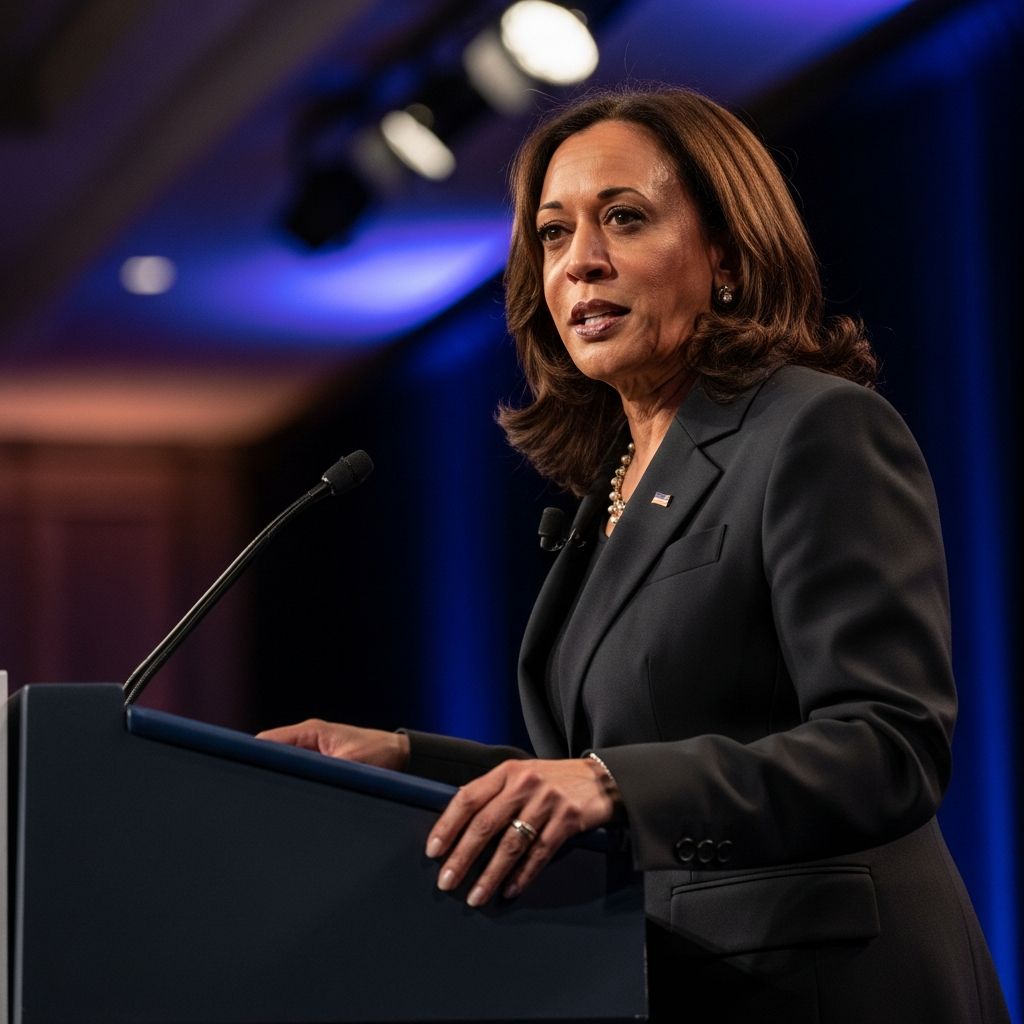
Kamala Harris has emerged as a commanding figure in American politics, leveraging her oratory skills to bridge personal experiences with national aspirations. Her speeches often blend prosecutorial precision with empathetic storytelling, making complex issues accessible and urgent.
Roots in the American Heartland
Harris frequently anchors her messages in the values of the middle class, portraying her background as emblematic of broader American struggles. By emphasizing her upbringing, she positions herself not as an outsider but as a product of the same economic and social fabric that binds most citizens. This narrative fosters relatability, turning potential divides into shared ground.
In key addresses, such as her Democratic National Convention speech, Harris declares the middle class as the cornerstone of national success, making it a personal mission. This approach echoes strategies of past successful nominees who wove family tales of adversity into campaigns, ultimately securing victory by humanizing their ambitions.
The Power of Vocal Identity
Harris’s delivery style reveals layers of her identity, blending cultural influences into a resonant timbre that captivates listeners. Linguistic analyses highlight how her voice modulates to convey authority and warmth, adapting to contexts from rallies to debates.
Consider her pointed remark during a 2019 primary debate: “This is a crisis of Donald Trump’s making, and it is on a long list of crises of Donald Trump’s making. And that’s why dude gotta go.” This casual yet forceful phrasing cuts through formality, embodying a prosecutor’s directness while signaling approachability.
- Modulation Techniques: Harris shifts pitch and pace to emphasize crises, drawing audiences into her rhythm.
- Cultural Inflections: Subtle nods to her heritage enhance authenticity without alienating mainstream listeners.
- Emotional Resonance: Pauses and volume build tension, mirroring courtroom drama.
Rhetorical Devices: Metaphors and Persuasion
Harris employs metaphors to vividify abstract concepts, transforming policy discussions into tangible imagery. In speeches marking events like the January 6th anniversary, she equates democracy to a structure requiring defense, warning that neglect leads to collapse.
Academic dissections of her addresses identify primary and dead metaphors, where phrases evolve from vivid comparisons to idiomatic staples. For instance, portraying positive outcomes as “rising” correlates experiential highs with progress, making optimism palpable.
| Speech Event | Metaphor Type | Example Purpose |
|---|---|---|
| January 6th Anniversary | Structural | Democracy as a building needing protection |
| Tennessee State Commencement | Primary/Dead | Success as elevation, implying growth |
| NEA Annual Meeting | Conceptual | Education as a pathway, evoking journeys |
These devices not only clarify but also emotionally engage, turning listeners into advocates.
Ideological Foundations in Discourse
Critical discourse analysis unveils Harris’s speeches as vehicles for ideologies like gender empowerment and anti-racism. At the 2020 DNC, she inspires women by modeling resilience, while condemning systemic inequities in health, education, and justice.
Vocabulary choices, pronoun usage (‘we’ for unity, ‘I’ for accountability), and active voice construct a persuasive framework. This linguistic architecture supports her endorsement of allies like Joe Biden and critiques of adversaries, framing narratives of progress against regression.
- Inspiration for women through personal triumph stories.
- Racist condemnation via exposés of policy failures.
- Persuasion powering collective action calls.
Confronting Adversaries with Precision
Harris’s prosecutorial past shines in her targeted critiques, detailing opponents’ legal and ethical lapses without ambiguity. Her DNC speech methodically dismantles rivals, contrasting her rule-of-law commitment with alleged abuses of power.
On issues like reproductive rights, she labels opposition as extreme, post-Roe v. Wade chaos as evidence of misguided agendas. This bluntness, paired with vows to honor military service, repositions her as the patriotic mainstream choice.
Building an Opportunity Framework
While avoiding exhaustive policy lists, Harris outlines visions like an ‘opportunity economy’ with middle-class tax relief and housing expansion. These broad strokes prioritize economic mobility, resonating with voters’ daily concerns.
Her rhetoric consistently ties personal stakes to national goals, urging a fighting spirit for decency, fairness, and justice—ideals she claims define true patriotism.
Voice as a Tool for National Unity
Beyond words, Harris’s speech patterns presuppose shared struggles, from structural racism to maternal health disparities. By presuming audience agreement on these pains, she builds consensus, propelling calls to action.
In concession addresses, she maintains poise, reinforcing democratic values even in defeat, as seen in post-election remarks.
Frequently Asked Questions
What makes Kamala Harris’s speeches effective?
Her blend of personal storytelling, metaphors, and direct critiques creates emotional and logical appeal, connecting diverse audiences.
How does Harris use her voice strategically?
She modulates tone for emphasis, incorporating cultural elements for authenticity, as in debate zingers.
What ideologies dominate her rhetoric?
Empowerment of women, anti-racism, and persuasive unity against division.
Does Harris focus on policy details?
She prioritizes visionary goals like opportunity economies over minutiae, emphasizing shared values.
How has her oratory evolved?
From prosecutorial sharpness to presidential breadth, adapting metaphors and presuppositions for broader impact.
Legacy of Rhetorical Leadership
Harris’s oratory redefines political communication, proving that authentic voice and strategic language can humanize leaders and mobilize nations. Her journey from senator to vice president underscores the potency of narrative-driven discourse in democracy.
By consistently affirming American greatness while challenging threats, she crafts a blueprint for future leaders: speak truth with conviction, root arguments in relatability, and always fight for the ideals that unite.
References
- What Kamala Harris Was Really Saying in Her Convention Speech — Politico. 2024-08-23. https://www.politico.com/news/magazine/2024/08/23/kamala-harris-dnc-speech-theme-analysis-00175973
- What Kamala Harris’s Voice and Speech Reveal About Her Identity — UC Berkeley VC Research. 2024. https://vcresearch.berkeley.edu/news/what-kamala-harriss-voice-and-speech-reveal-about-her-identity
- The Political Speeches of Kamala Harris: a Linguistic Analysis — University of Padua Thesis. 2022. https://thesis.unipd.it/retrieve/7878d1ab-5a54-425b-91d0-7dd57413fd66/Piccioni_Anna.pdf
- An Analysis of Metaphor in the Speech of Kamala Harris — Binadarma Repository. 2023. https://repository.binadarma.ac.id/7378/1/Artikerl%20Jurnal%20&%20LOA.pdf
- A Critical Discourse Analysis of Kamala Harris — Thesis. 2023. https://thuvienso.cdytquangninh.edu.vn/wp-content/uploads/2023/12/Luan-Van-Thac-sy_-Nguyen-Thi-Khanh-Van.pdf
- Key Takeaways from Kamala Harris’ Concession Speech — YouTube. 2024. https://www.youtube.com/watch?v=VWbuPzsOaOg