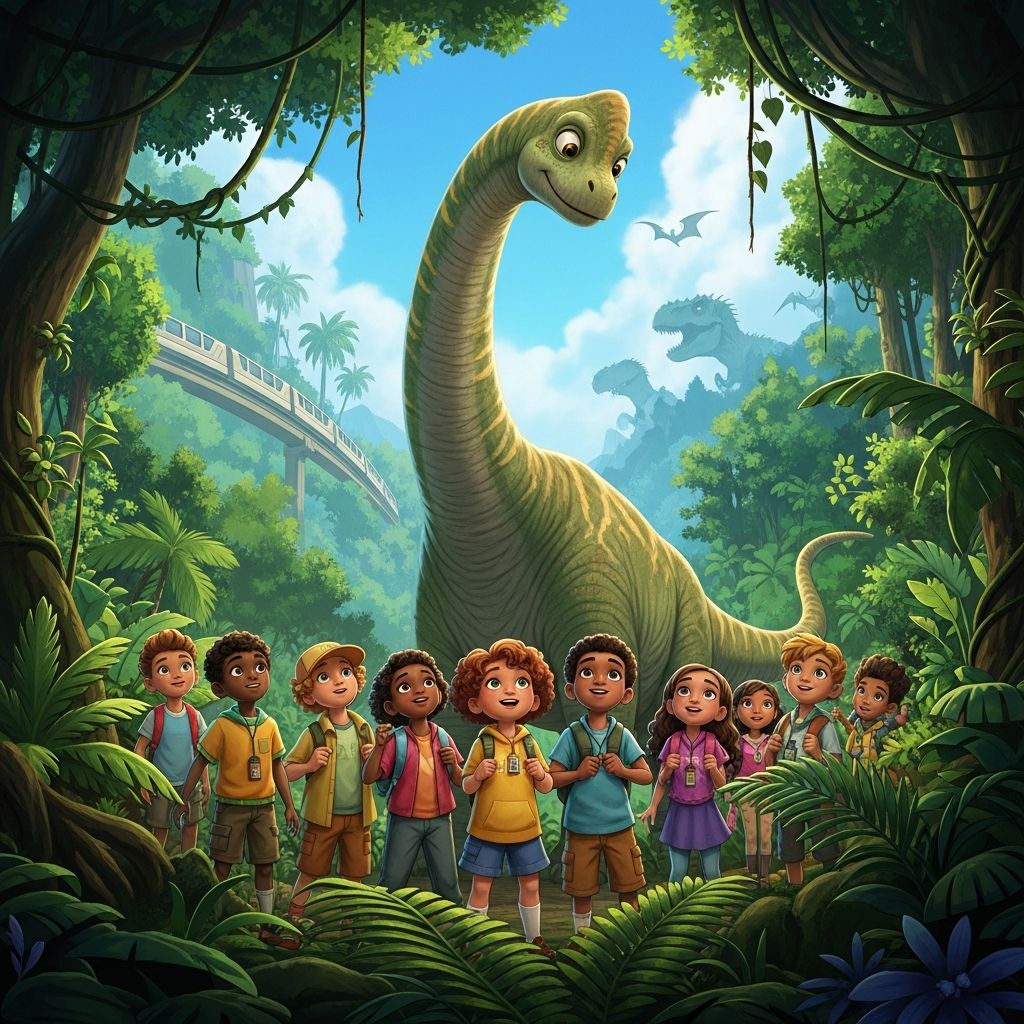
Jurassic World: Camp Cretaceous is an animated series set in the same timeline as the 2015 film Jurassic World, following six teenagers trapped on Isla Nublar when the dinosaurs escape and the park collapses. It streams on Netflix and is officially part of the wider Jurassic franchise, with creative involvement from producers like Steven Spielberg and Colin Trevorrow.
This guide is designed for parents and caregivers who want to understand how the show balances dinosaur thrills, danger, humor, and emotional themes before pressing play with their kids.
Overview: What Is Camp Cretaceous About?
The series centers on a group of teens selected for an exclusive adventure camp on the far side of Isla Nublar. When security fails and dinosaurs break loose, they are stranded with no clear way to contact the outside world.
- Setting: Isla Nublar, during and after the events of the Jurassic World movie.
- Format: Animated action-adventure series.
- Main hook: Survival story about teens navigating a dinosaur-filled island after disaster strikes.
- Platform: Streaming exclusively on Netflix.
Across its seasons, the show evolves from a contained disaster story into a longer journey involving secret research, corporate schemes, and the growing bond between the campers.
Main Characters and Dynamics
The heart of the show is the group of six campers, each with a distinct personality and backstory.
| Character | Initial Role | Key Traits |
|---|---|---|
| Darius | Jurassic superfan who wins a contest to attend the camp. | Brave, dinosaur-obsessed, often becomes the de facto leader. |
| Kenji | Rich kid with a VIP attitude and distant, powerful father. | Confident, reckless, eventually more responsible and loyal. |
| Brooklynn | Social media star documenting her camp experience. | Clever, curious, tech-savvy, driven to uncover secrets. |
| Yaz | Athletic track star. | Guarded, intensely loyal, struggles to open up. |
| Sammy | Outgoing camper with a hidden agenda tied to corporate espionage. | Warm, guilt-ridden, becomes a core member of the group. |
| Ben | Anxious rule-follower sent to camp to toughen up. | Timid at first, then surprisingly resilient and resourceful. |
Over time, they shift from awkward strangers to a tightly knit surrogate family. Conflicts about trust, leadership, and loyalty drive much of the drama, especially as they uncover secret experiments and corporate interests around the dinosaurs.
Tone and Intensity: How Scary Is It?
Although animated, Camp Cretaceous leans closer to the intensity of the live-action films than to gentle preschool cartoons. The show regularly uses classic suspense techniques—dark environments, jump scares, and roaring dinosaurs stalking the kids.
- Dinosaur attacks: Characters are frequently chased or cornered. There are scenes of roaring predators, snapping jaws, and near misses.
- Peril: The teens routinely face danger from heights, vehicles, collapsing structures, and extreme weather.
- Off-screen violence: Adult characters and dinosaurs are sometimes injured or killed, usually shown indirectly or implied rather than graphically depicted.
Common Sense Media and similar guides (based on studio screeners and early episodes) describe the violence as moderate: intense at times, but crafted to avoid gore, with the camera often cutting away from the most violent moments.
Age Suitability: Which Kids Will Enjoy It?
The series is broadly targeted at older children and preteens who are already familiar with dinosaur action and are ready for more complex, serialized storytelling.
- Likely sweet spot: Many families find it most appropriate for roughly 9–13-year-olds who can handle suspense and emotional stakes.
- Older teens: May enjoy the Jurassic connections and serialized plot, though the animation style and some humor skew younger.
- Younger viewers: Sensitive kids in the early elementary range may be frightened by the constant threat and jump scares.
Netflix rates and markets the show within its family and youth categories, signaling that it is not intended as adult horror but also not as content for very young children.
Themes Parents Should Know About
Beneath the dinosaur spectacle, Camp Cretaceous routinely explores themes that are highly relevant to tweens and teens:
- Friendship and found family: Six strangers slowly become a cohesive group who choose to look out for one another despite clashing personalities.
- Bravery and fear: Characters confront phobias, grief, and self-doubt, learning that courage often means acting while still afraid.
- Ethics of science: The show touches on genetic engineering, secret experiments, and the consequences of treating animals as products.
- Corporate responsibility: Adults in positions of power sometimes prioritize profit over safety, echoing critiques present throughout the Jurassic franchise.
- Resilience: Long-term survival on the island highlights resourcefulness, improvisation, and emotional endurance.
These themes can provide rich material for family conversations about how characters make decisions under pressure and what ethical lines they are willing to cross.
Violence, Peril, and Emotional Impact
The show’s handling of peril and loss is where parents may want the most detail.
Dinosaur and Action Violence
- Dinosaur attacks are frequent. There are scenes of characters nearly being eaten, vehicles being destroyed, and structures collapsing around them.
- Some adult characters or side characters do not survive encounters with predators, though their deaths are typically implied rather than shown graphically.
- Weapons appear in later seasons when outside groups arrive on the island, leading to conflicts that involve tranquilizers, containment gear, and sometimes more aggressive tactics.
Emotional Stakes and Loss
- Characters grapple with the fear that their families may believe they are dead or lost forever.
- There are moments of apparent character loss or separation that can be upsetting, especially for younger viewers.
- Long-term isolation and repeated disappointments (failed rescue attempts, betrayals) give the show more emotional weight than a typical self-contained cartoon episode.
These factors can make the series particularly intense for children who are sensitive to separation, abandonment, or on-screen anxiety.
Representation and Character Diversity
The main cast reflects a range of backgrounds and personalities, aligning with broader industry efforts to increase representation in children’s television.
- Racial and ethnic diversity: The campers include characters of different racial and ethnic backgrounds, with none reduced solely to stereotypes.
- Personality diversity: Introverts and extroverts, athletes and nerds, socially confident kids and anxious rule-followers all share the spotlight.
- Gender roles: Girls are frequently shown as athletic, brave, and technically skilled, participating fully in action scenes and leadership decisions.
Research on children’s media suggests that seeing diverse characters in meaningful roles can support a sense of inclusion and belonging for young viewers.
Science, Fantasy, and What Kids Learn
Like the films, the show blends real paleontology with fictional genetic engineering. Kids may pick up broad ideas about dinosaurs and scientific ethics while also absorbing some inaccuracies.
Potential Educational Touchpoints
- Different dinosaur species and basic traits (herbivore vs. carnivore, size, habitats).
- Simple survival concepts: teamwork, using limited resources, navigating terrain.
- Ethical questions around manipulating nature and animal welfare.
However, paleontologists have noted that the Jurassic franchise often exaggerates dinosaur behavior, intelligence, and appearance for dramatic effect. Parents may wish to clarify which elements are science-based and which are fantasy if children show strong interest in the subject.
Strengths: What the Show Does Well
For the right age group, Camp Cretaceous offers a compelling blend of character drama and creature thrills.
- Strong serialized storytelling: Ongoing mysteries and evolving character arcs reward viewers who follow the series from the beginning.
- Emotionally engaging: The show invests in friendships, conflicts, and personal growth, not just dinosaur encounters.
- High production values: The animation, sound design, and action choreography aim to capture the cinematic feel of the films.
- Age-appropriate compromise: The series threads the needle between kid-friendly animation and genuine tension, offering thrills without explicit gore.
Potential Concerns for Families
Parents may want to consider a few recurring issues before introducing the series:
- Intensity of suspense: Younger or more sensitive kids may find the relentless danger exhausting or frightening.
- Ethical ambiguity in adults: Some adult characters, including authority figures, behave selfishly or unethically, which may disturb children who expect adults to be reliable protectors.
- Limited on-screen consequences: The show sometimes downplays long-term trauma from repeated life-or-death experiences, which can be worth unpacking in conversation.
Watching the first few episodes together and discussing reactions can help you gauge whether to continue.
Family Viewing Tips and Conversation Starters
If you choose to watch Camp Cretaceous with your kids, you can turn it into more than just a thrill ride.
Before You Start
- Explain that while the show looks realistic, the dinosaurs and many situations are fictional exaggerations.
- Agree on a plan if someone feels scared (pause button, lights on, watching earlier in the day).
During and After Episodes
- Ask about decisions: “What would you have done in that situation?” or “Was that a fair way to treat other people or animals?”
- Talk about feelings: “Which character did you relate to the most in this episode and why?”
- Separate fact from fiction: If a dinosaur behavior seems extreme, ask, “Do you think real animals act like that?” and, if they’re curious, look up real science together from museum or university sources.
Quick Pros and Cons Summary
| Pros | Cons |
|---|---|
|
|
Frequently Asked Questions (FAQs)
Q: Do kids need to see the Jurassic World movies first?
A: No. The show includes enough context for newcomers, though kids who have seen Jurassic World will recognize key events happening in the background.
Q: Is there blood or graphic gore?
A: The series avoids graphic gore. Violence is mostly implied or shown through shadows, sound, and reaction shots rather than explicit injury detail, making it tense but not gruesome.
Q: How scary is it compared with the original Jurassic Park?
A: The suspense and dinosaur attacks are closer in spirit to the films than to typical kids’ cartoons, but the animated format and toned-down violence make it somewhat less intense than the live-action movies.
Q: Is there strong language or crude humor?
A: Dialogue generally stays within family-friendly bounds. The tone is closer to adventure and light sarcasm than to edgy or crude comedy.
Q: Are there positive messages for kids?
A: Yes. The show consistently highlights teamwork, loyalty, courage under pressure, and the importance of speaking up about unethical behavior, even when it comes from adults in power.
References
- Jurassic World Camp Cretaceous — Wikipedia. 2024-05-05. https://en.wikipedia.org/wiki/Jurassic_World_Camp_Cretaceous
- Jurassic World Camp Cretaceous – About the Show — Amblin Television. 2022-01-01. https://amblin.com/tv/jurassic-world-camp-cretaceous/
- Jurassic World: Camp Cretaceous — Rotten Tomatoes TV Series Info. 2022-06-01. https://www.rottentomatoes.com/tv/jurassic_world_camp_cretaceous
- Children and Media: Tips for Parents — American Academy of Pediatrics. 2020-07-01. https://www.healthychildren.org/English/family-life/Media/Pages/Children-and-Media-Tips-for-Parents.aspx
- Screen Violence and Youth — American Psychological Association. 2017-08-01. https://www.apa.org/pi/families/resources/screen-violence
- Why Diversity Matters in Children’s Media — Children’s Media Lab, Toronto Metropolitan University. 2021-03-15. https://www.torontomu.ca/childrens-media-lab/