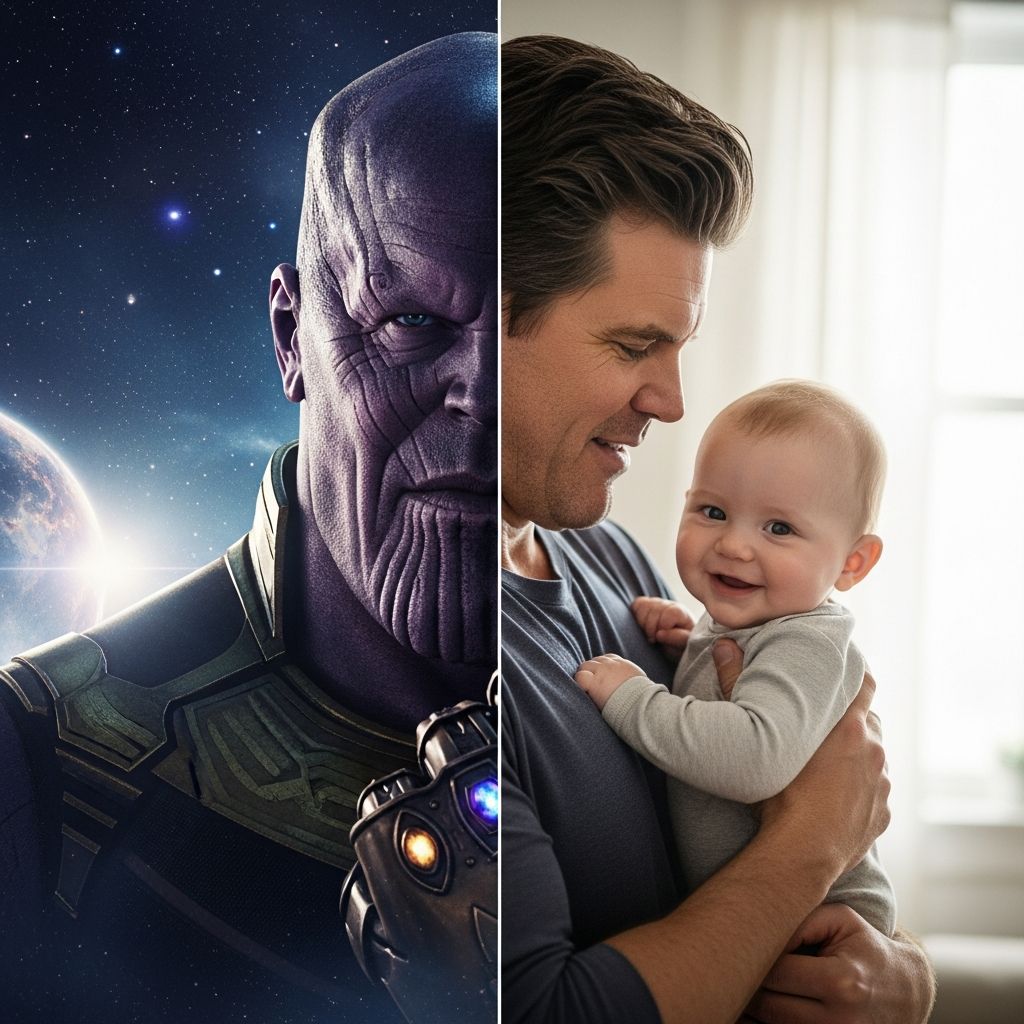
Josh Brolin may be globally recognized as the menacing face and voice of Thanos in the Marvel Cinematic Universe, but away from the motion-capture suit and the purple skin, he is a working actor who has navigated divorce, remarriage, blended families, and late-in-life fatherhood. His story shows how a career built on intense, often dark characters can coexist with a grounded family life built on presence, humility, and a willingness to evolve.
From Hollywood Legacy Kid to Working Actor
Brolin grew up in the shadow of show business. The son of actor James Brolin, he had early access to sets, scripts, and the unpredictable rhythms of an acting career. Yet his own journey was anything but automatic. Before he ever joined the Marvel universe, he built a reputation as a serious, often gritty performer.
Across decades, he appeared in films and series that demanded emotional weight and moral complexity:
- Crime and drama roles like No Country for Old Men, which showcased his ability to embody ordinary people caught in extraordinary danger.
- Character-driven work in films such as Inherent Vice and other auteur-driven projects, proving he was more than an action figure.
- Television projects, including the genre-blending series Outer Range, where he plays a rancher facing cosmic mysteries, demonstrating his comfort leading long-form storytelling.
Long before he put on Thanos’s digital armor, Brolin was a craftsman focused on performance, not merely spectacle.
Becoming Thanos: Redefining a Blockbuster Villain
In 2014, Brolin signed on to portray Thanos, a character who would become the central antagonist of the Marvel Cinematic Universe’s sweeping “Infinity Saga.” It was a commitment that would stretch across multiple films, beginning with a smaller role in Guardians of the Galaxy and culminating in the massive ensemble events of Avengers: Infinity War and Avengers: Endgame.
Acting Through Technology
Thanos is not a traditional on-camera role. He exists primarily through advanced CGI, with Brolin’s performance captured via motion and facial capture systems specially refined for the character.
- Marvel’s effects team developed a machine learning–based facial capture application, Masquerade, to precisely track and reproduce Brolin’s facial expressions.
- His features were integrated into Thanos’s design more closely in later films, making the character’s emotions legible through subtle movement rather than just exaggerated animation.
That technology allowed Brolin to bring genuine nuance to a giant alien warlord, turning what could have been a generic villain into a fully realized character.
Building a Villain with a Philosophy
Brolin did not approach Thanos as a one-note monster. Drawing inspiration from performances like Marlon Brando’s Colonel Kurtz in Apocalypse Now, he rooted the character in a calm, almost philosophical conviction, rather than frantic rage.
Critics and audiences responded strongly to that choice:
- Reviewers praised Thanos as a villain with emotional weight, noting his sadness and twisted sense of honor rather than simple cruelty.
- The character has been described as one of Marvel’s most compelling antagonists, in part because he truly believes he is saving the universe, not destroying it.
For Brolin, playing Thanos meant merging blockbuster scale with stage-level psychology—an approach that made his work resonate long after the credits rolled.
Life After the Snap: Choosing Fear Over Comfort
After appearing in two of the highest-grossing films of all time, Brolin could easily have coasted on his Marvel success. Instead, he made a surprising request to his representatives: he wanted to be challenged—and even unsettled—by his next roles.
Why Brolin Wanted to Be “Scared” Again
At a New York Comic Con panel, Brolin explained that following his run as Thanos, he told his agent he needed to be scared by his work again. For him, fear was not a sign of trouble but a sign of growth. Roles that felt too safe or repetitive were less appealing than those that forced him into new emotional or creative territory.
That mindset led him to projects like:
- A role in the ensemble mystery of the next Knives Out film, a franchise known for sharp writing and character-driven ensemble performances.
- Continuing challenging television work in shows like Outer Range, which blend genres and require sustained character evolution over multiple episodes.
By prioritizing roles that provoke uncertainty and require adaptation, Brolin effectively reset his post-Thanos career as a continual learning process rather than a victory lap.
Marriage, Blended Families, and Starting Over
Off-screen, Brolin’s life has involved multiple chapters in relationships and parenting. Like many people who marry young, build careers, and grow under public scrutiny, he has experienced both painful endings and new beginnings. Over time, he has become part of a blended family that includes adult children as well as younger kids, reflecting a generational span that many modern families recognize.
Blended Families in the Spotlight
Being a parent in the public eye adds pressure to every decision—from how much of family life to share to how to protect children’s privacy. Research on children of public figures suggests that consistent boundaries and clear family values help young people navigate visibility and media attention more safely. While each family handles this differently, Brolin’s approach appears to emphasize:
- Selective sharing of family moments rather than constant exposure.
- Co-parenting and connection with older children even as new children arrive later in life.
- Respecting individuality, allowing each child to define their own relationship to fame and entertainment.
Parenting at Different Life Stages
Parenting in one’s 20s or 30s can feel very different from parenting in one’s 40s or 50s. Older parents often report feeling more patient and more intentional, but also more aware of time and energy limits. Brolin’s later-life fatherhood sits within this broader pattern.
| Earlier Parenthood | Later-Life Parenthood |
|---|---|
| May coincide with career-building and financial instability. | Often overlaps with more established careers and resources. |
| Parents may rely more on energy and improvisation. | Parents may rely more on reflection, planning, and perspective. |
| Identity as a parent is still forming. | Parents may bring lessons from older children into raising younger ones. |
For actors like Brolin, this also intersects with career demands: global press tours and long shoots have to be balanced with naps, school schedules, and family routines.
Work–Life Balance When Your Job Is Global
Unlike office-based careers, acting at Brolin’s level involves unpredictable hours, multi-month shoots abroad, and heavy promotional travel. Maintaining any kind of normalcy for a marriage or children under those conditions requires careful planning and ongoing negotiation.
Challenges of a Traveling Parent
Academic research on families with frequently traveling or deployed parents notes higher stress around transitions—departures, returns, and sudden schedule changes can all disrupt routines and emotional security for children. To mitigate this, families often adopt strategies such as:
- Establishing predictable rituals (like nightly video calls or shared bedtime stories over the phone).
- Creating visual calendars for kids that show when a parent will be home or away.
- Prioritizing quality time over quantity when schedules are tight, focusing on presence rather than multitasking.
While every celebrity family handles this differently, Brolin’s trajectory suggests a shift from a career-first grind toward a more deliberate balance, particularly as he embraces roles that matter to him personally rather than simply maintaining visibility.
Choosing Meaningful Work Over Constant Exposure
After the global recognition of Thanos, Brolin had more leverage to choose projects that align with his values. Psychologists who study work–family balance note that when people gain more control over their schedules and workload, they often report less conflict between professional and family roles—even if they remain very busy.
For Brolin, this seems to show up in choices like:
- Opting for roles that offer character depth and creative collaboration rather than simply large paychecks.
- Shifting between film and television to accommodate more flexible or varied production timelines.
- Openly framing his career as a series of personal challenges, not just a ladder of fame.
The Emotional Cost of Playing a Villain
Portraying a character like Thanos raises an under-discussed question: what does it cost an actor emotionally to inhabit a mindset so focused on destruction, even if it is fictional and philosophically rationalized?
Staying Grounded While Playing Dark Characters
Actors often develop personal strategies to separate themselves from difficult roles, such as decompressing with family, physical routines, or creative hobbies. Mental health researchers emphasize that having strong social support and clear boundaries between role and self can reduce the risk of emotional spillover from intense work into personal life.
For a father like Brolin, this may mean:
- Leaving the emotional weight of a performance at work, rather than bringing it home.
- Letting the presence of children pull him back into ordinary, everyday concerns—meals, play, bedtime routines—which can act as a counterweight to the scale of his on-screen world.
- Reflecting on the ethical implications of his characters, turning them into conversation starters rather than private burdens.
When Your Kids Know You Erased Half the Universe
One of the stranger perks of Brolin’s career is that his children grow up knowing their father is, quite literally, the person who snapped half of all life in the universe out of existence—at least on screen. The Marvel films are cultural touchstones for an entire generation, which means that playground conversations, school references, and Halloween costumes can all include a version of their dad.
Fame, Identity, and the Next Generation
Research on children of famous parents suggests that they often wrestle with questions of identity: Are they expected to follow in their parent’s footsteps? Are friendships based on genuine connection or on proximity to fame? How parents handle these questions can shape how children see themselves.
Brolin’s own path—from the child of a working actor to a major star—likely informs how he guides his kids through a world where their last name and his most famous character come with built-in expectations. While each family’s approach differs, key principles that tend to support healthier outcomes include:
- Encouraging interests outside the family profession, whether in sports, academics, arts, or community service.
- Framing fame as a byproduct of work, not the goal of life.
- Maintaining private family spaces that are not for public consumption, online or otherwise.
Lessons from Josh Brolin’s Journey
Josh Brolin’s evolution—from a second-generation actor carving out his own space, to the performer behind one of cinema’s most memorable villains, to a husband and father navigating late-in-life parenting—offers several broader takeaways:
- Success does not eliminate the need for risk. Even after playing Thanos, Brolin sought roles that scared him, understanding that comfort can be creatively limiting.
- Technology can amplify humanity. The advanced CGI tools built for Thanos only worked because they captured and honored the subtleties of Brolin’s performance.
- Family life can be rewritten. Multiple marriages, blended families, and children at different life stages are common realities, and they do not preclude deep connection or growth.
- Public work, private values. Even when your job is front-page news or a global franchise, the daily work of parenting—showing up, listening, adjusting—remains intensely personal.
In the end, the contrast between Thanos erasing half the universe and Brolin reading bedtime stories or juggling school schedules is exactly what makes his story compelling: the same person capable of embodying near-limitless power on screen is also negotiating the universal, humbling work of being a present partner and parent.
Frequently Asked Questions (FAQs)
Q: What is Josh Brolin best known for?
Josh Brolin is widely known for portraying Thanos in the Marvel Cinematic Universe, particularly in Avengers: Infinity War and Avengers: Endgame, as well as for acclaimed roles in films like No Country for Old Men and various television projects.
Q: How did technology help Brolin bring Thanos to life?
Marvel used advanced CGI and a facial capture system called Masquerade, which translated Brolin’s detailed expressions into Thanos’s digital face, allowing the character to convey subtle, emotionally rich performances.
Q: Did Josh Brolin continue with Marvel after Endgame?
After Endgame, Brolin’s main arc as Thanos concluded, though he has continued voice work in Marvel-related projects and shifted focus to new roles in film and television that challenge him in different ways.
Q: Why did Brolin say he wanted to be “scared” again?
Following his massive success as Thanos, Brolin told his agent he wanted roles that made him feel creatively afraid, using fear as a signal that a part would stretch his abilities instead of repeating what he had already done.
Q: How does Josh Brolin balance his career with family life?
Like many traveling professionals, Brolin appears to prioritize selective, meaningful projects and relies on routines, communication, and intentional time with his wife and children to stay connected despite demanding schedules, reflecting broader strategies recommended in research on work–family balance.
References
- Thanos (Marvel Cinematic Universe) — Marvel Studios / MCU character overview. Last updated 2023. https://www.marvel.com/characters/thanos
- Thanos (Marvel Cinematic Universe) — Fandom / Plot and production details. 2023. https://marvelcinematicuniverse.fandom.com/wiki/Thanos
- Josh Brolin — IMDb filmography and biographical summary. 2024. https://www.imdb.com/name/nm0000982/
- After playing Thanos, Josh Brolin told his agent he needed “to be scared” again with challenging roles — Popverse. 2024-10-18. https://www.thepopverse.com/live-movies-josh-brolin-thanos-role-new-york-comic-con-nycc-2024-marvel-avengers
- Growing Up in the Spotlight: Child and Adolescent Development and the Children of Public Figures — American Academy of Child & Adolescent Psychiatry. 2019. https://www.aacap.org
- Older Parenthood: Age, Expertise, and Family Life — American Psychological Association Monitor on Psychology. 2021. https://www.apa.org/monitor/2021/03/older-parents
- Parental Travel and Family Routines — American Academy of Pediatrics, HealthyChildren.org. 2020. https://www.healthychildren.org
- Work-Family Balance — American Psychological Association, Topic Overview. 2022. https://www.apa.org/topics/work-family
- Managing Stress for Actors and Performers — National Health Service (NHS) / Mind (UK). 2020. https://www.mind.org.uk/information-support/types-of-mental-health-problems/stress