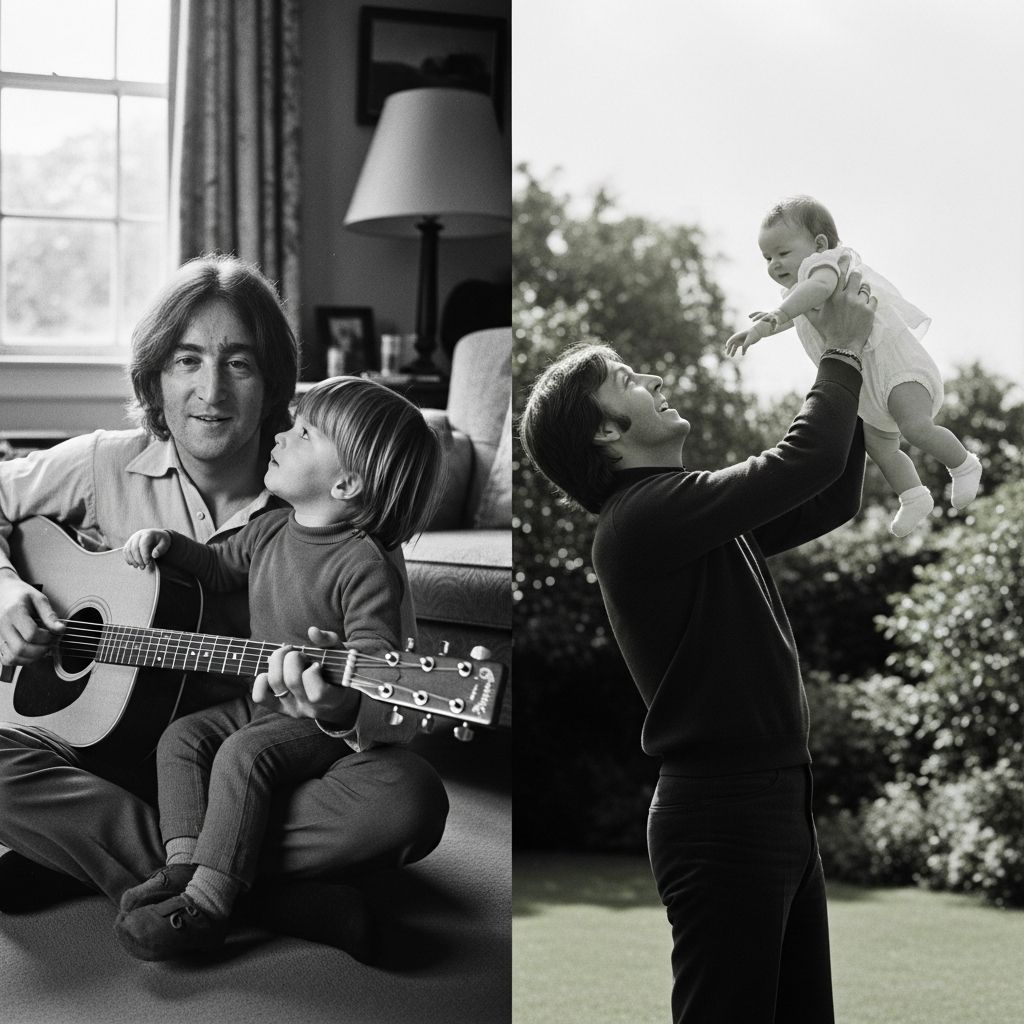
John Lennon and Paul McCartney reshaped popular music, but away from the studio and stage, they were also simply dads, trying, failing, learning, and sometimes changing course entirely.
Their stories do not offer a neat ranking of who was the “better” father; instead, they reveal how complicated, imperfect, and deeply human fatherhood can be in any era.
Beyond the Myth: Why Their Fatherhood Stories Matter Today
Most people know Lennon and McCartney as cultural icons, not as men arguing over school choices, missing bedtimes, or trying to protect their kids from cameras and headlines.
Looking at them as fathers helps modern parents see that even the most celebrated people struggle with presence, work-life balance, emotional maturity, and the weight of their own childhood wounds.
- They model how early mistakes in parenting do not have to define the rest of a parent’s life.
- Their contrasting paths highlight that there is no single “correct” way to be a loving parent, but there are patterns that consistently help or harm children.
- Their fame amplifies issues that ordinary families also face: co-parenting conflict, blended families, and the challenge of being emotionally available while working intensely.
Different Childhoods, Different Fathers
Both Lennon and McCartney lost their mothers young, but under very different emotional circumstances, shaping how each approached closeness, commitment, and family life later on.
Where one tended to seek stability and continuity, the other often struggled with abandonment, volatility, and an urgent desire to escape uncomfortable emotions.
| Aspect | John Lennon | Paul McCartney |
|---|---|---|
| Family structure | Grew up amid emotional instability and parental separation, leading to a deep fear of abandonment. | Raised in a more cohesive extended family environment that emphasized responsibility and everyday care. |
| Loss of mother | Experienced a brief reunion with his mother before she died, turning grief into anger, insecurity, and lifelong emotional turbulence. | Lost his mother suddenly as a teenager, processed grief more gradually, and channeled loss into caretaking and consistency. |
| Emotional coping style | Often used sarcasm, intensity, and later heavy substance use to manage pain, which sometimes blocked healthy connection with his children. | Tended toward caution, routine, and work-focused discipline, making it easier to show up practically and logistically for his kids. |
Modern parents do not need to share their biography to recognize the pattern: the way adults were parented rarely stays in the past; it shows up, often quietly, in how they speak, react, and prioritize as parents.
John Lennon: From Absent to Searching
In his earlier years of fatherhood, John Lennon was often physically and emotionally distant, especially during the period of intense fame and heavy touring.
Virtual strangers to millions, his children initially experienced him less as a stable presence and more as a moving target, shaped by his own unresolved chaos and experimentation.
Patterns Parents Can Recognize
- Absence during critical years: Work, substances, and personal crises often took precedence over everyday parenting tasks and emotional conversations.
- Idealism without consistency: He spoke passionately about love and peace yet struggled to bring that same steadiness into the daily reality of his relationships.
- Late attempts at repair: In later years, Lennon expressed more interest in domestic life and parenting, showing that people can change direction, even if not all damage can be erased.
Parents who grew up amid neglect or instability may see themselves in this arc: the urge to be a different kind of parent colliding with habits and defenses that were built for survival, not connection.
Paul McCartney: The Caretaking Traditionalist
Paul McCartney, by contrast, often gravitated toward being the organizer, the planner, and the person trying to hold family and work structures together when others pulled away.
His approach to fatherhood emphasized daily routines, practical involvement, and a clear preference for domestic stability, even while balancing massive professional obligations.
Patterns Parents Can Recognize
- Everyday presence: McCartney often centered his schedule around being physically present, prioritizing school runs, family dinners, and shared activities where possible.
- Blending ambition with nurture: Rather than choosing between career and family, he tried to integrate both, even if that meant constant travel and creative time management.
- Long-term commitment: His consistent involvement over decades, including in blended and extended family forms, illustrates how predictable love can be more powerful than grand gestures.
Many modern parents—especially those juggling demanding jobs—may recognize this instinct to be reliable and practical, sometimes at the cost of acknowledging their own stress or emotional fatigue.
Two Dads, Two Models of Masculinity
Lennon and McCartney illustrate two contrasting, imperfect versions of masculinity: the wounded rebel who struggles with intimacy, and the responsible caretaker who often steps into the role of emotional anchor.
Neither model is complete on its own, and together they reveal how cultural expectations around manhood can support or sabotage engaged fatherhood.
- Lennon shows how unprocessed trauma, ego, and self-medicating can make a parent unpredictable and unsafe, even when love is present.
- McCartney shows how steadiness, tenderness, and routine can nourish children but may also hide the parent’s own vulnerabilities when everything is held together too tightly.
- Both men demonstrate that fathers are not background characters but central emotional figures whose choices echo through generations.
Lessons Modern Parents Can Take Away
Parents do not need stadiums, hit records, or intense media scrutiny to face the same decisions about availability, honesty, and repair that confronted these two musicians.
Their lives underline several practical lessons that any caregiver can apply, regardless of fame, income, or family structure.
Key Takeaways for Everyday Parenting
- Presence outweighs persona. Children remember who listened, who showed up, and who made them feel safe more than they remember who others celebrated.
- Trauma is not destiny. Growing up amid chaos or loss increases risk but does not fix a parent’s future; seeking support, therapy, or community can break the cycle that trapped previous generations.
- Repair is powerful, but not infinite. Apologies, changed behavior, and renewed commitment can heal, but some opportunities—missed childhood years, absent milestones—cannot be completely replaced.
- Stability is a form of love. Routines, boundaries, and predictable affection can be as transformative for a child as creativity, spontaneity, or big adventures.
- Partnership matters. Who a parent chooses as a co-parent or partner shapes the emotional climate children grow up in, for better or worse.
Work, Fame, and the Myth of the “Selfless” Parent
Both Lennon and McCartney struggled in different ways with the tension between personal ambition and family obligations, a tension many non-famous parents feel in quieter but no less real ways.
Their stories show the danger of believing that a “good” parent must erase personal goals entirely, or conversely, that success automatically validates long stretches of emotional absence.
- Parents who chase only professional dreams may end up with public acclaim but private regret when they realize how much of their children’s internal world they missed.
- Parents who suppress all ambition in the name of sacrifice risk resentment or burnout, which children easily sense and internalize.
- A healthier middle path treats work as part of a full life, communicated honestly to children, while still protecting time and emotional space for connection.
How Narratives Shape Which Father We Admire
For decades, cultural commentary often romanticized Lennon as the raw, authentic genius and painted McCartney as merely safe or conventional, a framing that seeped into perceptions of their fatherhood as well.
More recently, closer scrutiny of their lives and relationships has led many observers to reevaluate who actually practiced sustainable care, responsibility, and accountability in family settings.
| Dimension | Common Public Narrative | Nuanced View of Fatherhood |
|---|---|---|
| Emotional depth | Lennon seen as more emotionally raw and honest. | Honesty in interviews did not always translate into day-to-day emotional safety for his children. |
| Stability | McCartney sometimes dismissed as conventional or less daring. | His conventionality often showed up as dependable caregiving and long-term involvement in his children’s lives. |
| Legacy as a parent | Debated and often overshadowed by artistic impact. | Increasingly evaluated through the lens of how consistently each man showed up, not just what he said about love and peace. |
For modern parents, this shift is a reminder that charisma and vulnerability in public do not automatically equal kindness and reliability at home; quiet steadiness can be the more transformative legacy.
Practical Ways to Apply These Insights
The point of examining famous fathers is not to idolize or condemn them, but to translate their most human moments into practical tools for everyday parenting.
Parents can use these stories as a mirror, asking where they resemble each pattern and what intentional adjustments could bring more safety, joy, and connection into their homes.
Simple Practices Inspired by Their Contrasts
- Schedule one non-negotiable weekly ritual with each child: a walk, a shared meal, or a bedtime conversation that work cannot easily displace.
- Notice when stress or old wounds trigger withdrawal, sarcasm, or anger, and seek help rather than letting those patterns quietly define the climate at home.
- Share age-appropriate stories about your own childhood losses and fears so children learn that emotions can be named, not buried.
- Protect children from adult relationship conflicts as much as possible, especially during separations or new partnerships, remembering that they did not choose those battles.
- Teach children that love is not measured only in dramatic gestures, but in dependable follow-through: kept promises, consistent rules, and predictable kindness.
FAQs About Lennon, McCartney, and Fatherhood
Did John Lennon and Paul McCartney have similar approaches to parenting?
No. While both experienced early loss, Lennon’s parenting was more erratic and shaped by emotional turbulence, whereas McCartney tended to emphasize structure, dependability, and continuous involvement with his children.
Can a parent change their style later in life, like Lennon tried to do?
Yes. Many parents, like Lennon, attempt more engaged, reflective parenting in later years, and these changes can still matter deeply to children, even though they cannot fully rewrite earlier absences.
Why is McCartney often seen as the more “responsible” father?
Observers frequently point to McCartney’s consistent presence, emphasis on everyday routines, and long-term involvement as signs of responsibility, especially when contrasted with Lennon’s periods of distance and instability.
What should modern parents learn from their contrasting lives?
The core lesson is that emotional availability, stability, and willingness to repair matter more than image or intensity; parents cannot control everything, but they can choose to show up, listen, and grow.
Is it fair to judge famous figures as parents?
Judgment is less useful than reflection; examining their mistakes and efforts helps highlight how cultural narratives can glamorize dysfunction while undervaluing humble, everyday care that truly supports children.
Closing Thoughts: No Winners, Only Warnings and Wisdom
Declaring one of these men the “better” father oversimplifies lives shaped by class, trauma, sudden wealth, and relentless attention.
For parents reading today, the more valuable move is not to crown a winner, but to ask a harder question: in this moment, at this stage of life, which parts of each man’s example are quietly influencing how love is being expressed at home?