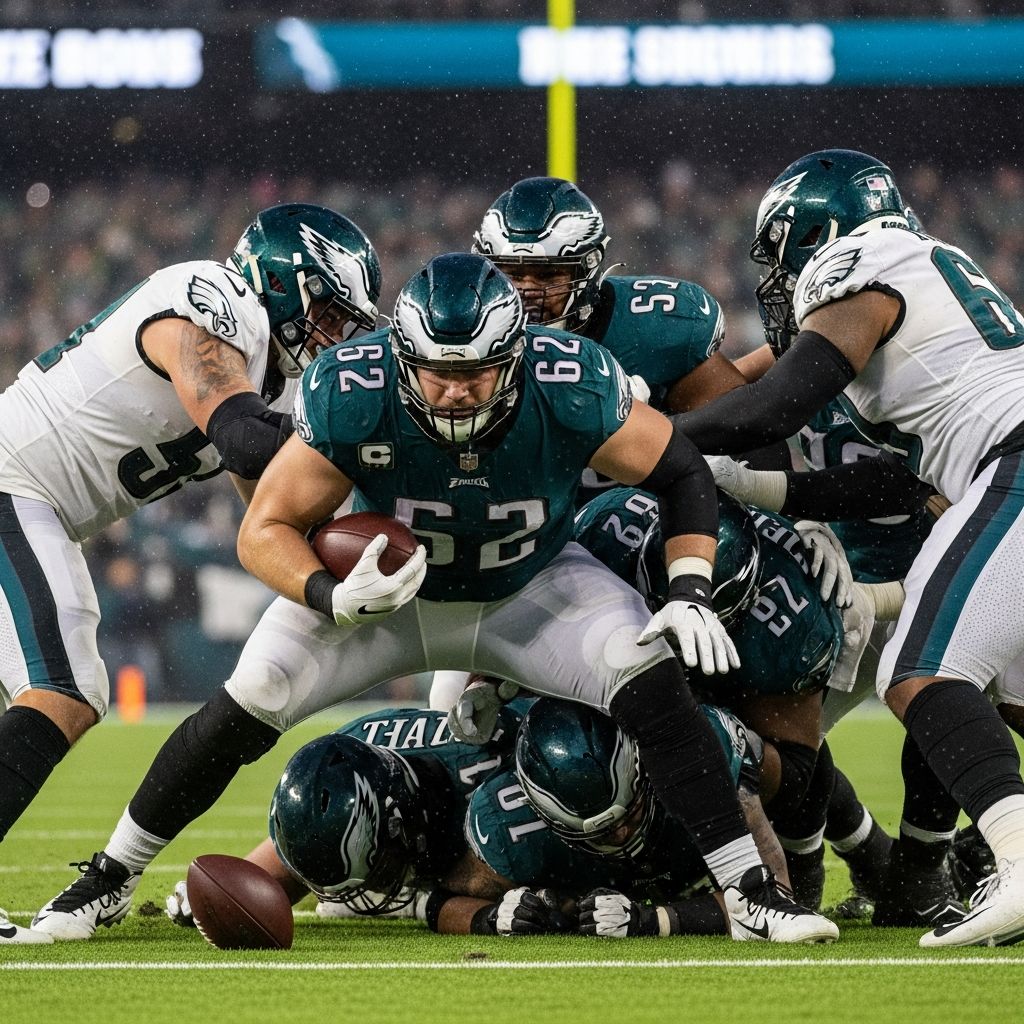
The Philadelphia Eagles’ now-famous “tush push” – also dubbed the “Brotherly Shove” – has become one of the most discussed plays in recent NFL history. At the center of it all stands former All-Pro center Jason Kelce, whose technique, leadership, and public comments have helped turn a simple short-yardage sneak into a league-wide flashpoint.
What Is the Tush Push?
The tush push is a specialized version of the quarterback sneak. The offense lines up in a tight formation on short-yardage downs, the quarterback takes the snap under center, and one or more teammates immediately push from behind to drive the pile forward for a first down or touchdown.
- Typically used on 3rd-and-short, 4th-and-short, or goal-line situations.
- Relies on low pad level, timing, and immediate forward surge after the snap.
- Made famous by the Eagles with Jalen Hurts at quarterback and Jason Kelce at center.
What makes the tush push unique is how intentionally it leverages bodies behind the quarterback to create a rugby-style scrum. That coordinated shove has sparked debate about whether the play fits within the spirit of traditional American football.
Jason Kelce’s Central Role
Jason Kelce, a longtime anchor of the Eagles’ offensive line, became the tactical and emotional core of the tush push. As the center, he controls the snap, identifies defensive fronts, and calls protections, all of which are critical when inches decide a play’s success.
- Kelce’s low center of gravity and exceptional leverage help create an immediate wedge up front.
- His experience allows the line to adjust to defensive shifts and stunt attempts designed to blow up the play.
- His leadership ensures every lineman fires off the ball with synchronized timing.
Beyond the field, Kelce has also been one of the most vocal players explaining why the Eagles run the play, how they practice it, and why he believes its effectiveness is rooted in execution rather than any unfair advantage.
Mechanics: How the Play Works
To understand why the tush push has been so effective, it helps to break down the basic mechanics. Although every team can attempt it, the Eagles’ version stands out because each component is fine-tuned.
Pre-snap alignment
The offense usually lines up in a condensed formation. Wide receivers may be tight to the formation or motion in, while the line crowds the ball to minimize space for defenders to shoot gaps.
- The quarterback is under center, not in shotgun.
- Running backs or tight ends align directly behind the quarterback to maximize pushing force.
- The offensive line uses low, coiled stances to explode forward on the snap.
Post-snap execution
On the snap, Kelce fires out low, aiming to win the leverage battle with the defensive tackle. Simultaneously, guards and tackles drive forward to collapse interior gaps while the quarterback immediately surges behind Kelce.
- Backs or tight ends push the quarterback’s hips and legs to keep him churning forward.
- The play is designed to hit straight ahead, limiting lateral movement where defenders can penetrate.
- Success often comes down to inches, but that is where the Eagles have consistently excelled.
Why the Tush Push Is So Controversial
As the Eagles started to convert short-yardage situations with remarkable regularity, other teams, analysts, and fans began to question whether the tush push was too effective. Critics argue that the play is both aesthetically unappealing and structurally difficult to officiate.
- Some coaches claim the play creates an almost automatic first down when executed by a strong offensive line and powerful quarterback.
- Defensive players have voiced concerns about player safety due to low collisions and large bodies pushing from behind.
- Others argue that the play resembles rugby more than traditional NFL offense, challenging the spirit of the game.
Supporters counter that every team has the same opportunity to run the play and that the Eagles’ success simply reflects superior coaching, personnel, and repetition in practice.
Officiating Challenges and Debate
One of the biggest practical concerns surrounding the tush push centers on officiating. When multiple bodies collide in a tight scrum, it can be difficult for officials to tell exactly where the ball is, when forward progress stops, or whether a fumble occurred before the whistle.
- Scrum-like piles can obscure the quarterback’s forward movement and ball security.
- Officials must quickly judge when to blow the play dead to protect player safety.
- Borderline issues like false starts or illegal formations can be harder to spot in crowded, fast-developing situations.
These challenges have fueled proposals to ban or modify the play on the grounds that it places too much strain on human judgment in the chaos at the line of scrimmage.
Rulebook Background and NFL Discussions
The current NFL rulebook allows ball carriers to be pushed forward by teammates, even though pulling a runner or using certain types of human chains is illegal. This distinction opened the door for plays like the tush push to develop.
As the Eagles’ efficiency drew national attention, league decision-makers began openly debating whether to revise those rules. Owners, competition committee members, and coaches have all weighed in on whether the play gives offenses an unfair edge or simply reflects strategic innovation.
| Perspective | Main Concern | Key Point |
|---|---|---|
| Supporters | Preserve creative play design | Every team can run it; success comes from execution and personnel. |
| Critics | Competitive balance and aesthetics | The play can feel nearly automatic and looks more like rugby than football. |
| Officials | Enforcement difficulty | Scrums complicate spotting the ball, judging forward progress, and detecting fouls. |
| Player safety advocates | Injury risk | Low, high-force collisions with multiple pushers may increase physical stress in the trenches. |
Jason Kelce’s Public Perspective
Jason Kelce has consistently framed the tush push as a product of discipline, technique, and repetition rather than a glitch in the rulebook. He has acknowledged that if the league finds the play too hard to officiate fairly or too risky, it has the authority to change the rules, but he pushes back on the idea that the play itself is illegitimate.
- Kelce often highlights that missed calls and judgment errors happen on all types of plays, not just on tush pushes.
- He argues that focusing anger solely on the play can distract from broader issues like defensive breakdowns or game-long performance.
- His comments emphasize respect for officials while questioning whether banning a successful play truly addresses underlying concerns.
Because of his credibility as a veteran lineman and future Hall of Fame candidate, fans and analysts pay close attention when he weighs in on the subject.
Impact on the Eagles’ Identity
The tush push has become more than a situational call for Philadelphia; it is now a symbol of the team’s identity. For a franchise that prides itself on physical line play and blue-collar toughness, the play reflects both philosophy and attitude.
- It sends a message that the offense expects to win in the trenches on demand.
- Fans associate the play with swagger, confidence, and a willingness to embrace controversy.
- Opponents often prepare specifically for it, dedicating practice time to countering a single short-yardage concept.
In this way, the tush push has elevated beyond Xs and Os, shaping how the Eagles see themselves and how the rest of the league views them.
Will Other Teams Copy the Tush Push?
Many teams have experimented with similar quarterback-sneak-plus-push designs, but few have matched the Eagles’ consistency. Copying the play is not as simple as copying the formation; it demands the right combination of scheme, personnel, and coaching.
- Teams need a strong, low-built offensive line and a quarterback comfortable with absorbing heavy contact.
- Repetition in practice is critical, as the play’s success hinges on micro-timing and coordinated leverage.
- Some organizations may decide the injury risk or public scrutiny outweighs the potential benefits.
As a result, the tush push has become a case study in how one team can weaponize a legal tactic more effectively than its peers, reshaping league-wide strategy discussions.
Future of the Tush Push in the NFL
The long-term future of the tush push remains uncertain. The play sits at the intersection of player safety, competitive balance, and entertainment value, all of which weigh heavily in league decisions. If rulemakers decide that the drawbacks outweigh the benefits, they may restrict pushing from behind or otherwise limit the concept.
On the other hand, the NFL has often celebrated innovation, and many fans enjoy seeing teams push the boundaries of what is possible within the rules. Whatever happens, the controversy has cemented the tush push as one of the defining tactical debates of this era.
Jason Kelce’s Legacy Beyond One Play
Even if the tush push is eventually banned or heavily modified, Jason Kelce’s legacy will extend far beyond a single short-yardage tactic. He is widely recognized for his athleticism at center, his football intelligence, and his larger-than-life personality both in the locker room and in public appearances.
- Multiple All-Pro selections and a Super Bowl ring already place him among the most accomplished centers of his generation.
- His work in the Eagles’ run game and screen game showcases skills that go far beyond quarterback sneaks.
- His candid commentary on league issues, including the tush push, has made him a respected voice in broader football conversations.
In many ways, the tush push controversy simply highlights Kelce’s enduring impact: he is a player who changes not just how the game is played, but how it is discussed.
FAQs About Jason Kelce and the Tush Push
Is the tush push legal in the NFL?
Yes, under current rules, teammates are allowed to push the ball carrier forward, which makes the tush push legal. However, the play remains under active review and could be modified or restricted in future rule changes.
Why is Jason Kelce so important to the play?
As the center, Kelce controls the snap and the initial point of contact. His leverage, technique, and pre-snap recognition are essential to creating the surge that allows the quarterback and pushers behind him to gain the necessary yardage.
Is the tush push safe for players?
Opinions differ. Some argue that the low, compact collisions are similar to other short-yardage plays, while others worry that repeated high-force scrums could increase the risk of lower-body and neck injuries for linemen and quarterbacks.
Can any team run the tush push as effectively as the Eagles?
In theory, any team can install a similar play, but in practice it requires the right combination of offensive line strength, quarterback build, coaching commitment, and practice time. Without those elements, the play may be far less reliable.
Will the tush push define Jason Kelce’s career?
While the play is a memorable part of his story, Kelce’s career is defined by far more: years of elite blocking, leadership, and versatility in one of the league’s most demanding positions. The tush push is a vivid chapter, not the whole book.
The tush push shows how a seemingly simple idea can reshape an entire sport’s conversation when executed at an elite level. Jason Kelce’s role in that transformation ensures that, whatever the rulebook eventually says, his influence on the modern NFL will be remembered for years to come.